Texas Acknowledgment of Statement of Elected Officer
What is this form?
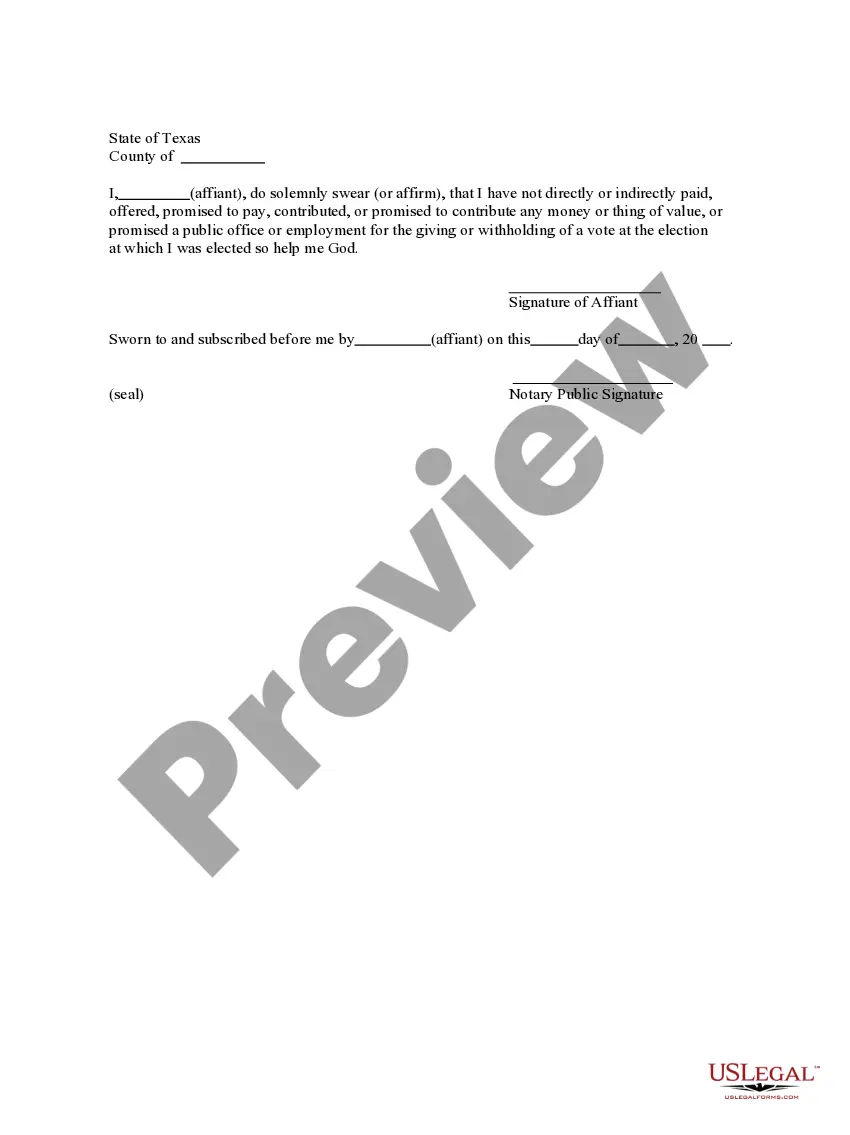
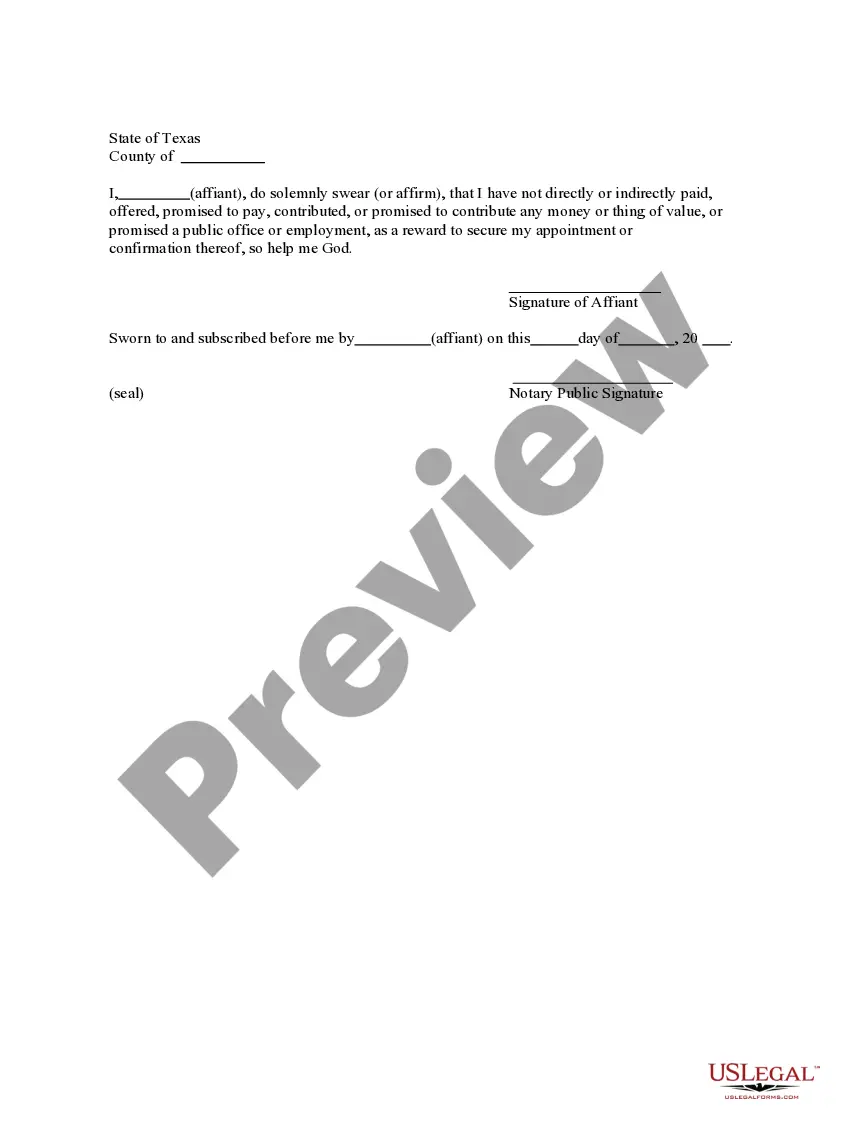
The Acknowledgment of Statement of Elected Officer is a legal document used to confirm that an elected official has not engaged in illegal activities to secure their position. This form specifically addresses the oath or affirmation administered to a public officer, ensuring their actions are compliant with election laws. Unlike other election-related documents, this form focuses directly on the ethical conduct of the elected individual, adding a layer of accountability to the election process.
Key parts of this document
- Identification of the affiant (the individual making the statement).
- A declaration affirming that the affiant has not engaged in any unlawful actions for obtaining a vote.
- Signature of the affiant to validate the statement.
- Section for a notary public to acknowledge the document.
- Space for the date and location of the acknowledgment.
When this form is needed
This form should be used when an individual is elected to public office and needs to formally declare that they have not participated in any illegal activities related to their election. It is particularly relevant in situations where transparency and ethics in elections are emphasized, ensuring that elected officials uphold the integrity of their office.
Who needs this form
- Individuals who have been elected to a public office.
- Political candidates seeking to confirm their adherence to electoral laws.
- Elected officials needing to validate their conduct post-election.
- Public officials required to submit sworn statements regarding their election campaign practices.
Instructions for completing this form
- Identify the affiant by entering their full name and any relevant identification.
- Read and acknowledge the statement regarding ethical election practices.
- Sign the form in the designated space to confirm the declaration.
- Complete the notary section, ensuring that a notary public is present to witness the signing.
- Enter the date and location where the acknowledgment occurs.
Is notarization required?
This form must be notarized to be legally valid. US Legal Forms provides secure online notarization powered by Notarize, allowing you to complete the process through a verified video call.
Get your form ready online
Our built-in tools help you complete, sign, share, and store your documents in one place.
Make edits, fill in missing information, and update formatting in US Legal Forms—just like you would in MS Word.
Download a copy, print it, send it by email, or mail it via USPS—whatever works best for your next step.
Sign and collect signatures with our SignNow integration. Send to multiple recipients, set reminders, and more. Go Premium to unlock E-Sign.
If this form requires notarization, complete it online through a secure video call—no need to meet a notary in person or wait for an appointment.
We protect your documents and personal data by following strict security and privacy standards.

Make edits, fill in missing information, and update formatting in US Legal Forms—just like you would in MS Word.

Download a copy, print it, send it by email, or mail it via USPS—whatever works best for your next step.

Sign and collect signatures with our SignNow integration. Send to multiple recipients, set reminders, and more. Go Premium to unlock E-Sign.

If this form requires notarization, complete it online through a secure video call—no need to meet a notary in person or wait for an appointment.

We protect your documents and personal data by following strict security and privacy standards.
Mistakes to watch out for
- Failing to properly sign the form, which invalidates the acknowledgment.
- Not providing accurate identification details for the affiant.
- Overlooking the notary requirements, leading to a lack of legal recognition.
- Inaccurate completion of dates or locations, causing potential issues with validity.
Advantages of online completion
- Convenient access to a secure, electronic version of the form.
- Ability to quickly fill out and edit the form as needed.
- Assured reliability of documents created through licensed legal resources.
- Simple download option ensures the form is readily available for submission.
Looking for another form?
Form popularity
FAQ
An acknowledgment is a formal declaration before an authorized official such as a notary, by a person who has signed a document, that the document is his or her act. Acknowledgments are governed by the Uniform Acknowledgment Act. The person acknowledging the document must personally appear before the notary.
Step 1: Require Personal Appearance. Step 2: Check Over The Document. Step 3: Carefully Identify The Signer. Step 4: Record Your Journal Entry. Step 5: Complete The Notarial Certificate. A Last Note: Never Give Advice.
Documents used for legal purposes in South Africa can often be notarized free of charge at a South African Police Service (SAPS) station. Contact your nearest SAPS station for details. Consular officers perform services customarily provided by Notaries Public in the United States.
Respect individual beliefs and choices. Do not joke or behave frivolously during the procedure. Use appropriate ceremonial gestures. Other State Requirements.
For an acknowledgment, the signer must always: Be positively identified by the Notary. The Notary must always identify the signer for an acknowledgement; whether the signer personally knows the Notary, presents an ID document, or is identified by a credible witness depends on the circumstances.
When you see (here insert the name and character of the officer) next to a blank as shown below, it means you should insert Your name, Notary Public in the blank.
A judge, retired judge, senior judge, clerk, or commissioner of a court of record; a justice of the peace or a clerk of a justice court; a notary public;
For an acknowledgment, the signer must always: Be positively identified by the Notary. The Notary must always identify the signer for an acknowledgement; whether the signer personally knows the Notary, presents an ID document, or is identified by a credible witness depends on the circumstances.
A notary public who has a direct or indirect financial (or other beneficial) interest in a document may not notarize such a document. The better practice is not to notarize for a spouse or family member in order to preserve the integrity of the notarization and to prevent a challenge to the notarization.