Agreement Between Contractor and Property Owner to Require a Release and Waiver of Liability and Personal Injury from Subcontractor in Favor of Property Owner
Overview of this form
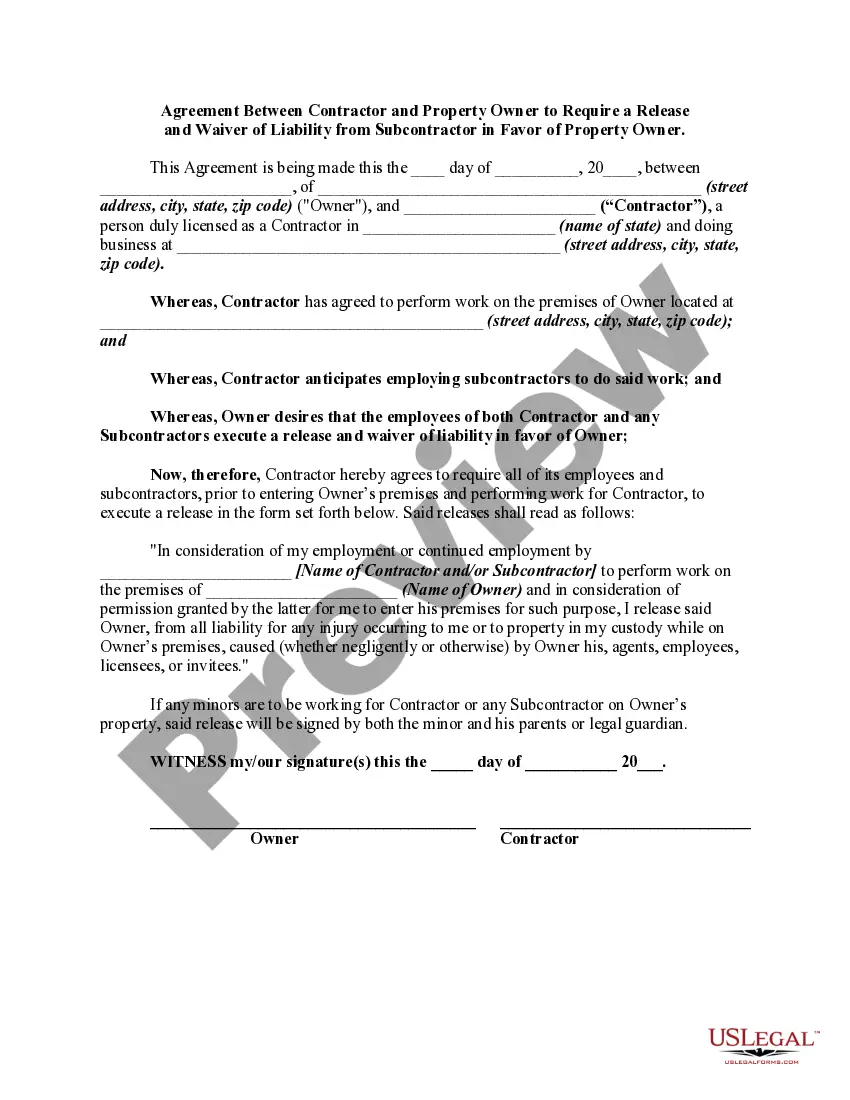
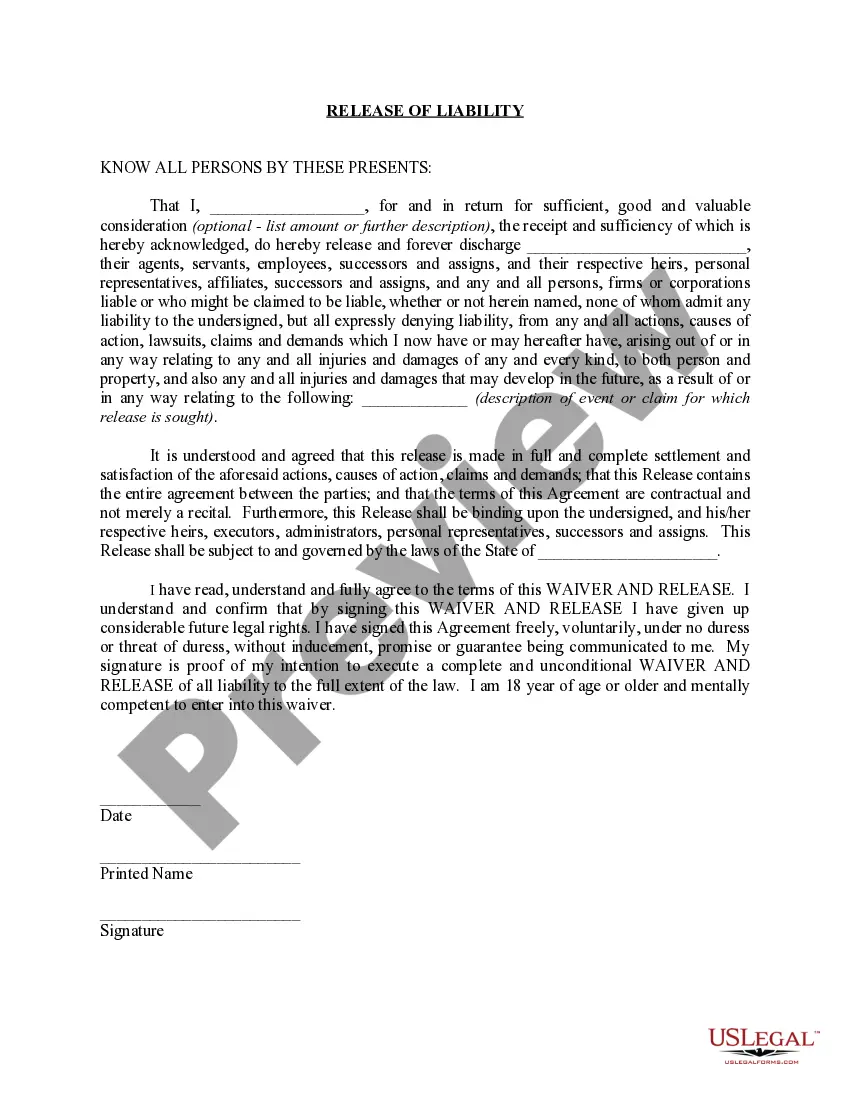
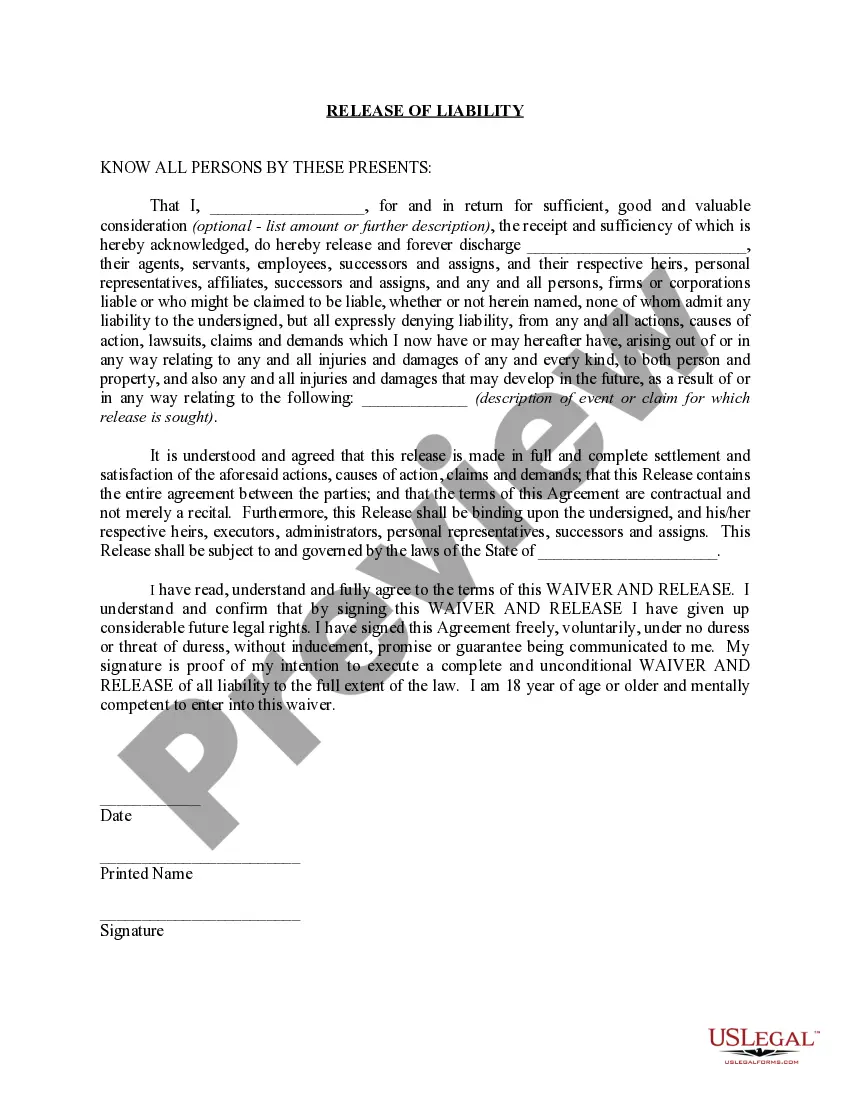
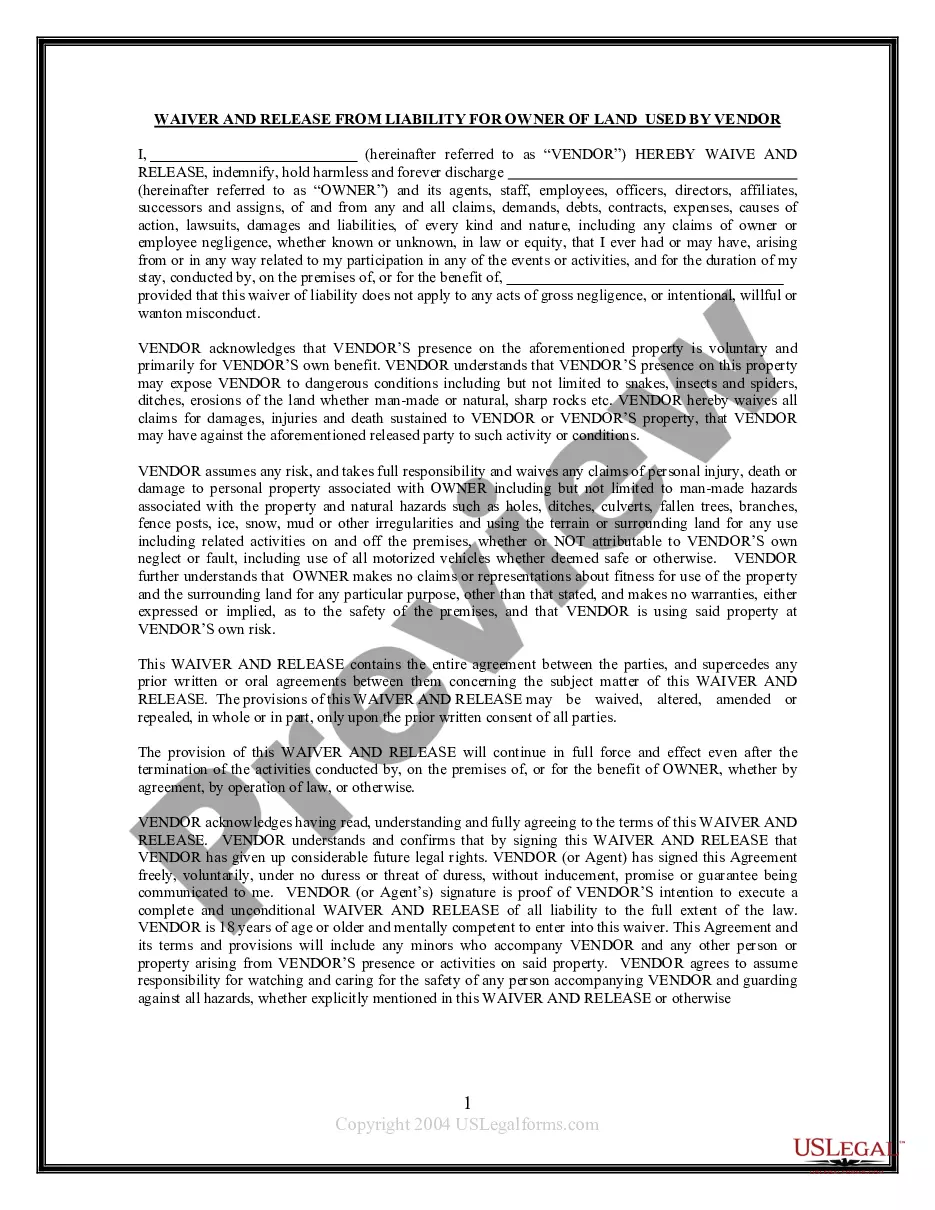
This form is an Agreement Between Contractor and Property Owner to Require a Release and Waiver of Liability from Subcontractor in Favor of Property Owner. It is a legal document that ensures the property owner is protected from liability for injuries or damages that may occur on their property when subcontractors perform work. This agreement differs from general contracts by specifically addressing liability concerns related to subcontractors and the property owner's rights.
Key parts of this document
- Identification of the property owner and contractor, including addresses.
- Details of the work to be performed by the contractor and their subcontractors.
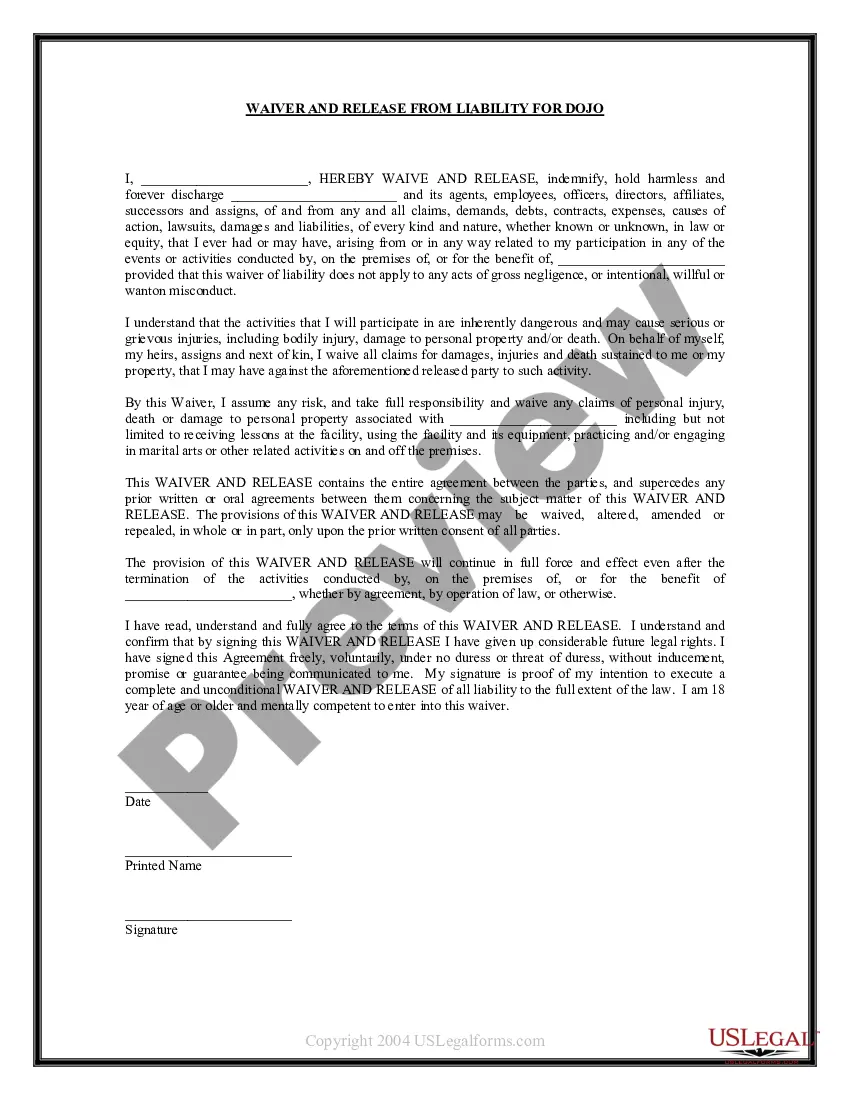
- A clause requiring subcontractors to sign a release and waiver of liability.
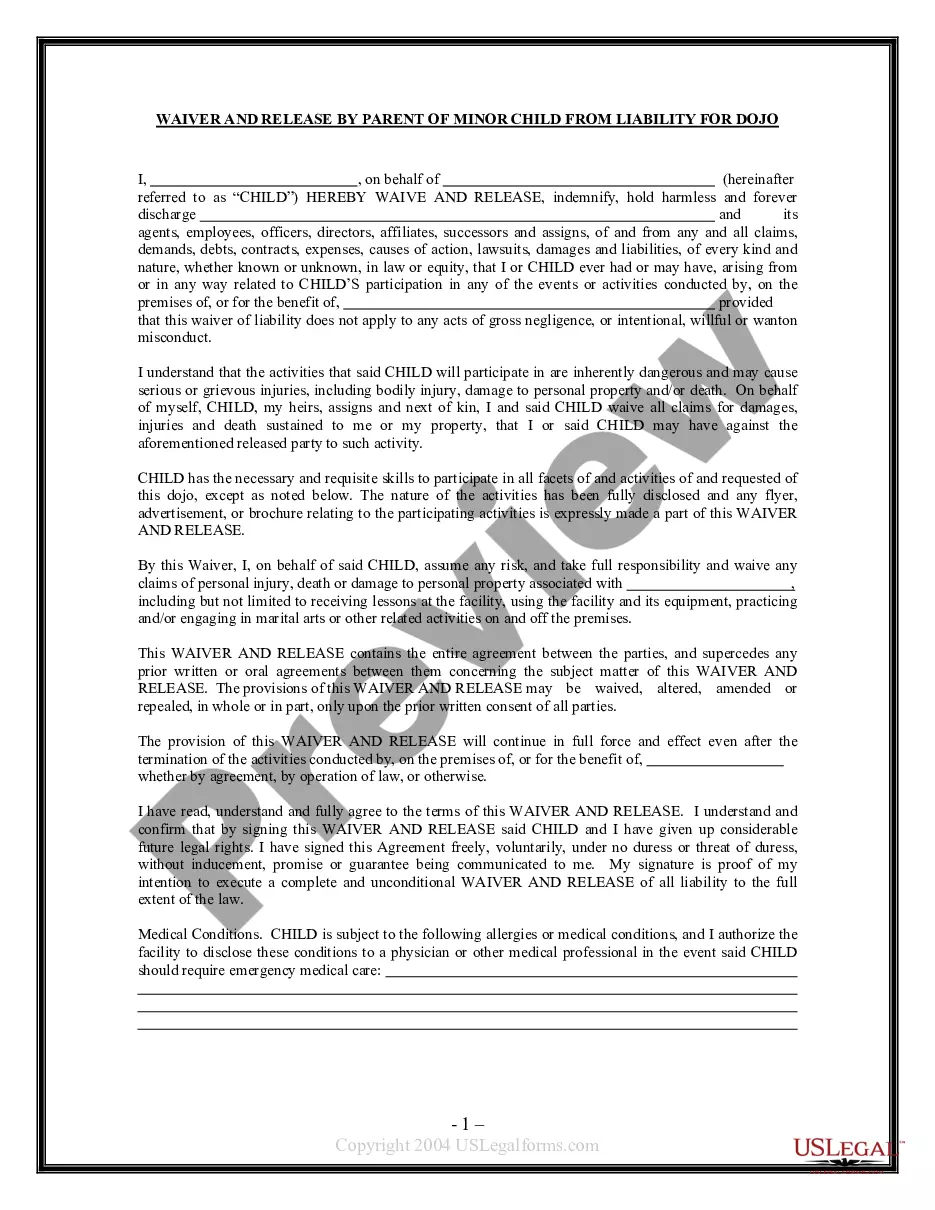
- Provisions for minors who may work on the property, including signature requirements from parents or guardians.
- Signatures of both parties to confirm agreement.
When to use this document
This form should be used whenever a contractor plans to have subcontractors perform work on a property. It is particularly important if the property owner wishes to mitigate their exposure to liability for any injuries that subcontractors or their employees may suffer while on the property. This agreement is useful in construction projects, renovations, or any situation where outside labor is permitted on private premises.
Who this form is for
- Property owners who are hiring contractors to perform work on their property.
- Contractors who plan to employ subcontractors for a project.
- Subcontractors who require a clear understanding of liability terms when working on another person's property.
Completing this form step by step
- Identify and enter the names and addresses of the property owner and contractor.
- Specify the location of the work being performed.
- Detail the nature of the work to be done by the contractor and subcontractors.
- Ensure all subcontractors understand and sign the release and waiver of liability form.
- Collect signatures from both the property owner and contractor to validate the agreement.
Does this document require notarization?
This form does not typically require notarization unless specified by local law. However, having it notarized can help add an extra layer of authenticity and enforcement.
Get your form ready online
Our built-in tools help you complete, sign, share, and store your documents in one place.
Make edits, fill in missing information, and update formatting in US Legal Forms—just like you would in MS Word.
Download a copy, print it, send it by email, or mail it via USPS—whatever works best for your next step.
Sign and collect signatures with our SignNow integration. Send to multiple recipients, set reminders, and more. Go Premium to unlock E-Sign.
If this form requires notarization, complete it online through a secure video call—no need to meet a notary in person or wait for an appointment.
We protect your documents and personal data by following strict security and privacy standards.

Make edits, fill in missing information, and update formatting in US Legal Forms—just like you would in MS Word.

Download a copy, print it, send it by email, or mail it via USPS—whatever works best for your next step.

Sign and collect signatures with our SignNow integration. Send to multiple recipients, set reminders, and more. Go Premium to unlock E-Sign.

If this form requires notarization, complete it online through a secure video call—no need to meet a notary in person or wait for an appointment.

We protect your documents and personal data by following strict security and privacy standards.
Common mistakes to avoid
- Failing to have all subcontractors sign the waiver before they start work.
- Not specifying details about the nature of the work being performed.
- Missing signatures from either the property owner or contractor.
- Using outdated forms that do not comply with current legal standards.
Benefits of completing this form online
- Convenience of downloading and filling out the form at your own pace.
- Editability, allowing users to customize the document for specific needs.
- Access to reliable, attorney-drafted content that simplifies the process of creating legal documents.
Main things to remember
- This agreement protects property owners from liability related to subcontractors' work.
- Clearly outline all parties and the scope of work to avoid misunderstandings.
- Ensure that required signatures are obtained to validate the agreement.
Looking for another form?
Form popularity
FAQ
This form is a contract that protects the property owner by requiring subcontractors to sign a release and waiver of liability in favor of the owner. It identifies the parties, describes the work, includes a subcontractor release, and covers minors with parent/guardian signatures, plus signatures by both parties. Use it whenever subcontractors will work on a property to limit owner liability.
Under this form, a subcontractor waiver is the requirement that the subcontractor sign a release and waiver of liability in favor of the property owner. It shifts risk away from the owner, formalizes the subcontractor’s acknowledgment of liability for injuries related to the work, and supports the owner’s protection on the job site.
In this form, the release and waiver of liability is the subcontractor’s promise not to hold the property owner liable for injuries or damages arising from the subcontracted work. The key components specify the subcontractor signing the waiver and the parties’ signatures; there is no indemnity provision listed in the components.
This form does not reference subrogation endorsements. It is a contract between the property owner, contractor, and subcontractor focusing on a release and waiver of liability. Insurance endorsements are separate; consult a licensed attorney or insurer to determine if any endorsement is appropriate for your project.
Signatures are required from the property owner and contractor to confirm the agreement, and subcontractors must sign the release and waiver of liability. If minors work on the property, parents or guardians must sign on behalf of the minor. These signatures acknowledge and enforce the terms of the waiver.
It is tailored to construction projects where a contractor uses subcontractors. The form specifically requires subcontractors to sign a release and waiver of liability in favor of the property owner, identifies the owner and contractor, describes the work, and includes minor-provision language, making it distinct from generic releases.