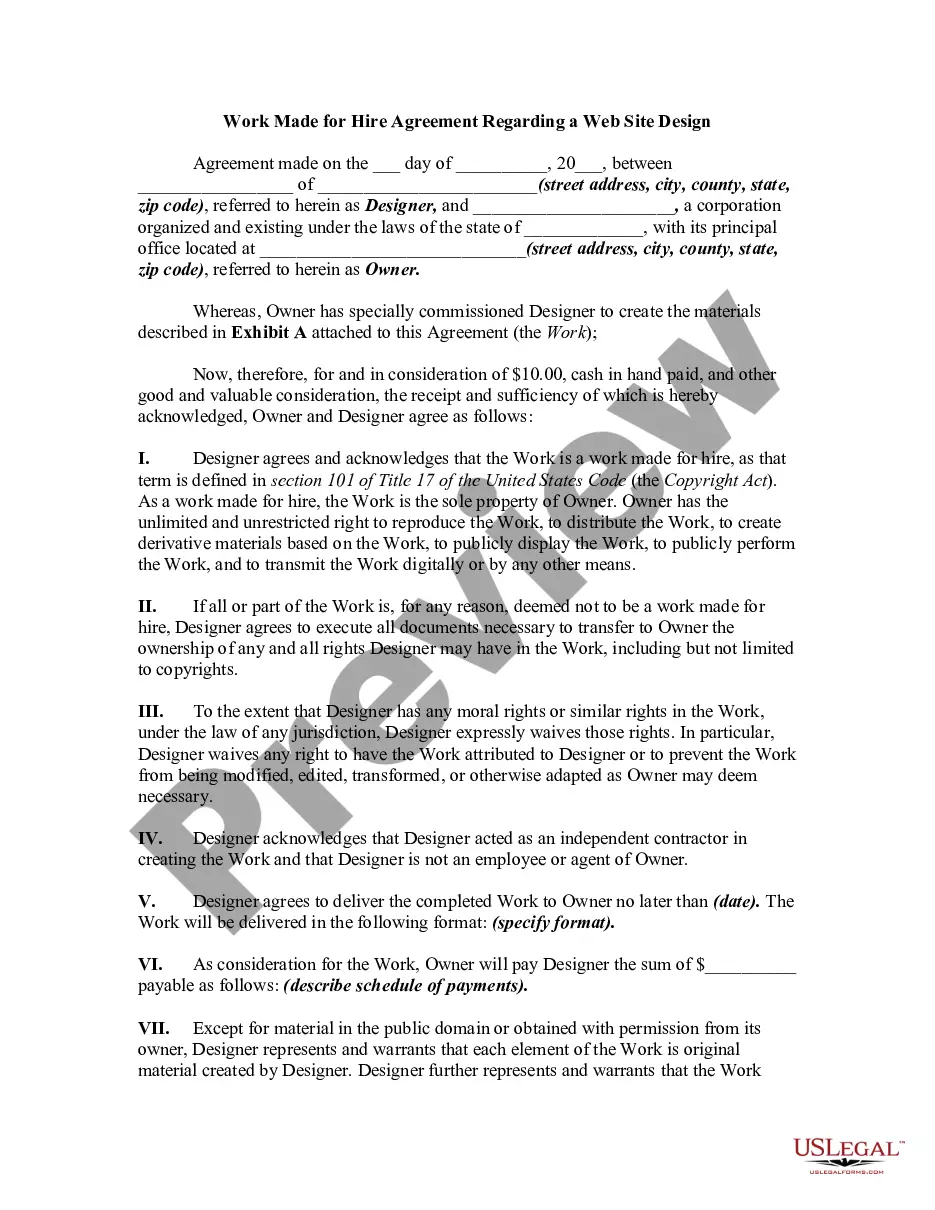
Work Made for Hire Agreement Regarding a Web Site Design
What is this form?
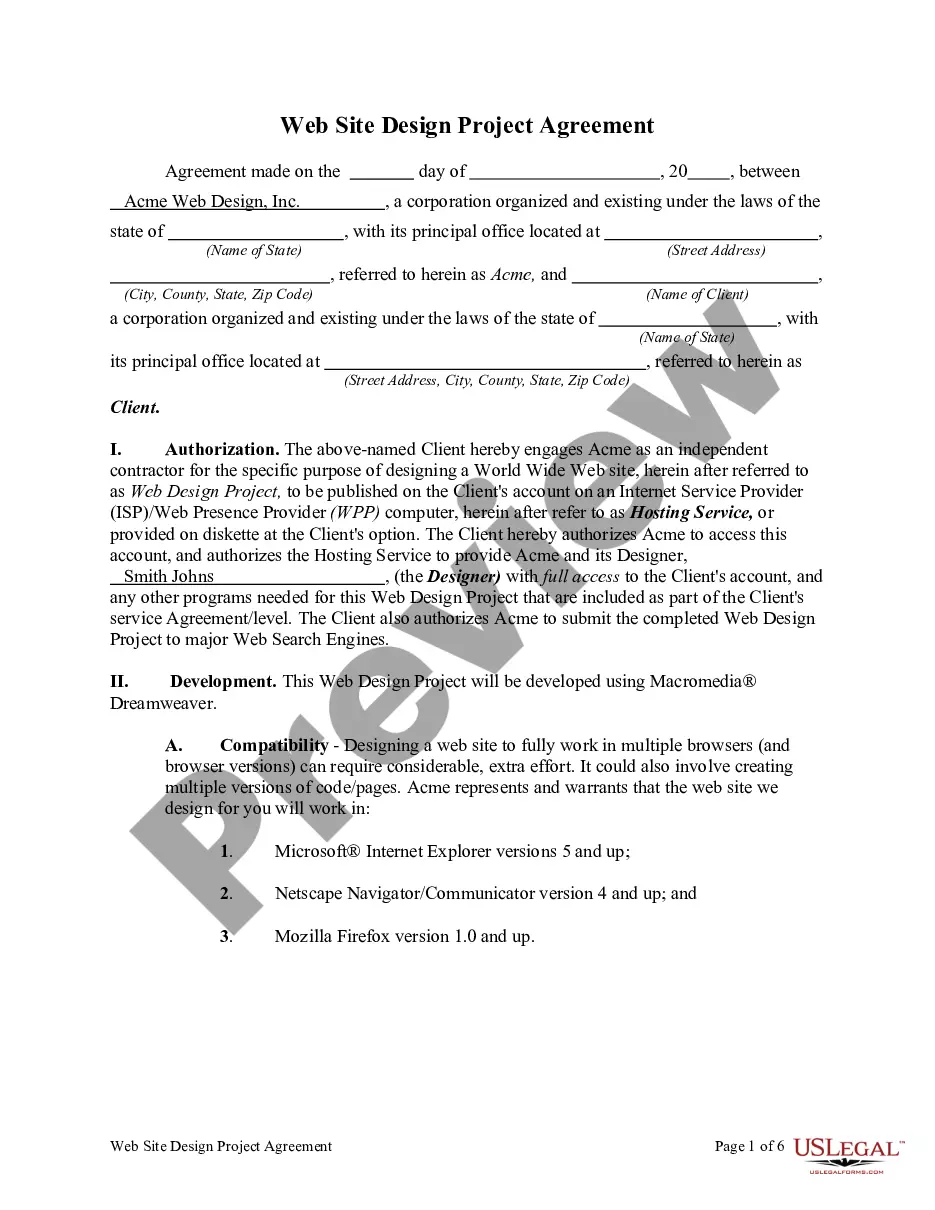
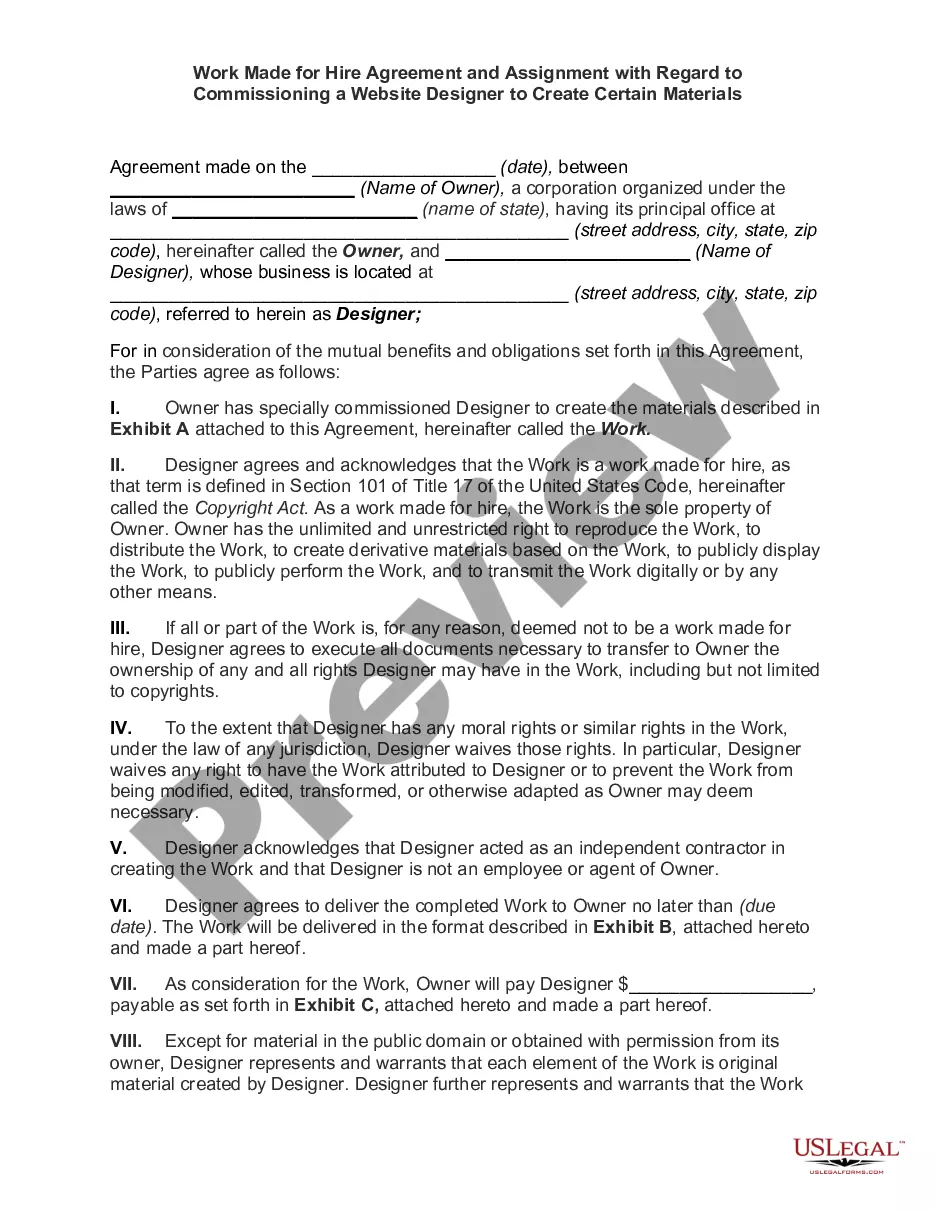
The Work Made for Hire Agreement Regarding a Web Site Design is a legal document that clarifies the ownership of creative work produced by a designer for a client. This form establishes that the work created is the property of the client, also known as the owner, and includes specific terms regarding copyright, moral rights, and the delivery of the work. It differs from typical contracts as it emphasizes the 'work made for hire' designation, ensuring that the designer has no claim to royalties or rights once the project is completed and paid for.
Form components explained
- Identification of the parties involved: Designer and Owner
- Definition of the commissioned work and its ownership
- Terms outlining payment details and schedule
- Clauses regarding the waiver of moral rights by the Designer
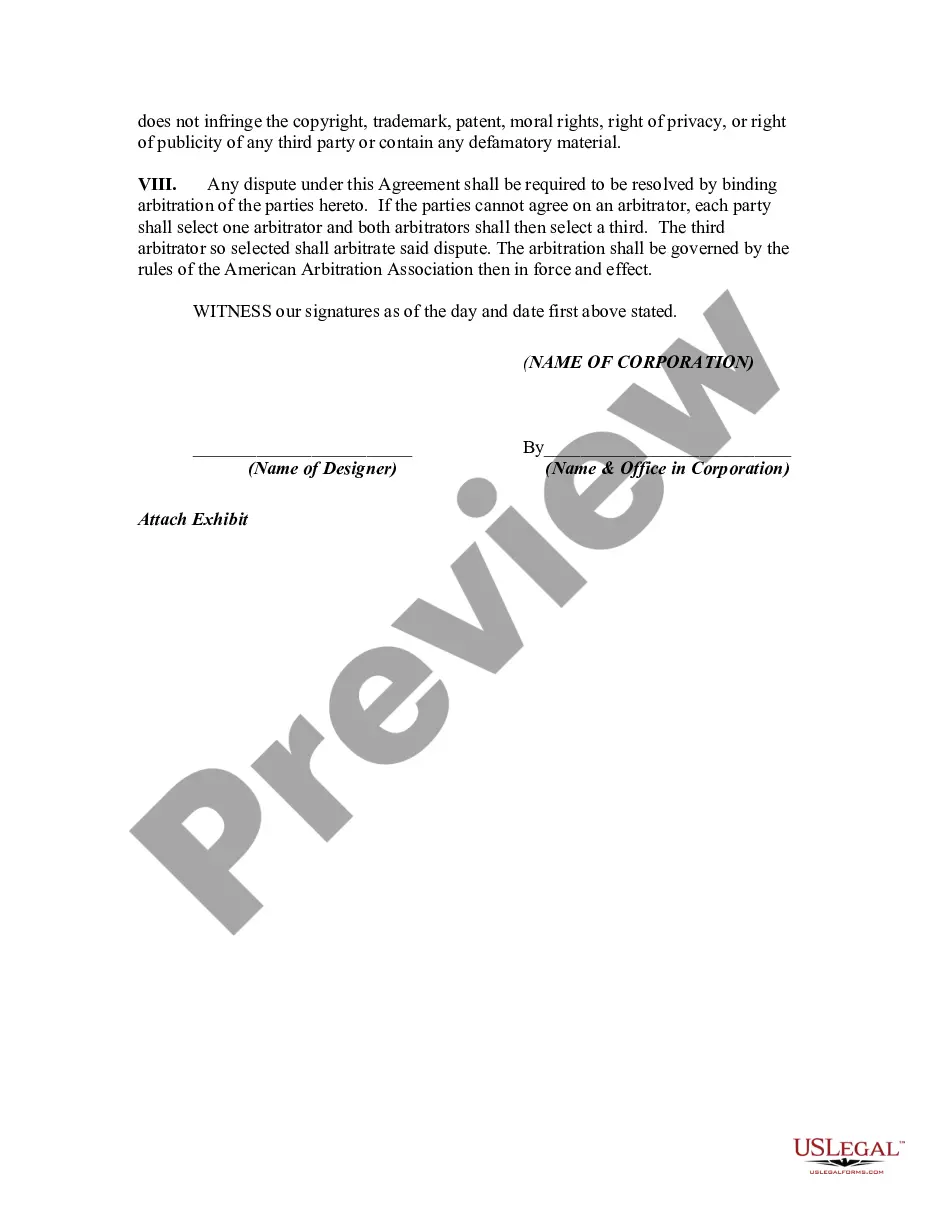
- Provisions for dispute resolution through arbitration
- Signature lines for both parties to agree to the terms
Common use cases
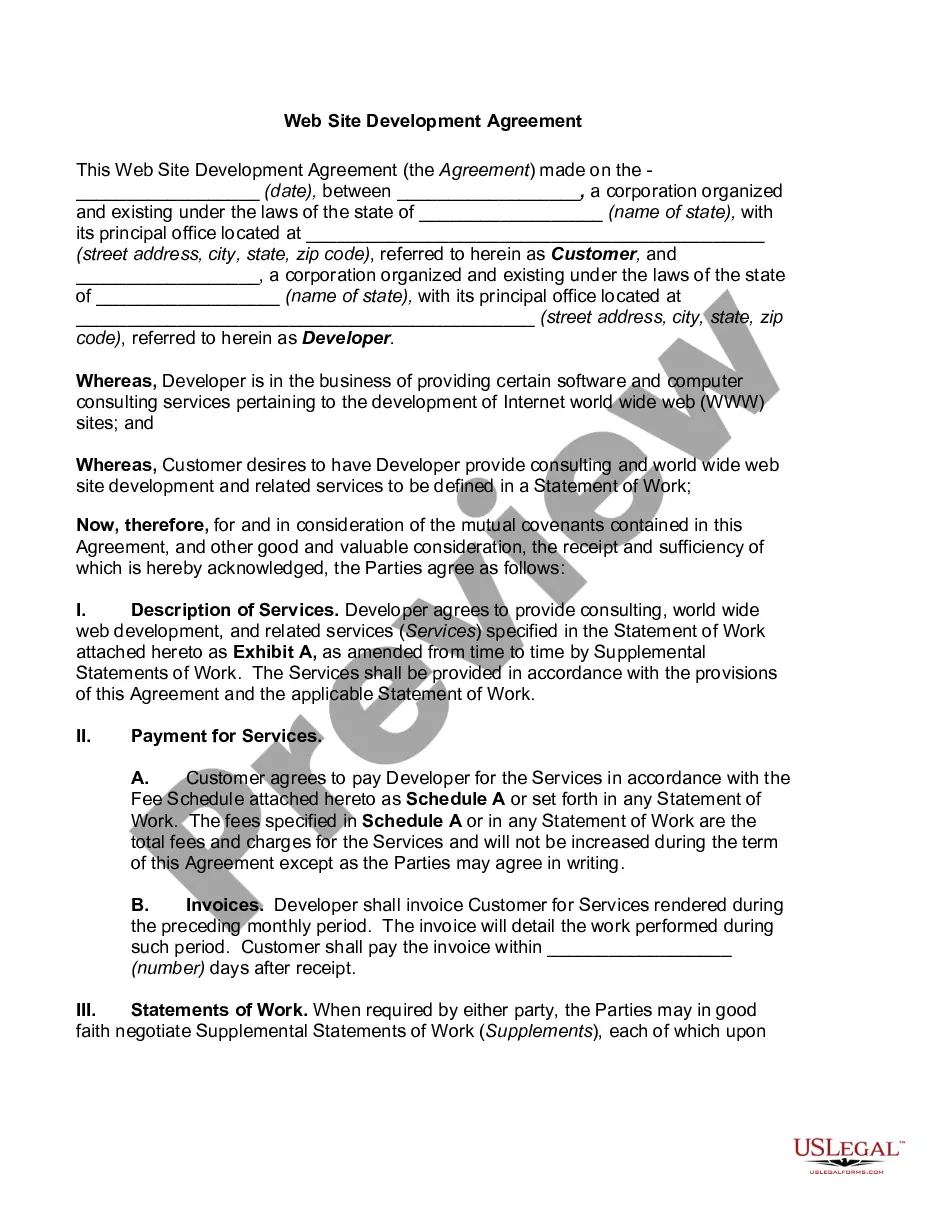
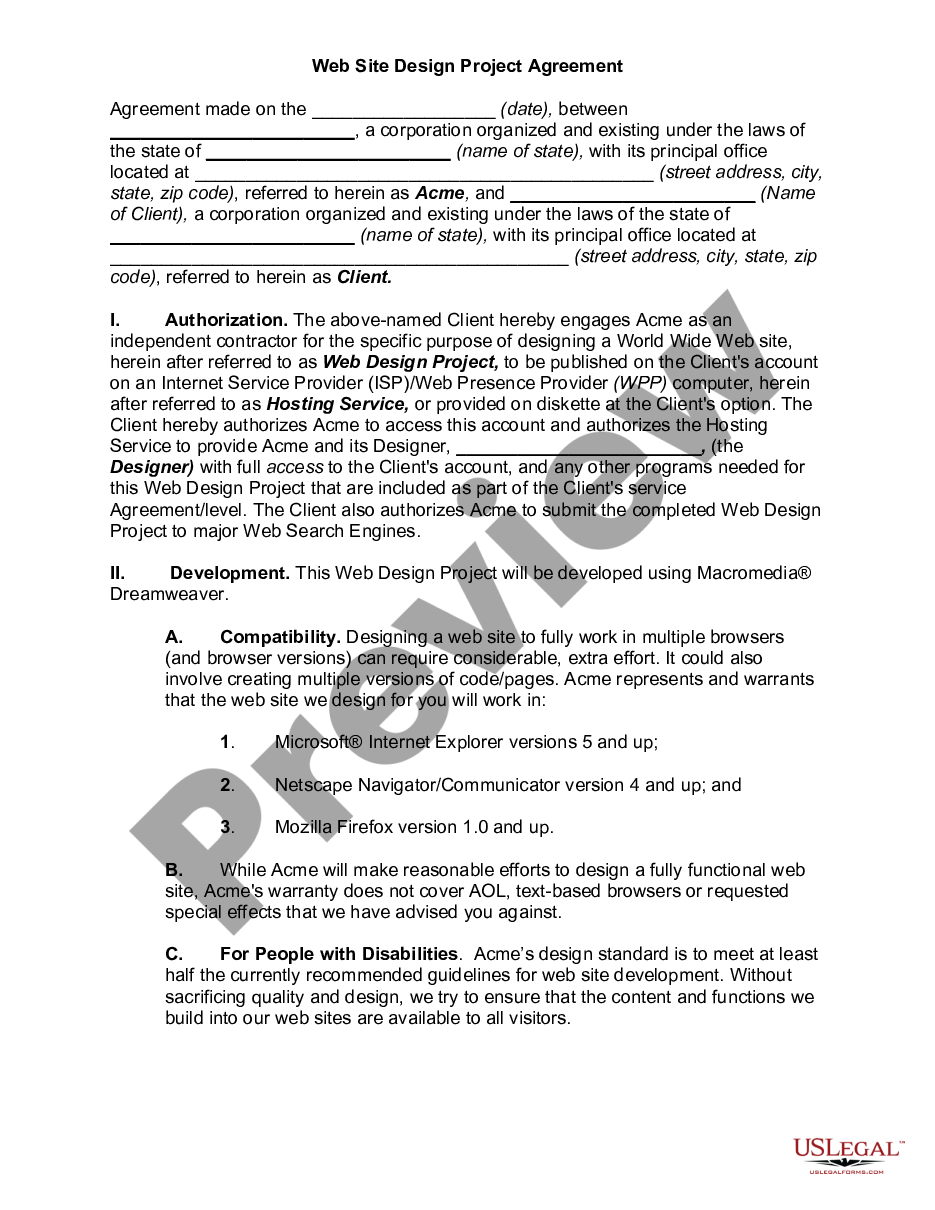
This agreement is essential when a business or individual hires a designer to create a website or web content. It ensures that the client retains full ownership of all materials produced, preventing any future claims on the creative work. Utilize this form to clearly delineate rights and responsibilities when entering into a design project that requires specific deliverables.
Who needs this form
- Business owners commissioning web design work
- Freelance web designers creating custom websites
- Agencies hiring designers for client projects
- Individuals seeking to protect their ownership of a web project
How to complete this form
- Identify the Designer and Owner by providing their names and addresses.
- Clearly describe the commissioned work in Exhibit A.
- Specify the compensation amount and payment schedule.
- Enter the date by which the Designer must deliver the completed work.
- Both parties should sign the agreement to indicate their acceptance of the terms.
Notarization guidance
Notarization is not commonly needed for this form. However, certain documents or local rules may make it necessary. Our notarization service, powered by Notarize, allows you to finalize it securely online anytime, day or night.
Get your form ready online
Our built-in tools help you complete, sign, share, and store your documents in one place.
Make edits, fill in missing information, and update formatting in US Legal Forms—just like you would in MS Word.
Download a copy, print it, send it by email, or mail it via USPS—whatever works best for your next step.
Sign and collect signatures with our SignNow integration. Send to multiple recipients, set reminders, and more. Go Premium to unlock E-Sign.
If this form requires notarization, complete it online through a secure video call—no need to meet a notary in person or wait for an appointment.
We protect your documents and personal data by following strict security and privacy standards.

Make edits, fill in missing information, and update formatting in US Legal Forms—just like you would in MS Word.

Download a copy, print it, send it by email, or mail it via USPS—whatever works best for your next step.

Sign and collect signatures with our SignNow integration. Send to multiple recipients, set reminders, and more. Go Premium to unlock E-Sign.

If this form requires notarization, complete it online through a secure video call—no need to meet a notary in person or wait for an appointment.

We protect your documents and personal data by following strict security and privacy standards.
Mistakes to watch out for
- Failing to specify the format in which the work will be delivered.
- Not including a detailed description of the work in Exhibit A.
- Omitting the payment details, which can lead to disputes later.
- Forgetting to sign the agreement, making it unenforceable.
Benefits of using this form online
- Convenience of downloading and editing the form as needed.
- Access to professionally designed templates drafted by licensed attorneys.
- Time-saving: complete and submit the form quickly without needing in-person visits.
- Year-round accessibility allows users to fill out the form at their convenience.
Legal use & context
- The agreement is enforceable under United States copyright law, provided it is properly filled out and executed.
- It is important to have clear terms to avoid any potential disputes about ownership and use of the work created.
- Be aware that local laws may impact the terms of the agreement, so it's advisable to consult an attorney if in doubt.
Main things to remember
- The agreement secures ownership rights for the Owner over the work created.
- It includes important stipulations regarding copyright and moral rights.
- Completion involves specific steps to ensure clarity and legality.
- Common mistakes can be avoided for a smoother project experience.
Looking for another form?
Form popularity
FAQ
If a work is made for hire, the employer or the party that specially ordered or commissioned that work is the initial owner of the copyright in the work unless the employer or the commissioning party has signed a written agreement to the contrary with the work's creator. Copyright Term.
In the copyright law of the United States, a work made for hire (work for hire or WFH) is a work subject to copyright that is created by an employee as part of his or her job, or some limited types of works for which all parties agree in writing to the WFH designation.
Work agreement means a written agreement between the employer and employee that details the terms and conditions of an employee's work away from his central workplace.
Identifying/Contact Information. Title and Description of the Project. Projected Timeline and Completion Date. Cost Estimate and Payment Schedule. Stop Work Clause and Stop Payment Clause. Act of God Clause. Change Order Agreement. Warranty.
Generally, the person who creates a work is considered its author and the automatic owner of copyright in that work. However, under the work made for hire doctrine, your employer or the company that has commissioned your work, not you, is considered the author and automatic copyright owner of your work.
Get it in writing. Keep it simple. Deal with the right person. Identify each party correctly. Spell out all of the details. Specify payment obligations. Agree on circumstances that terminate the contract. Agree on a way to resolve disputes.
But to qualify, a commissioned work must be specified as a work made for hire, either in a contract or other writing, and the work must fit within one of the following categories: (i) a contribution to a collective work, (ii) a part of a motion picture, (iii) a translation, (iv) a supplementary work, (v) a compilation,