Agreement for Artificial Insemination Between Recipient and Donor
What this document covers
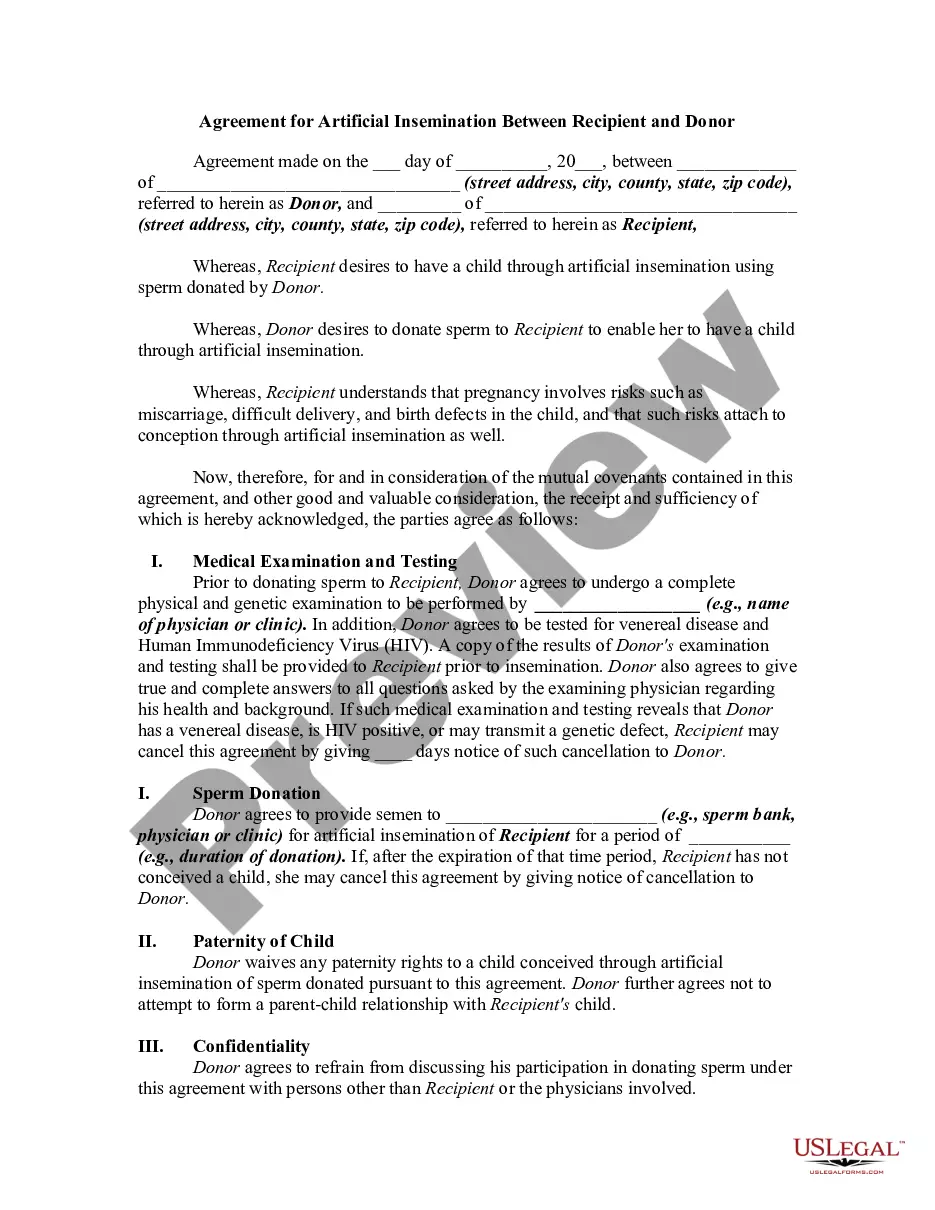
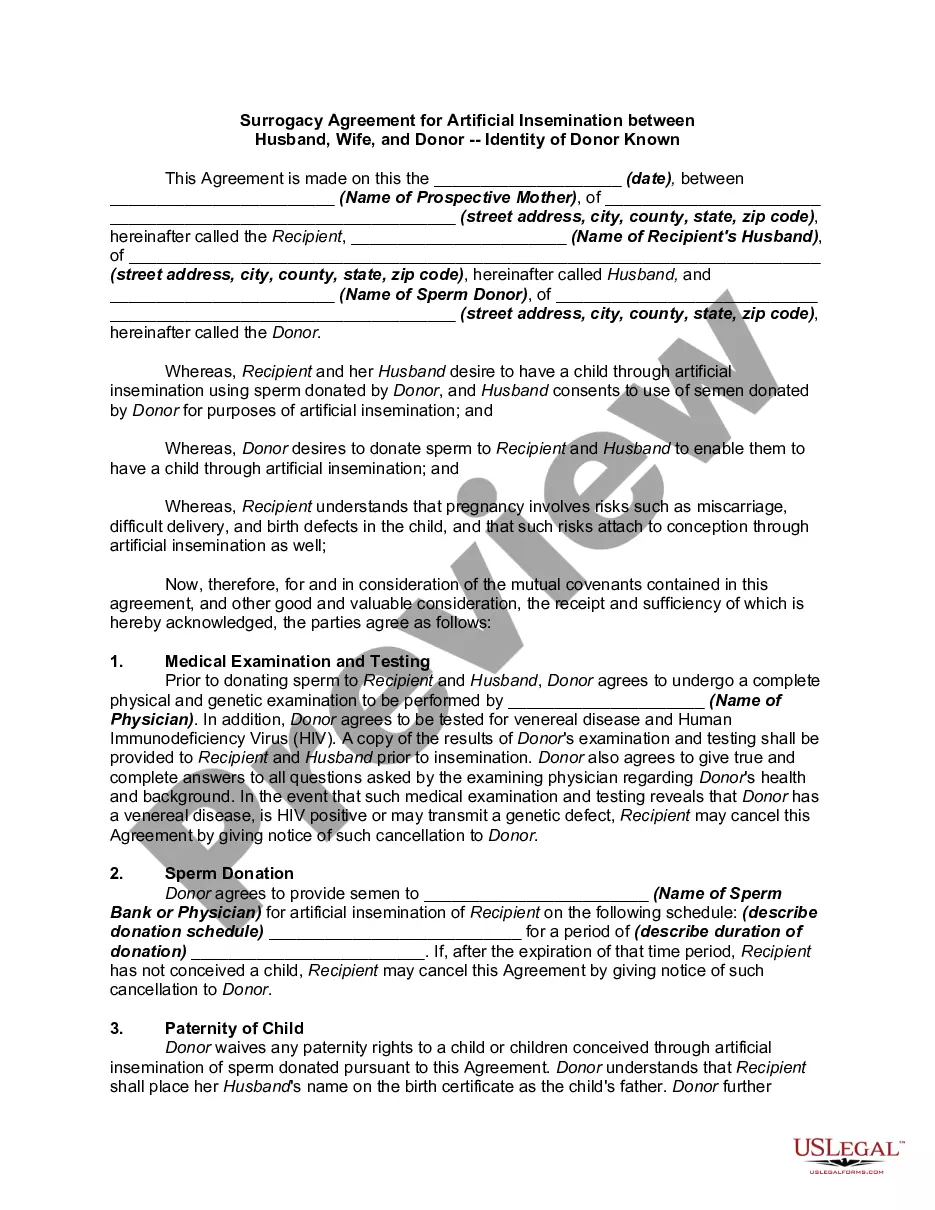
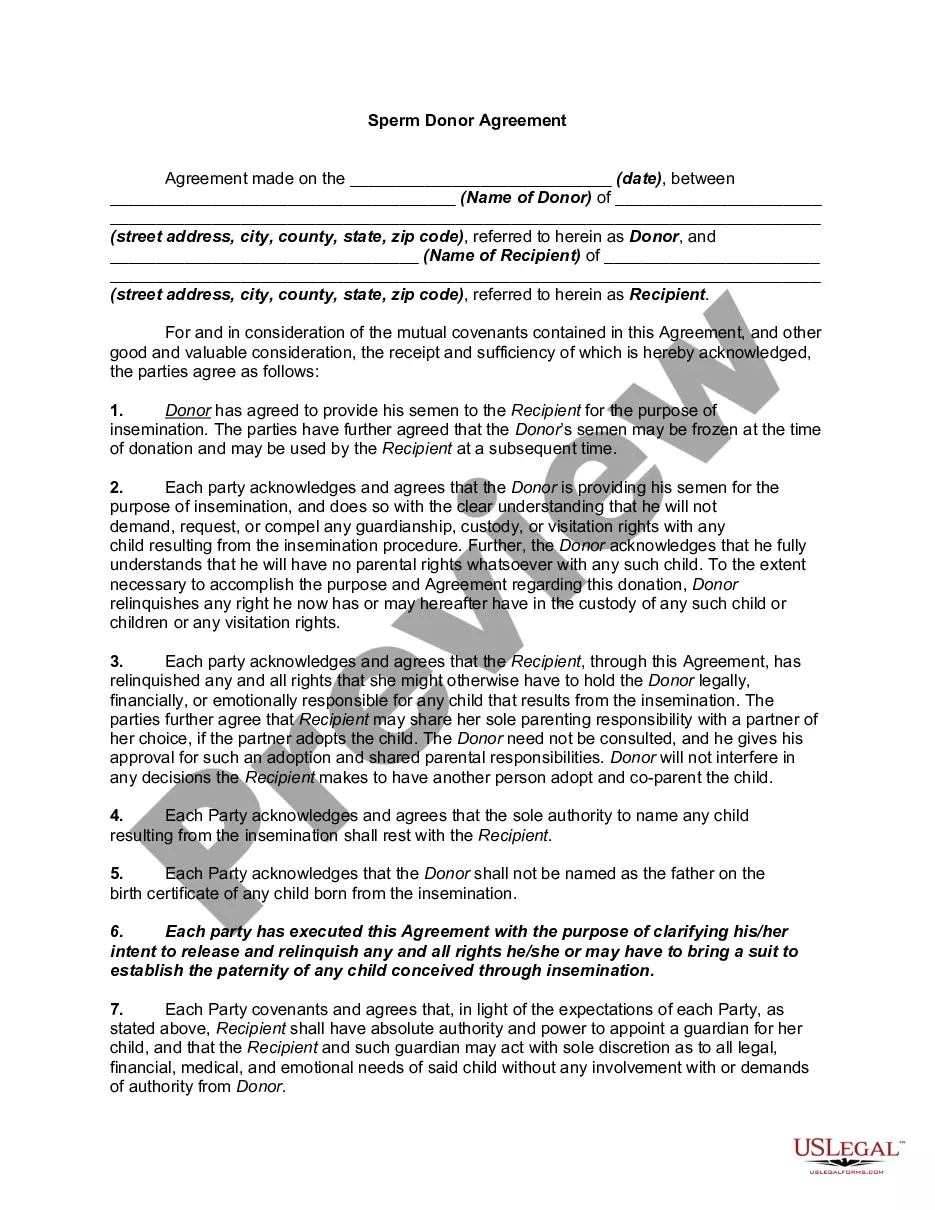
The Agreement for Artificial Insemination Between Recipient and Donor is a legal document that formalizes the arrangement between a recipient wishing to conceive a child using sperm from a known donor. This form establishes the rights and responsibilities of both parties involved in the artificial insemination process, including medical examinations, confidentiality, and paternity rights. It differs from other reproductive agreements by specifically addressing the unique aspects of an agreement between a personal recipient and a familiar sperm donor.
Key components of this form
- Identification of the recipient and the donor, including contact details.
- Medical examination and testing requirements for the donor before sperm donation.
- Terms regarding the donor's waiver of paternity rights.
- Confidentiality clauses to protect the privacy of both parties.
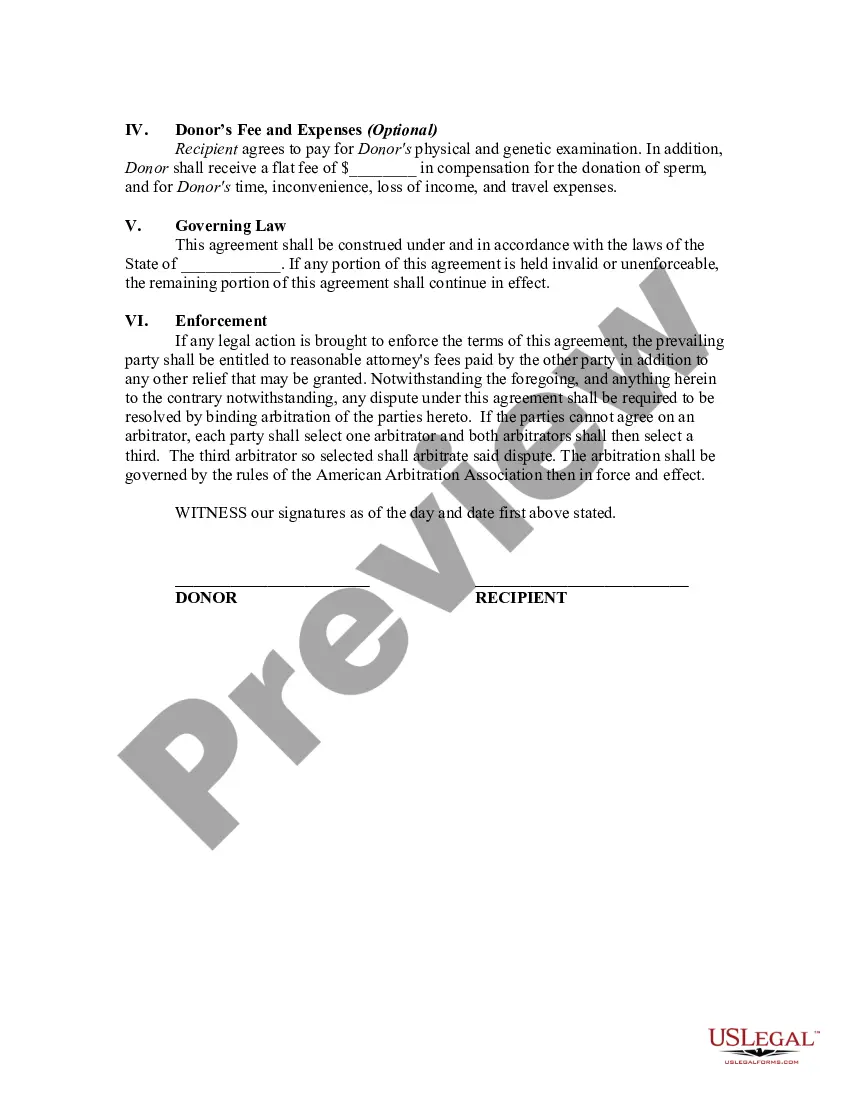
- Financial terms related to the donor's compensation and expenses.
- Legal enforcement and governing law stipulations.
Situations where this form applies
This agreement should be used when a known donor agrees to provide sperm for a recipient who is seeking to conceive a child via artificial insemination. It is particularly important to have a formal agreement in place to clarify the legal rights of both parties and to minimize potential disputes in the future. This form is essential in situations where the donor wishes to waive paternity rights or when confidentiality is a concern for either party.
Intended users of this form
- Individuals or couples planning to conceive a child through artificial insemination with the help of a known donor.
- Donors who intend to provide sperm to someone they know and want to clarify their legal obligations and rights.
- Recipients seeking a formal agreement to protect their interests and ensure clarity regarding the donor's role.
How to complete this form
- Identify the parties involved by entering the names and contact details of both the donor and the recipient.
- Specify the medical examination and testing requirements, including the name of the examining physician or clinic.
- Outline the terms of sperm donation, including duration and conditions for cancellation of the agreement.
- Include provisions regarding paternity rights and confidentiality obligations.
- Document any financial terms, including compensation for the donor's expenses.
- Both parties should sign and date the agreement to make it legally binding.
Notarization guidance
Notarization is not commonly needed for this form. However, certain documents or local rules may make it necessary. Our notarization service, powered by Notarize, allows you to finalize it securely online anytime, day or night.
Get your form ready online
Our built-in tools help you complete, sign, share, and store your documents in one place.
Make edits, fill in missing information, and update formatting in US Legal Forms—just like you would in MS Word.
Download a copy, print it, send it by email, or mail it via USPS—whatever works best for your next step.
Sign and collect signatures with our SignNow integration. Send to multiple recipients, set reminders, and more. Go Premium to unlock E-Sign.
If this form requires notarization, complete it online through a secure video call—no need to meet a notary in person or wait for an appointment.
We protect your documents and personal data by following strict security and privacy standards.

Make edits, fill in missing information, and update formatting in US Legal Forms—just like you would in MS Word.

Download a copy, print it, send it by email, or mail it via USPS—whatever works best for your next step.

Sign and collect signatures with our SignNow integration. Send to multiple recipients, set reminders, and more. Go Premium to unlock E-Sign.

If this form requires notarization, complete it online through a secure video call—no need to meet a notary in person or wait for an appointment.

We protect your documents and personal data by following strict security and privacy standards.
Common mistakes
- Failing to complete medical testing for the donor prior to signing the agreement.
- Not including clear terms regarding confidentiality, which can lead to breaches of privacy.
- Overlooking the need for both parties to sign and date the document.
- Neglecting to specify the duration of the donation or terms regarding cancellation.
Benefits of completing this form online
- Convenience of accessing and downloading the form anytime.
- Editability allows personalization to suit individual circumstances.
- Reliable templates drafted by licensed attorneys ensure legal compliance.
Looking for another form?
Form popularity
FAQ
The cost of artificial insemination varies according to whether a couple is using their sperm or a donor sperm and which procedure is being used. Most doctors report that the cost is anywhere from about $300 $1000 per cycle for intrauterine insemination and less for intracervical insemination.
Costs vary, since sperm banks and fertility centers all set their own prices, but a vial of donor sperm generally costs $900 to $1,000. The insemination procedure itself is often about $200 to $400, though it can be higher. A lot of people will try twice per cycle, which doubles those costs.
Yes! California law treats any person who provides sperm that is used for assisted reproduction as a sperm donor and not a parent if they are not married to the person giving birth.Otherwise, they may be inappropriately treated as a sperm donor without any parental rights.
In California, a man is a sperm donor and not a father if the child is conceived through assisted reproduction (not sex) and either (a) the man provides his sperm to a physician or sperm bank rather than directly to his recipient(s), or (b) the donor and the recipient(s) have a written agreement in place, prior to
If sperm is donated for the insemination of an unmarried woman, or if the donor provides sperm directly to the woman rather than her physician, the sperm donor might be entitled to assert parental rights and might be held responsible for child support.
Can a sperm donor be considered a legal parent? Well, the simple answer is that yes, sperm donors can be considered legal parents and can be responsible for the resulting child in some cases.
Donor Agreements involve an agreement between a donor and recipient parent/s that clarifies the relationships and expectations between the parties. Donor Agreements are often used between sperm donors and their donor recipients, and not so often with egg donors.
The simple answer is no. The IVF lab will not mix the sperm together. However, if you're a couple, you can elect to have half the eggs to be fertilized with one partner's sperm and the other half of the eggs fertilized by the other partner.
If your donor is donating to you via a private arrangement i.e. by home insemination it is illegal to pay him for the sale of sperm. Donors are allowed to receive a reasonable contribution towards costs such as travel expenses.