Sample Letter for Trial Setting for Non-Jury Trial
Overview of this form
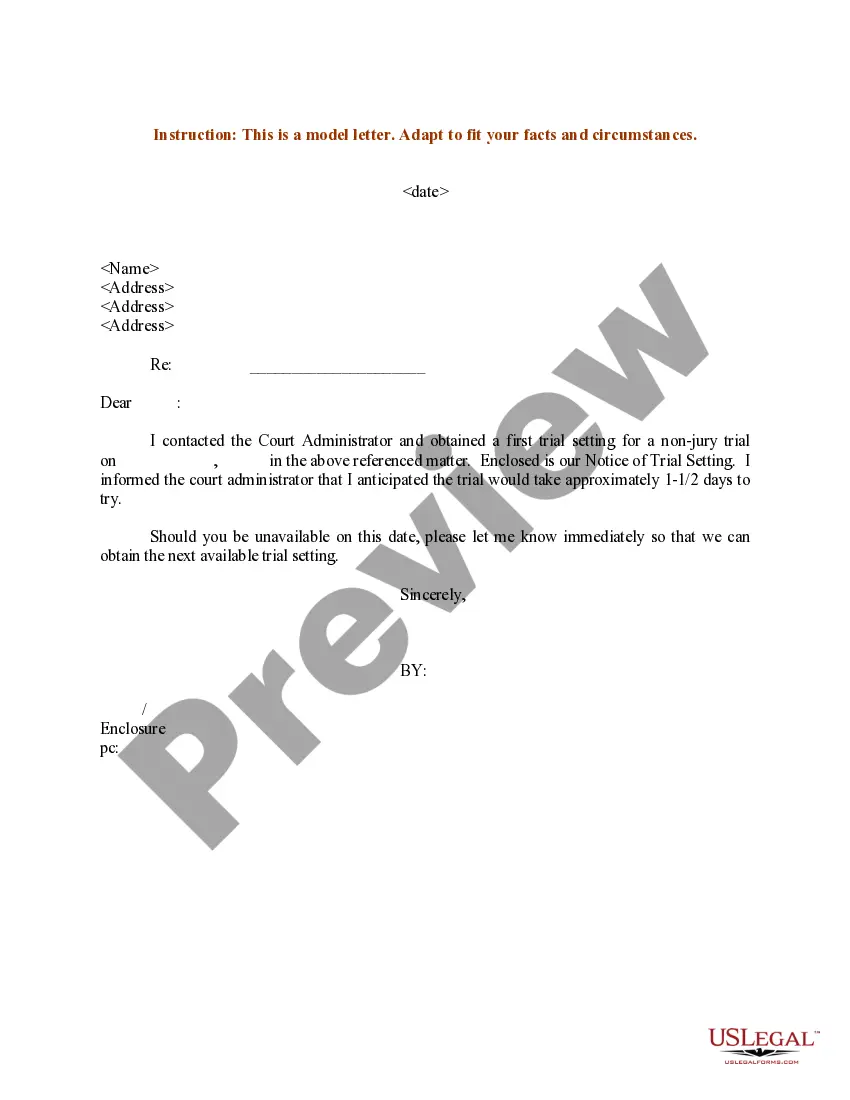
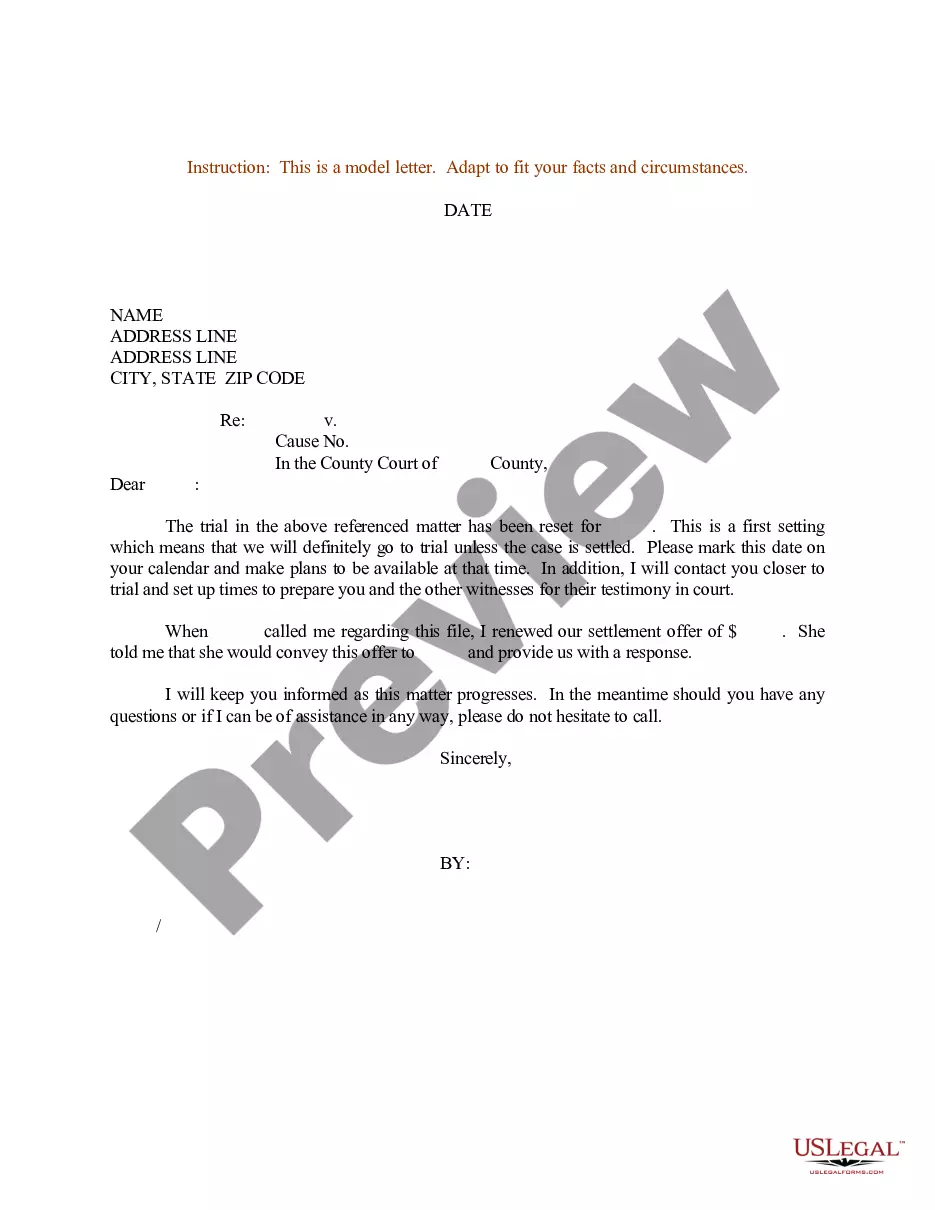
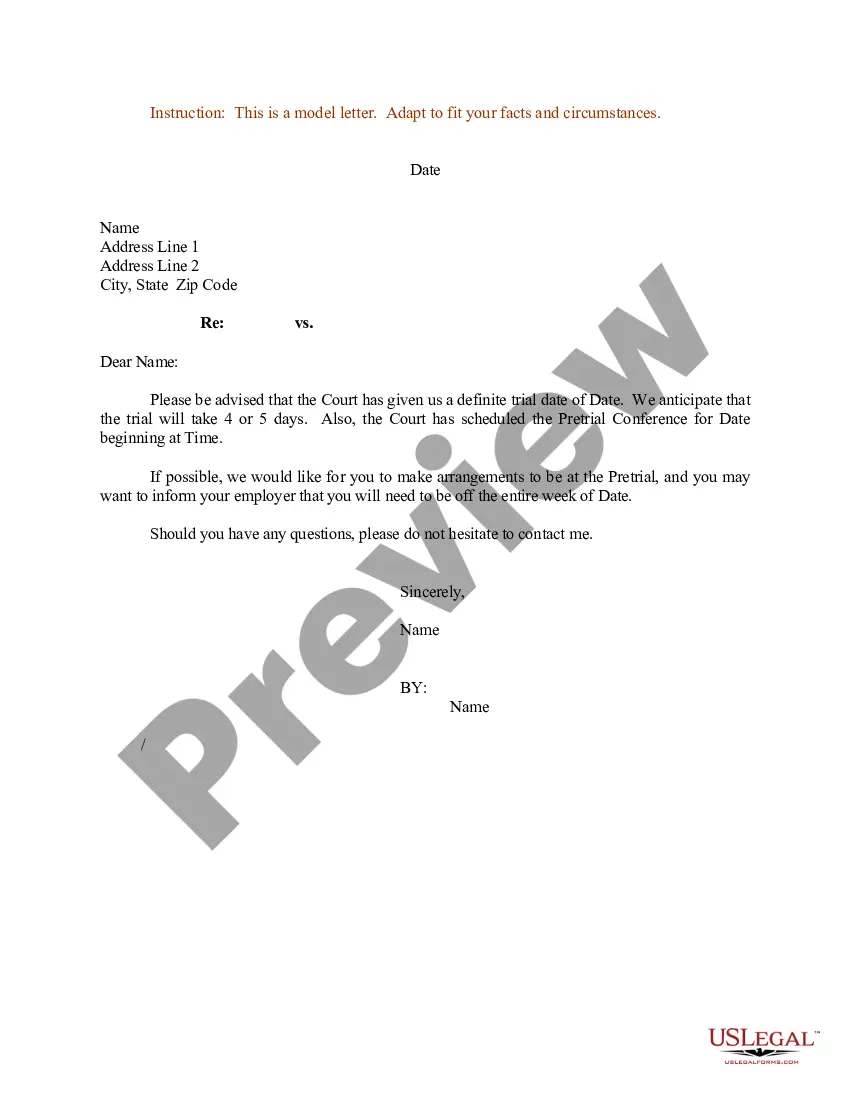
The Sample Letter for Trial Setting for Non-Jury Trial is a model letter that helps you formally request a trial date when a non-jury trial is involved. This form provides a clear structure for your request, allowing the court to process it efficiently. Unlike general correspondence, this letter is specifically tailored for legal proceedings, helping ensure your request adheres to the required format and legal expectations.
Form components explained
- Date of the letter
- Your name and address
- Recipient's name and address
- Subject line indicating the purpose of the letter
- Body of the letter detailing the request for trial setting
When to use this form
You should use the Sample Letter for Trial Setting for Non-Jury Trial when you need to formally notify the court of your request to set a date for a trial that does not require a jury. This is essential in situations where procedural timelines need to be adhered to, often after the pre-trial phase is complete or as part of ongoing legal proceedings. Using this letter ensures your request is presented in a structured and legally valid manner.
Intended users of this form
- Parties involved in a non-jury trial
- Attorneys representing clients in legal matters
- Individuals seeking to expedite their court proceedings
How to prepare this document
- Enter the current date at the top of the letter.
- Add your full name and address, ensuring all details are correct.
- Include the recipient's name and address below your information.
- Draft the subject line clearly stating the purpose of the letter.
- In the body of the letter, specify your request for the trial setting.
- Sign the letter at the bottom to validate your request.
Does this document require notarization?
Notarization is generally not required for this form. However, certain states or situations might demand it. You can complete notarization online through US Legal Forms, powered by Notarize, using a verified video call available anytime.
Get your form ready online
Our built-in tools help you complete, sign, share, and store your documents in one place.
Make edits, fill in missing information, and update formatting in US Legal Forms—just like you would in MS Word.
Download a copy, print it, send it by email, or mail it via USPS—whatever works best for your next step.
Sign and collect signatures with our SignNow integration. Send to multiple recipients, set reminders, and more. Go Premium to unlock E-Sign.
If this form requires notarization, complete it online through a secure video call—no need to meet a notary in person or wait for an appointment.
We protect your documents and personal data by following strict security and privacy standards.

Make edits, fill in missing information, and update formatting in US Legal Forms—just like you would in MS Word.

Download a copy, print it, send it by email, or mail it via USPS—whatever works best for your next step.

Sign and collect signatures with our SignNow integration. Send to multiple recipients, set reminders, and more. Go Premium to unlock E-Sign.

If this form requires notarization, complete it online through a secure video call—no need to meet a notary in person or wait for an appointment.

We protect your documents and personal data by following strict security and privacy standards.
Mistakes to watch out for
- Failing to include the correct date.
- Omitting any party's address information.
- Not clearly stating the purpose of the letter in the subject line.
- Using informal language instead of formal legal language.
Why use this form online
- Convenient downloadable format for quick access.
- Editable template allows you to customize details easily.
- Ensures reliability with a format designed by licensed attorneys.
Looking for another form?
Form popularity
FAQ
Someone might choose to waive their jury trial right if they believe that their case is better handled by a judge. For example, a case that requires a complex understanding of legal technicalities might better be handled by a judge than jurors.
According to the Supreme Court, the jury-trial right applies only when serious offenses are at handpetty offenses don't invoke it. For purposes of this right, a serious offense is one that carries a potential sentence of more than six months' imprisonment. (Baldwin v. New York, 399 U.S. 66 (1970).)
A bench trial is a trial by judge, as opposed to a trial by jury. The term applies most appropriately to any administrative hearing in relation to a summary offense to distinguish the type of trial.While a jury renders a verdict, a judge in a bench trial does the same by making a finding.
Anyone accused of a crime can choose to have their case heard by a jury, or they can waive their right to a jury trial and instead have their case decided only by the judge.
In the United States, a criminal defendant generally has the right to a trial by a jury. That right is guaranteed by the Sixth Amendment. In two circumstances, however, a criminal case may be decided through a trial by a judge instead of a jury known as a bench trial.
A non-jury trial is a trial in which a judge decides both questions of law and fact.A non-jury trial is held in the absence of a jury, and decided by a judge resulting in a judgment for the plaintiff(s) or defendant(s). In a non-jury trial the fact finder is one or more professional judges.
In a case tried without a jury, the court must find the defendant guilty or not guilty. If a party requests before the finding of guilty or not guilty, the court must state its specific findings of fact in open court or in a written decision or opinion.
All persons accused of misdemeanors or felonies are entitled to a jury trial. The jurors must unanimously agree upon guilt before the defendant can be found guilty and convicted.
It means that you will not have a jury deciding the facts in your case. The judge will decide the facts and apply the law.