Affidavit with Answers to Questions Regarding Observations of the Health of a Family Member - Hearing Loss
About this form
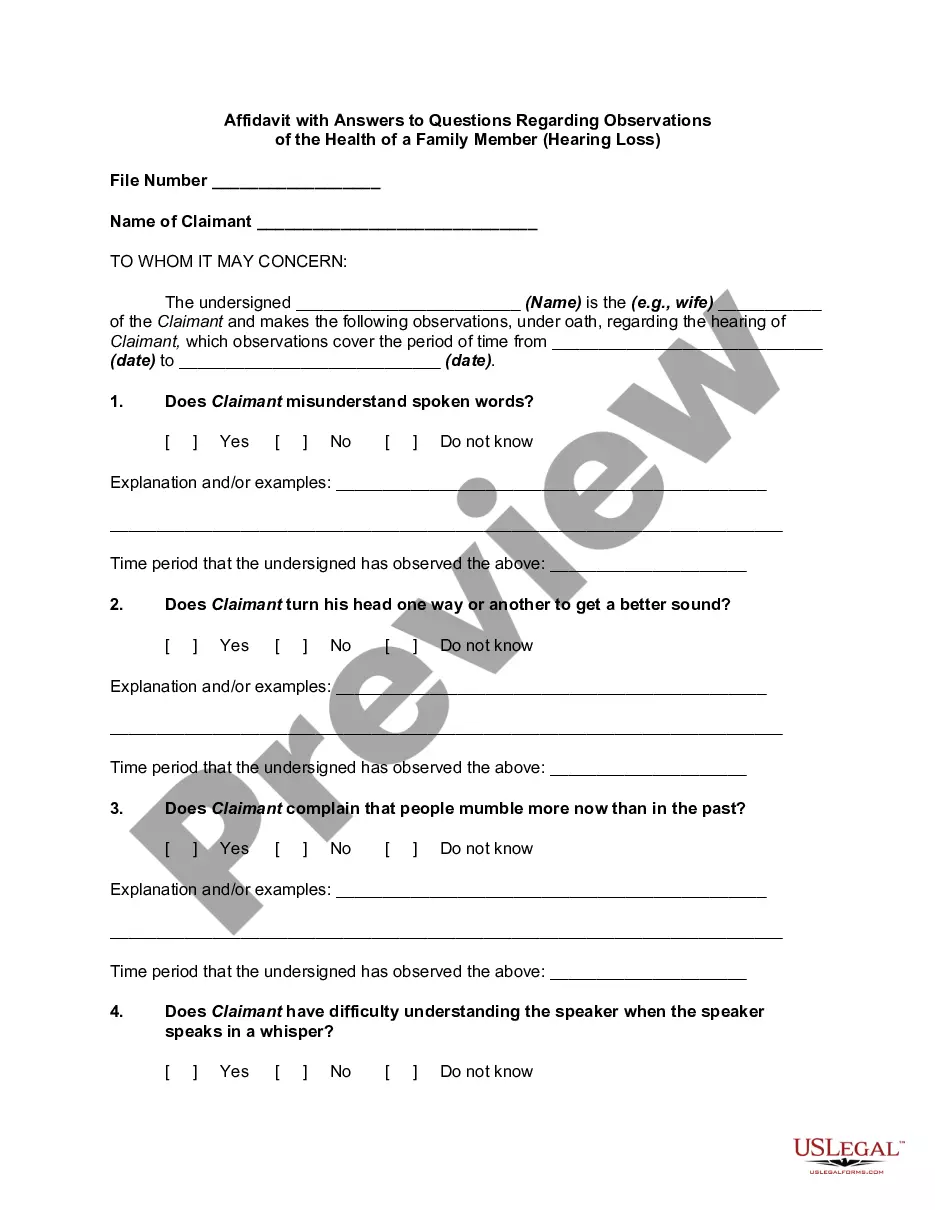
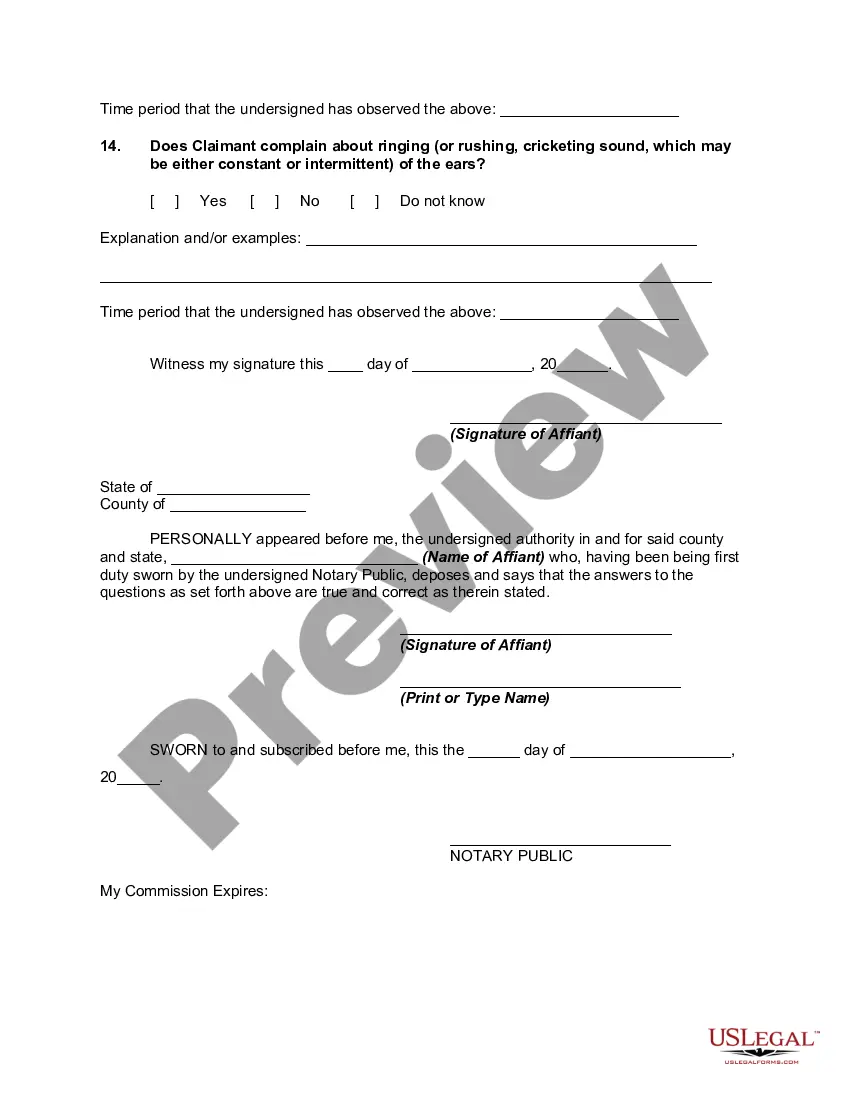
The Affidavit with Answers to Questions Regarding Observations of the Health of a Family Member - Hearing Loss is a legal document used to provide sworn statements about a person's hearing abilities. This affidavit typically includes observations made by a family member concerning the individualâs ability to hear, which may be required for legal or medical purposes. Unlike other affidavits, this form focuses specifically on hearing-related observations, making it essential for cases involving hearing loss assessments.
Form components explained
- Identification of the claimant and the relationship to the affiant.
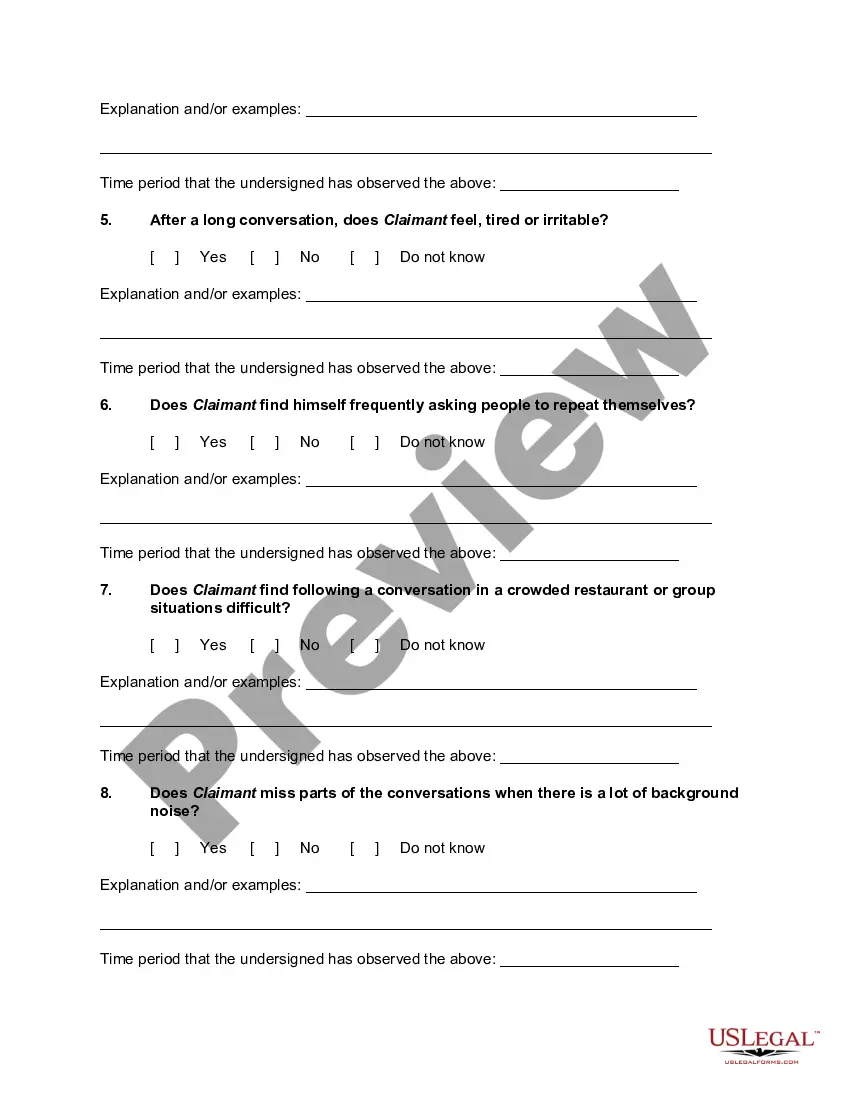
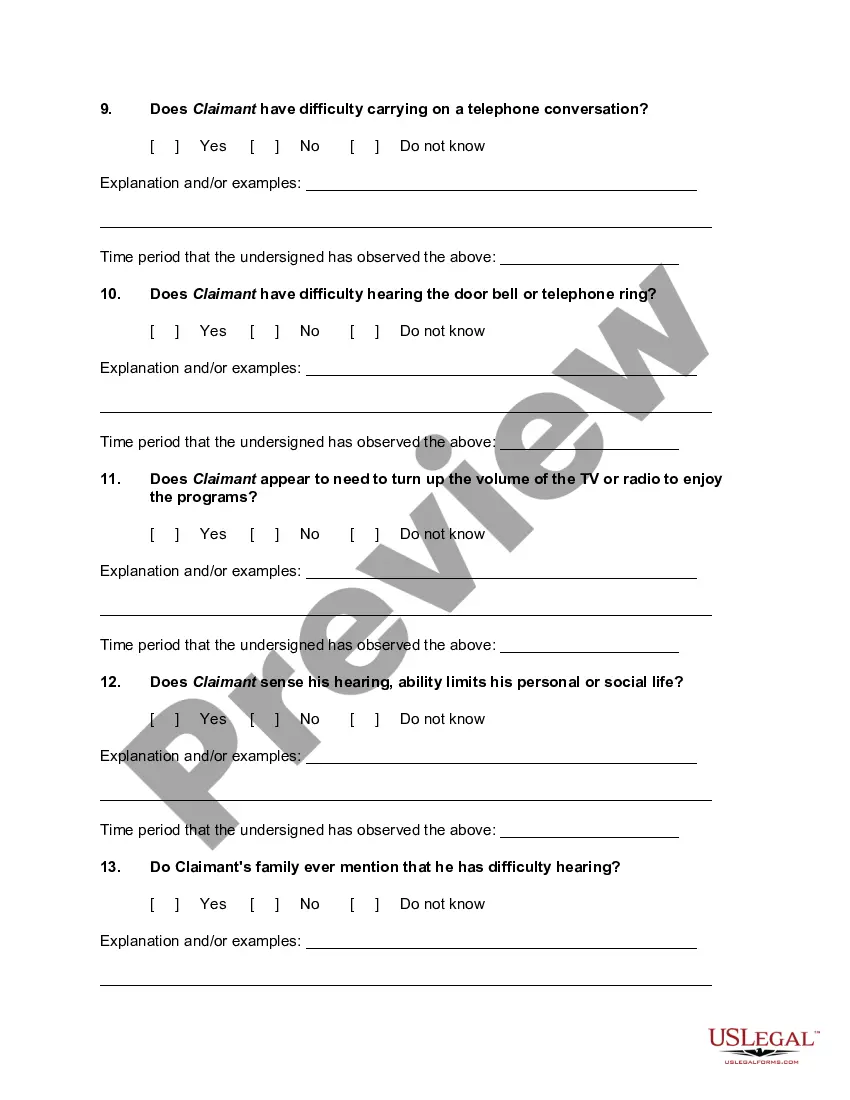
- A series of questions regarding the claimant's hearing abilities, responses, and explanations.
- Observation time periods for each query about the claimantâs hearing.
- Signature of the affiant to confirm the authenticity of the statements.
- Notary section to validate the affidavit.

Common use cases
This form is used when a family member needs to provide a formal account of another personâs hearing difficulties, often for insurance claims, disability applications, or legal matters concerning health assessments. It can be necessary in situations where proof of hearing impairment is required for eligibility for services or benefits.
Who needs this form
- Family members of individuals experiencing hearing loss.
- Caregivers or guardians who monitor the health of a claimant.
- Individuals involved in legal proceedings related to health assessments.
Completing this form step by step
- Identify the claimant and your relationship to them.
- Answer each question with 'Yes,' 'No,' or 'Do not know,' providing explanations where indicated.
- Specify the time periods during which you made your observations for each question.
- Sign the affidavit to affirm the truthfulness of your statements.
- Have a notary public witness your signature to finalize the affidavit.
Does this document require notarization?
Yes, this form must be notarized to be legally valid. The affidavit needs to be witnessed by a notary public who can affirm the identity of the affiant and verify their sworn statements. US Legal Forms provides integrated online notarization services, allowing you to complete this process securely and conveniently, 24/7.
Get your form ready online
Our built-in tools help you complete, sign, share, and store your documents in one place.
Make edits, fill in missing information, and update formatting in US Legal Forms—just like you would in MS Word.
Download a copy, print it, send it by email, or mail it via USPS—whatever works best for your next step.
Sign and collect signatures with our SignNow integration. Send to multiple recipients, set reminders, and more. Go Premium to unlock E-Sign.
If this form requires notarization, complete it online through a secure video call—no need to meet a notary in person or wait for an appointment.
We protect your documents and personal data by following strict security and privacy standards.

Make edits, fill in missing information, and update formatting in US Legal Forms—just like you would in MS Word.

Download a copy, print it, send it by email, or mail it via USPS—whatever works best for your next step.

Sign and collect signatures with our SignNow integration. Send to multiple recipients, set reminders, and more. Go Premium to unlock E-Sign.

If this form requires notarization, complete it online through a secure video call—no need to meet a notary in person or wait for an appointment.

We protect your documents and personal data by following strict security and privacy standards.
Common mistakes
- Failing to provide detailed explanations for observations.
- Ineffective documentation of the observation time periods.
- Not obtaining a notary signature, which is critical for validity.
Why use this form online
- Convenient access to downloadable templates without needing to visit a legal office.
- Templates are drafted by licensed attorneys to ensure legal compliance.
- Forms can be easily edited to suit individual needs before downloading.
Legal use & context
- This affidavit serves as a formal declaration of facts about an individual's hearing condition.
- It can be used in various legal contexts, including disability claims and insurance evaluations.
- Ensure that all observations are factual and supported by your personal experience to avoid issues of credibility.
What to keep in mind
- The affidavit provides a formal way to document hearing difficulties observed by family members.
- Proper completion and notarization are essential for the validity of the document.
- Consult local laws for any specific requirements related to the use of this form.
Looking for another form?
Form popularity
FAQ
How can a health care professional communicate with someone who is hearing-impaired? Use sign language, face patients when speaking, speak clearly, keep sentences short and uncomplicated.
Gain attention Gain the listener's attention before you begin talking, for example, by saying his or her name. If the person with hearing loss hears better from one ear, move to that side of the person. Also consider touching the listener's hand, arm or shoulder lightly to gain attention.
Face the hearing-impaired person directly, on the same level and in good light whenever possible. Do not talk from another room. Speak clearly, slowly, distinctly, but naturally, without shouting or exaggerating mouth movements. Say the person's name before beginning a conversation.
Find out how they communicate. Get their attention. Face them when you're talking. Speak clearly and naturally. Watch your mouth. Use visual cues, where possible. Make it clear what the topic of conversation is. Stand with your face to the light.
Speak clearly and don't shout Shouting will make your voice distorted and hard to understand. Instead, speak clearly and if necessary, slightly slower than normal. If you do need to raise your voice, project your voice the way you would if you were speaking to a person on the other side of the room.
Speak clearly, slowly, distinctly, but naturally, without shouting or exaggerating mouth movements. Shouting distorts the sound of speech and may make speech reading more difficult. Say the person's name before beginning a conversation.
Get Their Attention. Respectfully get the senior's attention before speaking. Reduce Background Noise. Speak One at a Time. Speak Clearly and Loudly. Repeat Yourself. Rephrase Your Question or Statement. Appearances and Visual Cues Matter. Be Understanding.
Find ways to communicate more effectively with the child. Don't talk while you're turned away from the student, such as when you're walking around the room or writing on the board. Reduce background noise as much as possible. Help the student engage with the rest of the class. Consider hearing assistance technology.
Get Their Attention. Respectfully get the senior's attention before speaking. Reduce Background Noise. Speak One at a Time. Speak Clearly and Loudly. Repeat Yourself. Rephrase Your Question or Statement. Appearances and Visual Cues Matter. Be Understanding.