Deed Granting Right of Way
Overview of this form
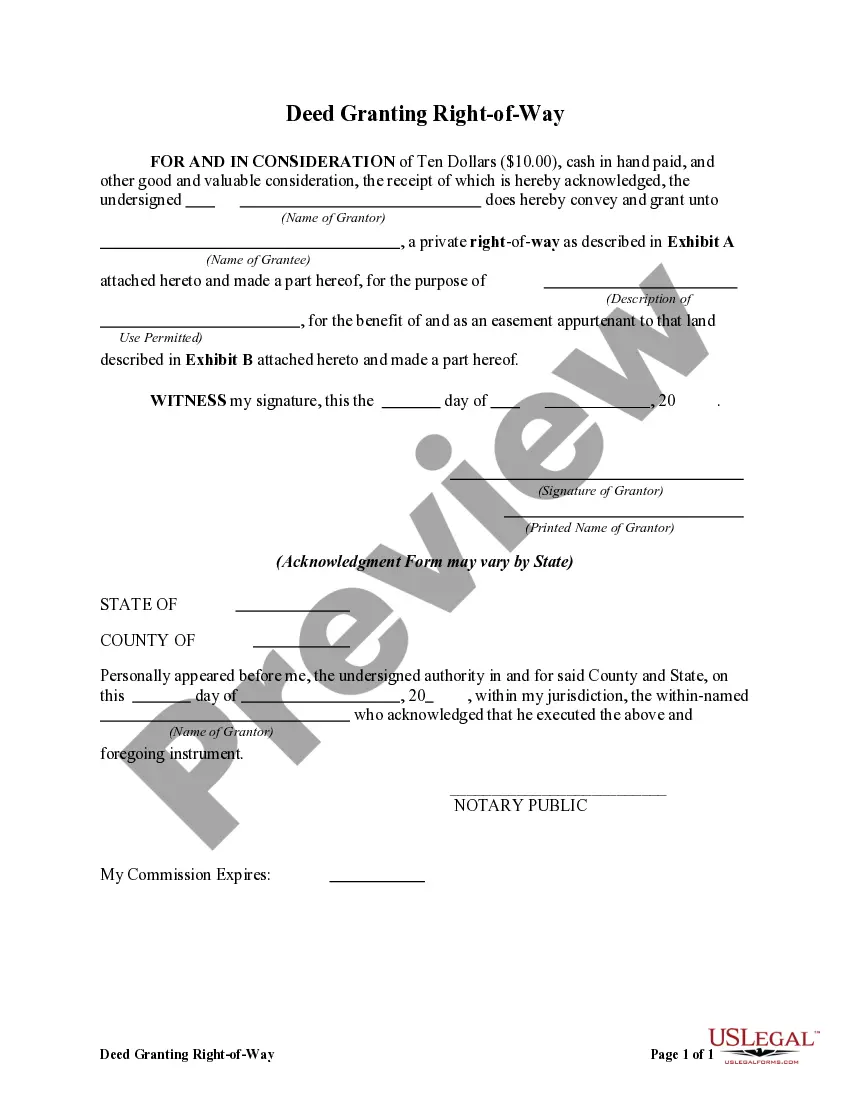
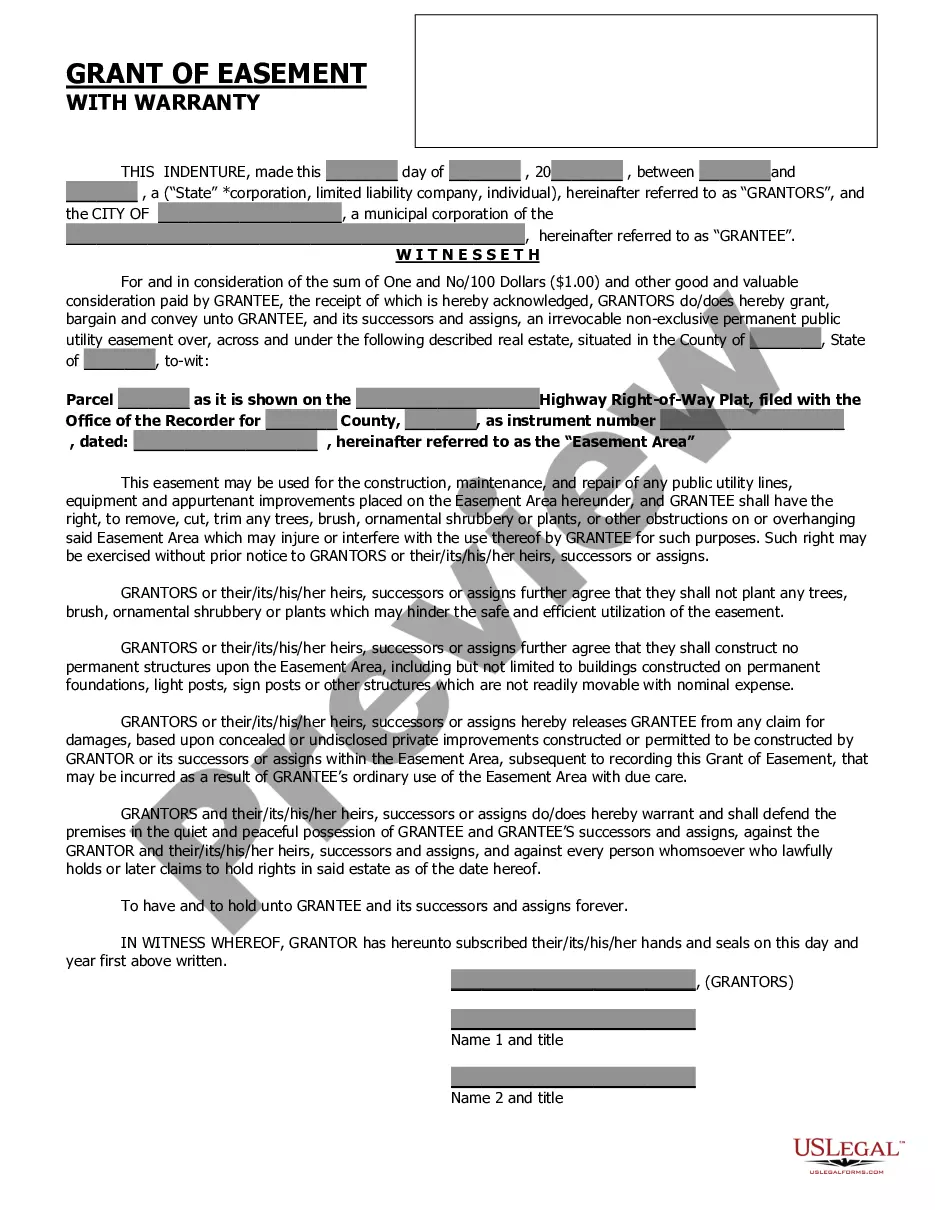
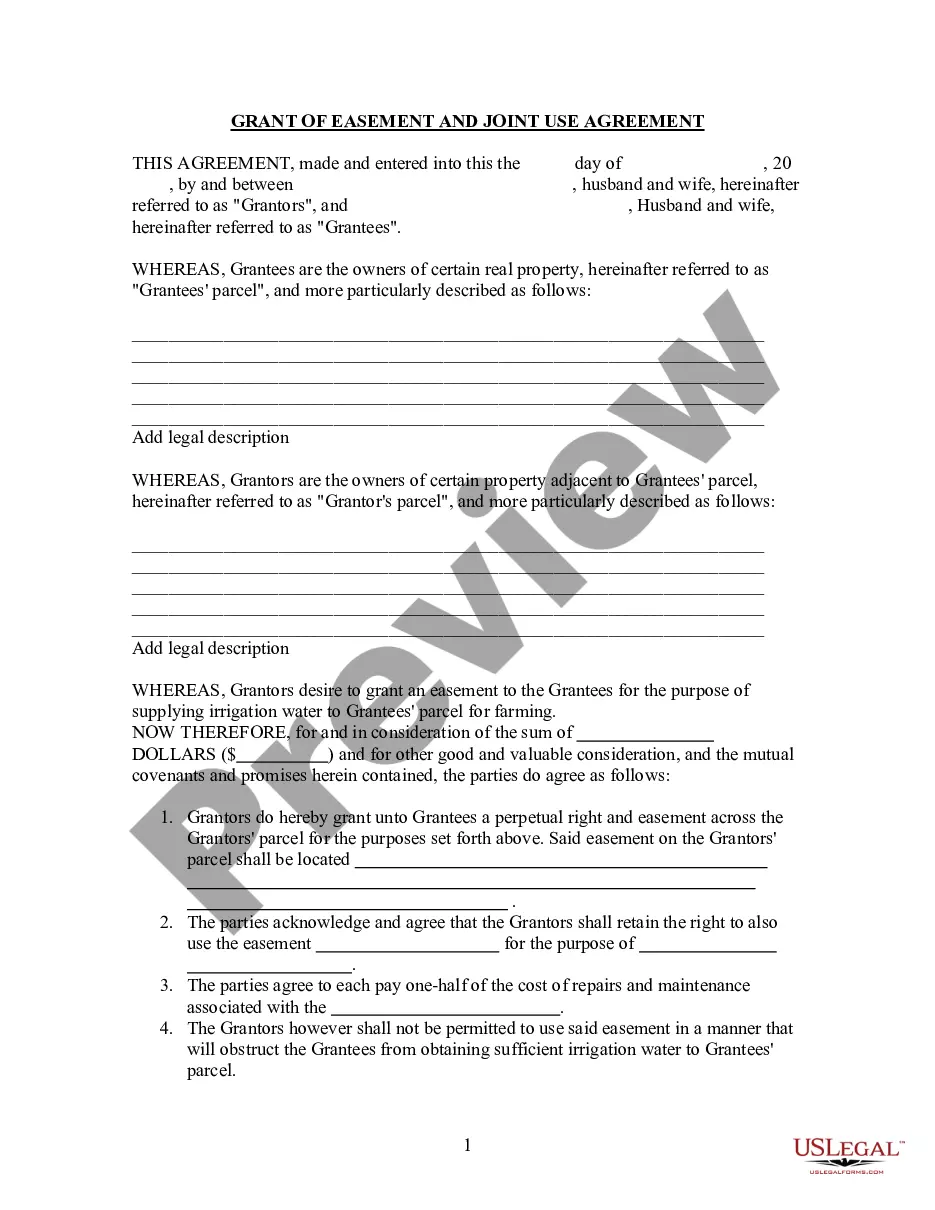
The Deed Granting Right of Way is a legal document that facilitates the use of one partyâs land by another party for a specific purpose. This form establishes a right of way, allowing individuals or entities to travel over another personâs property for various reasons, such as accessing utilities or landlocked parcels. Unlike similar forms that create easements, this deed is a straightforward grant of access to the specified land without establishing a permanent interest in the property.
Key parts of this document
- Parties involved: Identification of the grantor (property owner) and grantee (person receiving the right of way).
- Description of right of way: Clear specification of what the right entails, such as the purpose and limitations of the use.
- Property description: Detailed information about the property where the right of way is granted.
- Signatures: Required signatures from all parties to validate the deed.
- Legal description: Formal description should align with local laws for recording purposes.
Common use cases
This form is needed when one party requires access to another partyâs property for specific purposes, such as maintaining utility lines, creating pathways, or accessing land that is otherwise unreachable. It is particularly useful in situations where property boundaries limit access, ensuring both parties agree on the terms of use without disputes.
Who needs this form
- Property owners who wish to grant access to their land for specific uses.
- Individuals or businesses needing to cross someone else's property for essential services.
- Legal professionals assisting clients in establishing access rights.
- Land surveyors involved in defining property boundaries and access points.
How to prepare this document
- Identify the parties involved by entering their full names and addresses.
- Specify the property by providing a detailed description, including any boundaries.
- Clearly define the right of way purpose to avoid ambiguity.
- Enter the date on which the deed is executed.
- Have all parties sign the form in the presence of a witness, if required.
Does this document require notarization?
This form must be notarized to be legally valid. US Legal Forms provides secure online notarization powered by Notarize, allowing you to complete the process through a verified video call.
Get your form ready online
Our built-in tools help you complete, sign, share, and store your documents in one place.
Make edits, fill in missing information, and update formatting in US Legal Forms—just like you would in MS Word.
Download a copy, print it, send it by email, or mail it via USPS—whatever works best for your next step.
Sign and collect signatures with our SignNow integration. Send to multiple recipients, set reminders, and more. Go Premium to unlock E-Sign.
If this form requires notarization, complete it online through a secure video call—no need to meet a notary in person or wait for an appointment.
We protect your documents and personal data by following strict security and privacy standards.
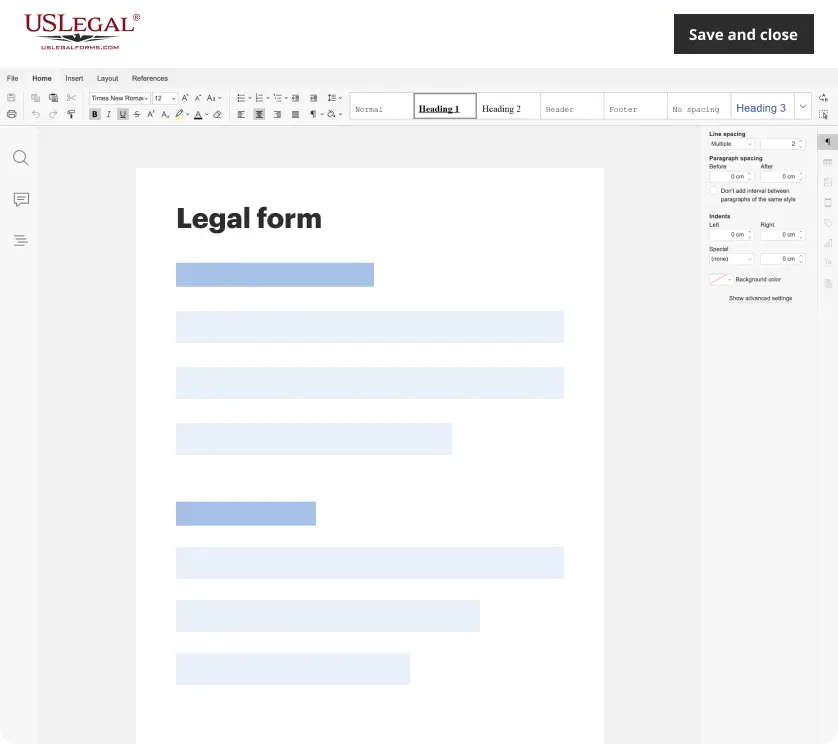
Make edits, fill in missing information, and update formatting in US Legal Forms—just like you would in MS Word.
Download a copy, print it, send it by email, or mail it via USPS—whatever works best for your next step.
Sign and collect signatures with our SignNow integration. Send to multiple recipients, set reminders, and more. Go Premium to unlock E-Sign.

If this form requires notarization, complete it online through a secure video call—no need to meet a notary in person or wait for an appointment.
We protect your documents and personal data by following strict security and privacy standards.
Typical mistakes to avoid
- Failing to accurately describe the property, which can lead to confusion or legal disputes.
- Omitting signatures from any necessary parties, rendering the form invalid.
- Not specifying the limitations of the right of way, leading to potential misuse.
Benefits of using this form online
- Convenience of downloading the form at any time.
- Editability allows users to customize the document to their specific needs.
- Reliability, as the forms are drafted by licensed attorneys, ensuring legal compliance.
Looking for another form?
Form popularity
FAQ
"National roads shall have a right of way of not less than twenty (20) meters, provided, that such minimum width may be reduced at the discretion of the Minister of Public Highways to fifteen (15) meters in highly urbanized areas and that a right of way of at least sixty (60) meters shall be reserved for roads
What are Easements and Rights-of-Way? Easements are nonpossessory interests in real property. More simply, an easement is the right to use another's property for a specific purpose. Rights-of-way are easements that specifically grant the holder the right to travel over another's property.
An EASEMENT, a privilege to pass over the land of another, whereby the holder of the easement acquires only a reasonable and usual enjoyment of the property, and the owner of the land retains the benefits and privileges of ownership consistent with the easement.
A: Firstly you should establish whether there is any legal right of way to the property.With an easement your mother may insist your neighbour removes the fence obstructing her right of way. That access has been blocked for two years is likely to be irrelevant. Easements can also be abandoned.
A private Right of Way typically gives one land owner the right to use another's property, usually a road of some kind, to get to and from her land. This right is usually given in the form of a deed, much like a deed to property.The deed granting a Right of Way is often vague, and doesn't help clarify things.
A Right of Way Easement is a form of Easement annexed to land which grants a right to travel over a part of the landowner's property. This right of way is usually granted to neighbouring landowners. The legal rights of the attached landowners to use and maintain the right of way may not always be clear.
Right of Way. An easement is the right to use another person's land for a stated purpose. It can involve a general area of the property or a specific portion. A right of way is an easement that allows someone to travel through your property to get to another location.
What is Right-of-Way? A right-of-way allows another individual to travel through your property. This benefits another person or another parcel of land you do not own. This grants access to anyone who may need to travel through your land.