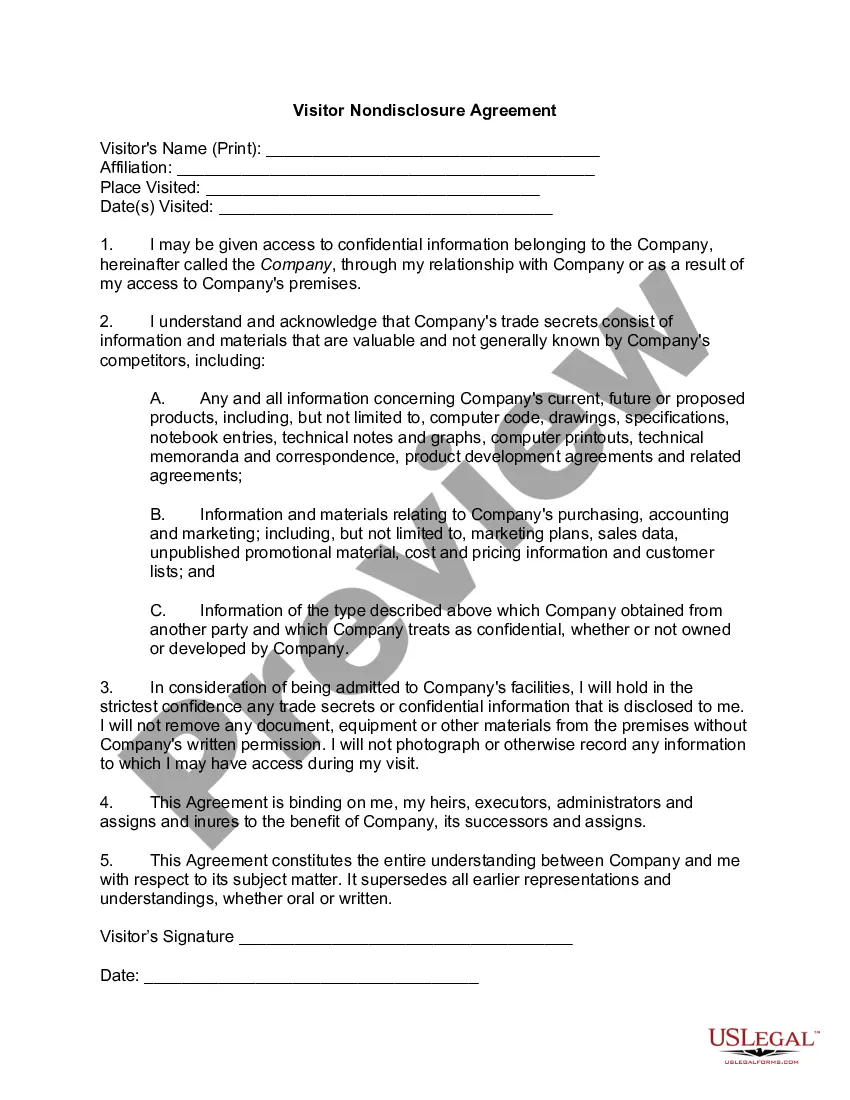
Visitor Nondisclosure Agreement
What is this form?
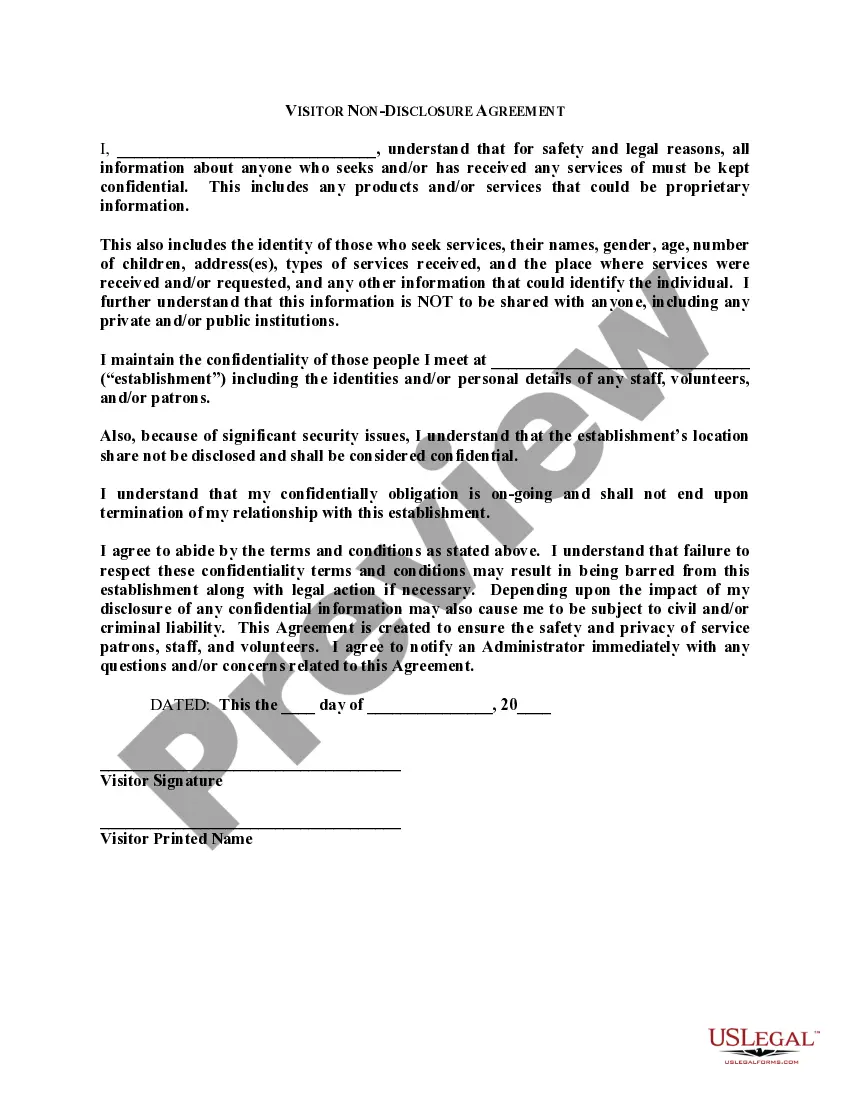
The Visitor Nondisclosure Agreement is a legal document designed to protect a company's confidential information from unauthorized disclosure by visitors. Unlike general nondisclosure agreements, this specific form is tailored for individuals who may access sensitive materials during their visit to a companyâs premises. By requiring visitors to sign this agreement, businesses can safeguard their trade secrets and proprietary information.
What’s included in this form
- Visitorâs name and affiliation
- Details of the place visited
- Date(s) of the visit
- Introduction acknowledging access to confidential information
- Specifics on trade secrets and confidential information
- Obligations to keep information confidential
- Signatures of the visitor with the date
When to use this document
This form should be used whenever visitors are allowed access to company premises where confidential information is present. Examples include potential clients or partners visiting for discussions, job candidates touring facilities, or representatives from other companies evaluating products. Using this agreement ensures that trade secrets remain protected during and after these visits.
Who needs this form
This form is intended for:
- Business owners who provide access to sensitive information
- Managers coordinating visits from external personnel
- Human resources representatives conducting interviews or tours
- Anyone overseeing access to company facilities where trade secrets may be disclosed
Steps to complete this form
- Identify and print the visitorâs name and affiliation.
- Fill in the details of the place visited and the date(s) of the visit.
- Review the introductory paragraph that specifies the acknowledgment of confidentiality obligations.
- Ensure the visitor understands the definition of trade secrets as outlined in the agreement.
- Both the visitor and an authorized company representative must sign the document and date it.
Does this form need to be notarized?
This form does not typically require notarization unless specified by local law. It is important to keep a signed copy for both the visitor and the company to ensure compliance and protection of confidential information.
Get your form ready online
Our built-in tools help you complete, sign, share, and store your documents in one place.
Make edits, fill in missing information, and update formatting in US Legal Forms—just like you would in MS Word.
Download a copy, print it, send it by email, or mail it via USPS—whatever works best for your next step.
Sign and collect signatures with our SignNow integration. Send to multiple recipients, set reminders, and more. Go Premium to unlock E-Sign.
If this form requires notarization, complete it online through a secure video call—no need to meet a notary in person or wait for an appointment.
We protect your documents and personal data by following strict security and privacy standards.

Make edits, fill in missing information, and update formatting in US Legal Forms—just like you would in MS Word.

Download a copy, print it, send it by email, or mail it via USPS—whatever works best for your next step.

Sign and collect signatures with our SignNow integration. Send to multiple recipients, set reminders, and more. Go Premium to unlock E-Sign.

If this form requires notarization, complete it online through a secure video call—no need to meet a notary in person or wait for an appointment.

We protect your documents and personal data by following strict security and privacy standards.
Mistakes to watch out for
- Failing to have visitors sign the agreement before granting access to confidential information.
- Not providing a signed copy to the visitor for their records.
- Allowing incomplete fields, especially the date and visitor details.
Advantages of online completion
- Convenience of download and immediate use.
- Editable template that allows customization prior to sharing.
- Access to forms drafted by licensed attorneys ensures legal reliability.
Legal use & context
- This agreement helps protect trade secrets and confidential information, making it enforceable in a court of law.
- Clear definitions within the agreement ensure all parties understand their responsibilities, promoting accountability.
- While it is a solid legal framework, it should be used as part of a larger strategy to safeguard proprietary information.
Quick recap
- The Visitor Nondisclosure Agreement is essential for protecting confidential information when hosting visitors.
- Completing the form correctly is critical to ensure legal protection.
- This form is valid across multiple jurisdictions and does not usually require notarization.
Looking for another form?
Form popularity
FAQ
No, unless the confidentiality provision specifically provides for disclosure to a spouse (some do such as settlement agreements) then a person bound by an NDA may not disclose to a spouse or their dog or their best buddy. Spouses are not s legally extension of s person bound by confidentiality.
NDAs are legally enforceable contracts, but they're now coming under increased scrutiny from lawmakers, attorneys and legal experts.Companies often use them as part of an employment contract or settlement agreement to protect sensitive information like trade secrets.
As with any contract, a nondisclosure agreement can be legally broken or ended. For example, the agreement might not be legally enforceable, in which case you can break it because you'll win a lawsuit. Alternately, you might negotiate with the other party to end the agreement early.
Read the Duration clauses. Good NDAs will have two different terms of duration. Read the termination clause. Like any other relationship, business partnerships can come to an early end unexpectedly. Read the Return of Information clause.
The cold hard truth is that most NDAs do not hold up in court. Non-Disclosure Agreements are most effective in establishing a paper trail of confidential information as it relates to partnerships, and discouraging partners from misappropriating proprietary information.
The party to be charged must have signed the contract. Since the NDAs benefit you, so long as the other party has signed, that ishould be sufficient.
Set the date of the agreement. Describe the two parties, sometimes called the Disclosing Party and the Receiving Party.7feff Include names and identification, so there can be no misunderstanding about who signed the agreement.
An employer will often require an employee to sign an NDA because it allows their company to operate at a higher level, with less risk.Understand, your employer is not asking you to sign an NDA out of mistrust, they are asking you to sign one because it is essential to conducting business smoothly and efficiently.