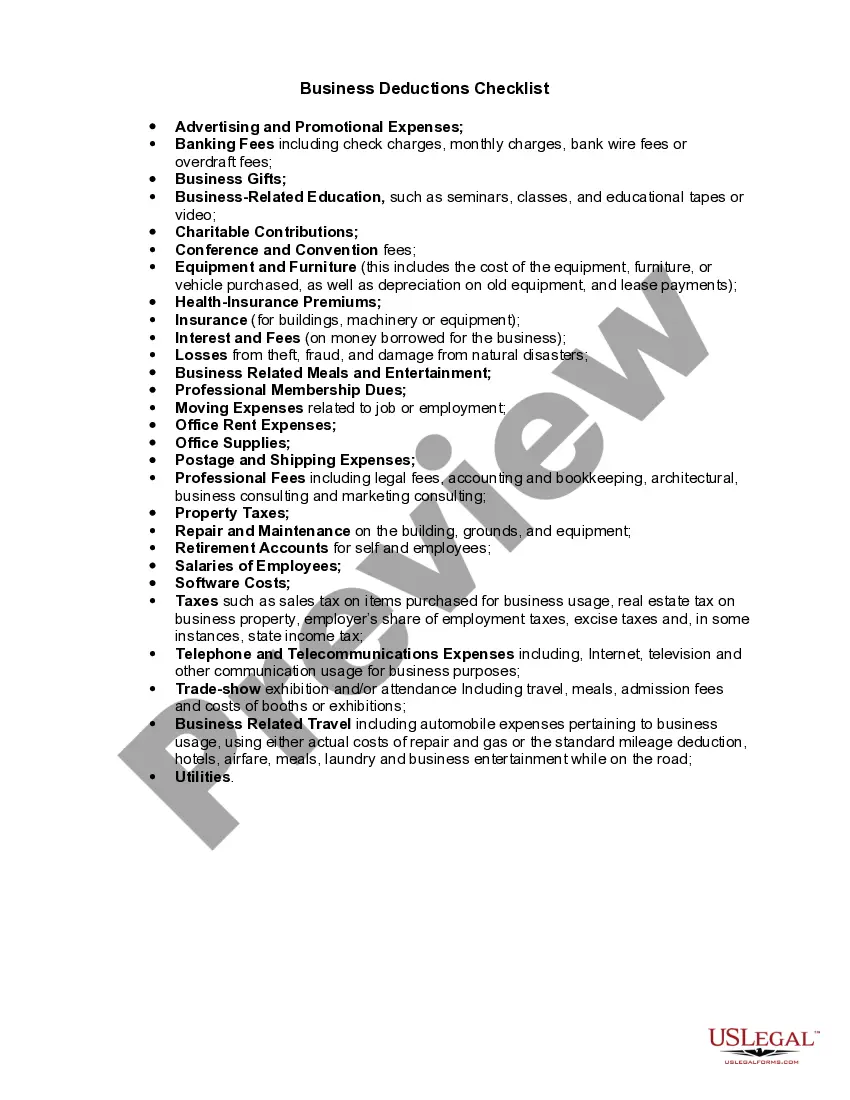
Business Deductions Checklist
Description
How to fill out Business Deductions Checklist?
Employ the most extensive legal catalogue of forms. US Legal Forms is the perfect place for getting up-to-date Business Deductions Checklist templates. Our platform offers 1000s of legal forms drafted by licensed attorneys and categorized by state.
To obtain a sample from US Legal Forms, users just need to sign up for an account first. If you’re already registered on our platform, log in and select the document you need and purchase it. After purchasing forms, users can see them in the My Forms section.
To get a US Legal Forms subscription online, follow the steps below:
- Find out if the Form name you have found is state-specific and suits your needs.
- If the template features a Preview function, utilize it to check the sample.
- In case the template does not suit you, use the search bar to find a better one.
- Hit Buy Now if the sample meets your requirements.
- Choose a pricing plan.
- Create an account.
- Pay with the help of PayPal or with yourr credit/credit card.
- Choose a document format and download the template.
- Once it is downloaded, print it and fill it out.
Save your time and effort using our service to find, download, and fill in the Form name. Join thousands of satisfied subscribers who’re already using US Legal Forms!
Form popularity
FAQ
A tax deduction (or tax write-off) is an expense that you can deduct from your taxable income. You take the amount of the expense and subtract that from your taxable income. Essentially, tax write-offs allow you to pay a smaller tax bill. But the expense has to fit the IRS criteria of a tax deduction.
Generally, for 2020 taxes a single individual under age 65 only has to file if their adjusted gross income exceeds $12,400. However, if you are self-employed you are required to file a tax return if your net income from your business is $400 or more.
Can I write off business expenses if I don't have an LLC or an S-Corp? Yes, even if you are filing as an individual, you can still write off business expenses. All businesses can deduct ordinary and necessary expenses from their revenue. The IRS will tax you as a sole proprietor if you are the only owner.
A write-off is an expense that can be claimed as a tax deduction. Tax write-offs are deducted from total revenue to determine total taxable income for a small business.Small business owners try to write-off as many expenses as possible to decrease the amount of tax they need to pay.
By writing off the assets in the same year they're purchased, the money you're investing in your business equipment comes directly off your taxable income, which decreases your tax payable. By purchasing business assets up to $20,000, you are decreasing your taxable income by that same amount.
CCPCs that have taxable capital of between $10 million and $15 million in the previous tax year are eligible for the Small Business Deduction but their business limit is reduced on a straight-line basis.
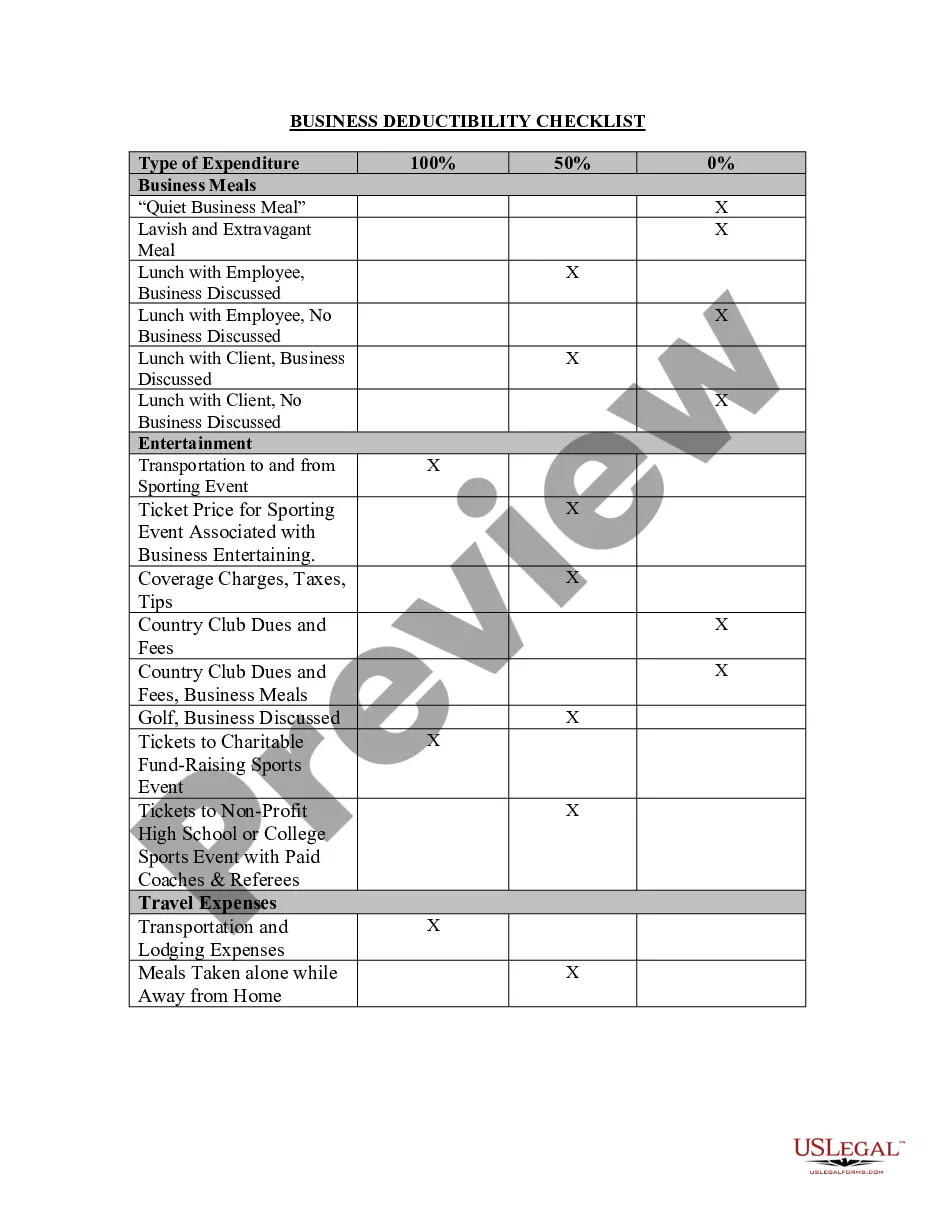
Business Meals. As a small business, you can deduct 50 percent of food and drink purchases that qualify. Work-Related Travel Expenses. Work-Related Car Use. Business Insurance. Home Office Expenses. Office Supplies. Phone and Internet Expenses. Business Interest and Bank Fees.
You should file a Schedule C. You do not need to have a business license to file a Schedule C.
Rental expense. LLCs can deduct the amount paid to rent their offices or retail spaces. Charitable giving. Doing good is good for tax purposes. Insurance. Tangible property. Professional expenses. Meals and entertainment. Independent contractors. Cost of goods sold.