Sample Letter for Persuasion - Suggest a Change in a Contract or Agreement
Understanding this form
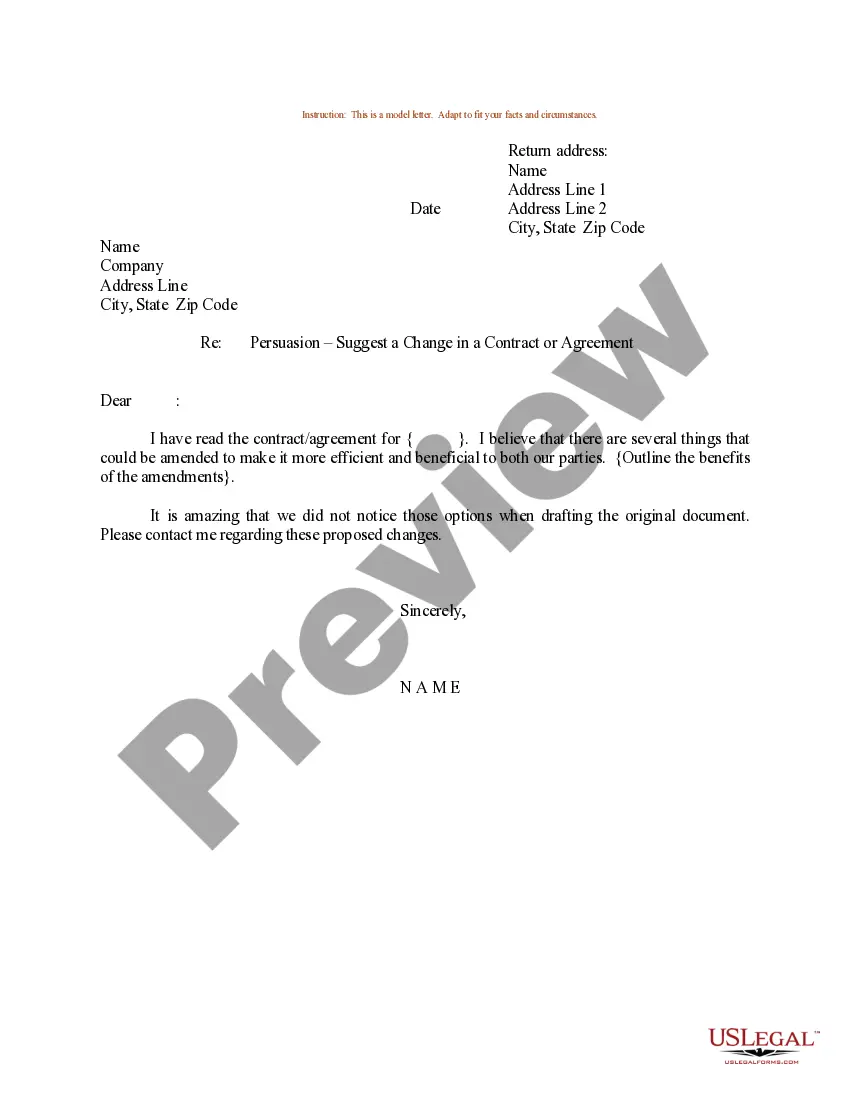
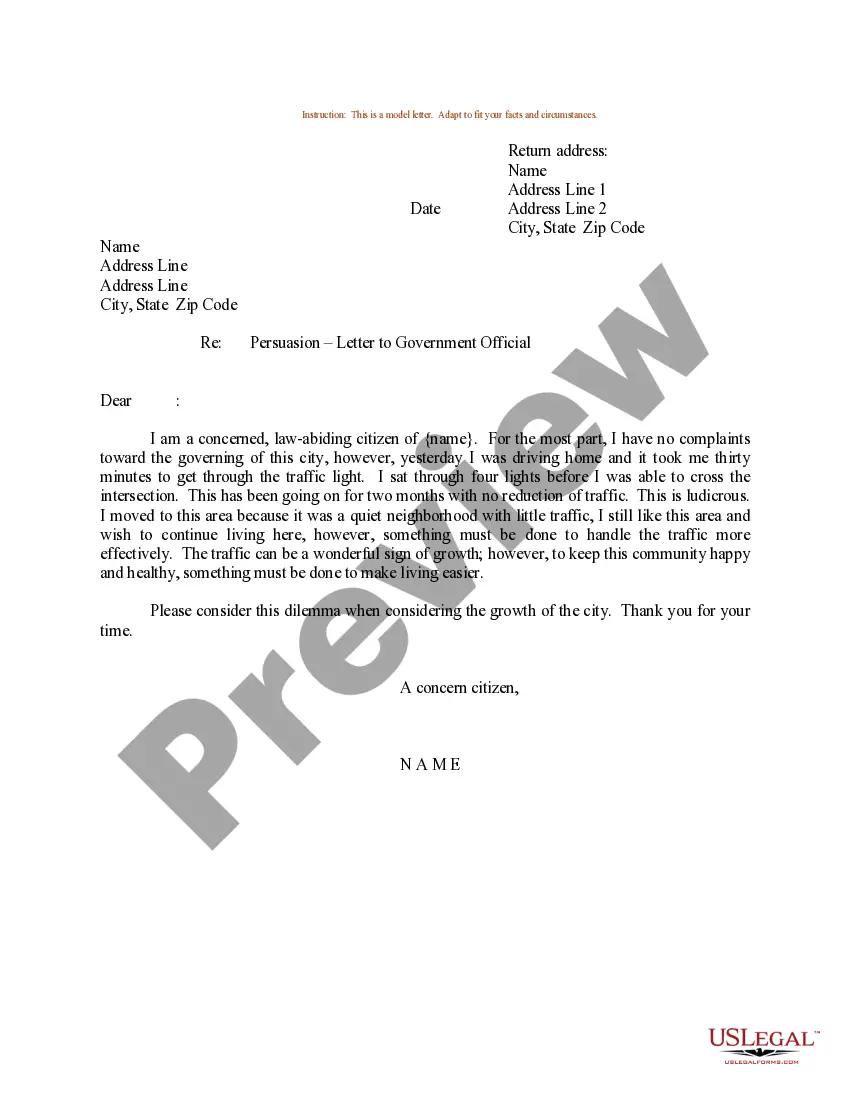
This Sample Letter for Persuasion is a template designed to help individuals suggest changes to existing contracts or agreements. Unlike standard contract modification forms, this letter serves as a persuasive communication tool that clearly expresses your desired modifications, making it a vital resource for encouraging negotiation and collaboration between parties.
Main sections of this form
- Return address: Your name and address details for proper identification.
- Date: The date when the letter is written, indicating its relevance.
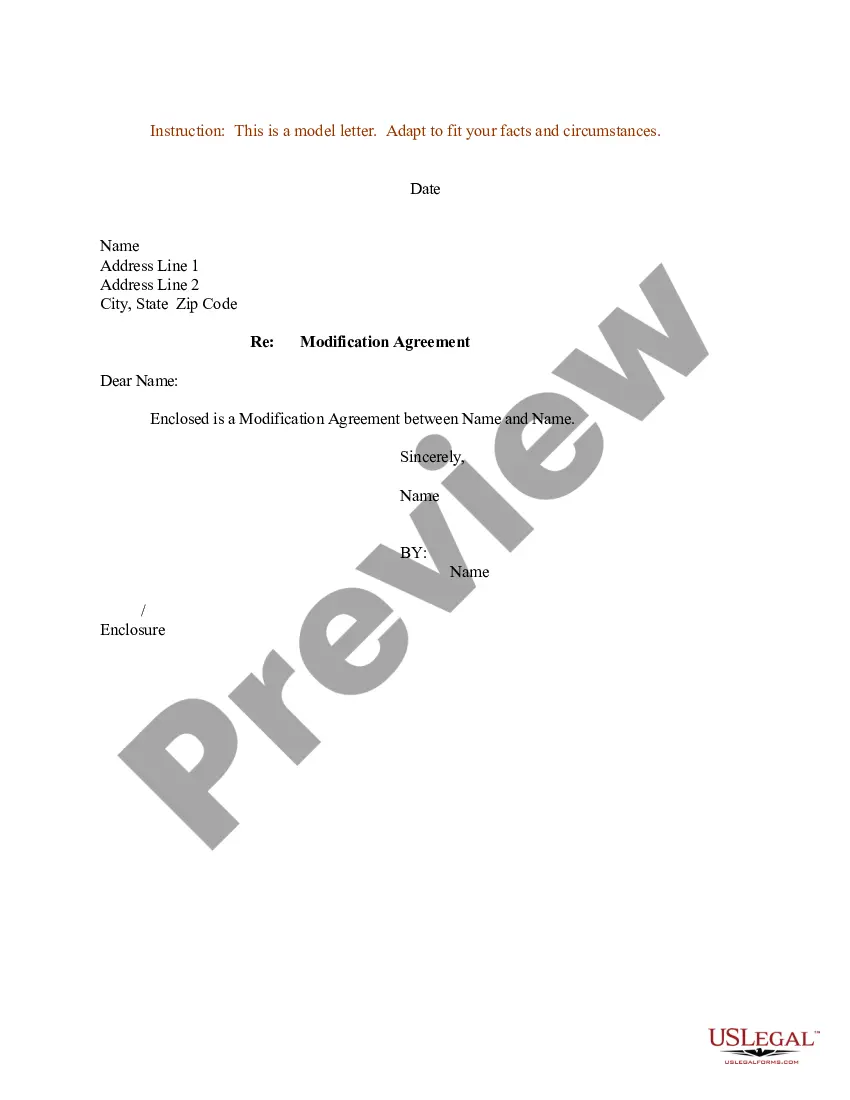
- Recipient details: Name and address of the individual or company to whom the letter is directed.
- Subject line: Clearly states the purpose of the letter, focusing on suggesting changes in a contract.
- Closing: A polite sign-off to maintain professionalism and courtesy.
When this form is needed
This form is useful when you need to propose modifications to a contract or agreement with another party. Common scenarios include renegotiating terms of a service agreement, adjusting payment schedules, or clarifying specific clauses within the contract. Utilizing this template can facilitate constructive dialogue and promote a more favorable outcome.
Who needs this form
- Individuals involved in business agreements who seek to amend terms.
- Contractors looking to negotiate enhancements in their service contracts.
- Anyone needing to clarify or modify the provisions of a legally binding document.
- Parties involved in real estate transactions requiring adjustments to terms.
How to prepare this document
- Identify the parties: Enter your information as the sender and the recipient's details in the designated sections.
- Specify the date: Clearly write the date of the letter to establish a timeline for the proposed changes.
- Draft your message: Articulate your suggested changes in a clear and persuasive manner while maintaining a professional tone.
- Review for clarity: Ensure your points are concise and easily understandable to promote a positive response.
- Sign and send: End with your name and send the letter to the intended recipient, ensuring you keep a copy for your records.
Does this document require notarization?
This form does not typically require notarization unless specified by local law. However, you may choose to have it notarized for additional validation of authenticity.
Get your form ready online
Our built-in tools help you complete, sign, share, and store your documents in one place.
Make edits, fill in missing information, and update formatting in US Legal Forms—just like you would in MS Word.
Download a copy, print it, send it by email, or mail it via USPS—whatever works best for your next step.
Sign and collect signatures with our SignNow integration. Send to multiple recipients, set reminders, and more. Go Premium to unlock E-Sign.
If this form requires notarization, complete it online through a secure video call—no need to meet a notary in person or wait for an appointment.
We protect your documents and personal data by following strict security and privacy standards.

Make edits, fill in missing information, and update formatting in US Legal Forms—just like you would in MS Word.

Download a copy, print it, send it by email, or mail it via USPS—whatever works best for your next step.

Sign and collect signatures with our SignNow integration. Send to multiple recipients, set reminders, and more. Go Premium to unlock E-Sign.

If this form requires notarization, complete it online through a secure video call—no need to meet a notary in person or wait for an appointment.

We protect your documents and personal data by following strict security and privacy standards.
Mistakes to watch out for
- Failing to include complete recipient details, which may lead to delivery issues.
- Not clearly outlining the suggested changes, resulting in miscommunication.
- Using an overly casual tone that may undermine the seriousness of the request.
- Neglecting to proofread for errors, affecting the document's professionalism.
Benefits of using this form online
- Convenience: Download and complete the form from the comfort of your home.
- Editability: Customize the letter to meet your specific needs without hassle.
- Reliability: Utilize a template drafted by licensed attorneys, ensuring legal accuracy.
Legal use & context
- This letter serves as a formal request and can be used as evidence of communication regarding contract negotiation.
- It is advisable to retain a copy for your records, as it may be necessary for future reference in case of disputes.
Quick recap
- The Sample Letter for Persuasion is an essential tool for negotiating changes in contracts.
- It's important to communicate clearly and professionally when suggesting contract modifications.
- Understanding the context and legal implications of your proposals can enhance negotiations.
Looking for another form?
Form popularity
FAQ
Heading - the name and address of sender, date, name and address of receiver. Greeting - the opening of the letter. Body - the text that contains the persuasive message. Closing - the sign-off of the letter. Signature - the hand-signed signature of the sender.
Know your addressee. Do not be verbose. Make your letter easy to read. Add call to action. Convince but do not demand. Do not be burdensome. Write in a friendly way and appeal to the reader's feelings. Remain polite and professional.
Refer the letter to the appropriate authority. Explain the reason for the request precisely. Describe how the copy of the document will help. Refer to the previous working or business relationship. Provide proof of the official contract document that you are requesting.
Begin your letter by clearly indicating the parties involved in the agreement. Remember to include the date the agreement takes effect and title of the venture. Clearly state the reason for your agreement in your first paragraph giving description of all details such as stake holder ratio, payment period etc.
When we think of persuasion, negative examples are often the first to come to mind, but persuasion can also be used as a positive force. Public service campaigns that urge people to recycle or quit smoking are great examples of persuasion used to improve people's lives.
Get it in writing. Keep it simple. Deal with the right person. Identify each party correctly. Spell out all of the details. Specify payment obligations. Agree on circumstances that terminate the contract. Agree on a way to resolve disputes.
The persuasive letters are a letter written to convince an organization or person, to accept the issue of the author (sender), interest or perspective. It can be written for any kind of organization i.e. school, bank, college, NGO, municipality, etc.
You should propose some changes in the contract if you don't agree to some of the terms. Remember that the agreement isn't definite. Start directly by stating that you need a few changes in the agreement. Tell the reader what changes you want. Ask the reader to respond and mention the action you will take afterward.
Establish trust and develop credibility. Understand the reader's purpose and align your own. Pay attention to language. Consider tone. Use rhetoric and repetition.