Investment Agreement between John Doe and ABC, Inc.
What is this form?
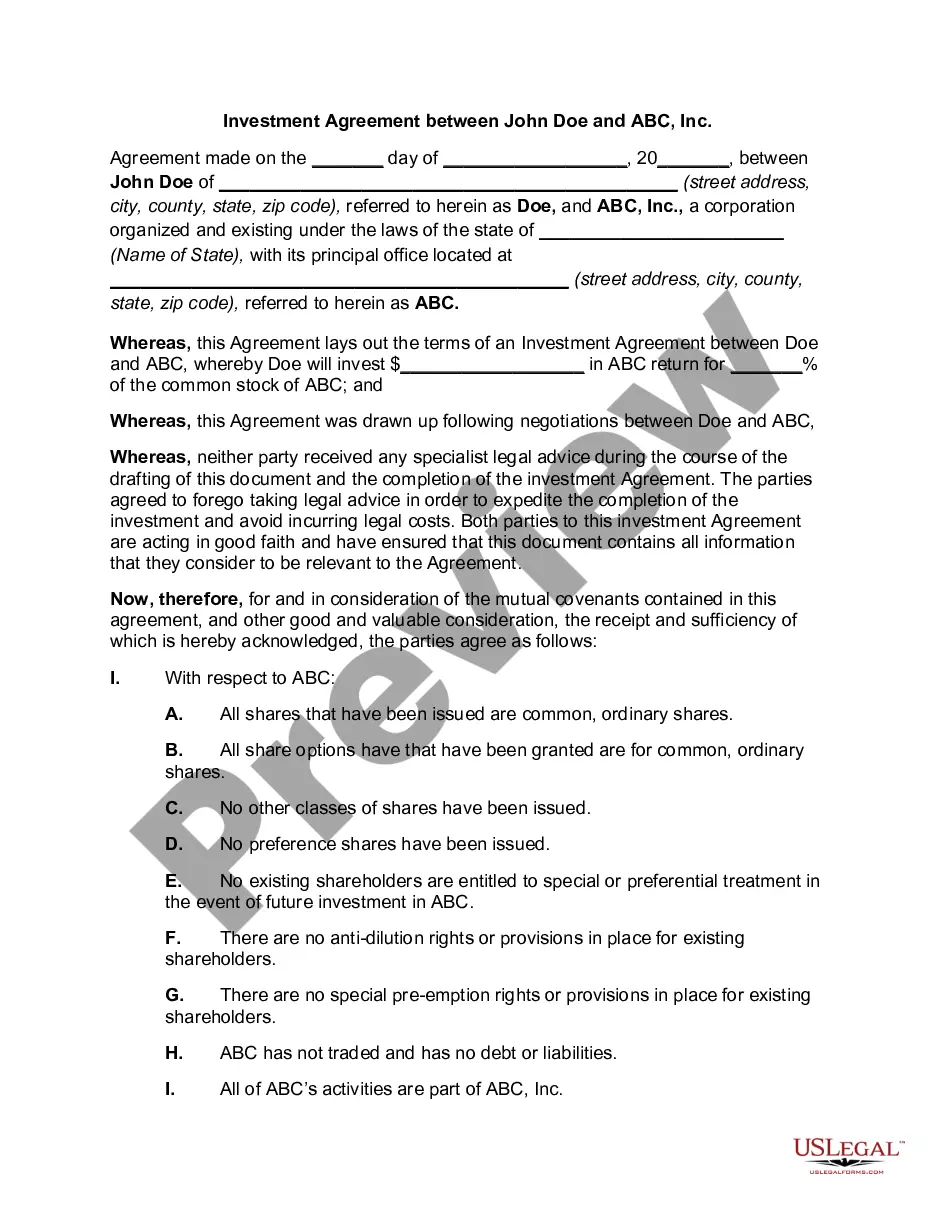
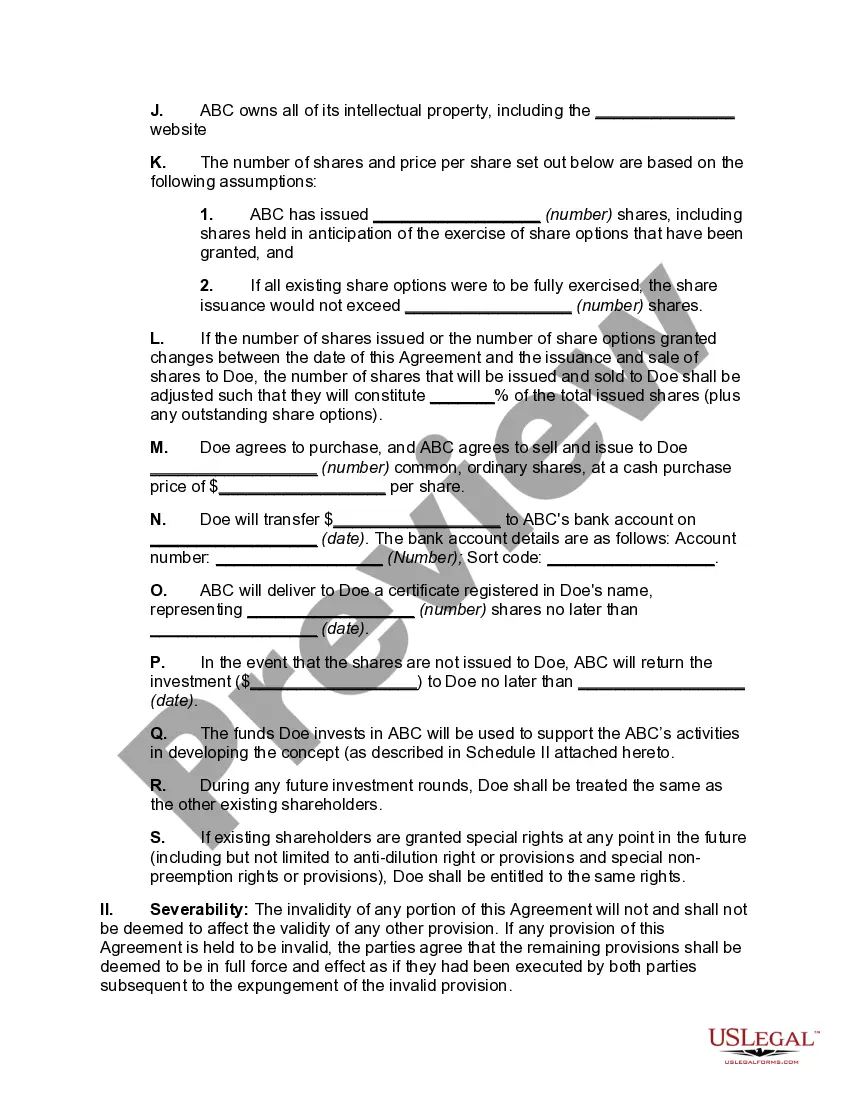
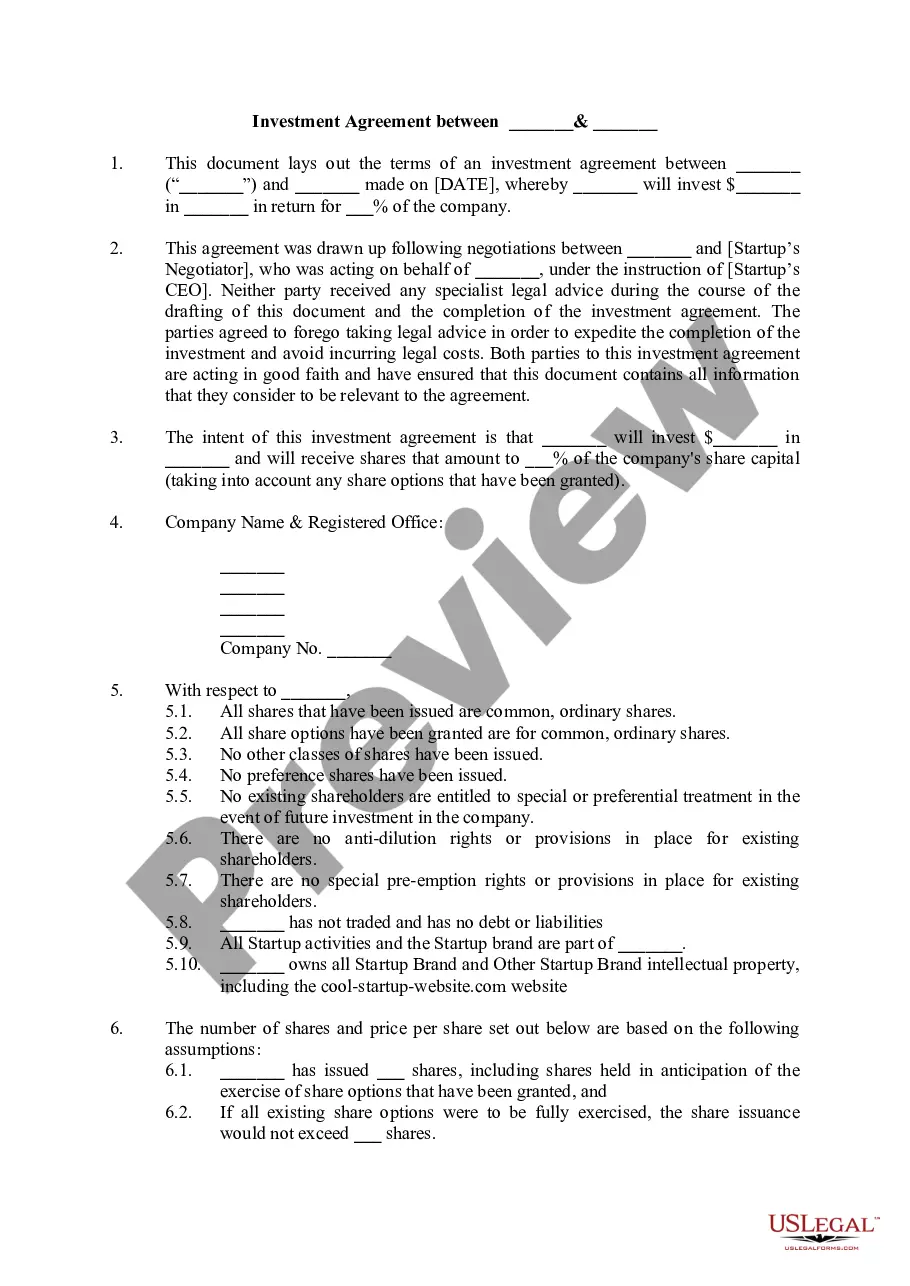
This Investment Agreement is a legally binding document between an investor, John Doe, and a company, ABC, Inc., for the purchasing of shares in the company. It outlines the terms of the investment, ensuring clarity between both parties regarding the sale of shares for a specific monetary investment. This agreement is distinct from other financial transactions as it includes comprehensive details about terms, conditions, and shareholders' rights, making it essential for formalizing an investment in a corporation.
Key parts of this document
- Definition of parties involved: John Doe and ABC, Inc.
- Details of the investment amount and share percentage.
- Terms related to the shares (e.g., common stock, no preference shares).
- Provisions for adjustments in share issuance.
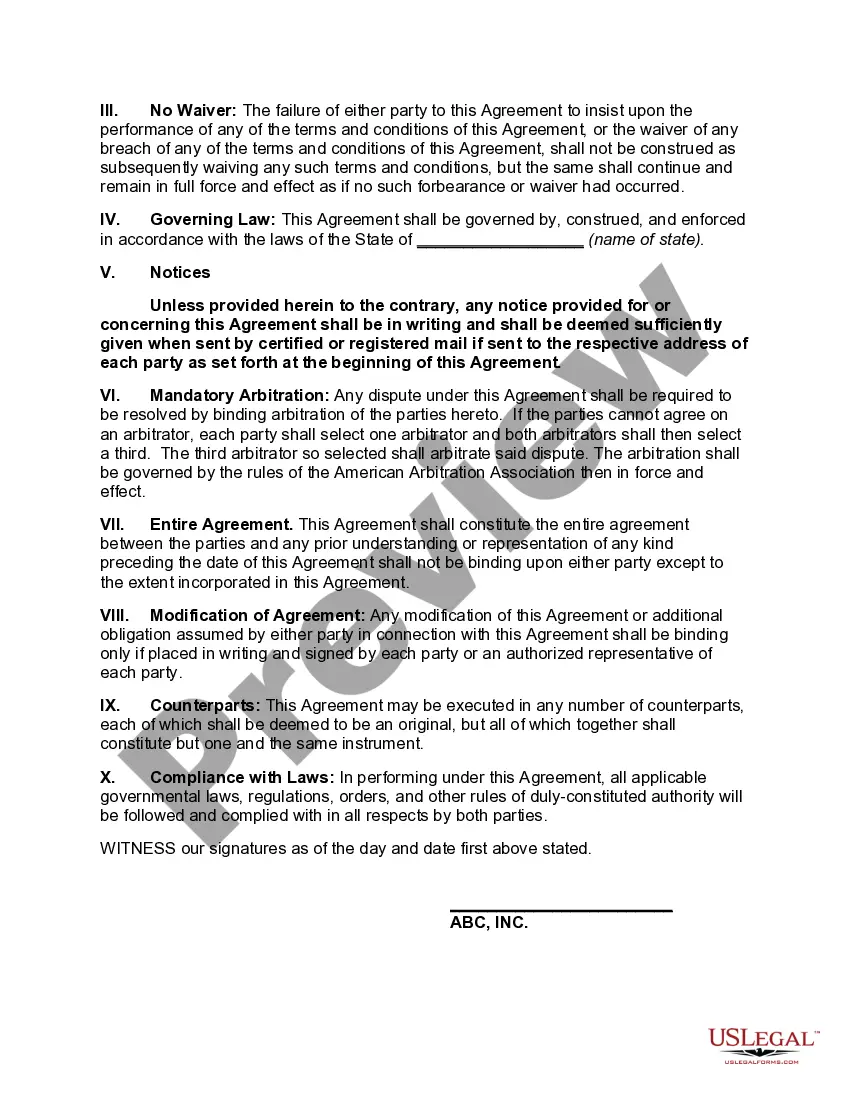
- Governing law and arbitration clauses.
- Conditions for returning the investment if shares are not issued.

When to use this form
This form should be used when an individual or entity intends to invest in a corporation by purchasing shares. It is appropriate in scenarios where both parties prefer to document the investment terms clearly, settle on the number of shares and their pricing, and outline rights pertaining to future investments. This agreement is suitable for those looking to establish a formal investment relationship without extensive legal procedures.
Intended users of this form
- Individuals looking to invest in a new or existing company.
- Corporations seeking to formalize a capital investment agreement.
- Parties involved in negotiations regarding share purchases.
Instructions for completing this form
- Identify the parties by entering the names and addresses of John Doe and ABC, Inc.
- Specify the investment amount and the corresponding percentage of shares being purchased.
- Complete the fields outlining the number of shares issued and the date of the transaction.
- Indicate the conditions surrounding share issuance and investment returns if applicable.
- Ensure all parties sign and date the agreement to finalize the document.
Notarization requirements for this form
Notarization is generally not required for this form. However, certain states or situations might demand it. You can complete notarization online through US Legal Forms, powered by Notarize, using a verified video call available anytime.
Get your form ready online
Our built-in tools help you complete, sign, share, and store your documents in one place.
Make edits, fill in missing information, and update formatting in US Legal Forms—just like you would in MS Word.
Download a copy, print it, send it by email, or mail it via USPS—whatever works best for your next step.
Sign and collect signatures with our SignNow integration. Send to multiple recipients, set reminders, and more. Go Premium to unlock E-Sign.
If this form requires notarization, complete it online through a secure video call—no need to meet a notary in person or wait for an appointment.
We protect your documents and personal data by following strict security and privacy standards.
Make edits, fill in missing information, and update formatting in US Legal Forms—just like you would in MS Word.
Download a copy, print it, send it by email, or mail it via USPS—whatever works best for your next step.
Sign and collect signatures with our SignNow integration. Send to multiple recipients, set reminders, and more. Go Premium to unlock E-Sign.

If this form requires notarization, complete it online through a secure video call—no need to meet a notary in person or wait for an appointment.
We protect your documents and personal data by following strict security and privacy standards.
Typical mistakes to avoid
- Failing to specify the exact number of shares and the investment amount.
- Not having all parties sign and date the agreement.
- Omitting important clauses regarding share adjustments and investment returns.
- Neglecting to review compliance with state-specific regulations.
Why complete this form online
- Convenient access from anywhere, allowing for easy completion at your own pace.
- Editable PDF format that can be tailored to your specific investment details.
- Guided instructions to help ensure all necessary information is included.
- Legal peace of mind, knowing that the form is drafted by licensed attorneys.
Looking for another form?
Form popularity
FAQ
In IPO's, a final prospectus must be delivered to all investors with or before they purchase the security being offered.
Rule 482 permits registered investment companies and business development companies to advertise generally, without having to qualify the advertisements as a prospectus under Section 10(a) of the Securities Act of 1933, as amended, or to accompany or precede the advertisement with such a prospectus.
Rule 154 permits delivery of one prospectus on behalf of two or more investors at a shared address who have given written consent to householding. The investors need not be related, and the shared address can be a residential, commercial, or electronic address.
Rule 153 provides that a prospectus is deemed to have been delivered for those purposes with respect to any transaction taking place on a national securities exchange (or facility thereof), a trading facility of a national securities association or on an alternative trading system, so long as (i) securities of the same
Investor Consent Rule 154 permits delivery of one prospectus on behalf of two or more investors at a shared address without written consent, if four conditions are met. First, the investors must have the same last name or the person relying on the rule must reasonably believe that they are members of the same family.
Under the SEC's guidance, an adviser must be able to show that it meets three requirements when effecting delivery electronically: notice, access, and evidence of delivery (or, in lieu of evidence of delivery, informed client consent).
On April 28, 2000, the SEC published an interpretive release, Release No. 33-7856, providing guidance on the use of the Internet and other electronic media. The release covers a number of topics of great importance to public companies, broker-dealers and other participants in the securities markets.
The Securities Exchange Act of 1934 regulates secondary financial markets to ensure a transparent and fair environment for investors. It prohibits fraudulent activities, such as insider trading, and ensures that publicly traded companies must disclose important information to current and potential shareholders.