Sample Letter regarding Judgment of Adoption
What is this form?
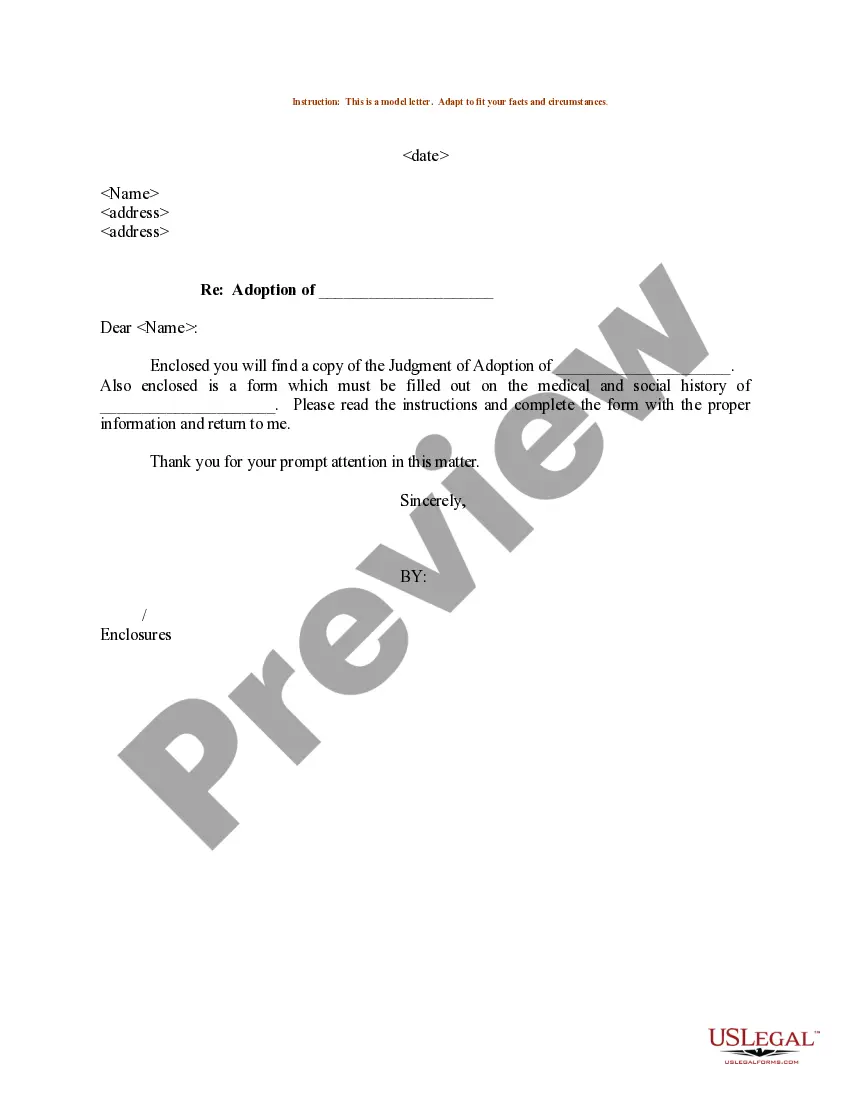
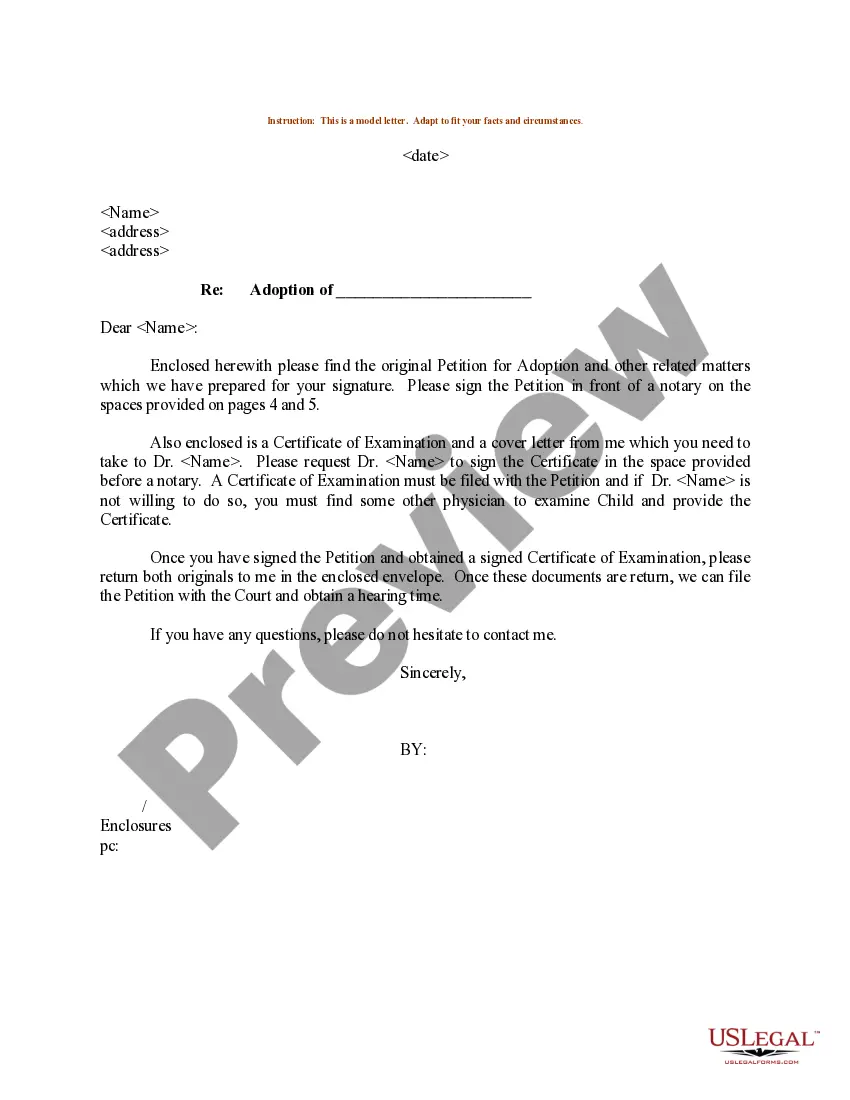
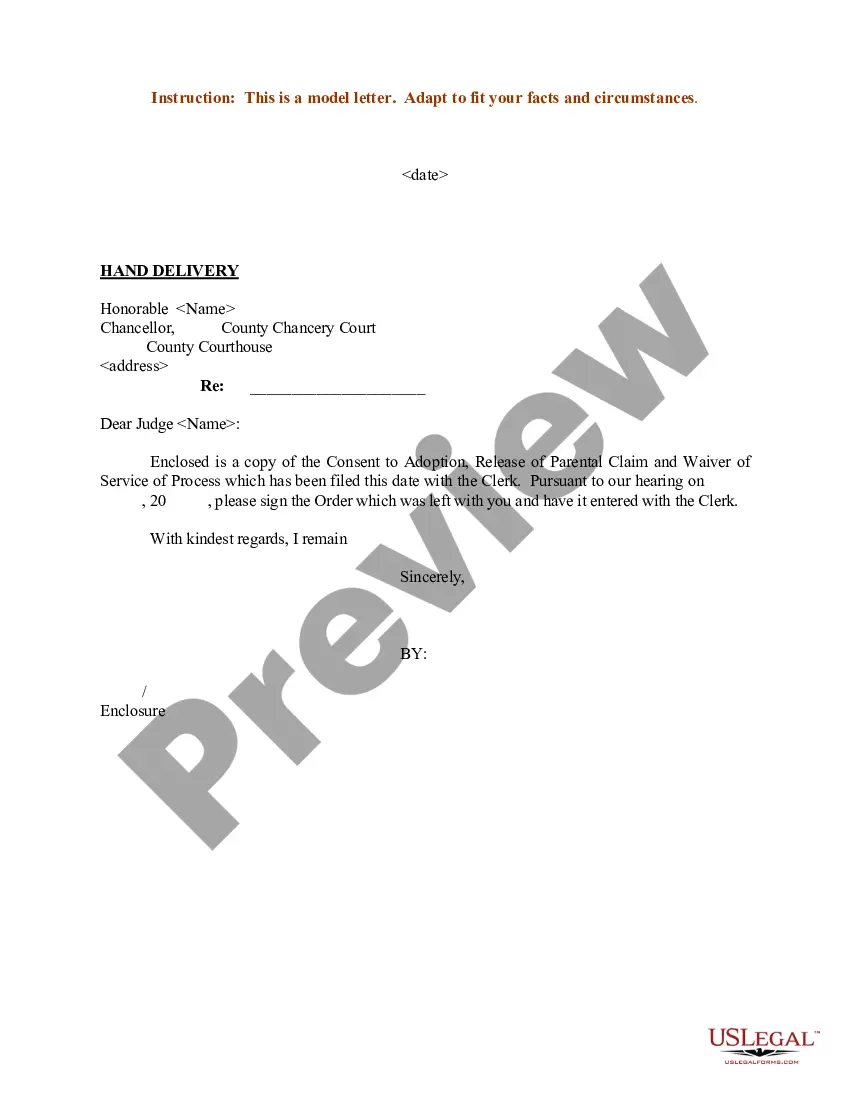
The Sample Letter regarding Judgment of Adoption is a document designed to formally communicate the outcomes of an adoption process. This letter serves as a notification to relevant parties about the adoption judgment, providing a clear reference for the involved individuals. Unlike other adoption forms, this letter specifically confirms the legal conclusions reached in the adoption case and is usually addressed to the parties directly involved.
What’s included in this form
- Date of the letter.
- Name and address of the sender.
- Subject line specifying the adoption reference.
- Recipient's name.
- Content stating the enclosure of the Judgment of Adoption.

When to use this form
This form is typically used after an adoption has been finalized. It is necessary when you need to inform relevant parties about the adoption judgment, such as social workers, family members, or legal representatives. It ensures that all interested parties receive proper documentation of the legal adoption process.
Intended users of this form
- Adoptive parents who need to notify parties about the adoption conclusion.
- Legal representatives managing the adoption's documentation.
- Social workers involved in the child's placement.
Completing this form step by step
- Begin by entering the date at the top of the letter.
- Fill in your name and address, which is the sender's information.
- Specify the subject line regarding the Judgment of Adoption.
- Include the name of the recipient who will receive the letter.
- State clearly that you are enclosing the Judgment of Adoption.
Does this document require notarization?
Notarization is generally not required for this form. However, certain states or situations might demand it. You can complete notarization online through US Legal Forms, powered by Notarize, using a verified video call available anytime.
Get your form ready online
Our built-in tools help you complete, sign, share, and store your documents in one place.
Make edits, fill in missing information, and update formatting in US Legal Forms—just like you would in MS Word.
Download a copy, print it, send it by email, or mail it via USPS—whatever works best for your next step.
Sign and collect signatures with our SignNow integration. Send to multiple recipients, set reminders, and more. Go Premium to unlock E-Sign.
If this form requires notarization, complete it online through a secure video call—no need to meet a notary in person or wait for an appointment.
We protect your documents and personal data by following strict security and privacy standards.

Make edits, fill in missing information, and update formatting in US Legal Forms—just like you would in MS Word.

Download a copy, print it, send it by email, or mail it via USPS—whatever works best for your next step.

Sign and collect signatures with our SignNow integration. Send to multiple recipients, set reminders, and more. Go Premium to unlock E-Sign.

If this form requires notarization, complete it online through a secure video call—no need to meet a notary in person or wait for an appointment.

We protect your documents and personal data by following strict security and privacy standards.
Mistakes to watch out for
- Forgetting to include the recipient's name or address.
- Neglecting to sign the letter before sending.
- Failing to include the date, making the letter appear incomplete.
Benefits of using this form online
- Convenient access to a professionally drafted letter.
- Editability, allowing customization to fit specific situations.
- Quick download and access to essential legal documents.
Legal use & context
- This letter serves as an official notification, which can be useful in legal proceedings or record-keeping.
- While it conveys important information, it should be accompanied by the legal adoption judgment for formal purposes.
Summary of main points
- The Sample Letter regarding Judgment of Adoption is essential for notifying relevant parties of adoption finalizations.
- Properly completing the letter ensures clear communication and compliance.
- This form can be utilized across multiple states, pending local adoption notification requirements.
Looking for another form?
Form popularity
FAQ
If you are collection proof you can write a letter to the debt collector that tells them it is not worth taking you to court. The letter also tells them not to harass you. If you are collection proof use the collection proof letter.
What Happens After a Judgment Is Entered Against You? The court enters a judgment against you if your creditor wins their claim or you fail to show up to court. You should receive a notice of the judgment entry in the mail. The judgment creditor can then use that court judgment to try to collect money from you.
Numbered part of form 1. Petitioner A Name is the name of the person filing the petition. Enter that person's name and date of birth.
Judgment proof is a description of a person who does not have enough assets for a creditor to seize when a court order requires debt repayment. A debtor who is broke and unemployed can be considered judgment proof, as can a debtor who only has certain legally protected types of assets or income.
Generally, birth parents have the right to choose what is in the best interest of their children and this includes the difficult decision whether to give them up for adoption. On the one hand, when birth parents choose to offer their child for adoption they are voluntarily terminating their parental rights.
An adoptive parent may appeal any State or county agency's decision affecting their child's adoption assistance. To do so, the parent must submit a written request to the state or county agency handling their adoption assistance agreement to initiate the process.
A judgment is a court order that is the decision in a lawsuit. If a judgment is entered against you, a debt collector will have stronger tools, like garnishment, to collect the debt.You are likely to have a judgment entered against you for the amount claimed in the lawsuit if you: Ignore the lawsuit, or.
If your income is protected from garnishment and you have no assets (house, property, savings etc.) with which to pay your debt, you may be 'Judgment Proof'. Income that can NOT be garnished: TANF, GAU, SSI, SSDI, SSA, Food Stamps, child support, pension, etc. Income that can be garnished is wages from employment.
Make sure you state you are exercising your rights under the Fair Debt Collection Practices Act. Include a sentence or two describing why you are judgment-proof For example: I am judgment proof because I am living only on Social Security benefits, own limited exempt property, and cannot meet current expenses.