Agreement to Dispose of Solid Radioactive Wastes on Land
What this document covers
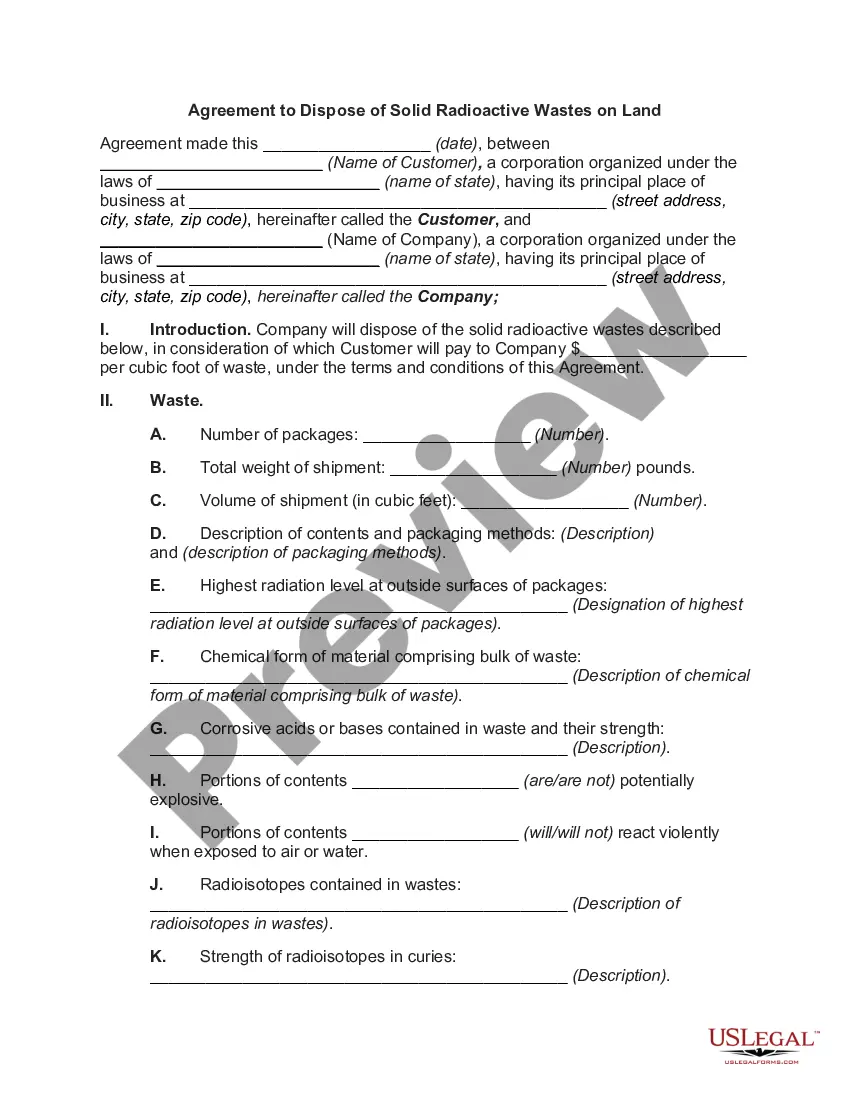
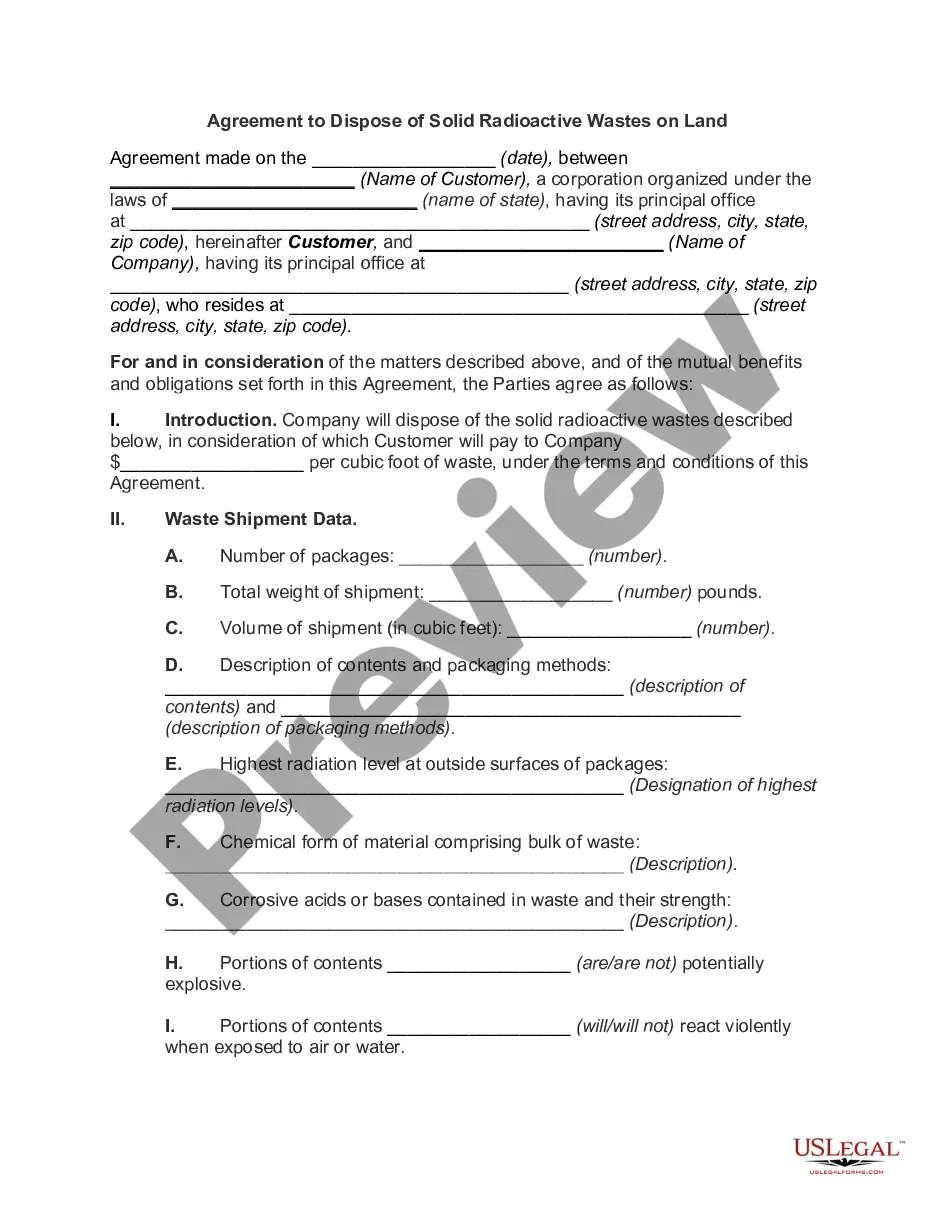
The Agreement to Dispose of Solid Radioactive Wastes on Land is a legal document used between a customer and a company for the safe disposal of solid radioactive waste generated from electricity production. This agreement outlines detailed terms regarding the waste's specifics, payment structure, legal compliance, and responsibilities of both parties. Unlike other disposal agreements, this form specifically addresses solid radioactive waste and includes mandatory requirements to ensure the safety and environmental protection during disposal.
Form components explained
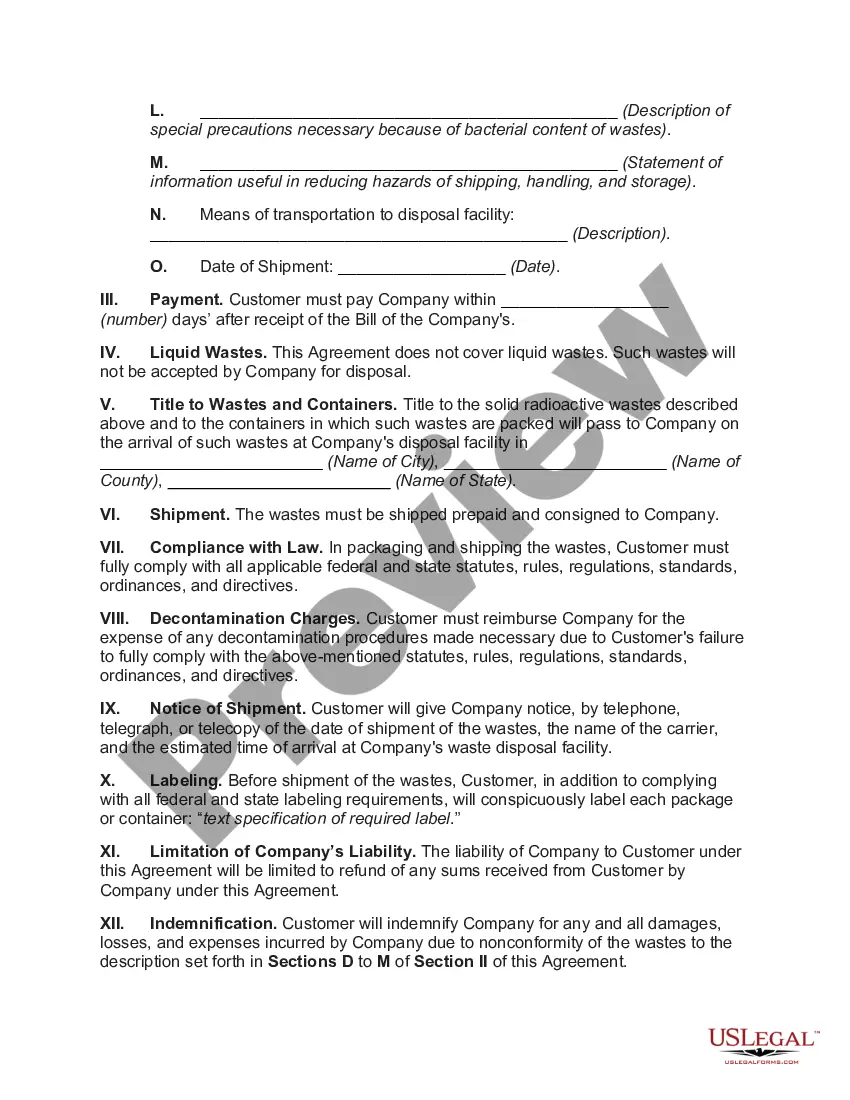
- Introduction detailing the disposal agreement and payment terms.
- Specifications about the type and quantity of waste being disposed of.
- Clauses regarding compliance with federal and state laws.
- Instructions for shipment and labeling requirements.
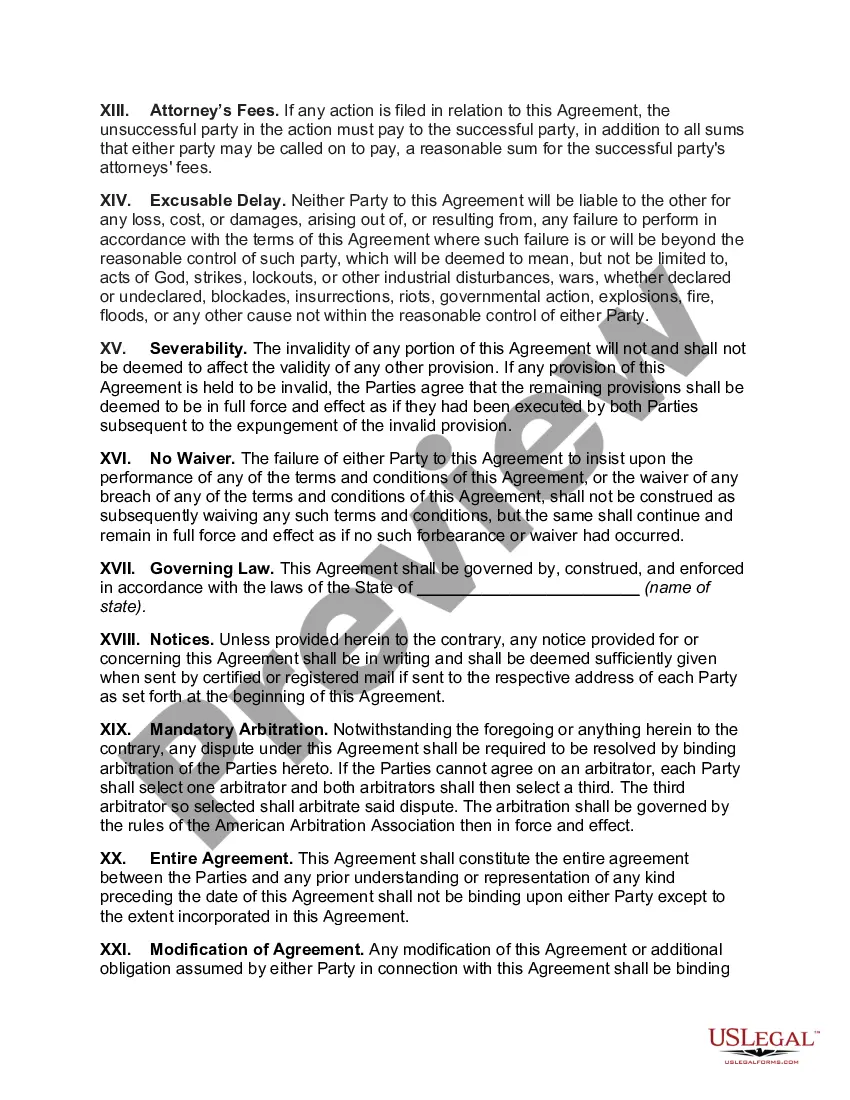
- Sections addressing liability limitations and indemnification between parties.
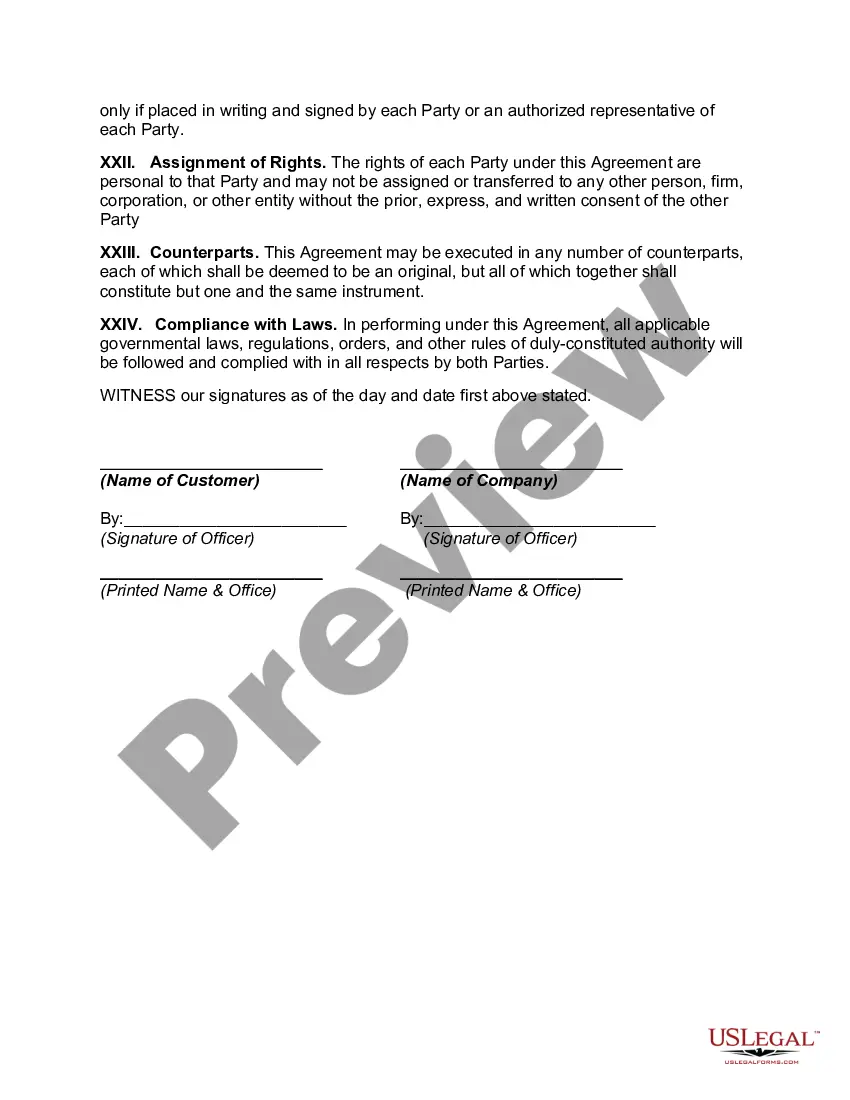
- Governing law and arbitration procedures for dispute resolution.
Situations where this form applies
This form should be used when a corporation needs to dispose of solid radioactive waste safely and legally. Situations that necessitate this agreement include the routine disposal of waste generated from power plants, decommissioning facilities, and any other scenarios where radioactive solid waste must be managed in compliance with environmental safety regulations.
Who can use this document
- Power generation companies producing radioactive waste.
- Environmental services companies handling the disposal of hazardous materials.
- Corporate entities involved in industrial activities with waste disposal needs.
- Legal professionals assisting clients with waste management agreements.
Completing this form step by step
- Identify and enter the names and addresses of the parties involved in the agreement, including the customer and the company.
- Clearly specify the details of the radioactive waste, including the number of packages, weight, volume, and descriptions of contents.
- Fill in the agreed payment terms based on the volume of waste, ensuring accurate calculations.
- Include compliance details, such as shipping methods, labeling, and legal provisions related to the waste.
- Sign and date the agreement by authorized representatives of both parties to finalize the document.
Is notarization required?
This form does not typically require notarization unless specified by local law. However, it is advisable to check if state regulations necessitate notarization for agreements regarding the disposal of hazardous or radioactive waste.
Get your form ready online
Our built-in tools help you complete, sign, share, and store your documents in one place.
Make edits, fill in missing information, and update formatting in US Legal Forms—just like you would in MS Word.
Download a copy, print it, send it by email, or mail it via USPS—whatever works best for your next step.
Sign and collect signatures with our SignNow integration. Send to multiple recipients, set reminders, and more. Go Premium to unlock E-Sign.
If this form requires notarization, complete it online through a secure video call—no need to meet a notary in person or wait for an appointment.
We protect your documents and personal data by following strict security and privacy standards.

Make edits, fill in missing information, and update formatting in US Legal Forms—just like you would in MS Word.

Download a copy, print it, send it by email, or mail it via USPS—whatever works best for your next step.

Sign and collect signatures with our SignNow integration. Send to multiple recipients, set reminders, and more. Go Premium to unlock E-Sign.

If this form requires notarization, complete it online through a secure video call—no need to meet a notary in person or wait for an appointment.

We protect your documents and personal data by following strict security and privacy standards.
Typical mistakes to avoid
- Failing to accurately describe the waste, which can lead to legal issues.
- Not adhering to labeling requirements, resulting in improper handling or delays.
- Missing signatures or dates, which can invalidate the agreement.
Why use this form online
- Convenience of downloading and completing the form at your own pace.
- Editability allows easy customization to fit specific circumstances.
- Access to reliable legal resources ensures the form is well-drafted and compliant.
Legal use & context
- The agreement establishes a legally binding contract between parties regarding waste disposal.
- Ensures compliance with environmental laws to protect public health and safety.
- Provides clear guidelines on liability and responsibilities, helping to mitigate disputes.
Key takeaways
- The Agreement to Dispose of Solid Radioactive Wastes is essential for legally managing radioactive waste disposal.
- It is crucial to comply with all legal requirements outlined in the agreement to avoid penalties.
- Accurate completion of the form is vital for successful waste disposal and to protect public health.
Looking for another form?
Form popularity
FAQ
Department of Energy Implementation of the Nuclear Waste Policy Act of 1982 U.S. GAO.
The Low-level Radioactive Waste Policy Amendments Act of 1985 gave the states responsibility for the disposal of their low-level radioactive waste. The Act encouraged the states to enter into compacts that would allow them to dispose of waste at a common disposal facility.
Select a storage container made of material compatible with the chemical it will hold. Complete and attach a hazardous waste tag to the bag or container.Store the container in the radioactive waste storage area of the lab.Request hazardous waste collection when you're ready for a waste pick up.
Question: What were the major implications of the U.S. Nuclear Waste Policy Act? It established guidelines for the research and development of permanent repositories, It designated the Federal Department of Energy as responsible for nuclear waste disposal.
The EPA is involved with the regulation of nuclear waste, environmental releases from nuclear power facilities, other airborne radionuclide emissions, and radionuclides in drinking water.
The NWPA assigns the Department of Energy (DOE) the responsibility to site, build, and operate a deep geologic repository for the disposal of high- level waste and spent nuclear fuel. Amended in 1987 - Section 180(c) was added to address the DOE shipments of SNF or HLW conducted under the NWPA.
The Nuclear Waste Policy Act (NWPA) supports the use of deep geologic repositories for the safe storage and/or disposal of radioactive waste. The Act establishes procedures to evaluate and select sites for geologic repositories and for the interaction of state and federal governments.
Disposal of low-level waste is straightforward and can be undertaken safely almost anywhere. Storage of used fuel is normally under water for at least five years and then often in dry storage. Deep geological disposal is widely agreed to be the best solution for final disposal of the most radioactive waste produced.