Underwriting Agreement regarding Sale and Distribution of Stock of Investment Company with Open End Mangagement Company
What is this form?
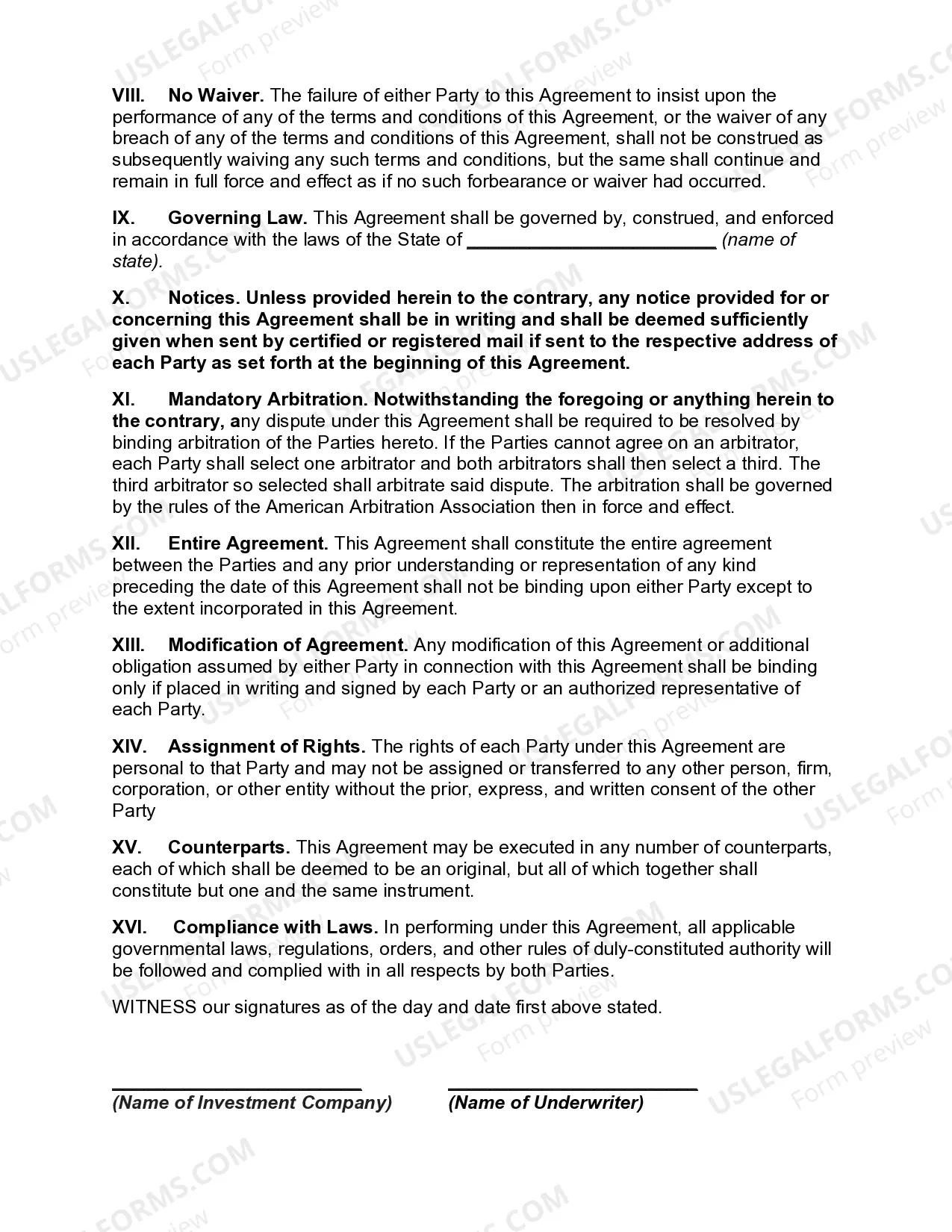
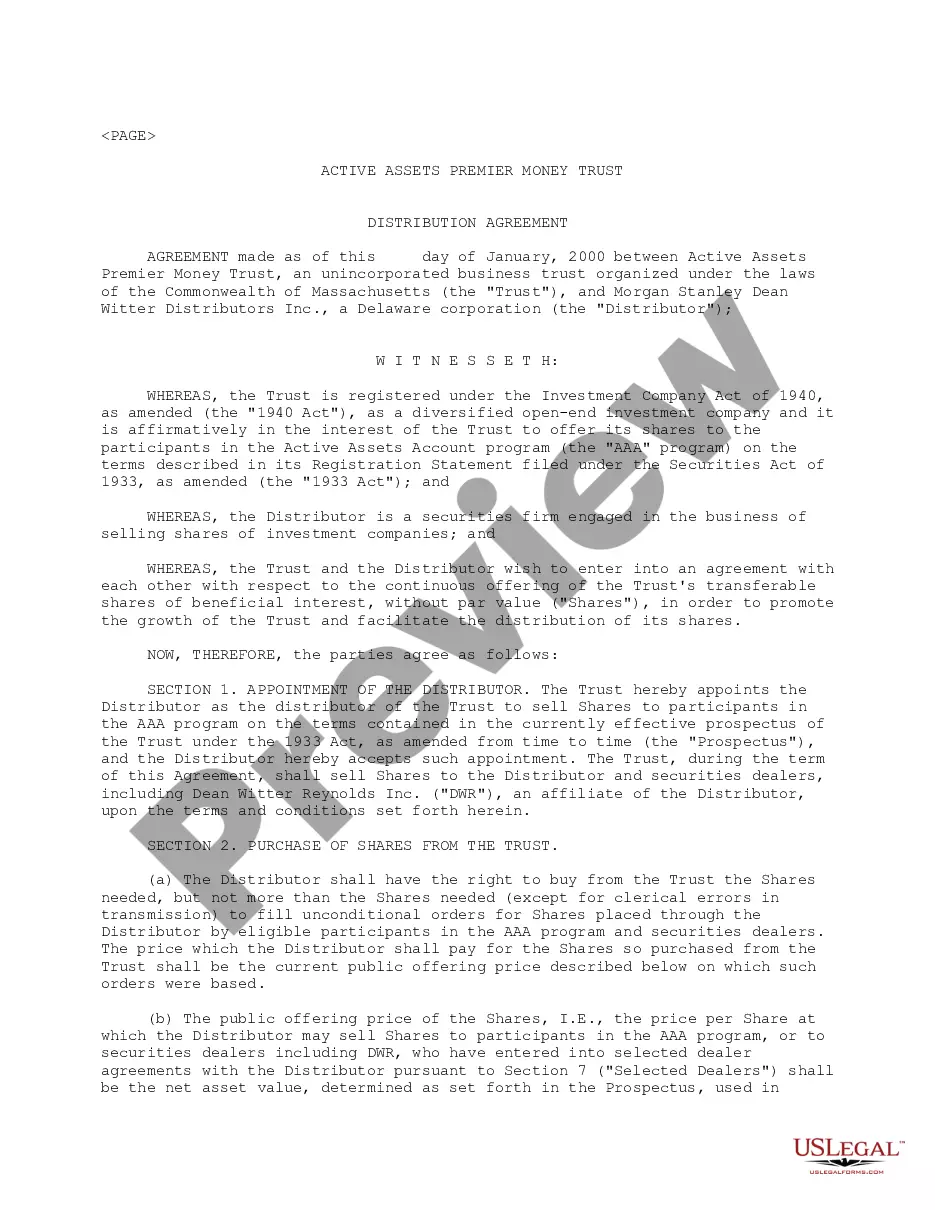
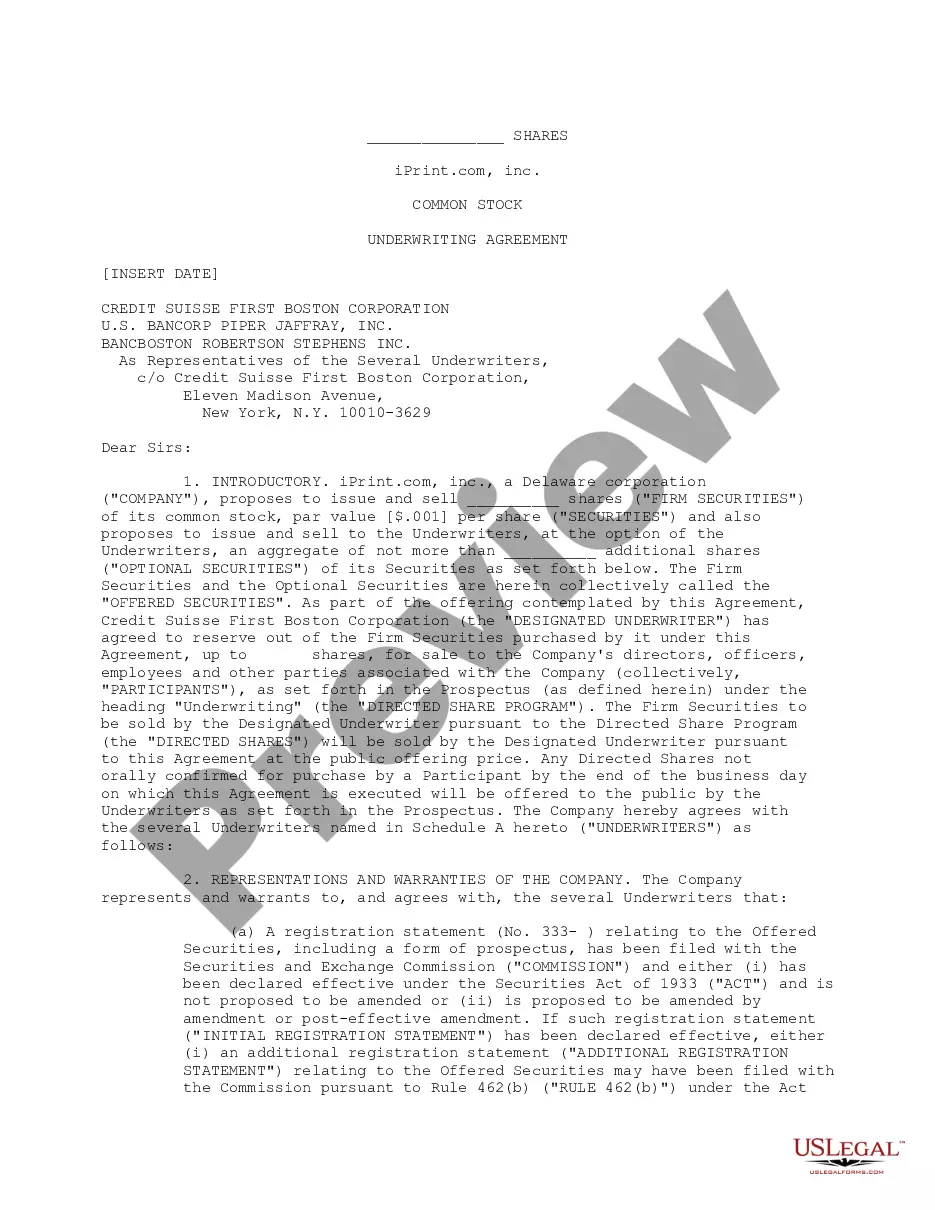
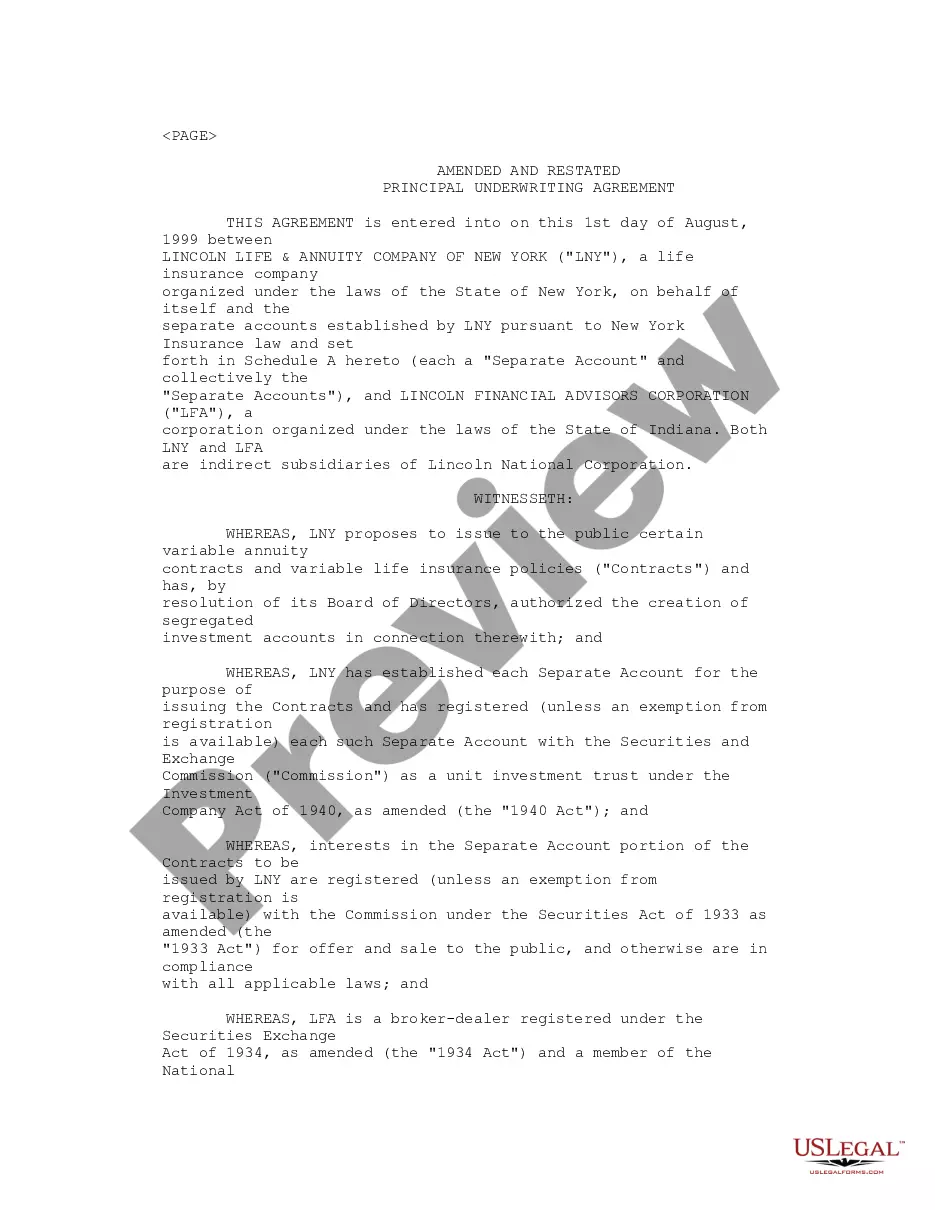
This Underwriting Agreement regarding the Sale and Distribution of Stock of an Investment Company with an Open-end Management Company serves as a formal contract between an investment company and an underwriter. The agreement outlines the responsibilities of both parties in selling and distributing shares of the investment company. This document is essential for facilitating organized investment efforts and ensuring compliance with legal standards specific to investment companies, such as those outlined in the Federal Investment Company Act of 1940.
Key components of this form
- Distribution of Securities: Establishes the underwriter as the exclusive distributor of the investment company's capital stock.
- Duties of the Fund: Lists responsibilities of the investment company, including maintaining registration and compliance.
- Duties of the Underwriter: Specifies obligations regarding order placement and prohibition on advantageous sales to insiders.
- Duration of Agreement: Defines the term and conditions for renewing the agreement.
- Mandatory Arbitration: Details the procedure for resolving disputes that arise under the agreement.

When this form is needed
This form is used when an investment company wants to establish a formal relationship with an underwriter to distribute its shares. It is ideal for companies seeking to reach a wider audience through retail and institutional sales while ensuring regulatory compliance. This agreement is particularly crucial when launching new investment products or during significant financial transitions.
Who should use this form
- Investment companies that wish to sell and distribute their shares through a professional underwriter.
- Underwriters looking for a formal contract to outline their responsibilities and rights in relation to the investment company.
- Legal professionals assisting investment firms in structuring investment agreements.
How to prepare this document
- Identify and enter the names and addresses of both the investment company and the underwriter.
- Define the terms of the agreement, including the duration and any unique conditions for sales and distribution.
- Specify obligations for both the Fund and Underwriter, ensuring all duties are distinctly outlined.
- Fill in the required fields, such as registration details and commission percentages for the underwriter's services.
- Have authorized representatives sign the agreement to finalize it legally.
Notarization guidance
This form does not typically require notarization to be legally valid. However, some jurisdictions or document types may still require it. US Legal Forms provides secure online notarization powered by Notarize, available 24/7 for added convenience.
Get your form ready online
Our built-in tools help you complete, sign, share, and store your documents in one place.
Make edits, fill in missing information, and update formatting in US Legal Forms—just like you would in MS Word.
Download a copy, print it, send it by email, or mail it via USPS—whatever works best for your next step.
Sign and collect signatures with our SignNow integration. Send to multiple recipients, set reminders, and more. Go Premium to unlock E-Sign.
If this form requires notarization, complete it online through a secure video call—no need to meet a notary in person or wait for an appointment.
We protect your documents and personal data by following strict security and privacy standards.
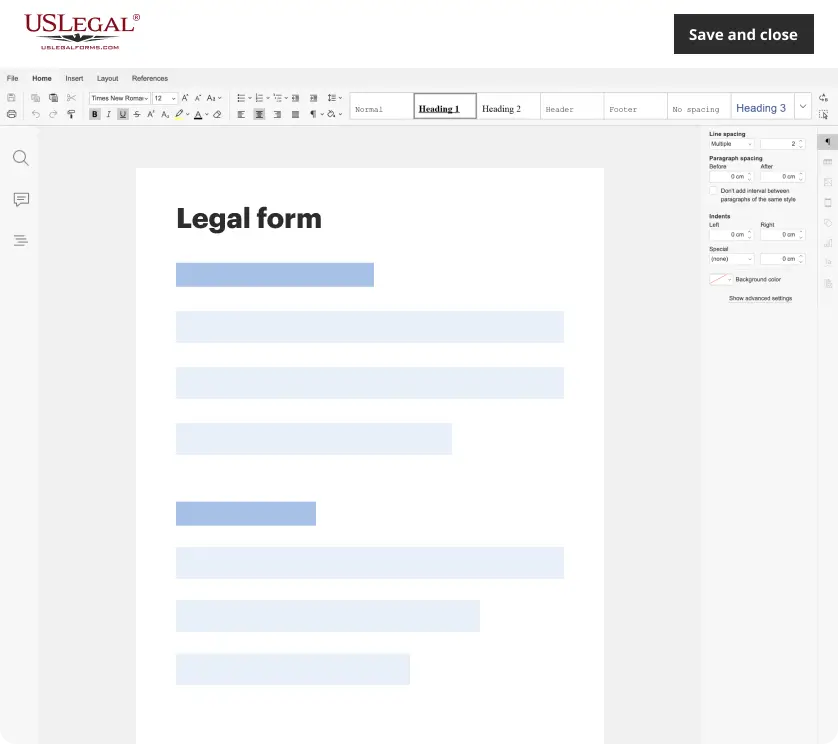
Make edits, fill in missing information, and update formatting in US Legal Forms—just like you would in MS Word.
Download a copy, print it, send it by email, or mail it via USPS—whatever works best for your next step.
Sign and collect signatures with our SignNow integration. Send to multiple recipients, set reminders, and more. Go Premium to unlock E-Sign.

If this form requires notarization, complete it online through a secure video call—no need to meet a notary in person or wait for an appointment.
We protect your documents and personal data by following strict security and privacy standards.
Common mistakes to avoid
- Failing to accurately identify the parties involved.
- Not specifying the duration of the agreement or conditions for renewal.
- Overlooking state-specific regulations that may affect the agreement.
- Missing signatures from authorized representatives.
Benefits of using this form online
- Convenient access to legally vetted template that saves time.
- Editability allows for customization based on specific requirements.
- Instant availability, enabling quick initiation of the underwriting process.
Legal use & context
- This agreement facilitates the legal sale of shares while ensuring adherence to federal and state investment laws.
- It provides a framework that protects both the investment company and the underwriter by clarifying expectations and delivering legal recourse options in case of disputes.
Looking for another form?
Form popularity
FAQ
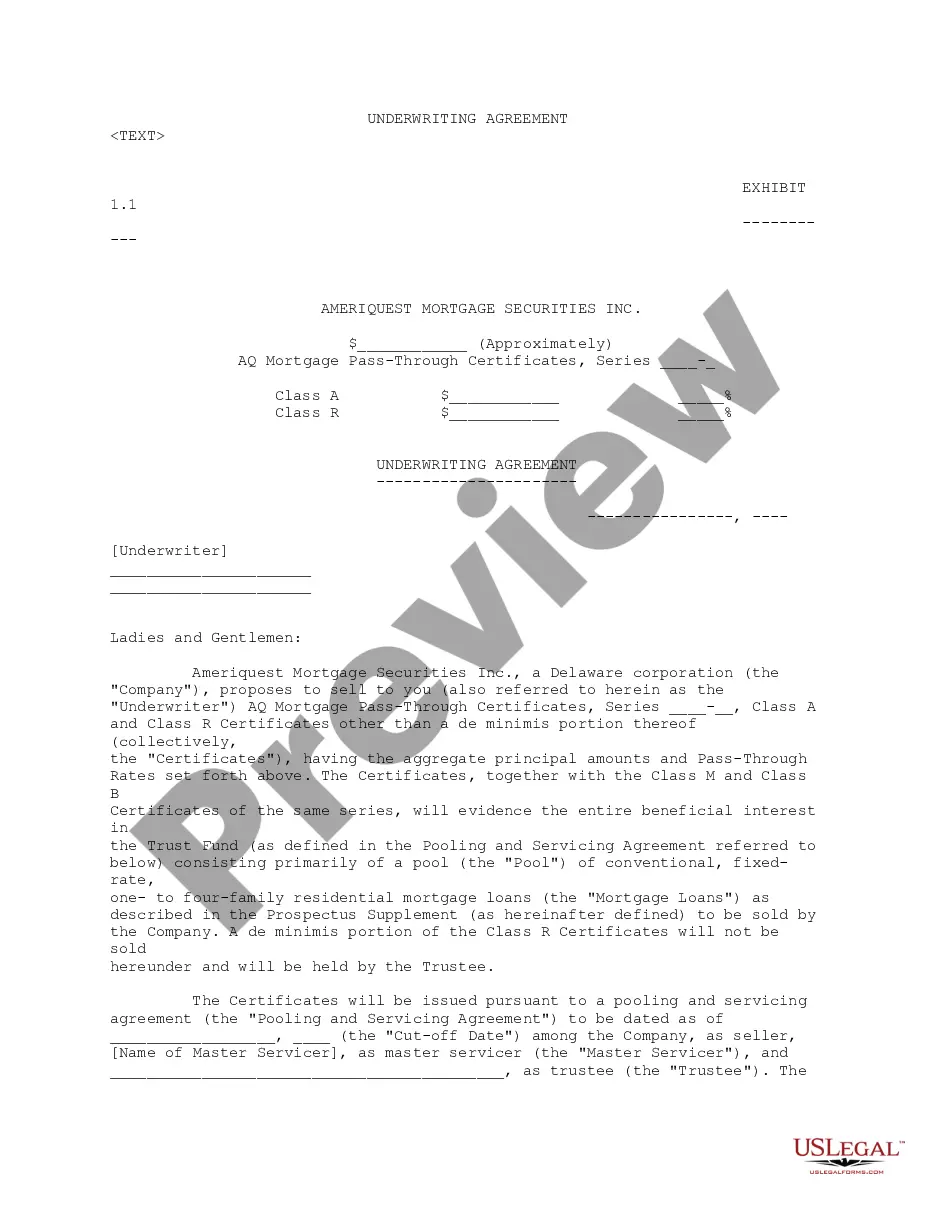
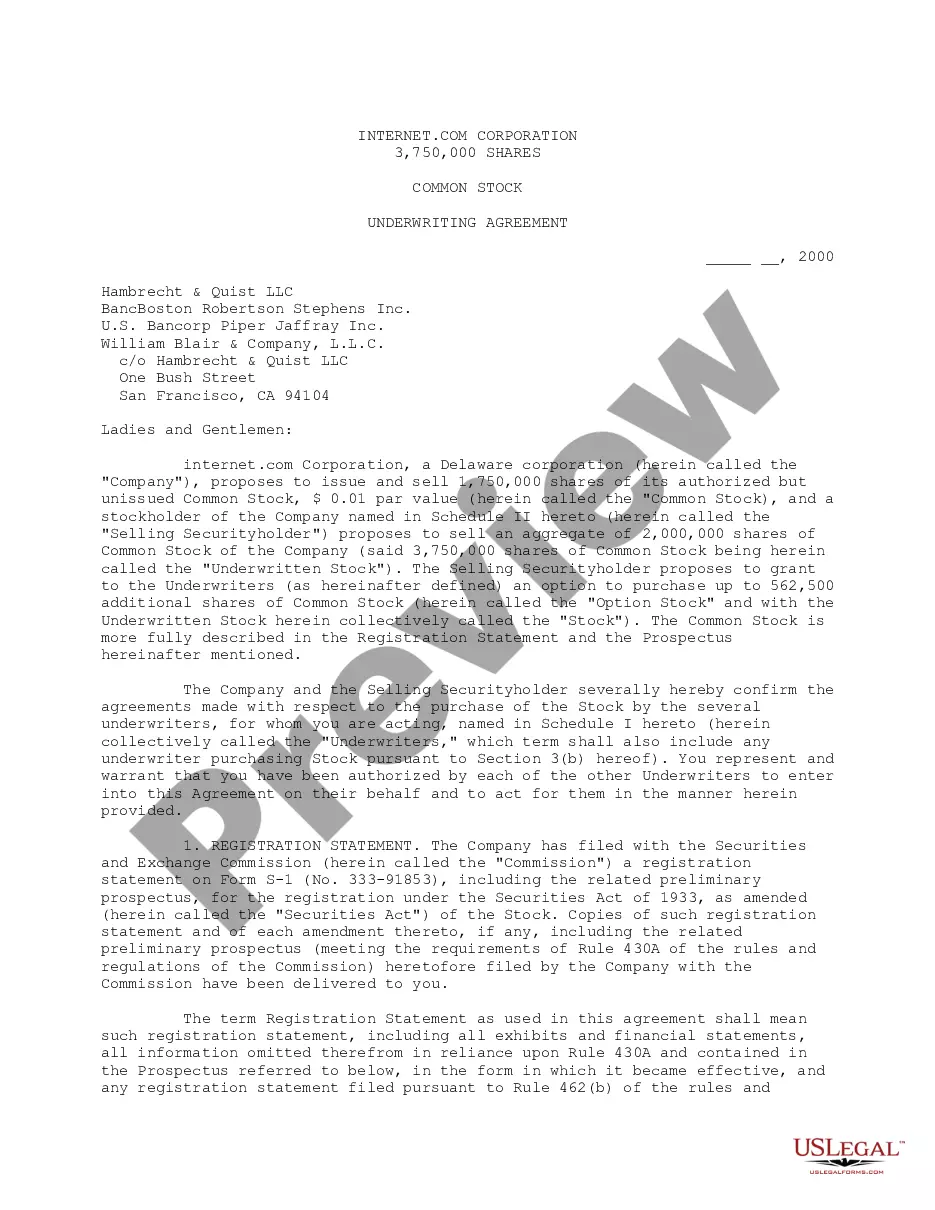
The agreement outlines the various responsibilities and obligations of the company and its underwriters for the transaction. It also includes the agreed-upon purchase price, the initial resale date, and the settlement date. The parties finalize the underwriting agreement prior to the roadshow.
#1 Loan underwriting Three primary factors?income, valuation, and credit score ?are used by loan underwriters to determine whether a loan will be repaid. The loan underwriting process frequently relates to a mortgage.
There are three kinds of underwriting, namely loans, securities, and insurance. Underwriting is a crucial process in the financial world because it helps investors make profitable investment decisions.
1) Normal underwriting ? where the underwriter agrees to take up shares/debentures only when the issue is not subscribed by the public in full. 2) Firm underwriting - where an underwriter agrees to buy a certain number of shares/debentures in addition to the shares he has to take under the underwriting agreement.
There are basically three different types of underwriting: loans, insurance, and securities.
The four main types of underwriters include ? general, life, banking, and medical stop-loss insurance.
The Bottom Line Underwriting simply means that your lender verifies your income, assets, debt and property details in order to issue final approval for your loan. An underwriter is a financial expert who takes a look at your finances and assesses how much risk a lender will take on if they decide to give you a loan.
There are several different kinds of underwriting agreements: the firm commitment agreement, the best efforts agreement, the mini-maxi agreement, the all or none agreement, and the standby agreement.