Agreement to Let Lands Lie Open with No Construction of Fence
Overview of this form
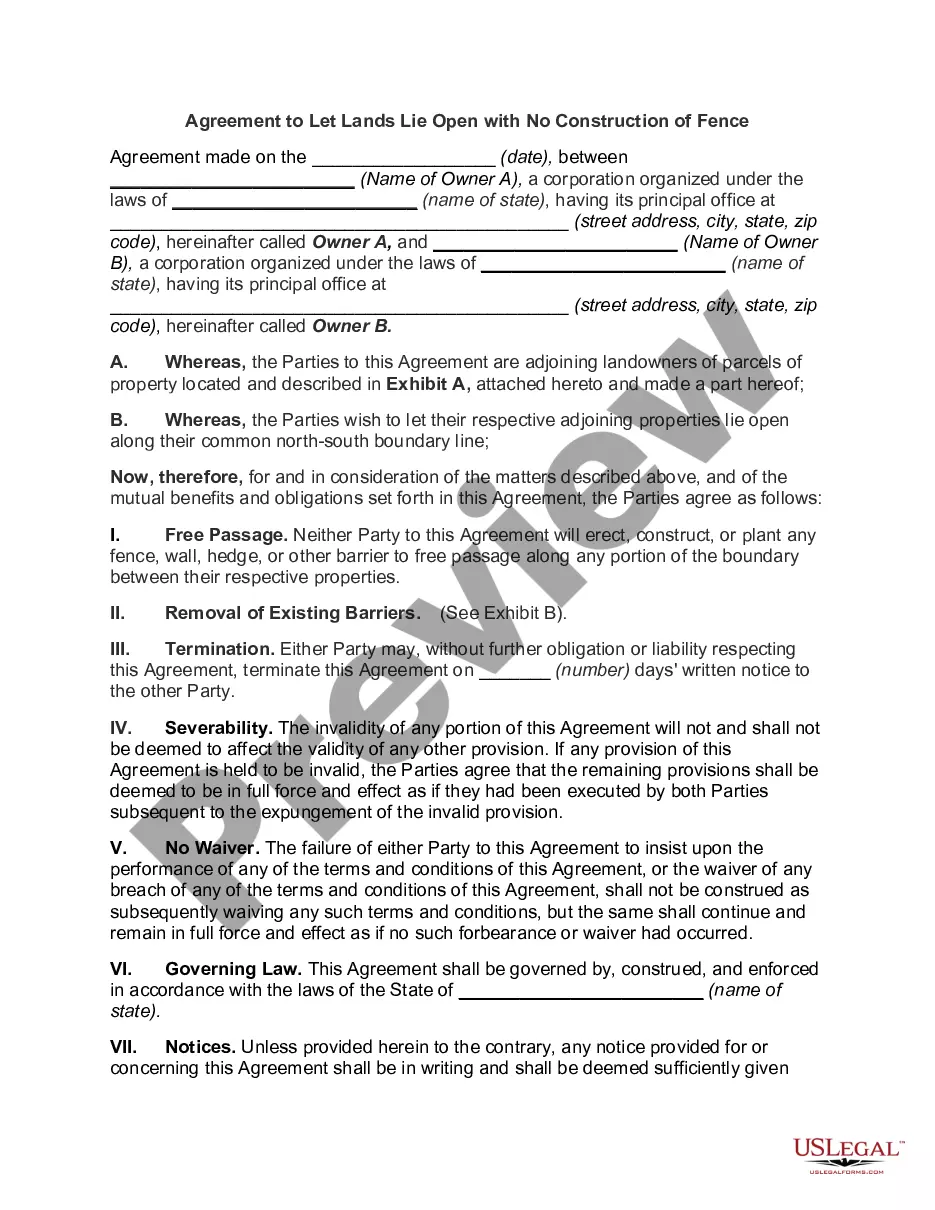
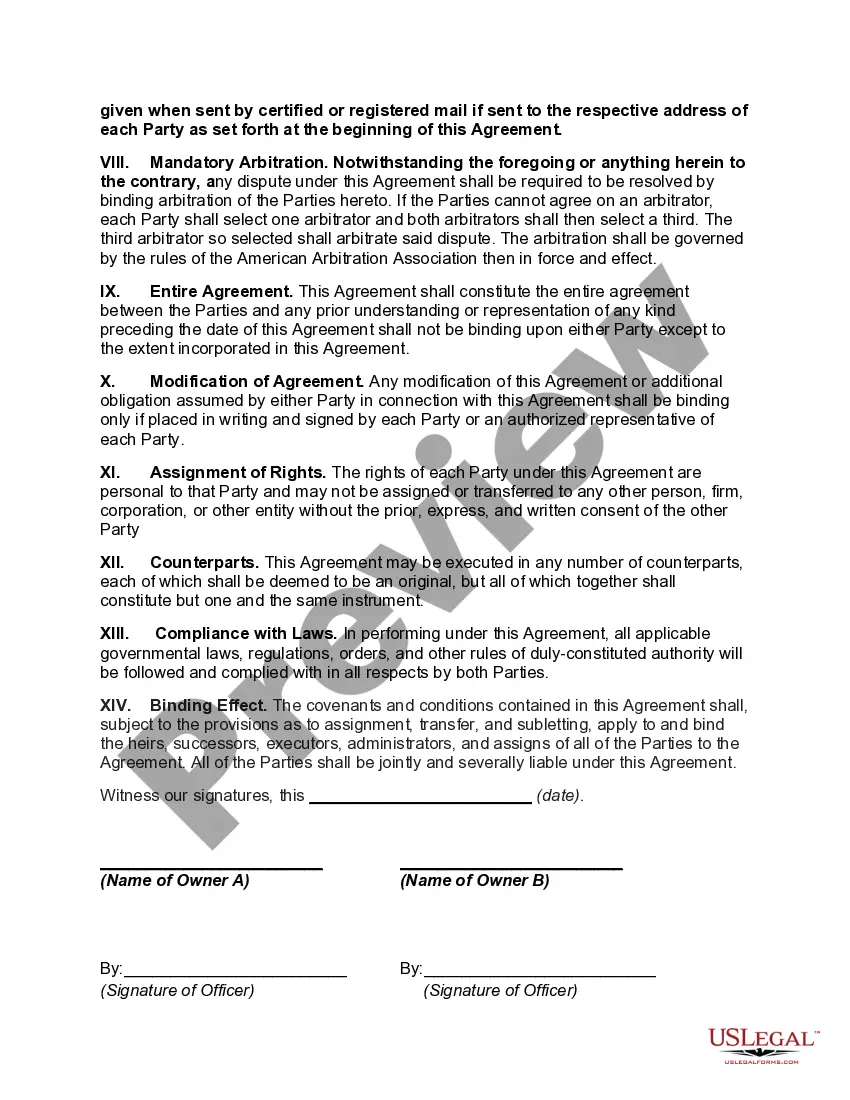
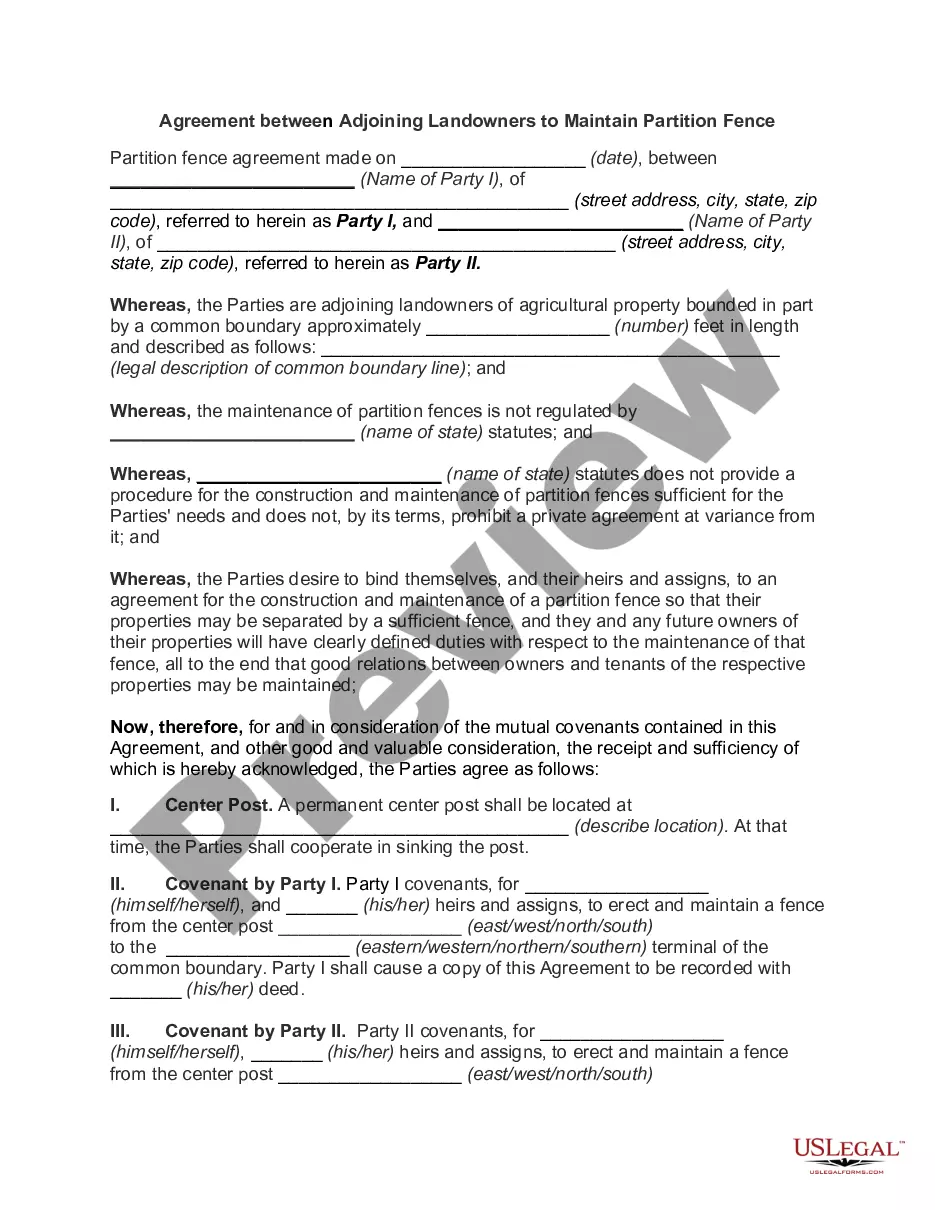
The Agreement to Let Lands Lie Open with No Construction of Fence is a legal document that allows two adjoining landowners to agree on leaving their properties open without any fencing or barriers. This form is essential for landowners who wish to maintain free passage along their common boundary line without the construction of any fences, reinforcing a collaborative relationship between neighbors. Unlike other land agreements, this specific document addresses the mutual understanding and responsibilities of both parties regarding the upkeep of their shared property boundaries.
Key parts of this document
- Free Passage: Ensures no barriers will obstruct movement along the property line.
- Removal of Existing Barriers: Details any current structures that may need to be addressed.
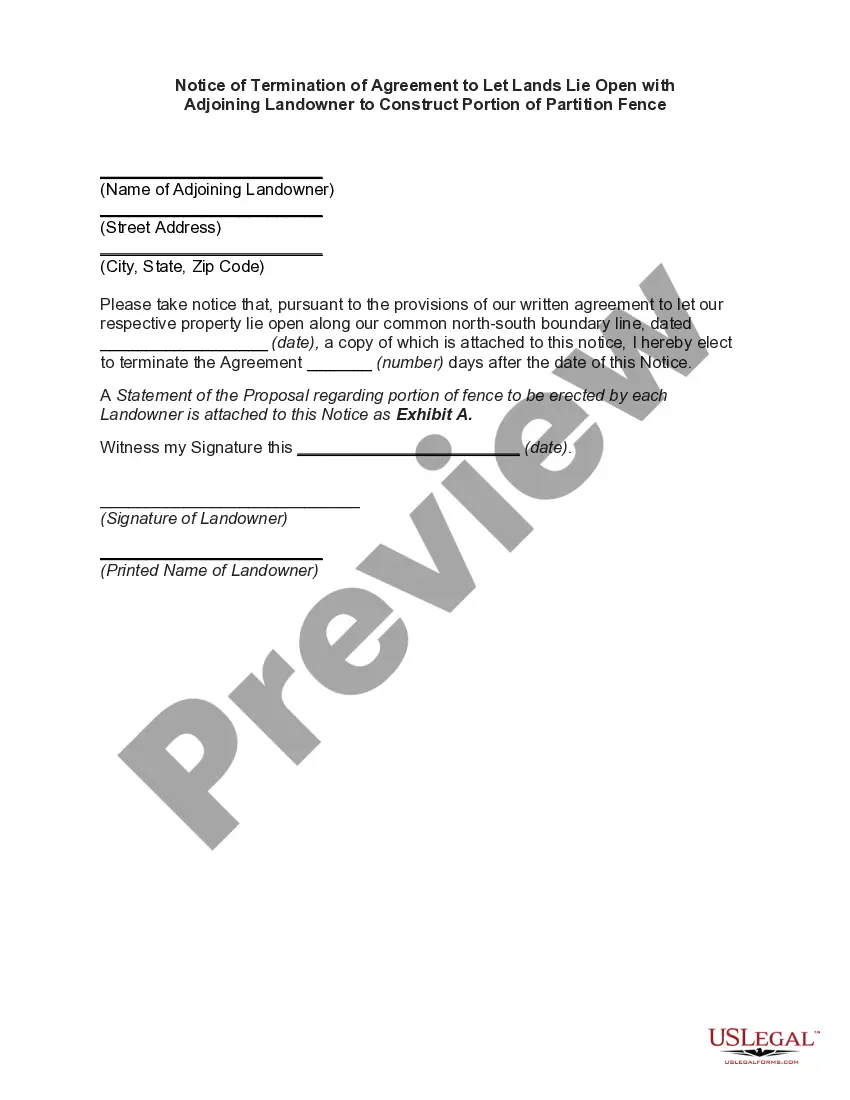
- Termination Clause: Outlines how either party can terminate the agreement with written notice.
- Severability: Addresses the validity of the agreement if any part is found to be unenforceable.
- No Waiver: Protects the rights of both parties in case of non-performance or breach of the agreement.
- Governing Law: Specifies which stateâs laws govern the agreement.


When to use this form
This form is used when two neighboring landowners wish to document their agreement to keep their shared boundary area clear of any fencing or walls. It is notably useful in rural or semi-rural settings where properties may share borders without defined barriers. Landowners may choose this agreement to maintain ease of access, improve aesthetic appeal, or avoid disputes over property lines.
Who needs this form
- Property owners with adjoining land who wish to keep their properties open.
- Landowners interested in formalizing their agreement regarding boundary management.
- Individuals seeking to prevent disputes related to fencing and property access.
- Real estate attorneys who assist clients in drafting land agreements.
Completing this form step by step
- Identify the parties: Insert the names and addresses of Owner A and Owner B.
- Specify the property: Attach Exhibit A with a detailed description of the properties involved.
- Enter the date: Fill in the date on which the agreement is made.
- Sign the agreement: Both parties must sign and date the document in the presence of witnesses, if required.
- Attach any exhibits: Ensure to attach any referenced exhibits that provide further details about property conditions or existing barriers.
Does this form need to be notarized?
This form does not typically require notarization unless specified by local law. However, having it notarized can enhance its legal validity and provide additional proof of authenticity.
Get your form ready online
Our built-in tools help you complete, sign, share, and store your documents in one place.
Make edits, fill in missing information, and update formatting in US Legal Forms—just like you would in MS Word.
Download a copy, print it, send it by email, or mail it via USPS—whatever works best for your next step.
Sign and collect signatures with our SignNow integration. Send to multiple recipients, set reminders, and more. Go Premium to unlock E-Sign.
If this form requires notarization, complete it online through a secure video call—no need to meet a notary in person or wait for an appointment.
We protect your documents and personal data by following strict security and privacy standards.

Make edits, fill in missing information, and update formatting in US Legal Forms—just like you would in MS Word.

Download a copy, print it, send it by email, or mail it via USPS—whatever works best for your next step.

Sign and collect signatures with our SignNow integration. Send to multiple recipients, set reminders, and more. Go Premium to unlock E-Sign.

If this form requires notarization, complete it online through a secure video call—no need to meet a notary in person or wait for an appointment.

We protect your documents and personal data by following strict security and privacy standards.
Mistakes to watch out for
- Failing to include all parties' names and addresses accurately.
- Not attaching the exhibit that describes the properties involved.
- Leaving out the date of the agreement.
- Missing signatures or failing to have witnesses sign, if necessary.
Why complete this form online
- Convenient access to legal forms from anywhere, any time.
- Easy to edit and customize the form according to specific needs.
- Reliable templates drafted by licensed attorneys to ensure compliance with laws.
Looking for another form?
Form popularity
FAQ
How Close To The Property Line Can I Build? Fences are typically built between 2 and 8 inches from the line between properties. Some areas will allow the building of fences directly on the property line, but in this case, you'll have to cooperate with your neighbor and potentially share the cost of the fence.
Ohio Revised Code § 971.08 provides a landowner with a ten foot right to access his or her neighbor's property in order to construct a new line fence or to maintain an existing fence.
§ 55-317. Adjoining landowners shall build and maintain, at their joint and equal expense, division fences between their lands, unless one of them shall choose to let his land lie open or unless they shall otherwise agree between themselves.
Landowners must now allow access for a neighbor to build or maintain a line fence. The new law grants rights to a neighbor or his or her contractor to enter upon up to ten feet of the adjoining property to construct and maintain a line fence. The ten foot width runs the entire length of the fence.
The exact amount a building needs to be set back from the property line will vary from one location to another. However, the required setback on the side is typically between 5 ? 10 feet, while the front and back require around 10 ? 20 feet at a minimum.
Yes, in most cases, you can build a fence on an easement. Fences are regularly built along or across easements.
You are allowed by law to enter up to 10 feet into your adjoining property to build and maintain the fence. Ohio fence law forbids all barbed wire, hedges, or electrified wire boundary fences on commercial and individual properties unless written consent has been given from an adjoining neighbor.
Check Rules and Regulations Typically, fences are installed anywhere from 2 to 8 inches from a property line in most areas. Some areas might allow to go right up to a property line, especially if you live in an urban row house where every inch makes a difference!