Elements of the Offense(s) Charged
What this document covers
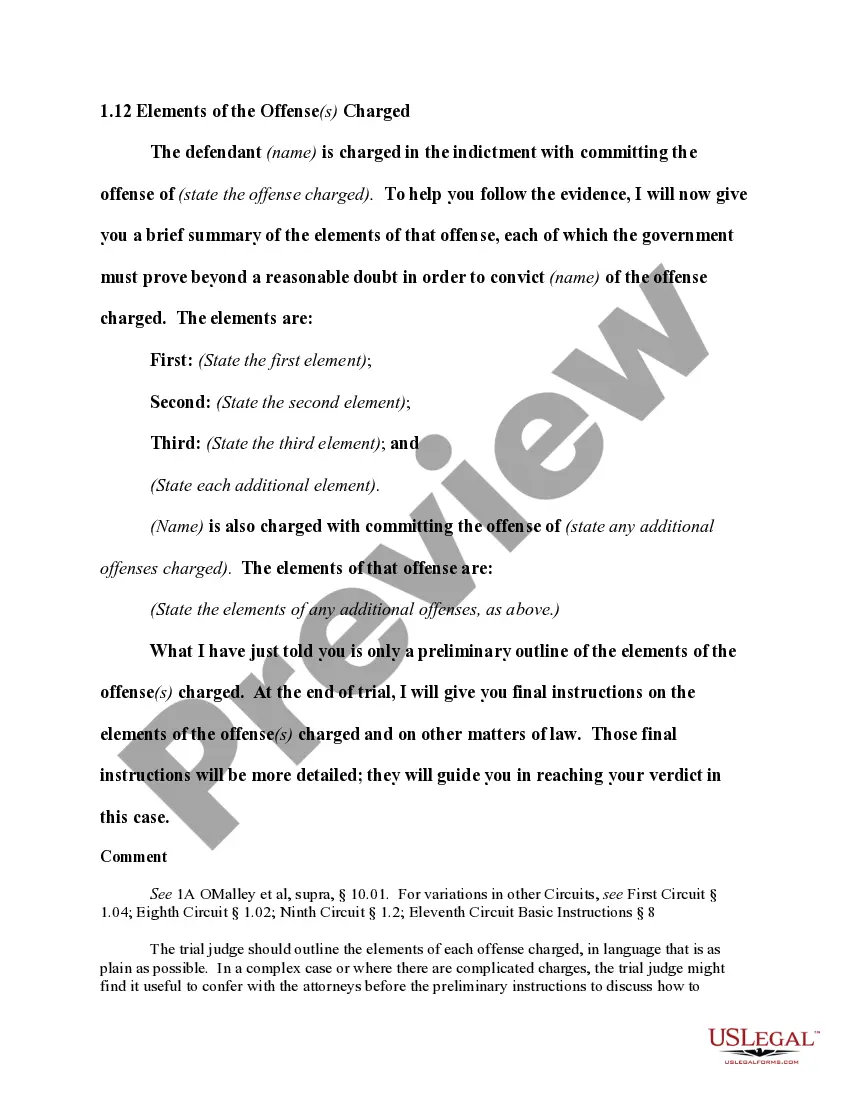
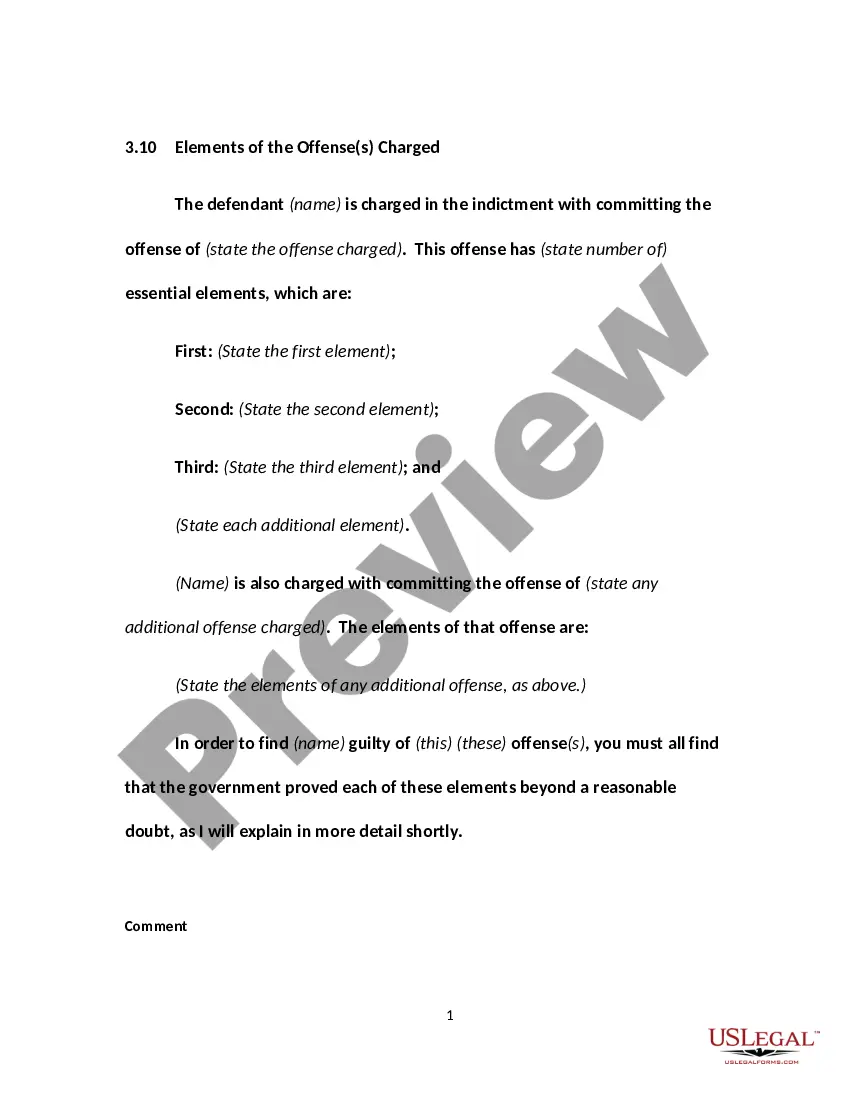
The "Elements of the Offense(s) Charged" form is a legal document used in criminal trials to outline the specific elements that the prosecution must prove to obtain a conviction. This form helps jurors understand the components of the crimes being charged and distinguishes itself from similar documents by providing a clear framework for evaluating the evidence presented during the trial.
Form components explained
- Charge description: States the specific offenses the defendant is charged with.
- Element breakdown: Outlines the elements of each offense that must be proved beyond a reasonable doubt.
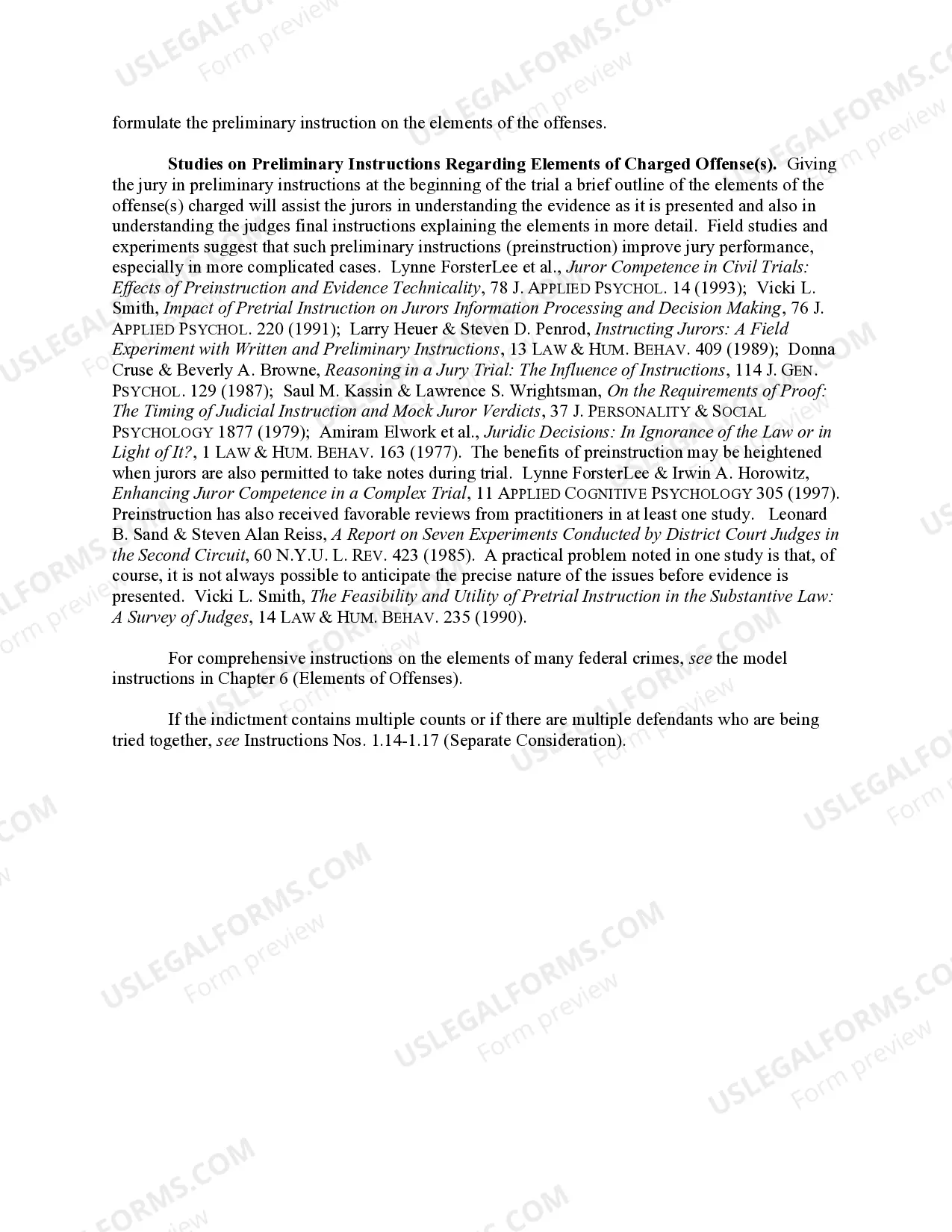
- Preliminary instructions: Provides jurors with initial guidance that will be expanded upon at the end of the trial.
- Additional charges: Details any other offenses the defendant may face and their specific elements.
When this form is needed
This form is typically used at the beginning of a criminal trial when jurors are being instructed on the offenses the defendant has been charged with. It is essential in ensuring that jurors clearly understand what is being alleged and the legal standards that must be applied when considering the evidence during the trial.
Who can use this document
- Judges overseeing criminal trials who need to provide initial instructions to jurors.
- Prosecutors presenting cases involving multiple offenses against a defendant.
- Defense attorneys who need to understand the charges against their clients.
- Jurors tasked with evaluating the evidence in a criminal trial.
Completing this form step by step
- Identify the defendant's name and the offenses charged.
- List the elements of each offense sequentially, ensuring clarity for each point.
- Outline any additional offenses, along with their respective elements.
- Provide preliminary instructions that jurors will reference throughout the trial.
Notarization requirements for this form
This form does not typically require notarization to be legally valid. However, some jurisdictions or document types may still require it. US Legal Forms provides secure online notarization powered by Notarize, available 24/7 for added convenience.
Get your form ready online
Our built-in tools help you complete, sign, share, and store your documents in one place.
Make edits, fill in missing information, and update formatting in US Legal Forms—just like you would in MS Word.
Download a copy, print it, send it by email, or mail it via USPS—whatever works best for your next step.
Sign and collect signatures with our SignNow integration. Send to multiple recipients, set reminders, and more. Go Premium to unlock E-Sign.
If this form requires notarization, complete it online through a secure video call—no need to meet a notary in person or wait for an appointment.
We protect your documents and personal data by following strict security and privacy standards.

Make edits, fill in missing information, and update formatting in US Legal Forms—just like you would in MS Word.

Download a copy, print it, send it by email, or mail it via USPS—whatever works best for your next step.

Sign and collect signatures with our SignNow integration. Send to multiple recipients, set reminders, and more. Go Premium to unlock E-Sign.

If this form requires notarization, complete it online through a secure video call—no need to meet a notary in person or wait for an appointment.

We protect your documents and personal data by following strict security and privacy standards.
Common mistakes
- Failing to clearly define each element of the offense, leading to juror confusion.
- Overlooking additional charges that may need to be included.
- Using overly complex language that may hinder juror comprehension.
Advantages of online completion
- Convenient access to forms at any time, allowing for quick adaptation to specific case needs.
- Editability enables users to customize elements based on the charges and legal standards.
- Provides reliable templates drafted by licensed attorneys, ensuring legal accuracy.
Looking for another form?
Form popularity
FAQ
The discussion of substantive criminal law briefly defines the seven principles essential for a crime to have been committed, i.e., legality, actus reus, mens rea, fusion of actus reus and mens rea, harm, causation, and stipulation of punishment.
Although there are many different kinds of crimes, criminal acts can generally be divided into five primary categories: crimes against a person, crimes against property, inchoate crimes, statutory crimes, and financial crimes.
The four elements of a crime are: Criminal act. Criminal intent. A concurrence of the previous two elements. Causation.
There are 8 main elements to a crime. The criminal act, known as actus reus. A guilty mind, often called "intent", or mens rea. A coincidence between the actus reus or the crime, and mens rea, or the intent. Causation; the act committed must have caused the event that led to the crime. Harm.Legality.Punishment.
Most crimes require that three essential elements be present: a criminal act (actus reus), criminal intent (mens rea), and a concurrence of the previous two elements. Depending on the crime, there can also be a fourth element known as causation.
In general, every crime involves three elements: first, the act or conduct (actus reus); second, the individual's mental state at the time of the act (mens rea); and third, the causation between the act and the effect (typically either proximate causation or but-for causation).
Types of Mens Rea (Levels of Culpability) Intent. When a person acts with the determination to commit a dangerous or illegal act, they have criminal intent.Knowledge. When a person is consciously aware that their actions would result in a particular type of harm, they have criminal knowledge.Recklessness.Negligence.
In general, there are ??- in the United States: criminal act, state of mind, concurrence of criminal act and causation.