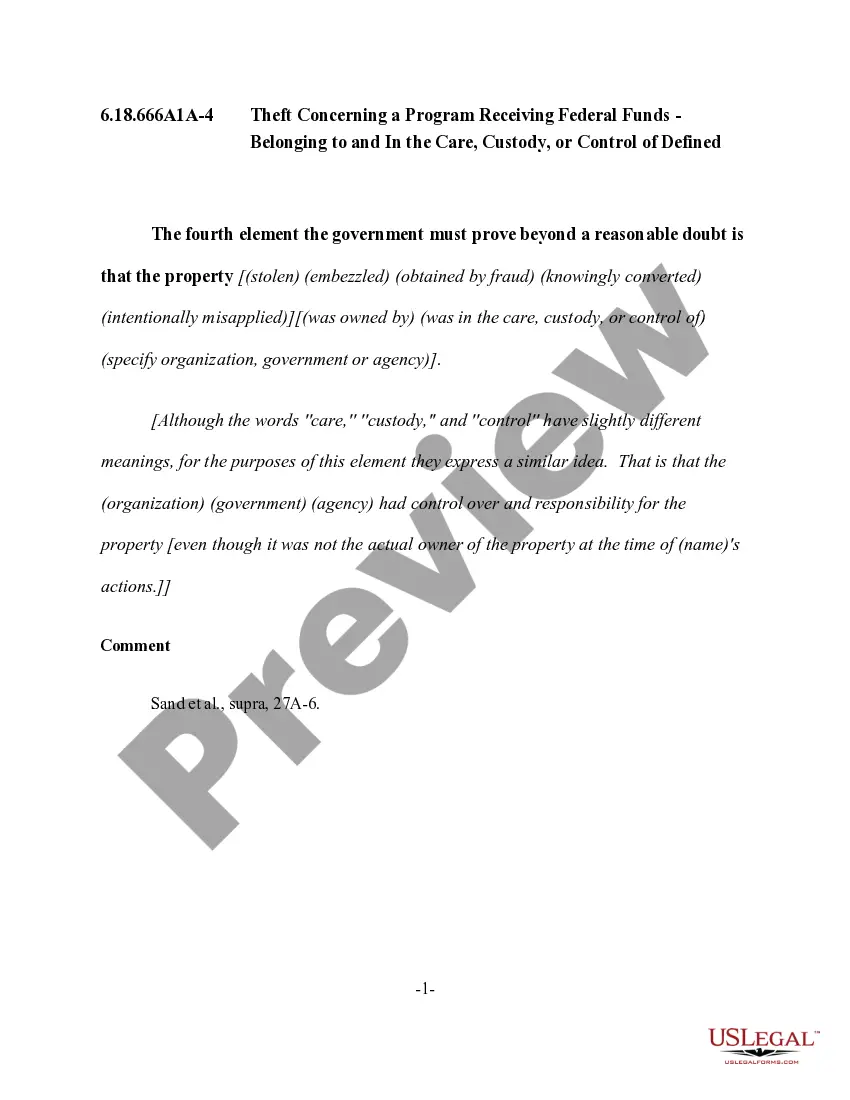
Theft Concerning a Program Receiving Federal Funds - Belonging to and In the Care, Custody, or Control of Defined
Overview of this form
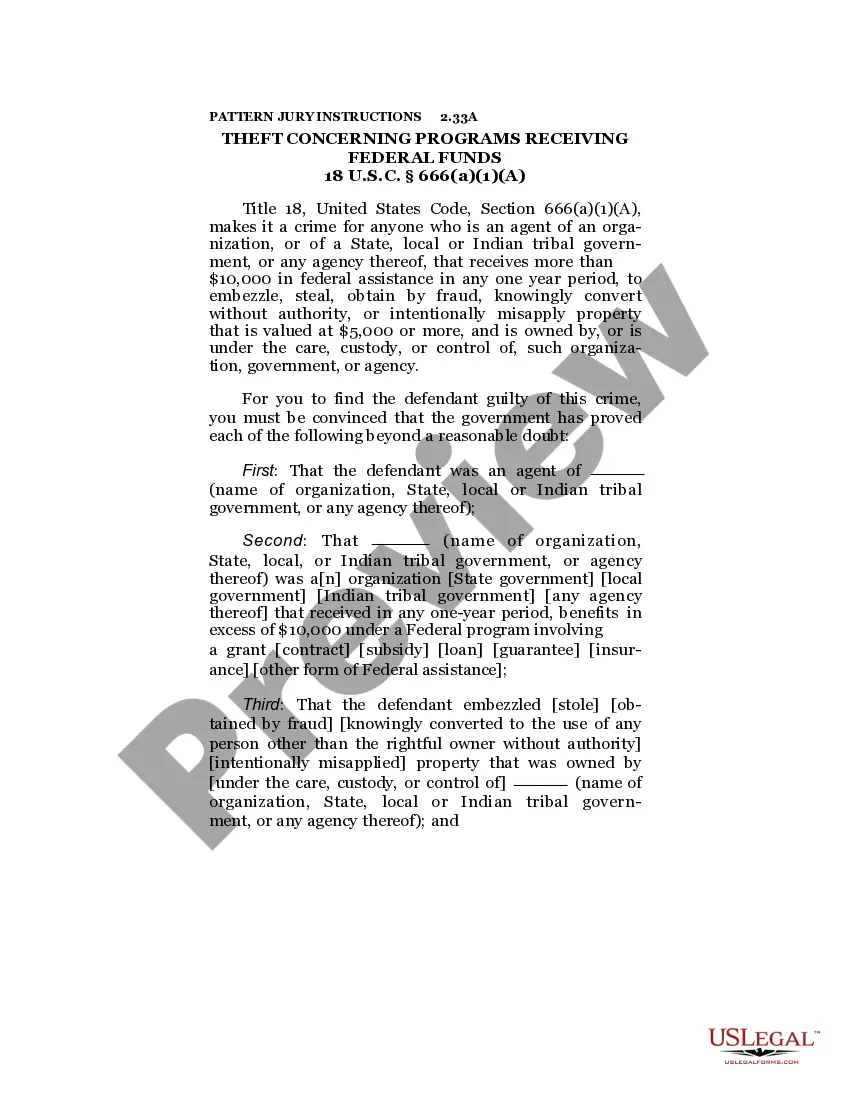
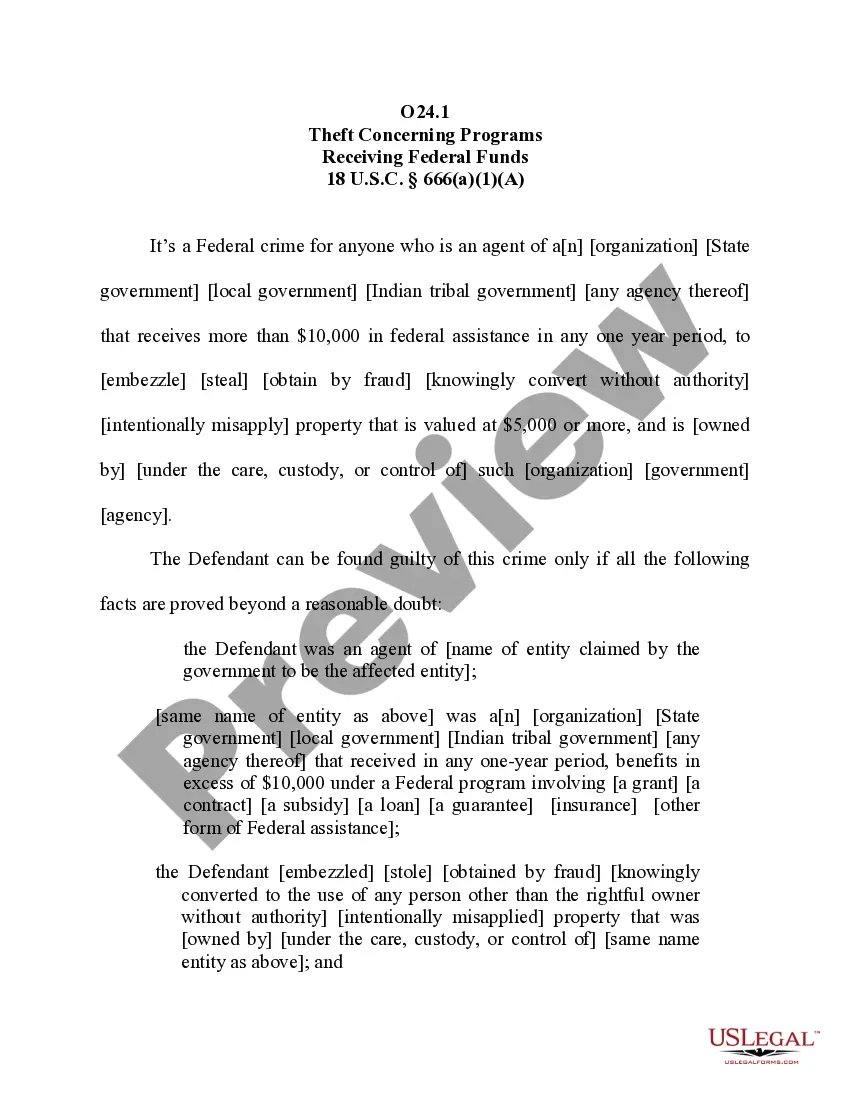
The Theft Concerning a Program Receiving Federal Funds is a legal form used to address theft or embezzlement related to federal programs. It specifically outlines the government's obligation to prove that the property in question was under the care, custody, or control of an organization or agency receiving federal funds. This form is essential in cases where federal laws apply, making it distinct from other theft-related documents, as it incorporates aspects of federal oversight and compliance.
Main sections of this form
- The definition of property regarding theft, covering phrases such as stolen, embezzled, and knowingly converted.
- The relationship between the organization or agency and the property in question, asserting care, custody, or control.
- Explanation of terms like care, custody, and control, emphasizing their legal significance in this context.
When to use this document
This form should be used in situations where there is a suspicion or allegation of theft involving property that is part of a federal program. It may be necessary when investigating or prosecuting theft claims related to federal funds, especially when the proving of care and custody by an agency is crucial to the case.
Who this form is for
- Prosecutors handling cases of theft involving federal programs.
- Defense attorneys representing clients accused of theft or related offenses.
- Law enforcement agencies conducting investigations into federal fund misappropriation.
- Organizations receiving federal funds needing to ensure compliance with legal standards.
How to complete this form
- Identify the parties involved in the alleged theft, including the organization or agency.
- Specify the property that is claimed to have been stolen or embezzled.
- Detail the circumstances of the theft, including how the accused is connected to the property.
- Provide relevant dates and other identifying information pertinent to the theft claim.
- Obtain necessary signatures to validate the form and submit it to the appropriate authorities.
Notarization guidance
Notarization is generally not required for this form. However, certain states or situations might demand it. You can complete notarization online through US Legal Forms, powered by Notarize, using a verified video call available anytime.
Get your form ready online
Our built-in tools help you complete, sign, share, and store your documents in one place.
Make edits, fill in missing information, and update formatting in US Legal Forms—just like you would in MS Word.
Download a copy, print it, send it by email, or mail it via USPS—whatever works best for your next step.
Sign and collect signatures with our SignNow integration. Send to multiple recipients, set reminders, and more. Go Premium to unlock E-Sign.
If this form requires notarization, complete it online through a secure video call—no need to meet a notary in person or wait for an appointment.
We protect your documents and personal data by following strict security and privacy standards.

Make edits, fill in missing information, and update formatting in US Legal Forms—just like you would in MS Word.

Download a copy, print it, send it by email, or mail it via USPS—whatever works best for your next step.

Sign and collect signatures with our SignNow integration. Send to multiple recipients, set reminders, and more. Go Premium to unlock E-Sign.

If this form requires notarization, complete it online through a secure video call—no need to meet a notary in person or wait for an appointment.

We protect your documents and personal data by following strict security and privacy standards.
Typical mistakes to avoid
- Failing to clearly identify all parties involved in the theft.
- Providing insufficient details about the property and its connection to federal funds.
- Not accurately defining the terms related to care, custody, or control.
Benefits of using this form online
- Convenience of immediate access and download at any time.
- Editable templates that allow for customization to fit specific cases.
- Reliability of using professionally drafted legal forms endorsed by licensed attorneys.
Legal use & context
- This form is used as part of a legal proceeding to establish theft under federal law.
- It serves as a critical component in prosecuting or defending against theft claims involving federal funding.
- Understanding the nuances of care, custody, and control is essential for its effective use in court.
Key takeaways
- The Theft Concerning a Program Receiving Federal Funds form is essential in cases involving federal financial resources.
- Key components include property identification and the establishing of duty of care by agencies.
- The form can be utilized by various legal professionals and organizations involved with federal funding.
Looking for another form?

Form popularity
FAQ
§ 666. The section is designed to facilitate the prosecution of persons who steal money or otherwise divert property or services from state and local governments or private organizations--for example, universities, foundations and business corporations--that receive large amounts of Federal funds.
18 U.S. Code Chapter 31 - EMBEZZLEMENT AND THEFT.
Theft of government property under 18 U.S.C. § 641 makes it a crime to steal, embezzle, or knowing convert with intent for your own personal gain the property, or to sell, convey, or dispose of any record, voucher, money, or something of value issued by a department of the United States government.
If you're convicted of violating 18 U.S.C. 666, you face up to 10 years in prison and a fine of up to $250,000 per count of embezzlement. While the agencies most often prosecute alleged fraud violations under 18 U.S. Code 666, they can also use other statutes, such as; 18 U.S.C.
Sale or Receipt of Stolen Goods ? 18 U.S.C. 18 U.S.C. §2315 makes it unlawful to knowingly receive, possess, conceal, sell, or dispose of stolen property which has a value of $5,000 or more and which is a part of interstate commerce.
If you're convicted of violating 18 U.S.C. 666, you face up to 10 years in prison and a fine of up to $250,000 per count of embezzlement. While the agencies most often prosecute alleged fraud violations under 18 U.S. Code 666, they can also use other statutes, such as; 18 U.S.C.
Section 242 of Title 18 makes it a crime for a person acting under color of any law to willfully deprive a person of a right or privilege protected by the Constitution or laws of the United States.
Section 1832 of Title 18 of the United States Code legally defines the federal crime of theft of trade secrets, including some of the most valuable intellectual property owned by a company or person. In 1997, the Economic Espionage Act took effect.