Confidentiality Agreement between Company and Research Company (Foundation)
Overview of this form
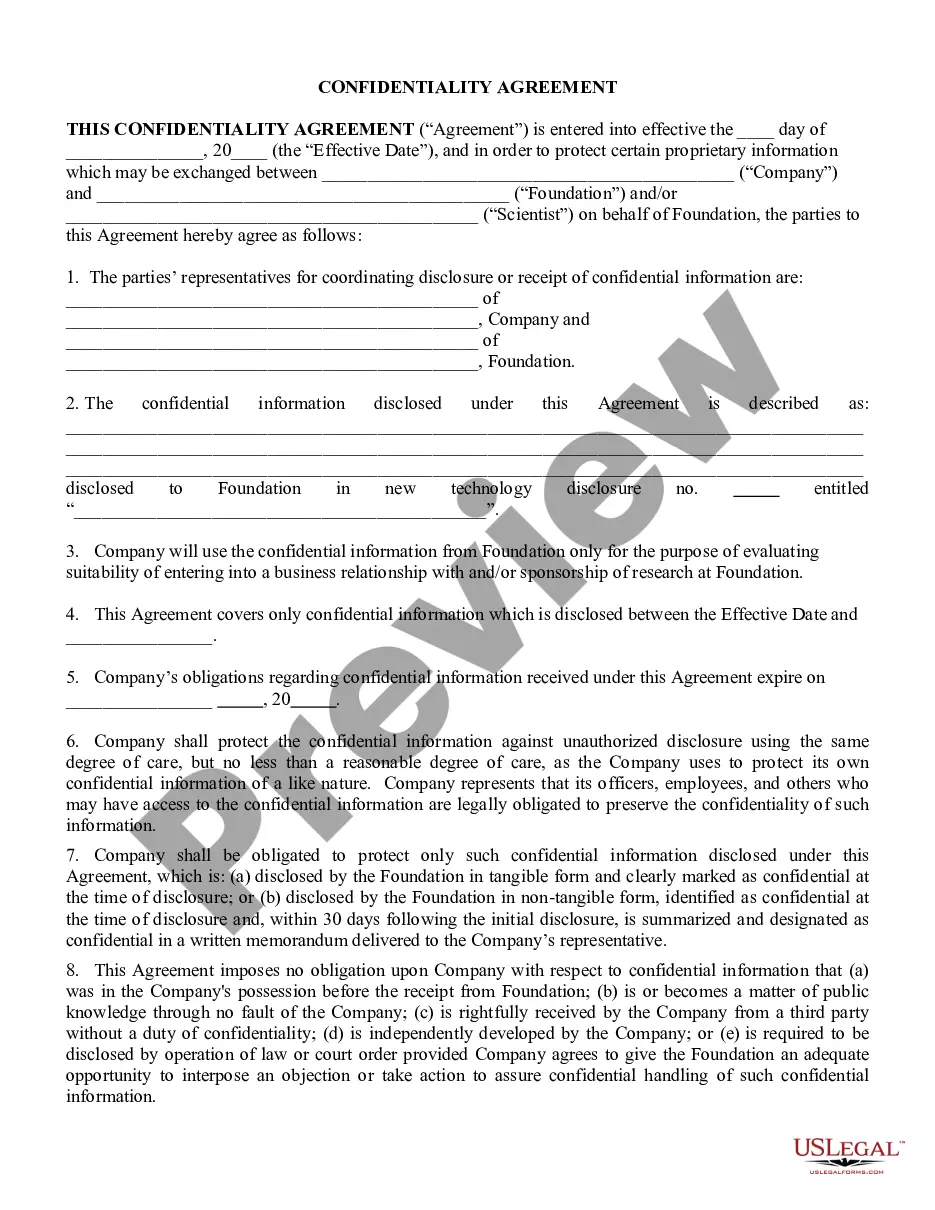
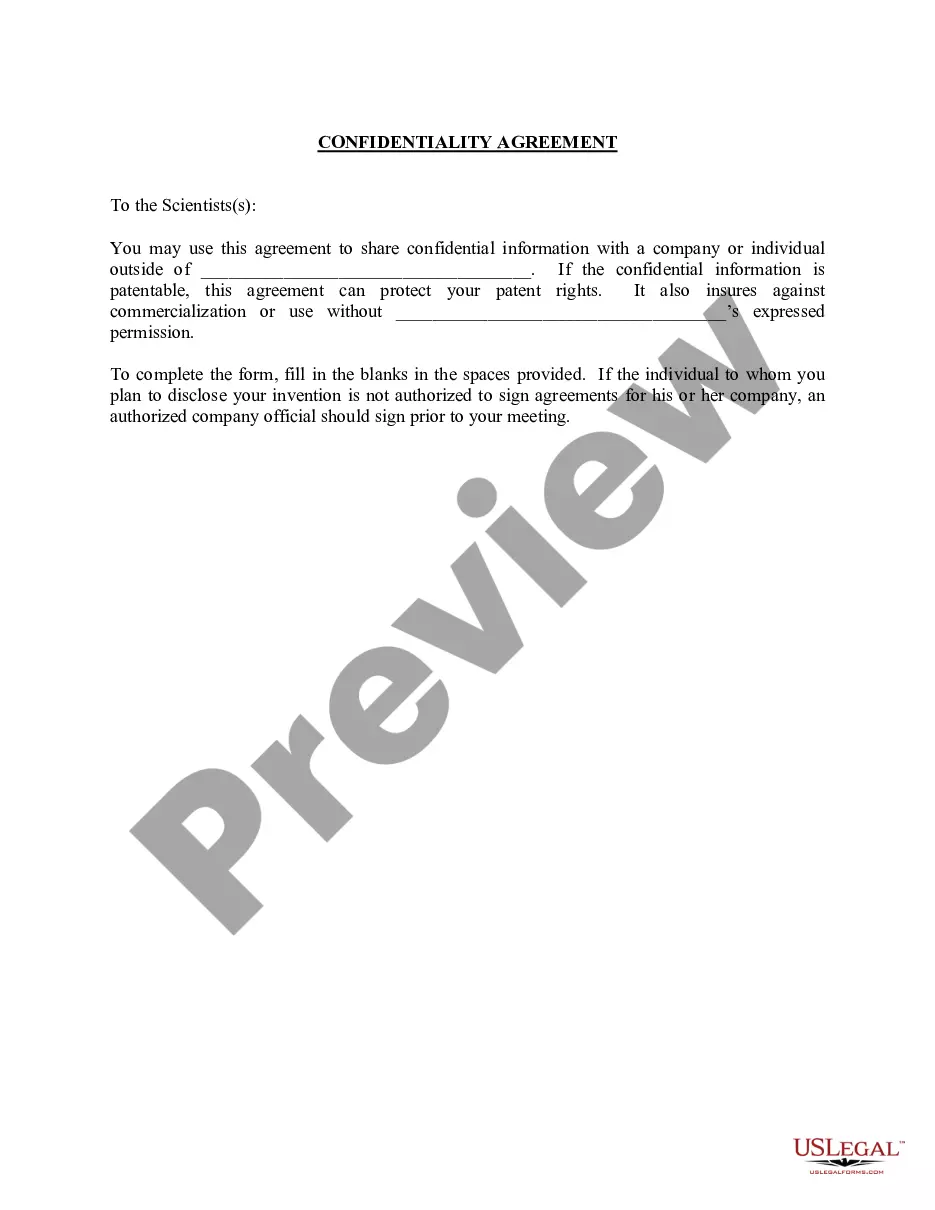
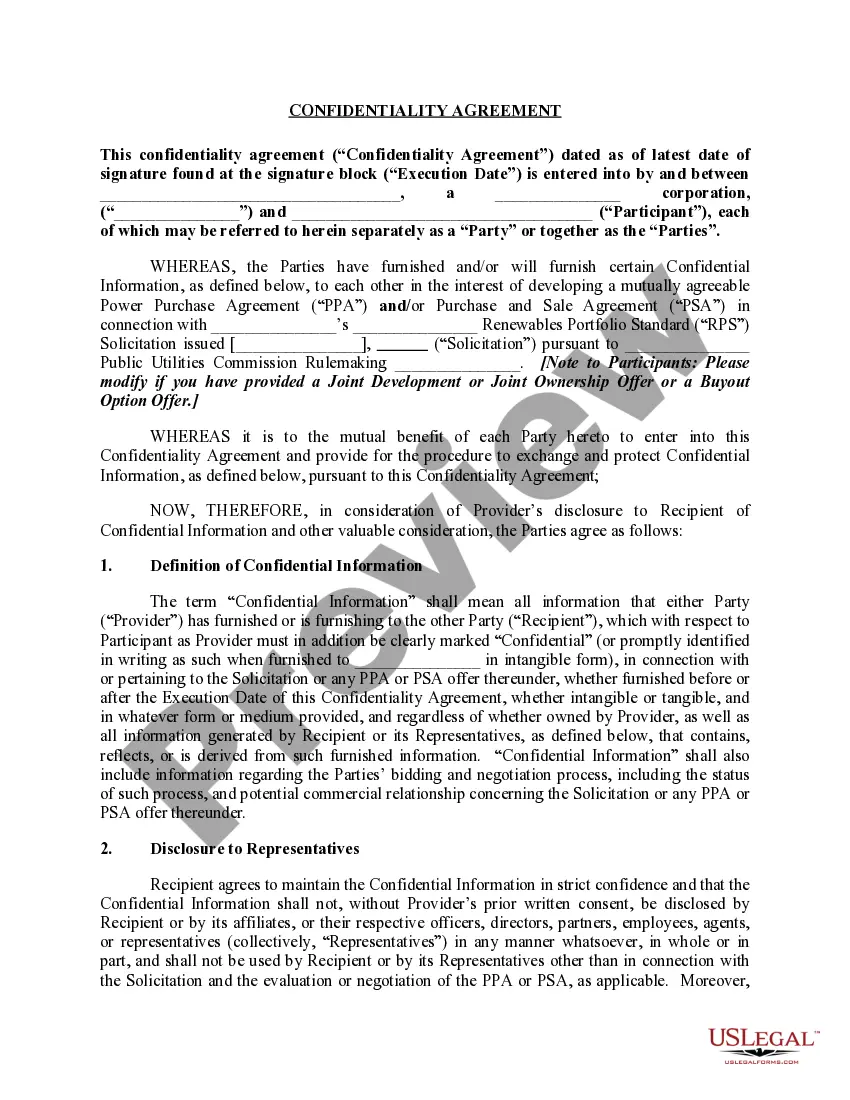
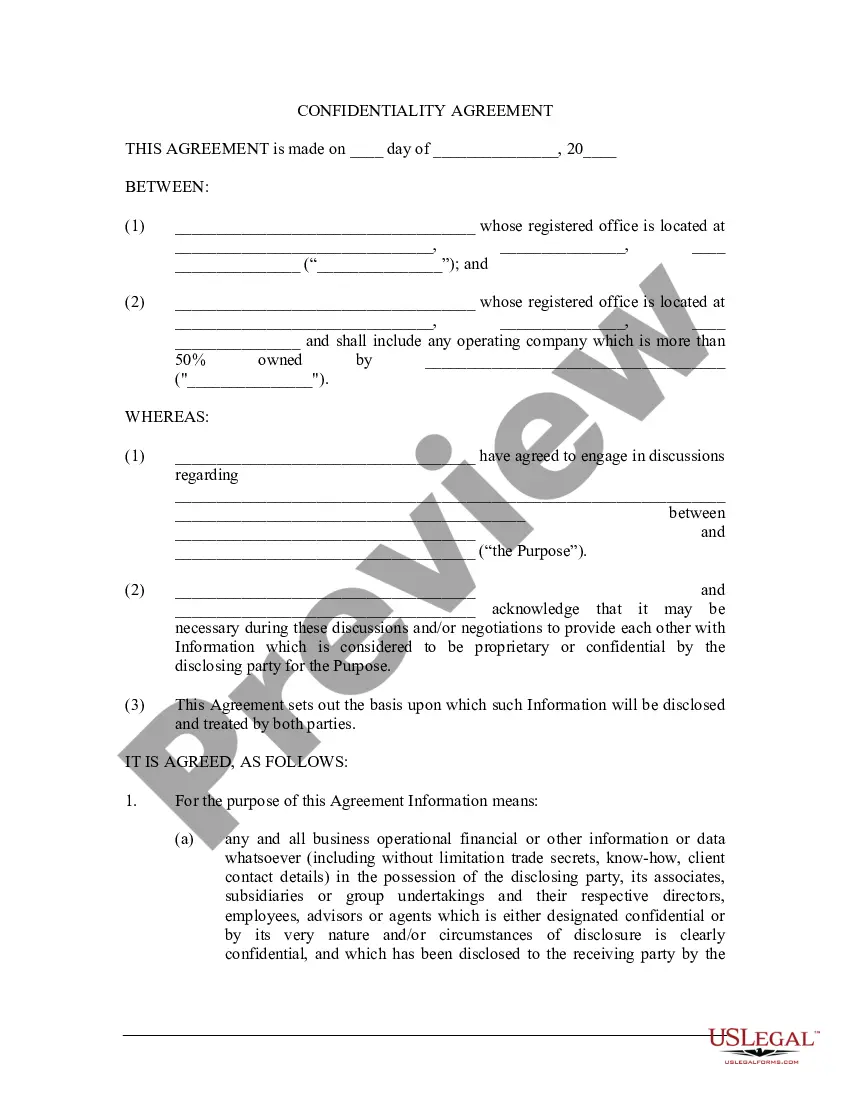
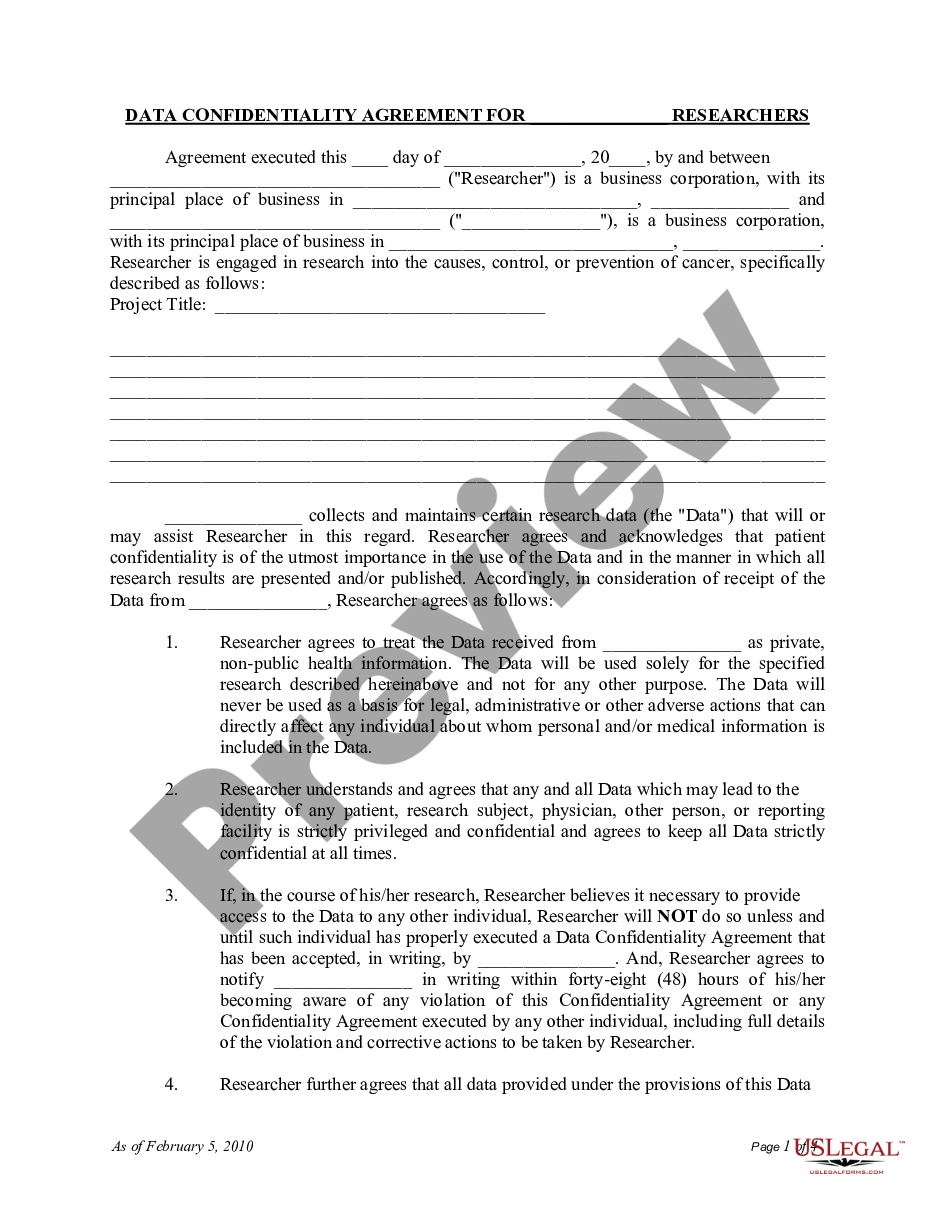
The Confidentiality Agreement between a Company and a Research Company (Foundation) is a legal document designed to protect proprietary information shared between the involved parties. This form ensures that sensitive details regarding new technology, especially pertaining to suitability evaluations, will remain confidential and not be disclosed without proper authorization. Unlike other non-disclosure agreements, this document specifically clarifies that no agency or partnership relationship is created through its execution, making it ideal for companies looking to safeguard their innovations while collaborating with research foundations.
Key parts of this document
- Effective date: Specifies the date when the agreement becomes active.
- Identification of parties: Names the Company and the Foundation involved in the agreement.
- Definition of confidential information: Outlines what constitutes confidential information and the conditions for its disclosure and protection.
- Obligations of the Company: Describes the Company's responsibilities toward safeguarding confidential information.
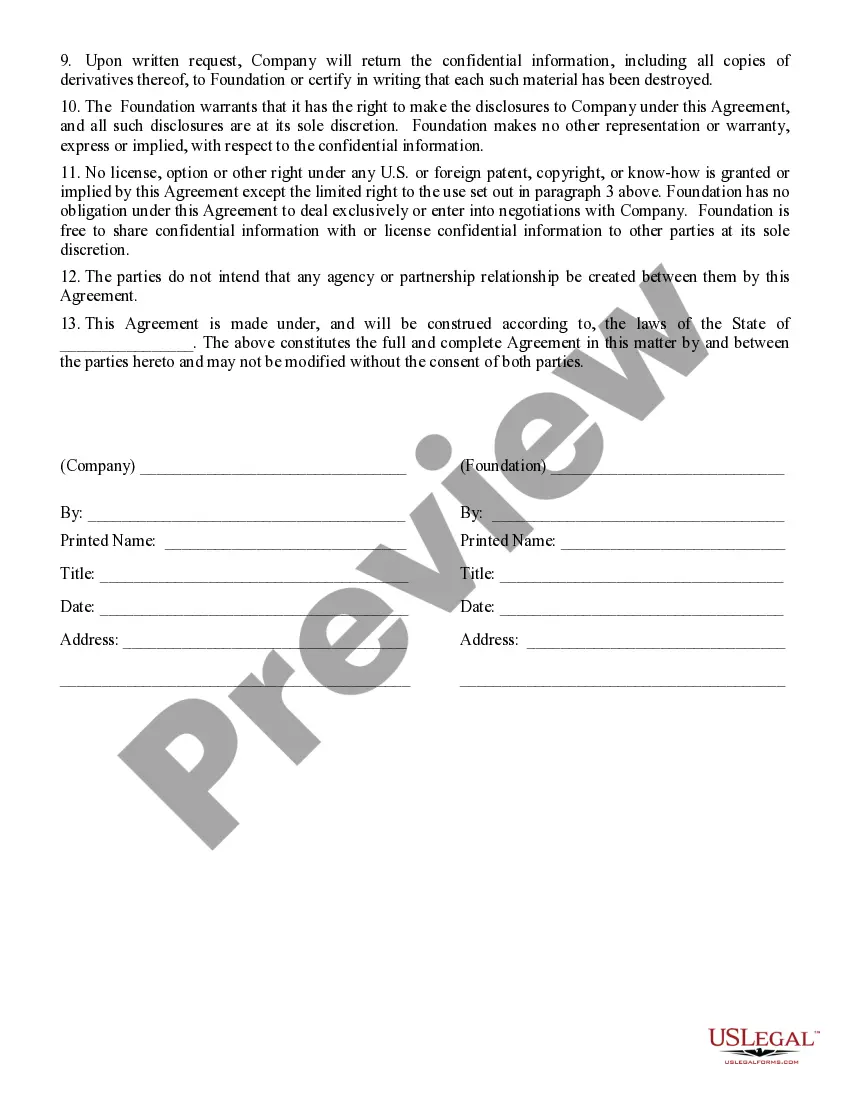
- Return or destruction of information: Details the requirements for returning or certifying the destruction of confidential material upon request.
- No creation of agency: Clearly states that the agreement does not establish any agency or partnership relationship between the parties.

When to use this form
This confidentiality agreement should be used when a company intends to share proprietary information with a research foundation during the evaluation or development of new technology. It is particularly useful in scenarios involving collaboration on research projects, granting access to sensitive data, or when considering potential partnerships, ensuring that all shared information remains secure from unauthorized disclosure.
Who can use this document
- Businesses planning to collaborate with research foundations on projects involving confidential technology.
- Research foundations receiving sensitive information from companies for evaluation purposes.
- Scientists or researchers acting on behalf of a foundation who need to ensure confidentiality in their work with private sector entities.
- Organizations wanting to establish clear terms around the protection of their proprietary information.
Completing this form step by step
- Identify the parties: Fill in the names of the Company and Research Foundation.
- Enter the effective date: Specify when the agreement goes into effect.
- Define the confidential information: Include details about what information is to be considered confidential.
- Assign representatives: Designate individuals from each party responsible for managing the confidentiality agreement.
- Obtain signatures: Ensure that authorized representatives from both parties sign and date the agreement.
Notarization guidance
This form does not typically require notarization to be legally valid. However, some jurisdictions or document types may still require it. US Legal Forms provides secure online notarization powered by Notarize, available 24/7 for added convenience.
Get your form ready online
Our built-in tools help you complete, sign, share, and store your documents in one place.
Make edits, fill in missing information, and update formatting in US Legal Forms—just like you would in MS Word.
Download a copy, print it, send it by email, or mail it via USPS—whatever works best for your next step.
Sign and collect signatures with our SignNow integration. Send to multiple recipients, set reminders, and more. Go Premium to unlock E-Sign.
If this form requires notarization, complete it online through a secure video call—no need to meet a notary in person or wait for an appointment.
We protect your documents and personal data by following strict security and privacy standards.

Make edits, fill in missing information, and update formatting in US Legal Forms—just like you would in MS Word.

Download a copy, print it, send it by email, or mail it via USPS—whatever works best for your next step.

Sign and collect signatures with our SignNow integration. Send to multiple recipients, set reminders, and more. Go Premium to unlock E-Sign.

If this form requires notarization, complete it online through a secure video call—no need to meet a notary in person or wait for an appointment.

We protect your documents and personal data by following strict security and privacy standards.
Common mistakes to avoid
- Failing to clearly define what constitutes confidential information.
- Not specifying an expiration date for the confidentiality obligations.
- Neglecting to have authorized representatives sign the agreement.
- Using vague language that could lead to different interpretations of the agreement.
Why use this form online
- Convenience: Easily download and fill out the form at your convenience.
- Editability: Modify the template to fit specific needs and scenarios.
- Reliability: Use forms prepared by licensed attorneys, ensuring proper legal standards are maintained.
Legal use & context
- This agreement serves to enforce confidentiality between entities and is legally binding when executed properly.
- It is important to comply with local laws and regulations regarding non-disclosure agreements to ensure full enforceability.
- Failure to adhere to the terms outlined may lead to legal disputes and loss of proprietary information.
Looking for another form?
Form popularity
FAQ
The legal name, address and contact details of the other party with which you wish to contract; Provide wording so that the Contracts Assistant can insert brief description of purpose/subject matter of the confidential information can be included in the CDA; Start and end date for the discussion.
There are three types of NDAs: unilateral, bilateral, and multilateral. Read on to learn when you should use each type.
Types of Agreement Many large companies require contractors to sign an NDA before starting work on any project. An MSA document is similar to an NDA, except it has been written for members of a group or organization rather than between two individuals or companies.
Keep all the research information shared with me confidential. I will not discuss or share any of the research information with anyone other than with the Researcher(s) or others identified by the Researcher(s). 2. Keep all research information secure while it is in my possession.
A Confidential Disclosure Agreement (CDA), also referred to as non-disclosure agreement (NDA) or secrecy agreement, is a legal agreement between a minimum of two parties which outlines information the parties wish to share with one another for certain evaluation purposes, but wish to restrict from wider use and
compete agreement is only used between an employee and a business to specify who may hire them should they leave the company. An NDA is much broader and is used to protect any personal or businessrelated information that one or both parties want to remain confidential.
Confidentiality. Also known as a non-disclosure agreement or clause, this section of an MSA protects intellectual property and other proprietary information from being disclosed.
Types of Agreement Many large companies require contractors to sign an NDA before starting work on any project. An MSA document is similar to an NDA, except it has been written for members of a group or organization rather than between two individuals or companies.