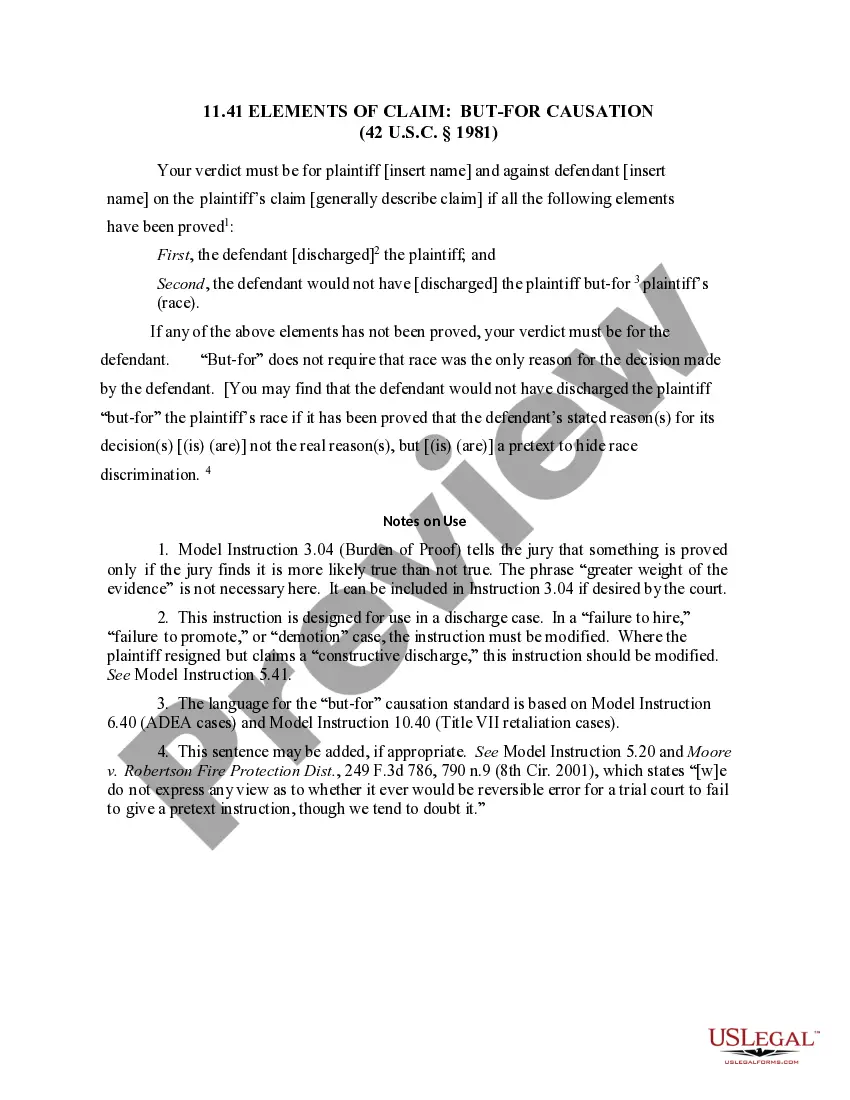
11.41 ELEMENTS OF CLAIM: DETERMINING FACTOR (42 U.S.C. Civ. 1981)
Understanding this form
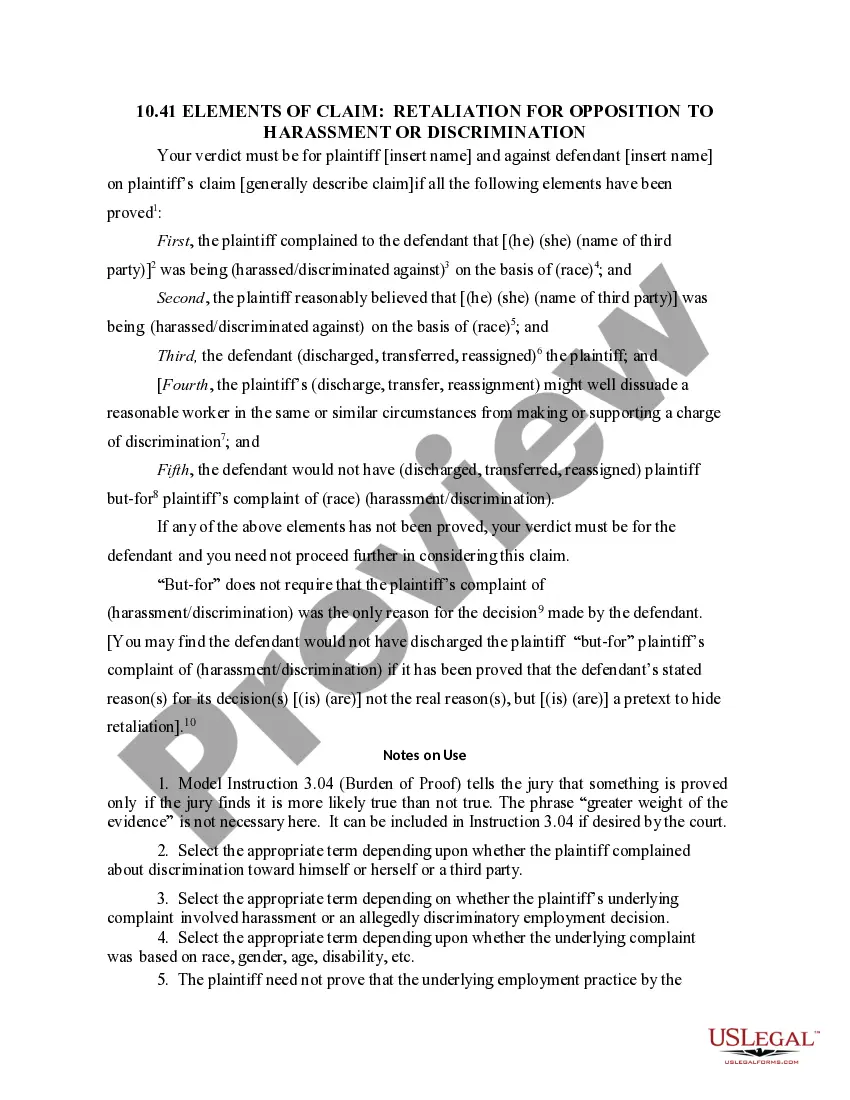
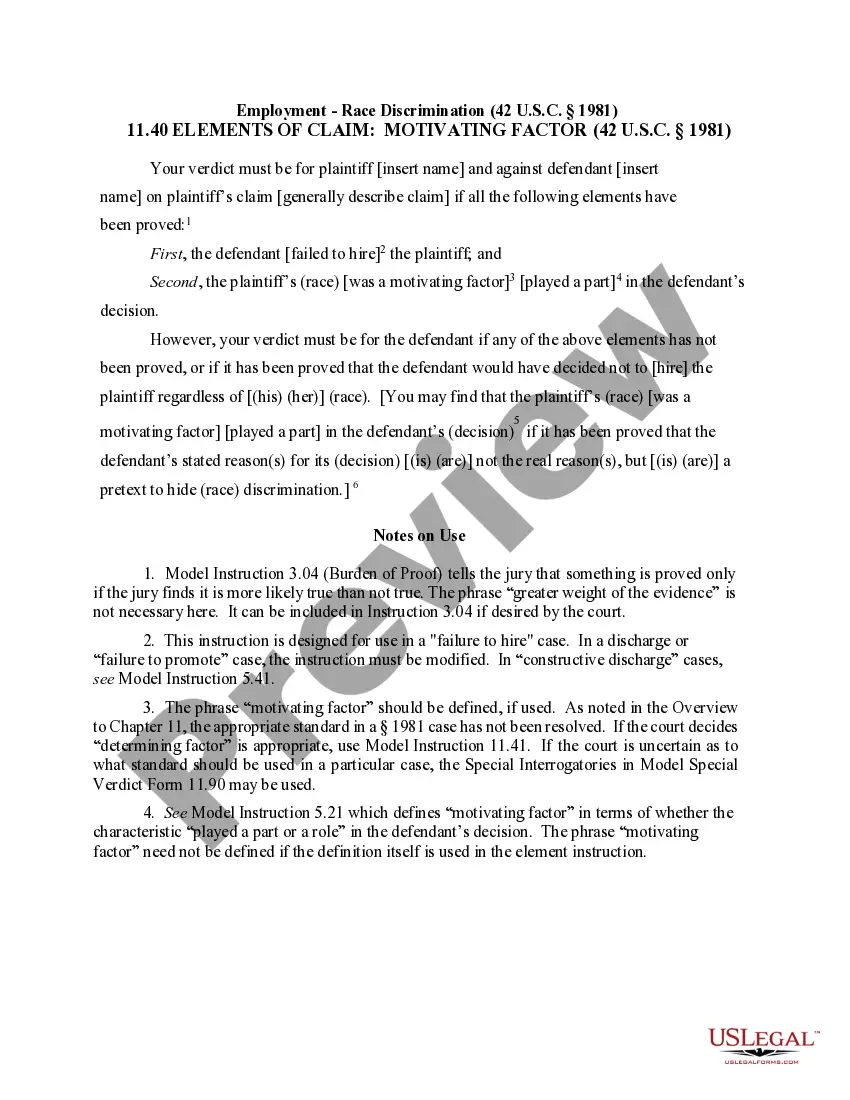
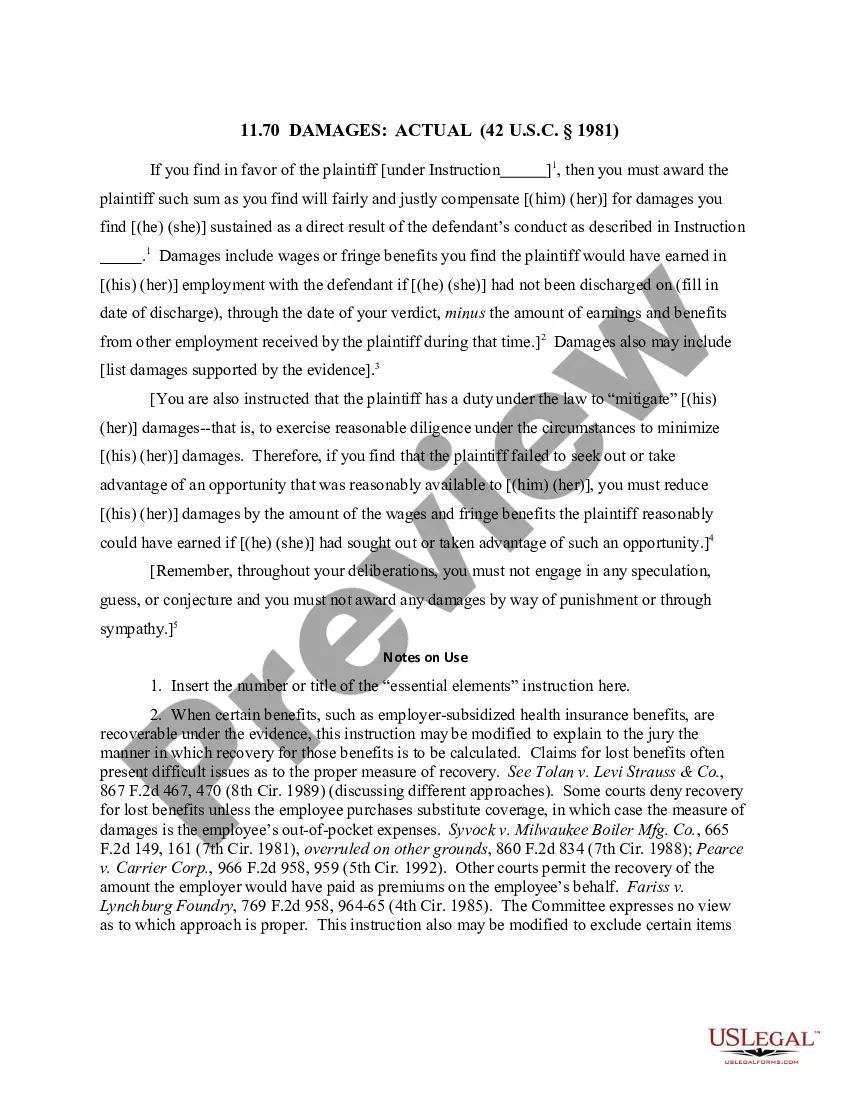
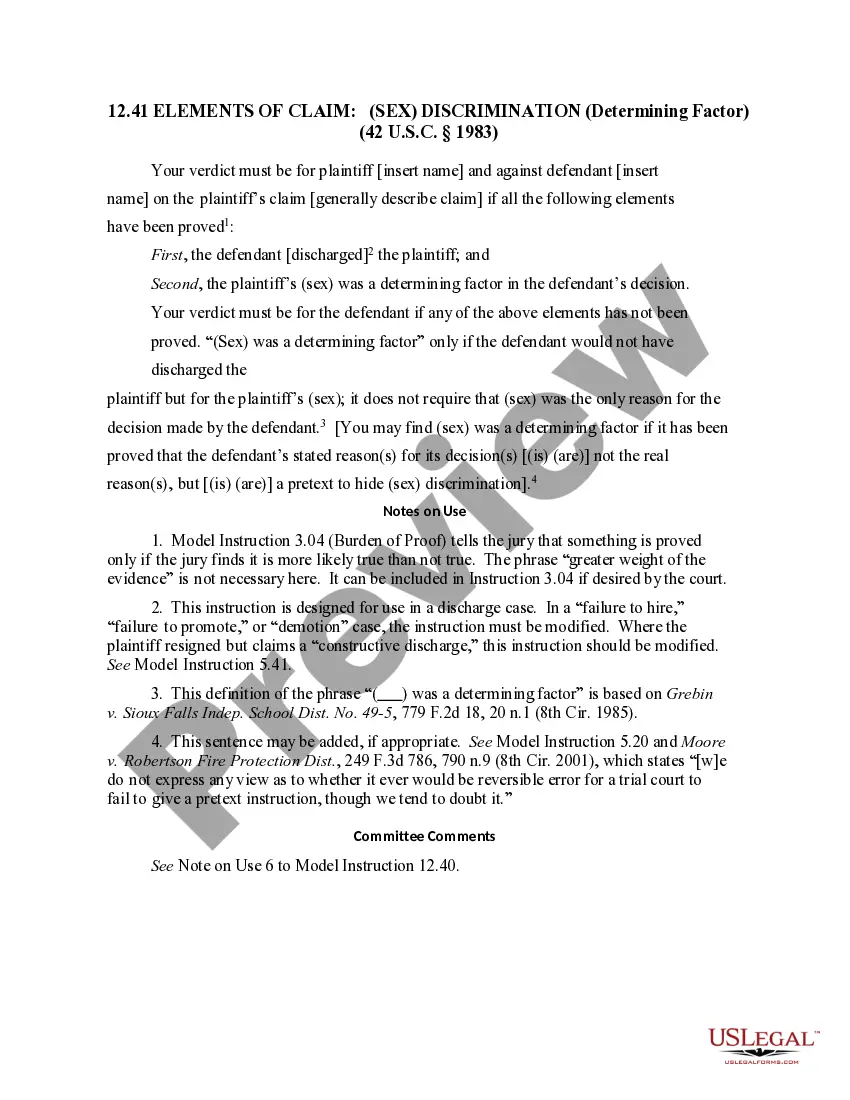
The "Elements of Claim: Determining Factor (42 U.S.C. Civ. 1981)" form is a legal instruction used in cases alleging racial discrimination in employment decisions. This form outlines the essential elements a plaintiff must prove to establish that race was a determining factor in a defendant's decision, such as wrongful discharge. It differs from similar forms by specifically focusing on the "but-for" causation standard, which indicates that the plaintiff's race must have played a significant role in the adverse action, even if not the only reason.
Form components explained
- Identification of the plaintiff and defendant involved in the claim.
- Clear statement of the adverse action taken (e.g., discharge).
- Criteria to establish that the plaintiff's race was a determining factor for the decision.
- Explanations of what constitutes "but-for" causation.
- Clarification on the burden of proof for the jury in assessing evidence.
When to use this document
This form is used in legal proceedings where an individual claims that they were discriminated against based on race during employment actions, such as being wrongfully fired. It can also be utilized in failure to hire or promotion cases, with appropriate modifications. If the plaintiff believes they were constructively discharged, adaptations to this instruction may also be necessary.
Who this form is for
This form is intended for:
- Plaintiffs seeking to establish a claim of employment discrimination based on race.
- Attorneys representing clients in civil rights or employment law cases.
- Individuals who want to understand their rights under 42 U.S.C. § 1981.
Steps to complete this form
- Identify and state the names of the plaintiff and defendant involved in the claim.
- Clearly describe the claim being made (e.g., wrongful discharge).
- Indicate the specific action taken by the defendant (e.g., termination of employment).
- Outline the evidence supporting the assertion that race was a determining factor in the action.
- Review the jury instructions on burden of proof to ensure clarity for presentation.
Does this form need to be notarized?
This form does not typically require notarization unless specified by local law. Users should check local regulations to confirm any such requirements in their jurisdiction.
Get your form ready online
Our built-in tools help you complete, sign, share, and store your documents in one place.
Make edits, fill in missing information, and update formatting in US Legal Forms—just like you would in MS Word.
Download a copy, print it, send it by email, or mail it via USPS—whatever works best for your next step.
Sign and collect signatures with our SignNow integration. Send to multiple recipients, set reminders, and more. Go Premium to unlock E-Sign.
If this form requires notarization, complete it online through a secure video call—no need to meet a notary in person or wait for an appointment.
We protect your documents and personal data by following strict security and privacy standards.

Make edits, fill in missing information, and update formatting in US Legal Forms—just like you would in MS Word.

Download a copy, print it, send it by email, or mail it via USPS—whatever works best for your next step.

Sign and collect signatures with our SignNow integration. Send to multiple recipients, set reminders, and more. Go Premium to unlock E-Sign.

If this form requires notarization, complete it online through a secure video call—no need to meet a notary in person or wait for an appointment.

We protect your documents and personal data by following strict security and privacy standards.
Typical mistakes to avoid
- Failing to provide sufficient evidence to show that race was a determining factor.
- Using incorrect or vague descriptions of the adverse action taken by the defendant.
- Neglecting to understand the modification needed for varying discrimination claims.
Benefits of using this form online
- Convenient access to the latest legal instructions without the need for extensive legal research.
- Editable templates allow for tailored use to meet specific case requirements.
- Reliable guidance provided by licensed attorneys ensures compliance with legal standards.
Legal use & context
- This form is relevant to establishing claims under federal law regarding race-based discrimination in employment.
- The "but-for" causation standard is crucial for the success of the plaintiff's claim.
- Federal courts generally accept this form as part of jury instructions in relevant cases.
Looking for another form?
Form popularity
FAQ
Which of the following is true regarding caps on punitive damages in Title VII cases based on discrimination other than race? Punitive damages are capped at $300,000 for employers of more than 500 employees.
Section 1981 is a shorthand reference to 42 U.S.C. § 1981, which derives from Section 1 of the 1866 Civil Rights Act. The statute establishes that certain rights are to be guaranteed to all citizens of the United States, and these rights are to be protected against impairment by nongovernment and state discrimination.
If there was intentional discrimination, an employee may be able to recover compensatory and punitive damages. Compensatory and punitive damages under Title VII are subject to a combined cap based on the employer's size.
Limits On Compensatory & Punitive Damages These limits vary depending on the size of the employer: For employers with 15-100 employees, the limit is $50,000. For employers with 101-200 employees, the limit is $100,000. For employers with 201-500 employees, the limit is $200,000.
What Are Punitive Damages in California? Much like a personal injury case, punitive damages in employment cases are designed to punish your employer and deter them (and other employers) from committing the same intentional and malicious discriminatory actions.
In most state and federal discrimination cases, the employee is entitled to receive the following types of damages: back pay; front pay; lost benefits such as health, vacation, sick leave, and pension; reinstatement; reasonable accommodations; and compensatory and punitive damages. 2.
Since 1870, Congress has substantively amended Section 1981 on only one occasion, after this Court's de- cision in Patterson v. McLean Credit Union, 491 U.S. 164 (1989). In Patterson, the Court ?reaffirmed? that Section 1981 ?prohibits racial discrimination in the making and enforcement of private contracts.? Id.
Model In this case plaintiff is alleging that defendant describe alleged disparate treatment plaintiff.plaintiff must prove that defendant intentionally discriminated against plaintiff.that plaintiff must prove that his/her race was a motivating factor in defendant's decision.