14.41 ELEMENTS OF CLAIM: WRONGFUL TERMINATION (Employee Needed to Care for Spouse, Parent, Son or Daughter with a Serious Health Condition
Understanding this form
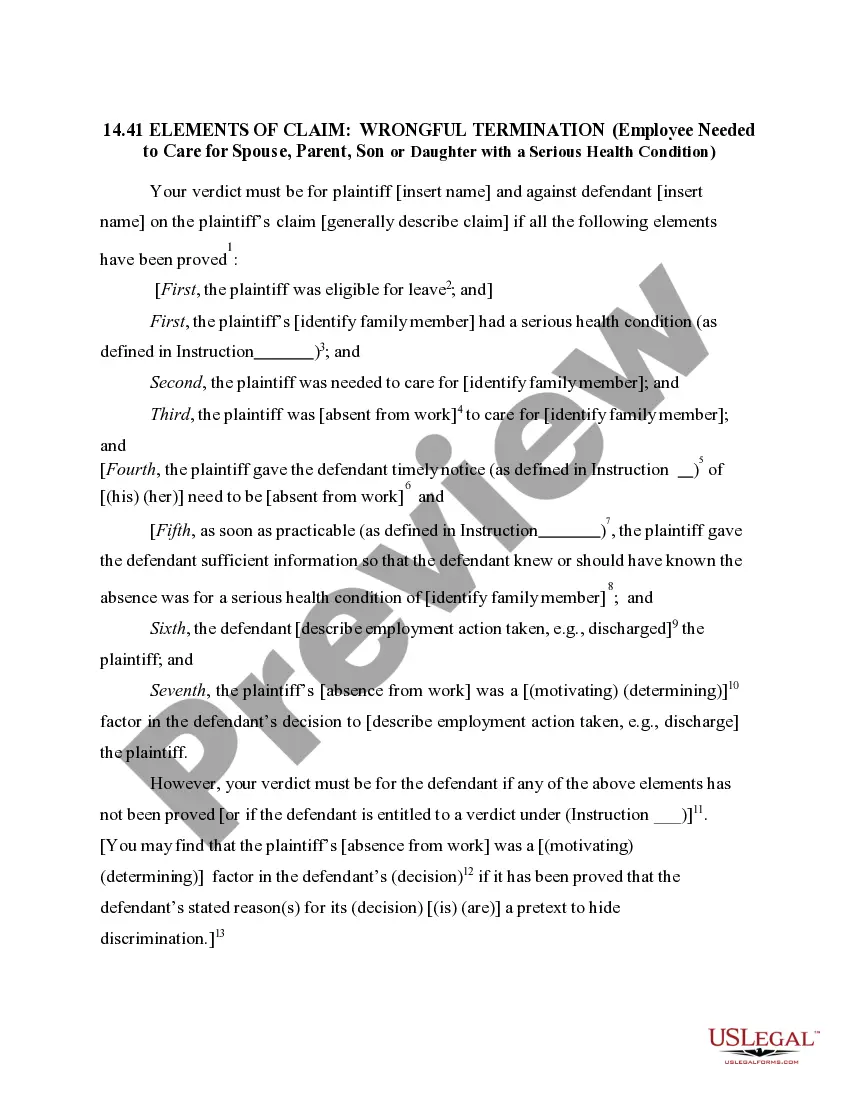
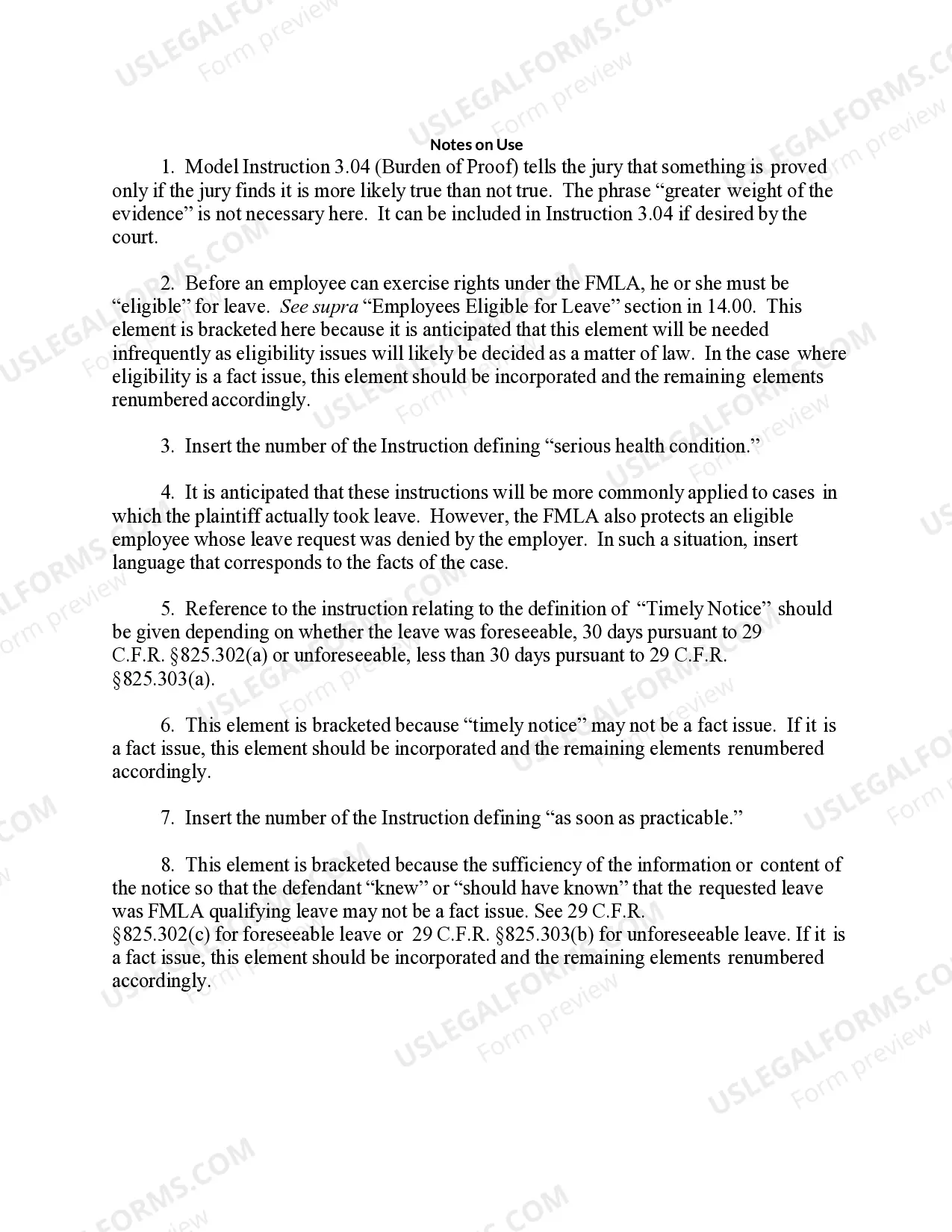
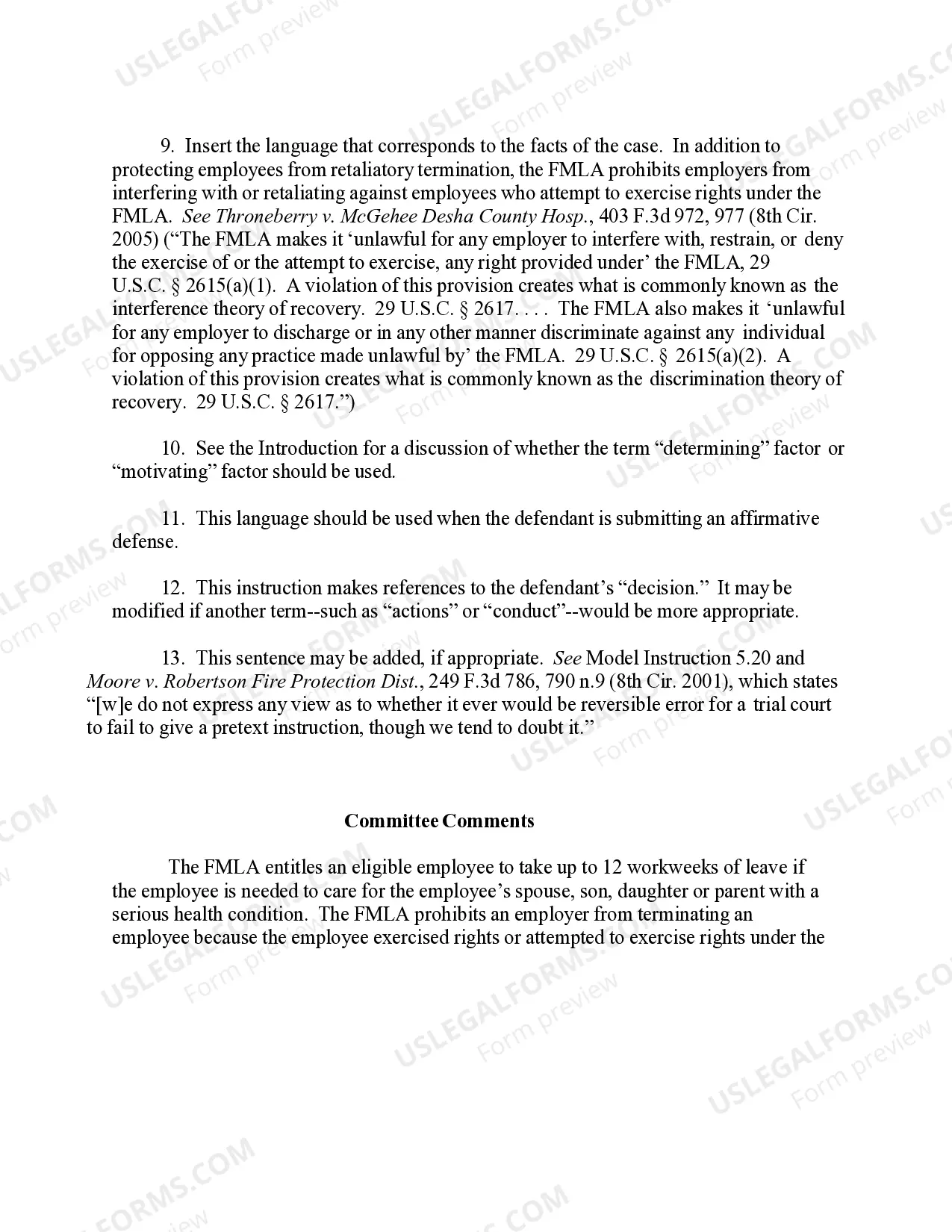
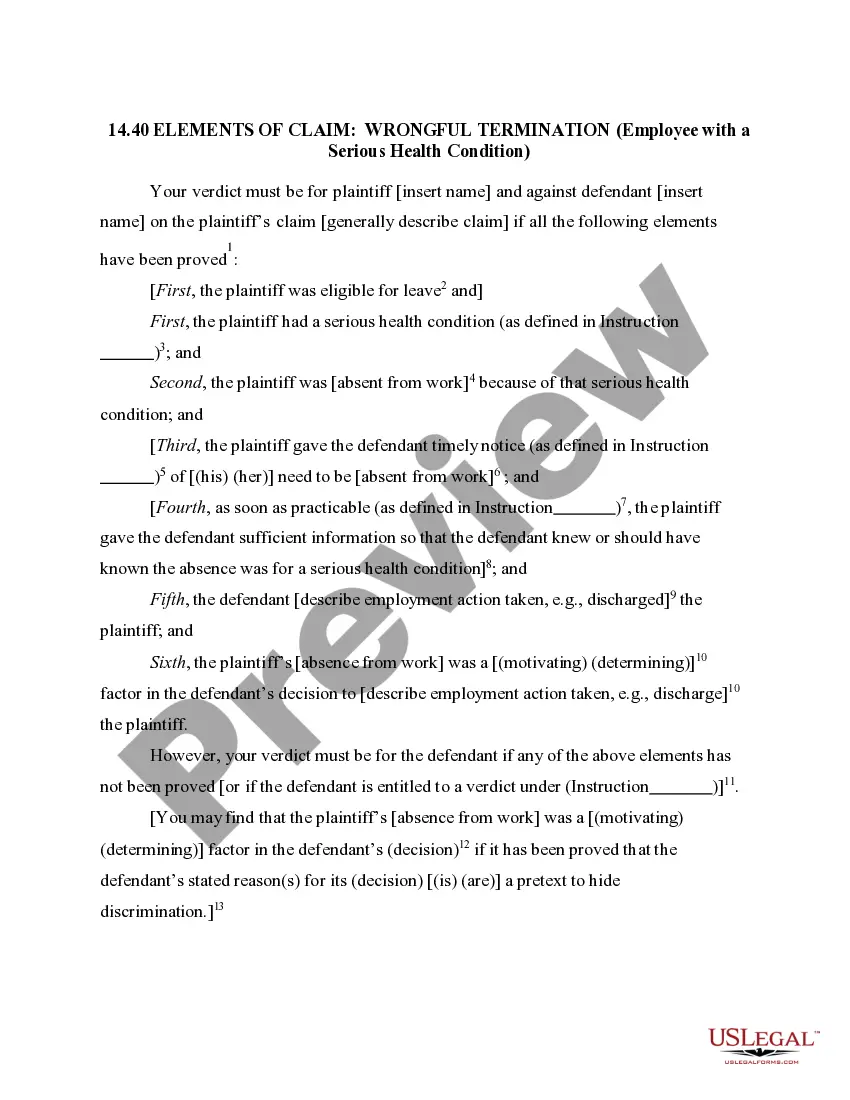
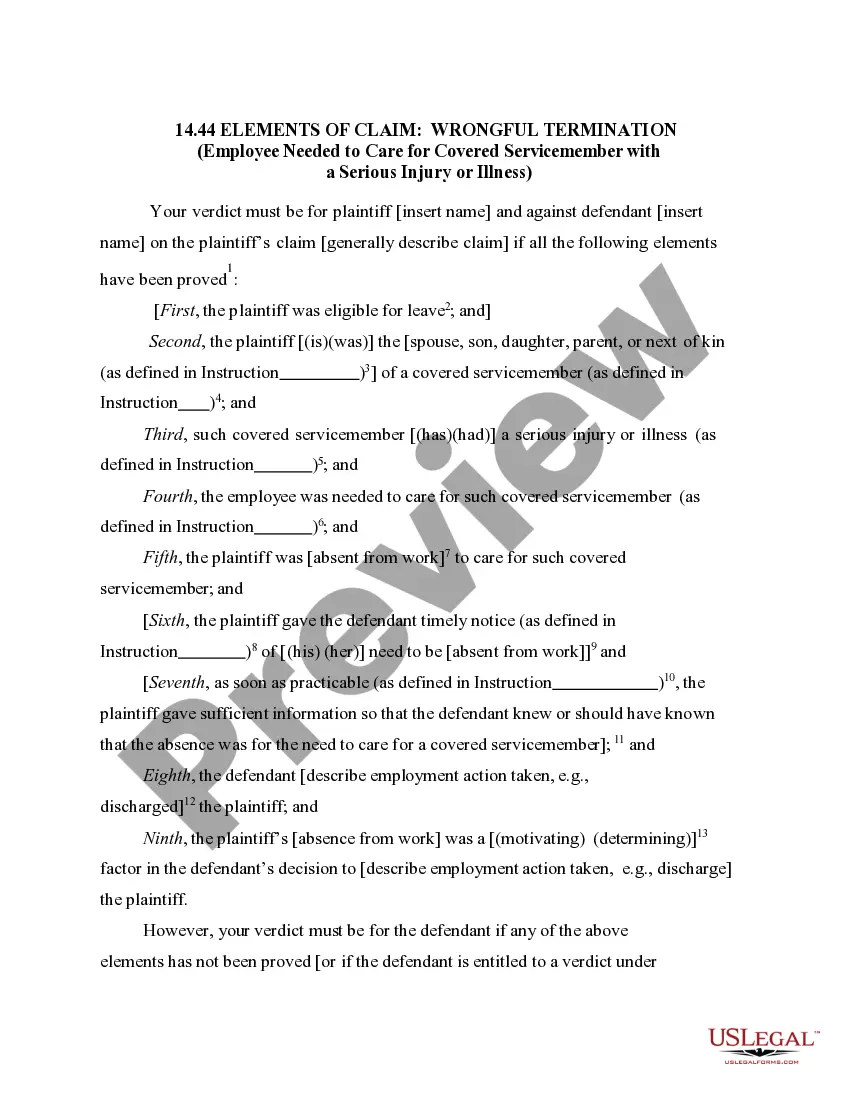
This form, known as the 14.41 Elements of Claim: Wrongful Termination (Employee Needed to Care for Spouse, Parent, Son or Daughter with a Serious Health Condition), is used to outline the legal basis for a wrongful termination claim under the Family and Medical Leave Act (FMLA). It specifies the circumstances under which an employee can assert that their termination was unjust, particularly when they had to take leave to care for a seriously ill family member. This form is distinct from other employment-related forms as it provides a structured approach to proving wrongful termination due to caregiving responsibilities.
Form components explained
- Criteria for eligibility for FMLA leave.
- Definition of a serious health condition.
- Obligations for notifying the employer about absence.
- Details regarding the action taken by the employer.
- Connection between the employee's absence and the employer's decision.
When to use this document
This form should be used when an employee believes they were wrongfully terminated after taking leave to care for a family member with a serious health condition. It is applicable in situations where an employee needs to assert their rights under the FMLA and demonstrate that their termination was motivated by their need to care for an ill relative.
Who should use this form
- Employees who were terminated while on leave to care for a sick family member.
- Individuals who need to provide evidence for a wrongful termination claim.
- Workers seeking to understand their rights under FMLA.
How to prepare this document
- Identify the parties involved, including the plaintiff and the defendant.
- Specify the family member with a serious health condition.
- Document the dates and duration of absence from work.
- Include any notice provided to the employer regarding the absence.
- Outline the employment action taken by the employer that may be considered wrongful termination.
Does this form need to be notarized?
Notarization is generally not required for this form. However, certain states or situations might demand it. You can complete notarization online through US Legal Forms, powered by Notarize, using a verified video call available anytime.
Get your form ready online
Our built-in tools help you complete, sign, share, and store your documents in one place.
Make edits, fill in missing information, and update formatting in US Legal Forms—just like you would in MS Word.
Download a copy, print it, send it by email, or mail it via USPS—whatever works best for your next step.
Sign and collect signatures with our SignNow integration. Send to multiple recipients, set reminders, and more. Go Premium to unlock E-Sign.
If this form requires notarization, complete it online through a secure video call—no need to meet a notary in person or wait for an appointment.
We protect your documents and personal data by following strict security and privacy standards.

Make edits, fill in missing information, and update formatting in US Legal Forms—just like you would in MS Word.

Download a copy, print it, send it by email, or mail it via USPS—whatever works best for your next step.

Sign and collect signatures with our SignNow integration. Send to multiple recipients, set reminders, and more. Go Premium to unlock E-Sign.

If this form requires notarization, complete it online through a secure video call—no need to meet a notary in person or wait for an appointment.

We protect your documents and personal data by following strict security and privacy standards.
Common mistakes
- Failing to provide timely notice to the employer about the need for leave.
- Not documenting the serious health condition of the family member thoroughly.
- Overlooking state-specific regulations that may impact the claim.
Why use this form online
- Convenient access without the need for in-person consultation.
- Easy to fill out and edit according to personal circumstances.
- Reliable resources provided by licensed attorneys to ensure accuracy.
Legal use & context
- The FMLA entitles eligible employees to take leave for family health issues.
- Wrongful termination claims must be substantiated with clear evidence.
- The employer must not retaliate against an employee exercising their rights under the FMLA.
Quick recap
- This form is crucial for making a legal claim of wrongful termination under the FMLA.
- Employers are prohibited from terminating employees for taking FMLA leave.
- Clearly documenting all elements of the claim is vital for success.
Looking for another form?
Form popularity
FAQ
Serious health condition means an illness, injury, impairment, or physical or mental condition which requires: Overnight hospitalization (including prenatal care), including the period of incapacity or subsequent treatment in connection with the overnight care.
The Family and Medical Leave Act (FMLA) provides certain workers job-protected leave when they need time off work because of a serious health condition. Workers can also take FMLA leave from work to care for a child, parent, or spouse with a serious health condition.
The FMLA defines a serious health condition as an illness, injury, impairment, or physical or mental condition that involves either inpatient care or continuing treatment by a health care provider. Both physical and mental health conditions qualify for FMLA leave.
An employee who must miss work for multiple treatments has a serious health condition if the treatments are for: restorative surgery after an accident or injury, or. a condition that would require an absence of more than three days if not treated.
Major Medical Event means a medical event that is serious in nature and has an adverse effect on the Member's physical health.
A ?son or daughter? is defined by the FMLA regulations as a biological, adopted, or foster child, a stepchild, a legal ward, or a child of a person standing in loco parentis who is either under 18 years of age or is 18 years of age or older and ?incapable of self-care because of a mental or physical disability? at the
A common assumption on the part of many HR professionals is that if an employee's family member is receiving care from professionals in a hospital, hospice or other care facility, the employer can deny the employee's FMLA leave request. This is simply not the case.
A chronic condition whether physical or mental (e.g., rheumatoid arthritis, anxiety, dissociative disorders) that may cause occasional periods when an individual is unable to work is a qualifying serious health condition if it requires treatment by a health care provider at least twice a year and recurs over an