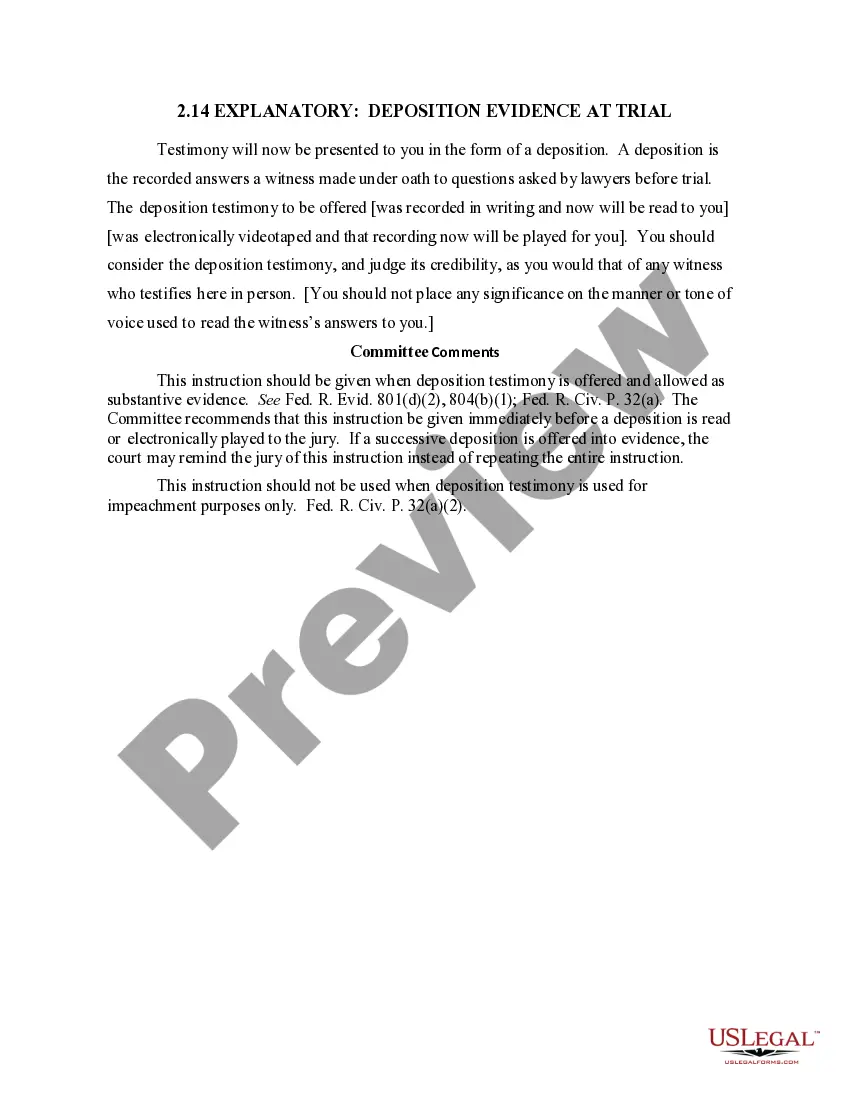
2.14 EXPLANATORY: DEPOSITION EVIDENCE AT TRIAL
About this form
The 2.14 Explanatory: Deposition Evidence at Trial form provides instructions for jurors regarding how to properly interpret and consider deposition testimony presented during a trial. A deposition is a legally recorded statement made by a witness under oath, and it may be used as substantive evidence. This form guides jurors on how to evaluate deposition testimony, ensuring they understand its credibility and relevance, just as they would with live testimony.
Form components explained
- Definition of deposition: A record of a witness's sworn testimony before trial.
- Instructions on evaluating credibility: Jurors are encouraged to assess deposition testimony like any in-person witness.
- Clarification on format: Explains whether the deposition will be read or played as a video recording.
- Guidance on tone: Jurors are reminded not to judge the witness by the manner of delivery.
- Legal references: References to Federal Rules of Evidence that support the use of depositions at trial.
Situations where this form applies
This form is applicable when a party introduces deposition testimony into evidence during a trial. It serves to clarify how jurors should consider this testimony, particularly in cases where live witness testimony is not available. It's essential in situations where depositions have been taken in preparation for trial, allowing jurors to understand their role in assessing this form of evidence.
Intended users of this form
- Judges overseeing a trial where deposition testimony is presented.
- Lawyers who need to inform jurors about the proper interpretation of deposition evidence.
- Jurors who must evaluate deposition testimony during legal proceedings.
Instructions for completing this form
- Identify the type of deposition: Specify whether it is read from a transcript or played as a video recording.
- Prepare juror instructions: Clearly outline how jurors should evaluate the credibility of the deposition compared to in-person testimony.
- Ensure legal compliance: Reference the appropriate Federal Rules of Evidence to support the instructions.
- Provide context: Explain that the manner in which the deposition is presented should not influence jurors' evaluations.
- Deliver the instructions: Present the form to the jury immediately before the deposition is shared.
Notarization requirements for this form
This form does not typically require notarization to be legally valid. However, some jurisdictions or document types may still require it. US Legal Forms provides secure online notarization powered by Notarize, available 24/7 for added convenience.
Get your form ready online
Our built-in tools help you complete, sign, share, and store your documents in one place.
Make edits, fill in missing information, and update formatting in US Legal Forms—just like you would in MS Word.
Download a copy, print it, send it by email, or mail it via USPS—whatever works best for your next step.
Sign and collect signatures with our SignNow integration. Send to multiple recipients, set reminders, and more. Go Premium to unlock E-Sign.
If this form requires notarization, complete it online through a secure video call—no need to meet a notary in person or wait for an appointment.
We protect your documents and personal data by following strict security and privacy standards.

Make edits, fill in missing information, and update formatting in US Legal Forms—just like you would in MS Word.

Download a copy, print it, send it by email, or mail it via USPS—whatever works best for your next step.

Sign and collect signatures with our SignNow integration. Send to multiple recipients, set reminders, and more. Go Premium to unlock E-Sign.

If this form requires notarization, complete it online through a secure video call—no need to meet a notary in person or wait for an appointment.

We protect your documents and personal data by following strict security and privacy standards.
Mistakes to watch out for
- Failure to provide clear instructions on the nature of deposition testimony.
- Not reminding jurors to disregard the manner of delivery when evaluating credibility.
- Overlooking important legal references that support the validity of the deposition.
Benefits of using this form online
- Convenient access to legal guidelines and instructions at any time.
- Easy to customize for specific cases and jurisdictions.
- Reliability ensuring that the instructions are consistent with current legal standards.
Legal use & context
- Depositions can be used as substantive evidence in court under specific legal rules.
- Jurors are instructed to evaluate deposition testimony just as they would live testimony.
- If depositions are introduced solely for impeachment purposes, different instructions apply.
Main things to remember
- The form provides essential instructions on evaluating deposition evidence.
- It clarifies that jurors should assess deposition credibility similar to in-person testimony.
- Understanding the legal context is crucial to ensure fair evaluations of depositions in trials.
Looking for another form?
Form popularity
FAQ
The United States Supreme Court has held that exculpatory evidence is any evidence that is favorable to the defendant on issues of guilt or punishment. Exculpatory evidence is also sometimes called ?Bradyevidence? or ?Bradymaterial,? a name that comes from the Court's decision in Brady v.
Evidence that could be used to challenge the credibility of a prosecution witness is also exculpatory and must be turned over to the defense. The U.S. Supreme Court has ruled repeatedly for more than 60 years that the prosecutor's disclosure of exculpatory evidence to the defendant is essential to a fair trial.
The Brady rule, named after Brady v. Maryland, requires prosecutors to disclose material, exculpatory information in the government's possession to the defense.
Evidence that could be used to challenge the credibility of a prosecution witness is also exculpatory and must be turned over to the defense. The U.S. Supreme Court has ruled repeatedly for more than 60 years that the prosecutor's disclosure of exculpatory evidence to the defendant is essential to a fair trial.
In criminal law, exculpatory evidence is evidence, such as a statement, tending to excuse, justify, or absolve the alleged fault or guilt of a defendant. In other words, the evidence is favorable to the defendant. In contrast to it, inculpatory evidence tends to stress guilt. See also: Brady Rule.
Exculpatory evidence, on the other hand, supports a defendant's innocence. It can include proof of an alibi, an eyewitness statement, video footage, audio recordings or any other physical evidence that shows doubt that the person in question committed the crime.
There are essentially three ways to use a deposition at trial. The first is reading from the deposition of a witness that is unavailable. The second is reading from the deposition of an opposing party. The third is using the deposition for impeachment.
Depositions are usually hearsay and are thus inadmissible at trial. There are, however, three exceptions to the hearsay rule that are particularly relevant to deposition testimony. The first is when a party admits something in a deposition that is against their interest.