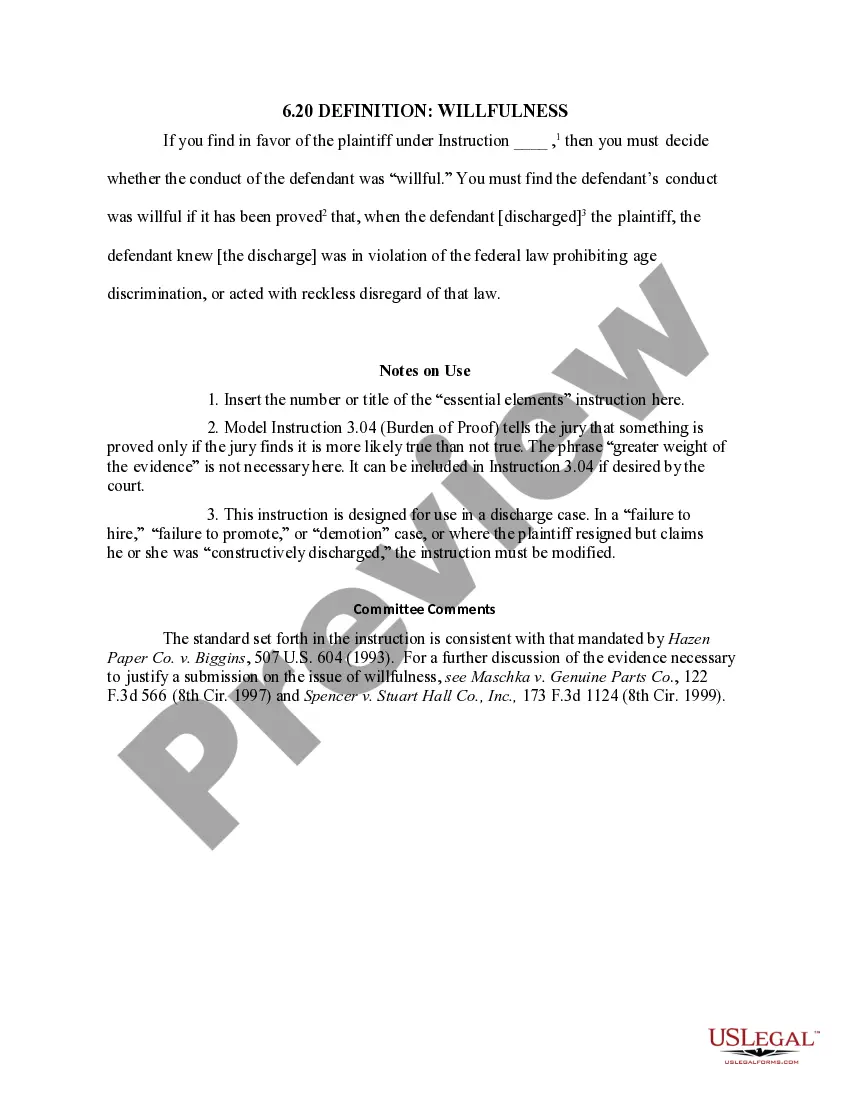
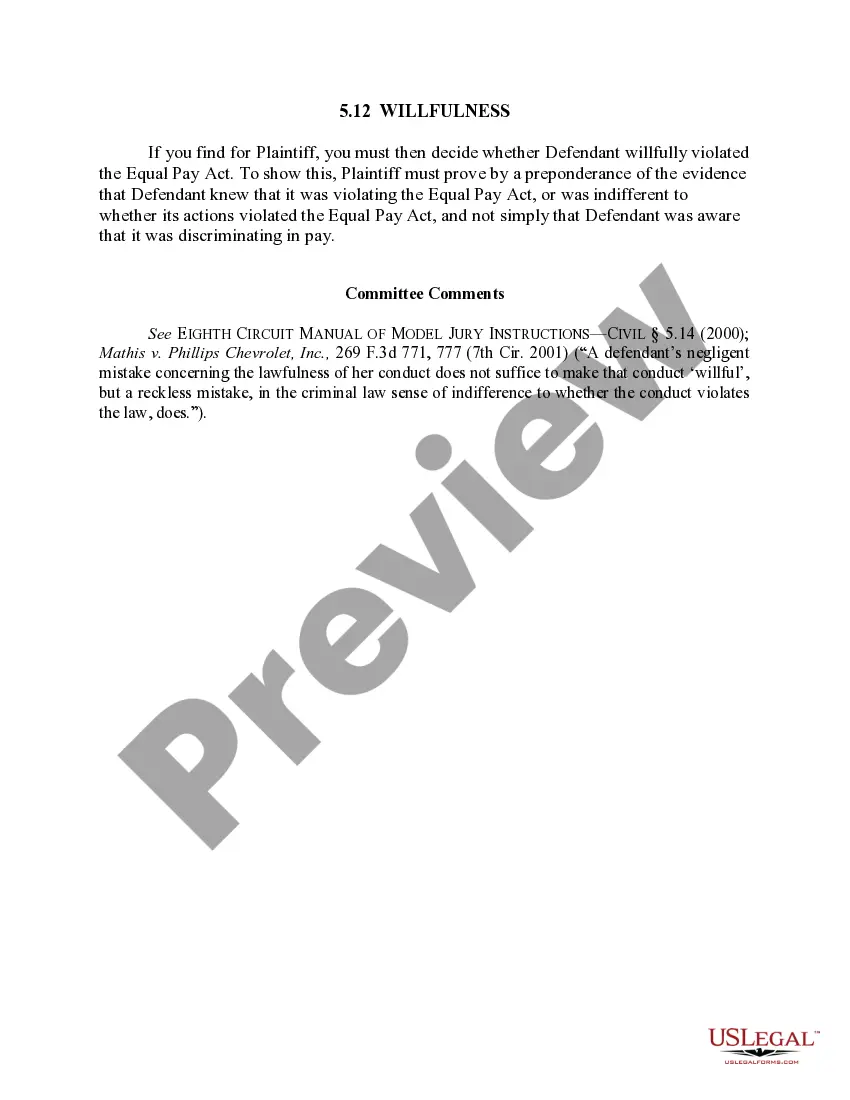
6.20 DEFINITION: WILLFULNESS
Overview of this form
The 6.20 Definition: Willfulness form is designed to clarify the concept of willfulness in legal cases, particularly regarding wrongful termination due to age discrimination. This form helps establish whether the defendant's actions were knowingly in violation of federal law or if they acted with reckless disregard. It is distinct from other legal instructions, as it specifically addresses the intent behind the conduct of the defendant in employment-related disputes.
Key components of this form
- Instruction on determining if the defendant's conduct was willful.
- Criteria for proving willful behavior, including knowledge of law violations.
- Notes on modifying the instruction for various employment scenarios.
- References to relevant case laws for further context.
- Guidance on linking the instruction to essential elements in a trial.
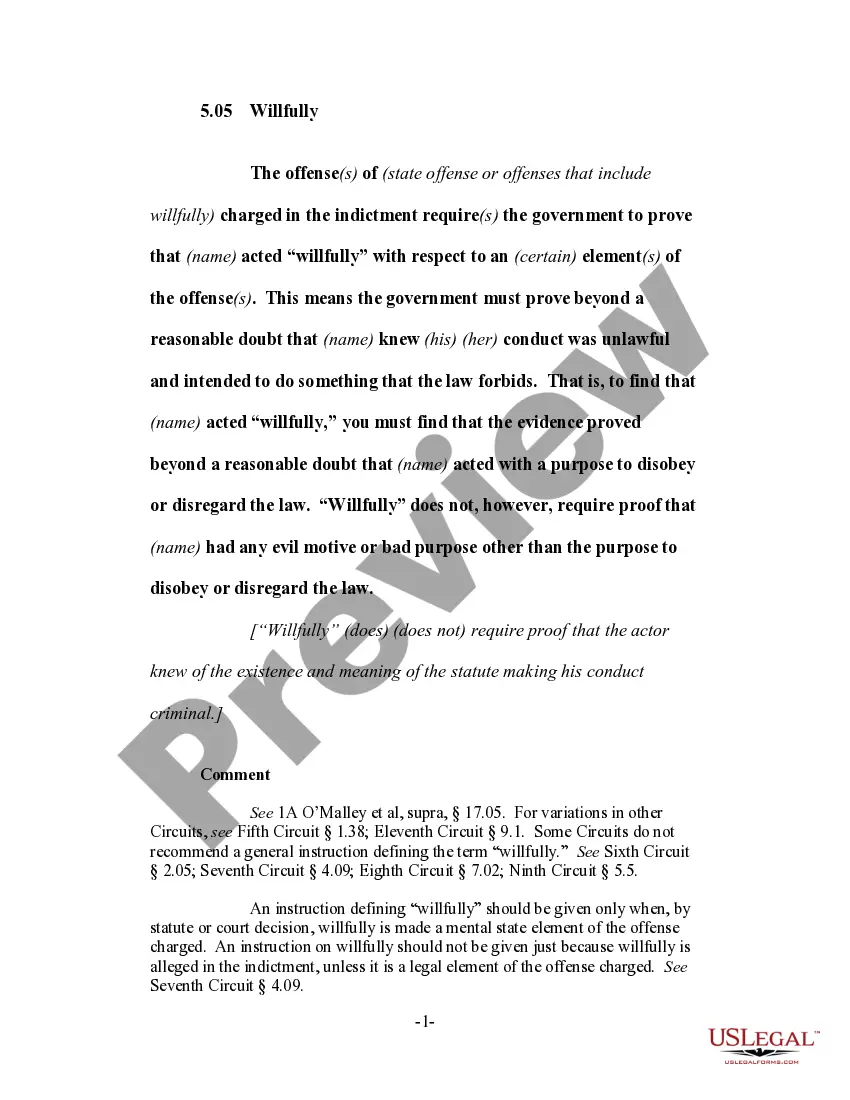
When to use this document
This form should be used in legal cases where a plaintiff claims wrongful termination due to age discrimination. It is essential when evaluating whether the defendant acted willfully in their decision to terminate the plaintiff. This form also applies to related situations, such as failure to hire, failure to promote, or wrongful demotion, provided it is adapted accordingly.
Intended users of this form
- Legal professionals handling age discrimination cases.
- Plaintiffs seeking to prove willfulness in employment-related disputes.
- Attorneys preparing jury instructions for trials related to wrongful termination.
- Jurors needing clarification on the definition of willfulness in a case.
Completing this form step by step
- Identify the specific instruction or number for essential elements you want to reference.
- Evaluate the evidence presented about the defendantâs conduct.
- Determine if there was knowledge of law violation or reckless disregard by the defendant.
- Incorporate guidance from relevant court cases to support your findings.
- Modify the instruction as necessary based on the specifics of the case (e.g., discharge vs. failure to hire).
Notarization requirements for this form
This form does not typically require notarization to be legally valid. However, some jurisdictions or document types may still require it. US Legal Forms provides secure online notarization powered by Notarize, available 24/7 for added convenience.
Get your form ready online
Our built-in tools help you complete, sign, share, and store your documents in one place.
Make edits, fill in missing information, and update formatting in US Legal Forms—just like you would in MS Word.
Download a copy, print it, send it by email, or mail it via USPS—whatever works best for your next step.
Sign and collect signatures with our SignNow integration. Send to multiple recipients, set reminders, and more. Go Premium to unlock E-Sign.
If this form requires notarization, complete it online through a secure video call—no need to meet a notary in person or wait for an appointment.
We protect your documents and personal data by following strict security and privacy standards.
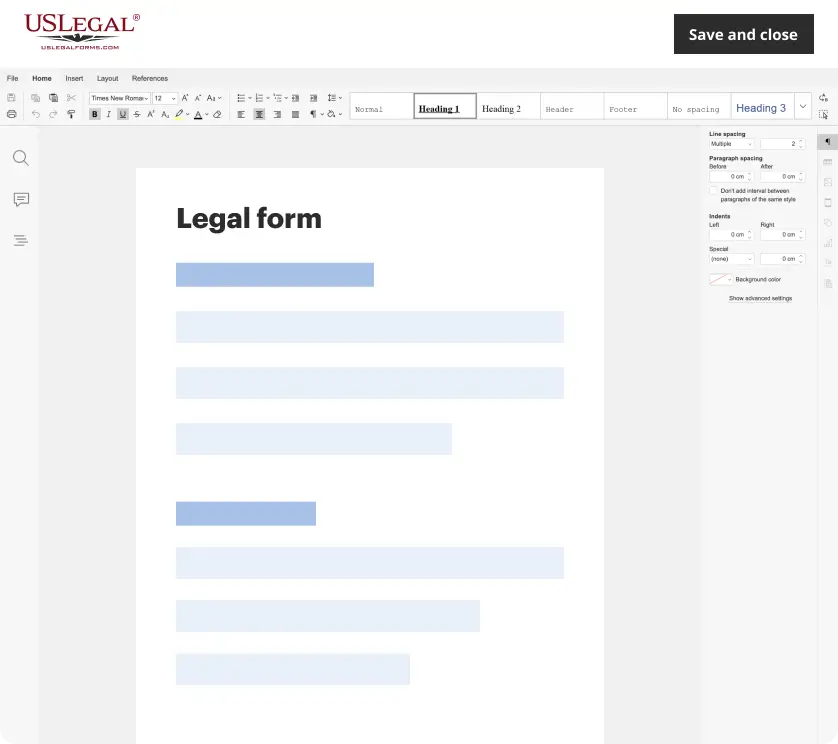
Make edits, fill in missing information, and update formatting in US Legal Forms—just like you would in MS Word.
Download a copy, print it, send it by email, or mail it via USPS—whatever works best for your next step.
Sign and collect signatures with our SignNow integration. Send to multiple recipients, set reminders, and more. Go Premium to unlock E-Sign.
If this form requires notarization, complete it online through a secure video call—no need to meet a notary in person or wait for an appointment.
We protect your documents and personal data by following strict security and privacy standards.
Common mistakes to avoid
- Failing to adjust the form for specific employment situations like demotion or constructive discharge.
- Omitting case law references that help provide context for the definition of willfulness.
- Not clearly establishing the burden of proof as described in the initial instructions.
Why use this form online
- Convenient access to form templates drafted by licensed attorneys.
- Editable formats allow customization to fit specific case needs.
- Reliability of obtaining legally valid documents quickly and easily.
Legal use & context
- This instruction is vital for establishing culpability in age discrimination cases.
- It outlines the necessary burden of proof required to demonstrate willfulness.
- The form aligns with federal guidelines established in significant legal cases.
Quick recap
- The 6.20 Definition: Willfulness form is crucial for clarifying intent in wrongful termination cases.
- The case context cited in this form helps understand legal definitions of willfulness.
- Modification may be required to tailor the instruction to specific employment scenarios.
Looking for another form?
Form popularity
FAQ
Willful. Black's Law Dictionary: 2nd Edition. Definition: Proceeding from a conscious motion of the will; intending the result which actually comes to pass; designed; intentional ; malicious. A willful differs essentially from a negligent act.
?wil-f?l. : stubbornly determined to have one's own way. a willful child. : done deliberately : intentional. willful obedience.
Search Legal Terms and Definitions adj. referring to acts which are intentional, conscious and directed toward achieving a purpose. Some willful conduct which has wrongful or unfortunate results is considered "hardheaded," "stubborn" and even "malicious." Example: "The defendant's attack on his neighbor was willful."
The term willful refers to acts which are intentional, conscious, voluntary, and designed to achieve a particular result.
Direct evidence It often takes the form of: testimony from someone who says that the defendant told them that he or she intended to commit the crime, an eyewitness saying that the defendant acted deliberately, or. the defendant's confession that he or she intended to act.
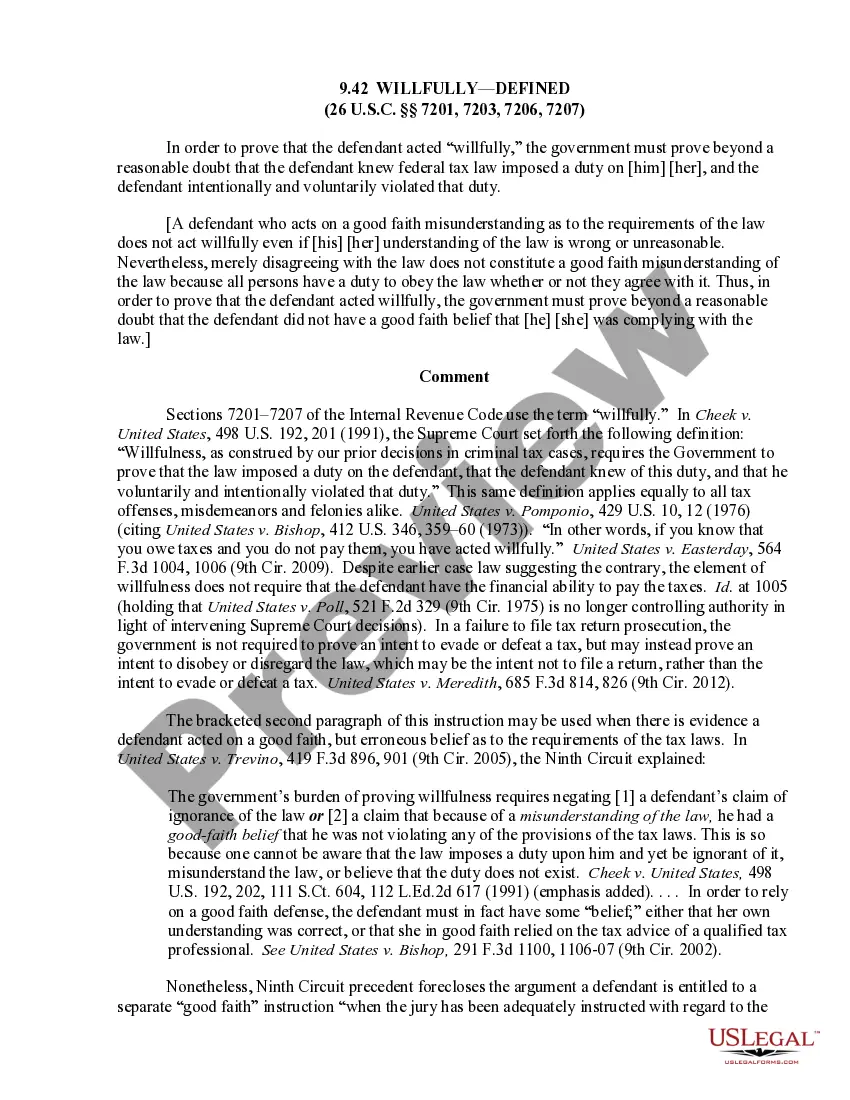
In order to prove that the defendant acted "willfully," the government must prove beyond a reasonable doubt that the defendant knew federal tax law imposed a duty on him her, and the defendant intentionally and voluntarily violated that duty.
How can a California Defense Attorney Argue Lack of Intent? They were not capable of forming the required intent because of their mental state; They intended to cause a different result; They no longer had the required intent when the action occurred; The action was accidental or the result of impulse.
That is because in the civil courts and tax courts, the definition of willfulness includes a reckless disregard for a legal duty. In other words, if you should have been aware of your obligation to file FBARs or tax returns, you can still be found to have willfully violated the requirement to do so.