6.80 GENERAL VERDICT FORM
Overview of this form
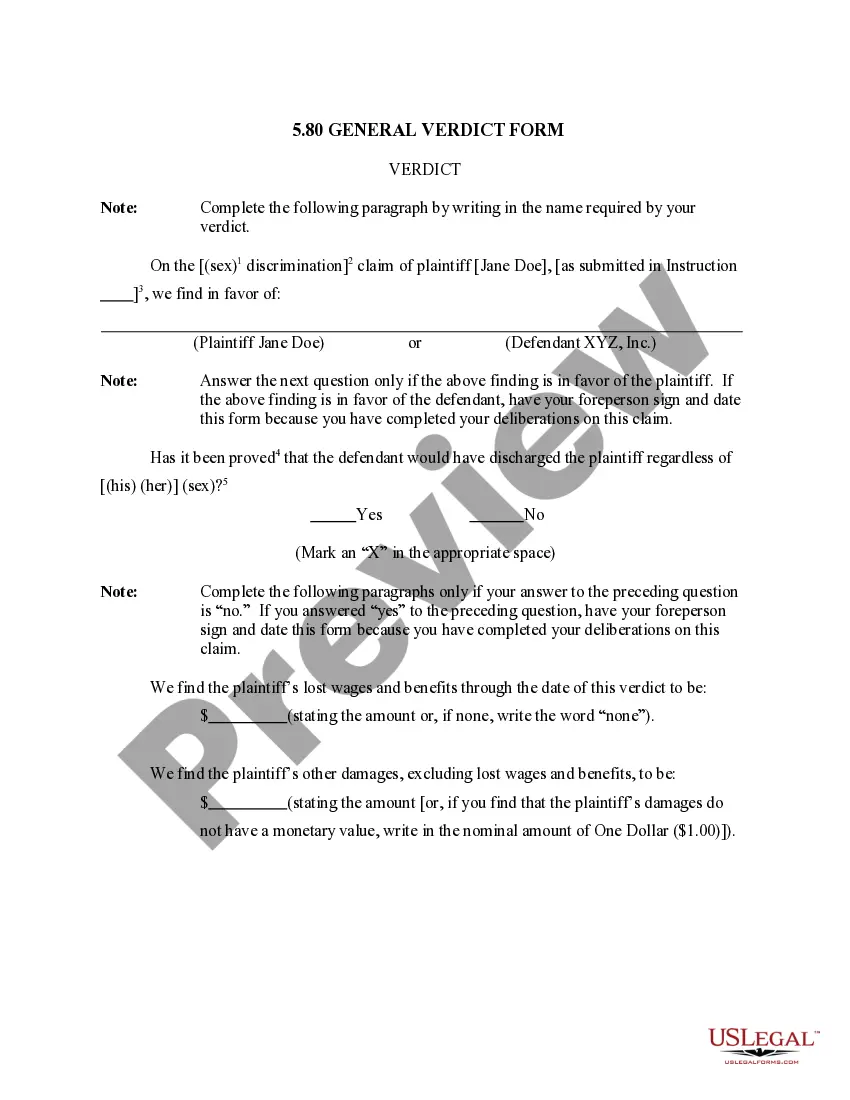
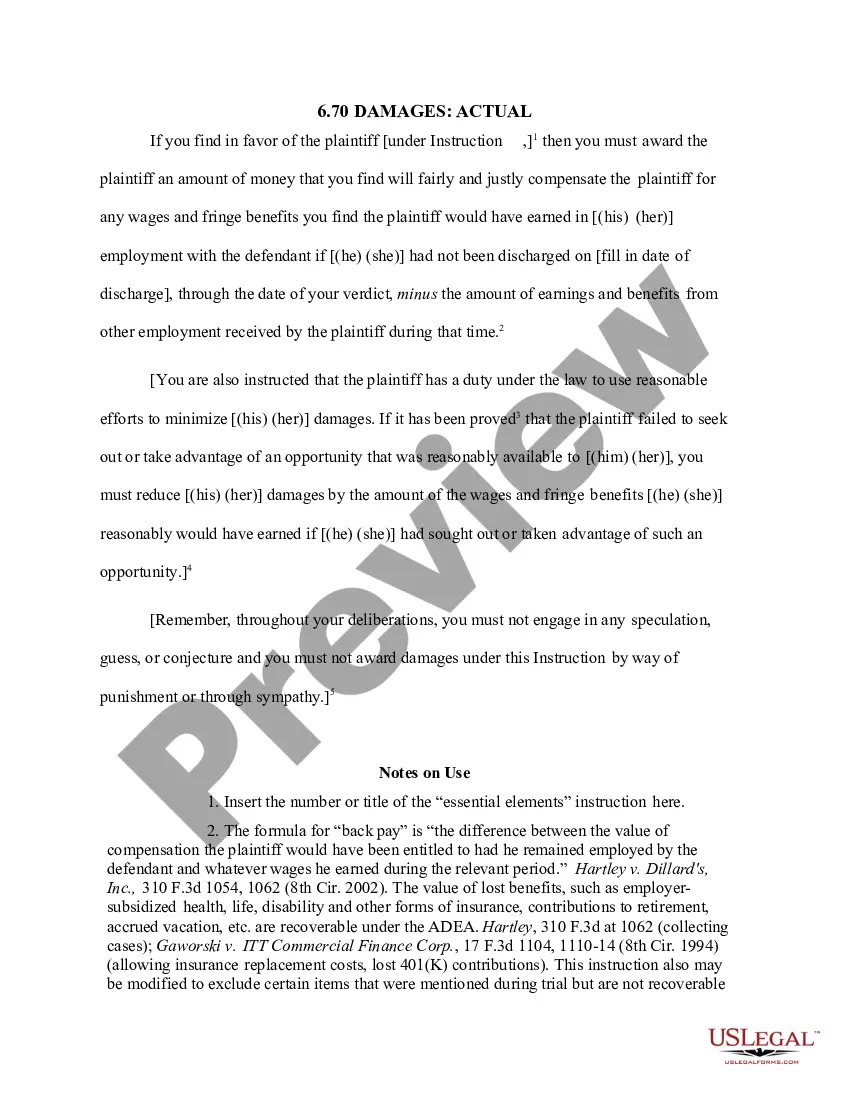
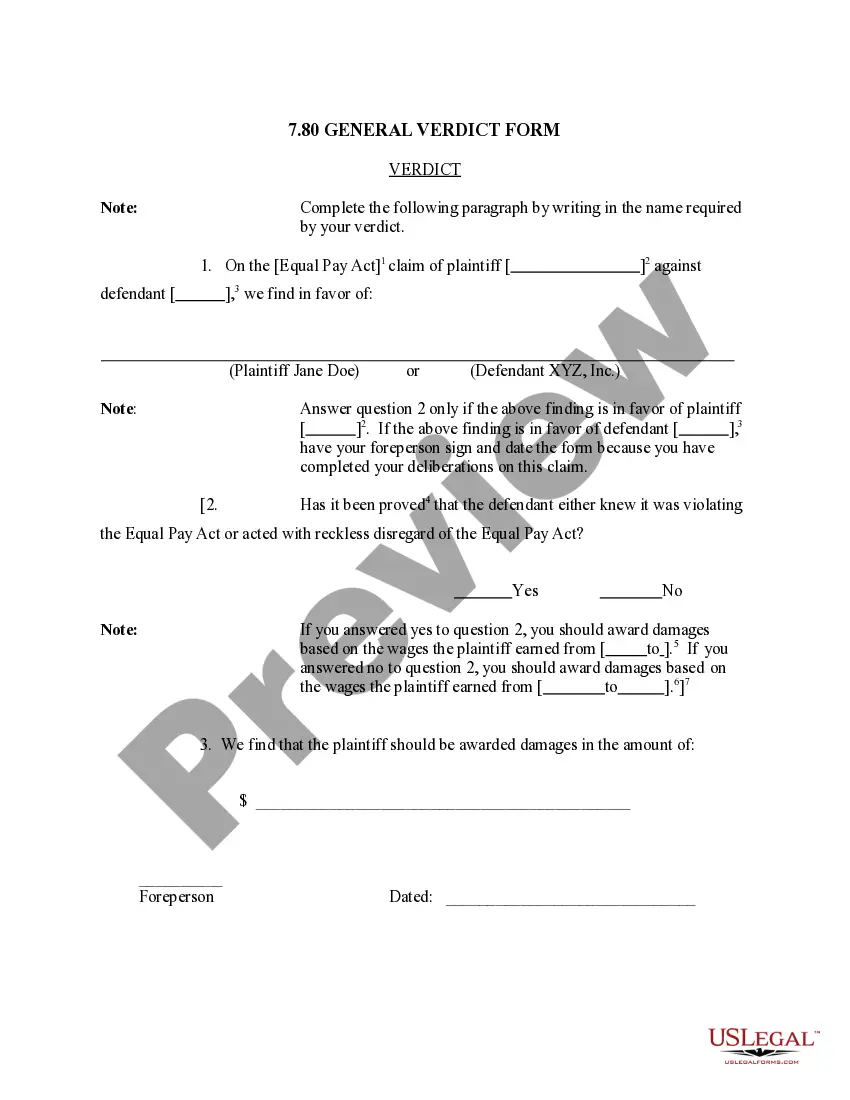
The General Verdict Form is a crucial document used in court to record the jury's final decisions on the claims presented in a civil trial. This form serves as an official record of whether the jury finds in favor of the plaintiff or the defendant. It is essential for translating the jury's deliberations into a legally recognized conclusion, distinguishing it from other jury forms by specifically addressing verdict outcomes and damages.
Form components explained
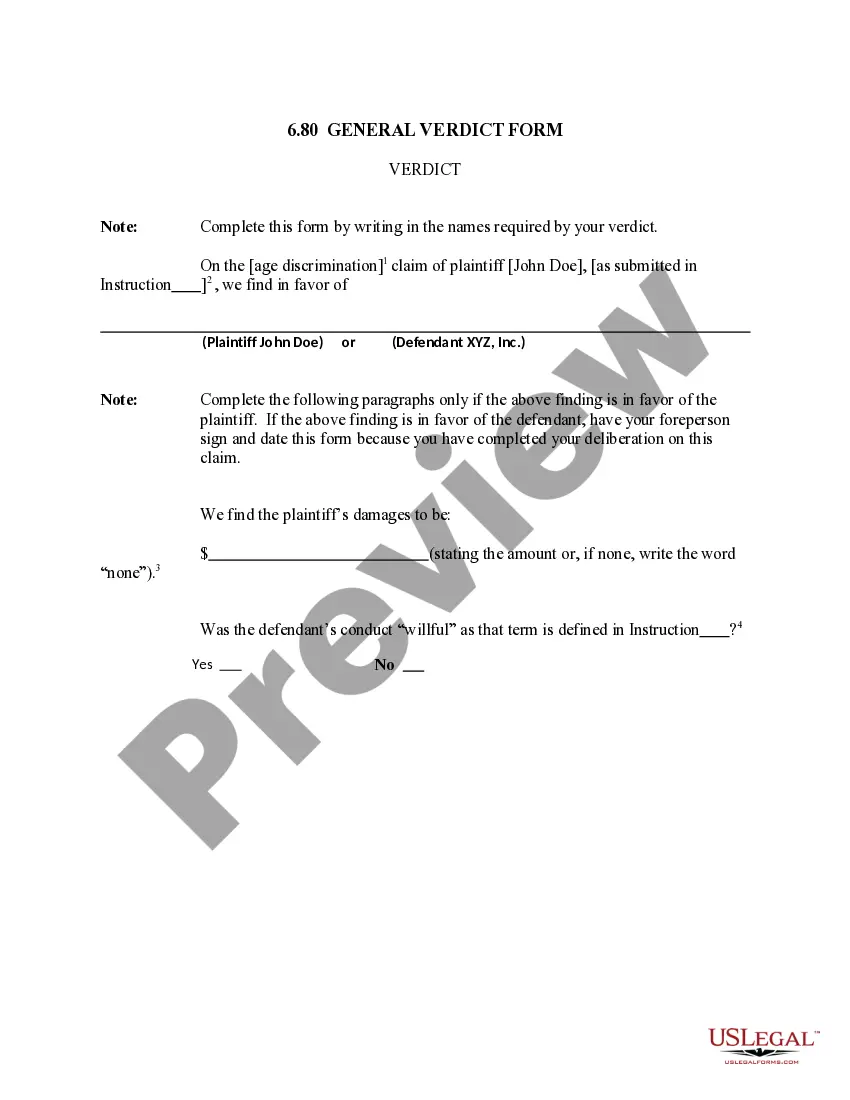
- Sections to indicate the parties involved (plaintiff and defendant).
- Space to record the jury's verdict on the plaintiff's claim.
- Section to specify the awarded damages, if any.
- Question on whether the defendant's conduct was willful.
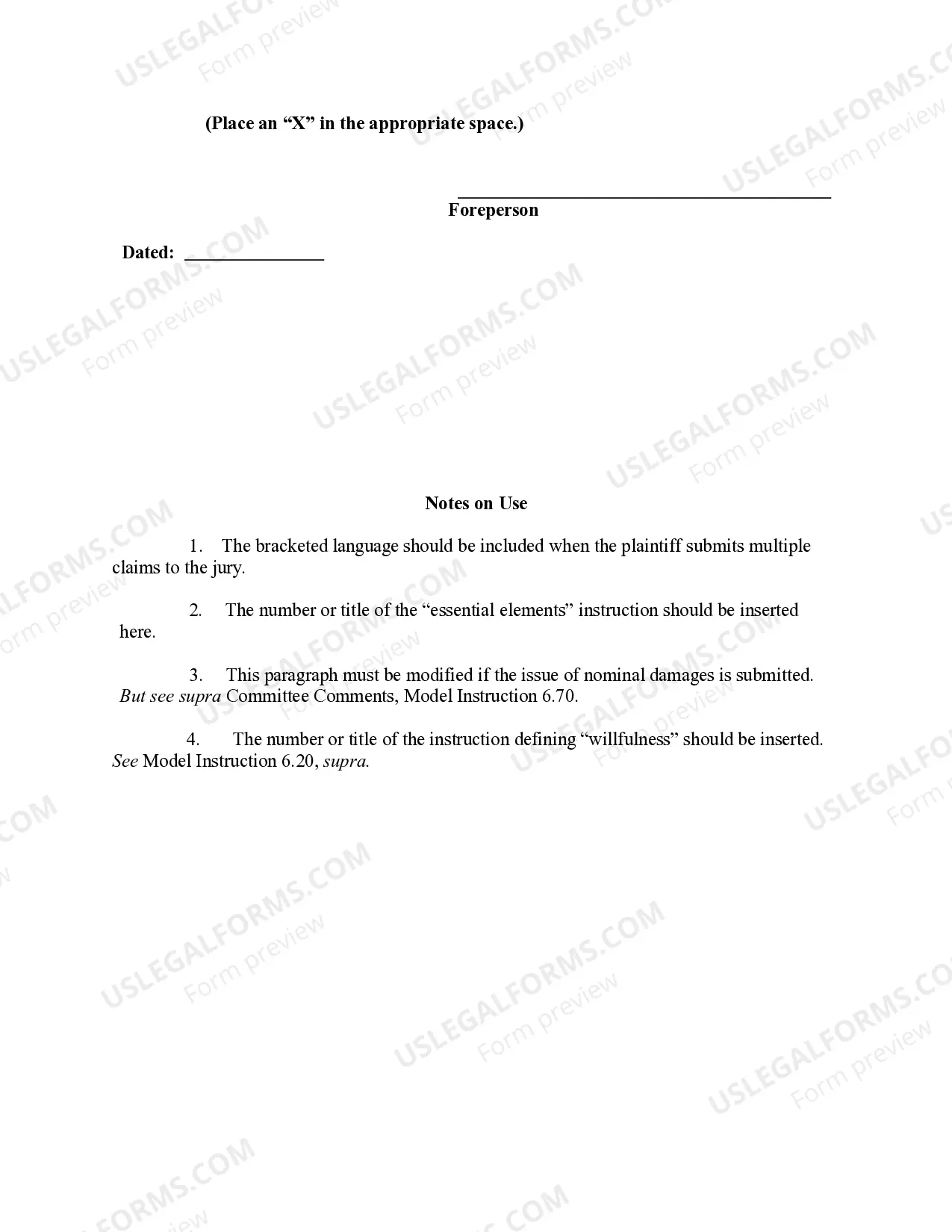
- Signature area for the foreperson of the jury, along with the date.
When to use this document
This form is used at the conclusion of a civil trial, specifically during jury deliberations when deciding on the outcome of a claim. It is applicable in cases involving disputes such as contracts, personal injury, or discrimination. The General Verdict Form allows jurors to formally report their findings and decisions, ensuring a clear understanding of their conclusion in the case.
Who needs this form
- Juries in civil trial cases.
- Judges overseeing civil litigation involving juries.
- Attorneys involved in the preparation of jury instructions and verdict forms.
Steps to complete this form
- Identify the parties involved in the case and fill in their names.
- Determine the jury's decision on the plaintiff's claim (favoring either the plaintiff or defendant) and write it in the appropriate space.
- If the verdict favors the plaintiff, specify the amount of damages awarded or indicate 'none' if applicable.
- Answer the question regarding the willfulness of the defendant's conduct by marking 'Yes' or 'No.'
- Have the foreperson sign and date the form to finalize the jury's verdict.
Notarization guidance
Notarization is not commonly needed for this form. However, certain documents or local rules may make it necessary. Our notarization service, powered by Notarize, allows you to finalize it securely online anytime, day or night.
Get your form ready online
Our built-in tools help you complete, sign, share, and store your documents in one place.
Make edits, fill in missing information, and update formatting in US Legal Forms—just like you would in MS Word.
Download a copy, print it, send it by email, or mail it via USPS—whatever works best for your next step.
Sign and collect signatures with our SignNow integration. Send to multiple recipients, set reminders, and more. Go Premium to unlock E-Sign.
If this form requires notarization, complete it online through a secure video call—no need to meet a notary in person or wait for an appointment.
We protect your documents and personal data by following strict security and privacy standards.
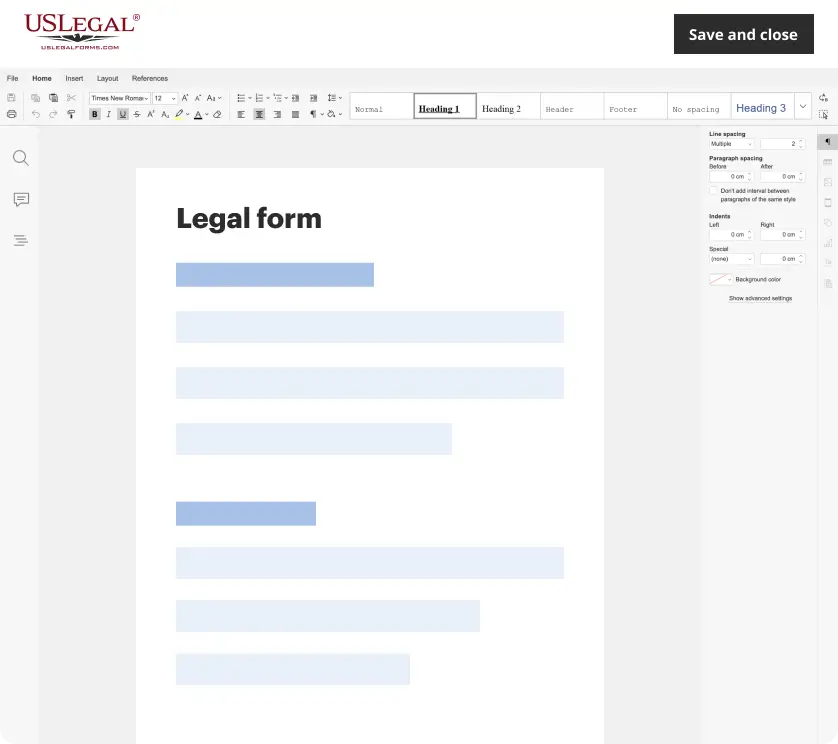
Make edits, fill in missing information, and update formatting in US Legal Forms—just like you would in MS Word.
Download a copy, print it, send it by email, or mail it via USPS—whatever works best for your next step.
Sign and collect signatures with our SignNow integration. Send to multiple recipients, set reminders, and more. Go Premium to unlock E-Sign.

If this form requires notarization, complete it online through a secure video call—no need to meet a notary in person or wait for an appointment.
We protect your documents and personal data by following strict security and privacy standards.
Mistakes to watch out for
- Failing to specify whether the plaintiff or defendant is favored in the verdict.
- Leaving the damages section blank when the plaintiff prevails.
- Not having the foreperson sign and date the form, which is essential for the verdict to be valid.
Why complete this form online
- Convenient access to fill out and modify the form as needed before finalizing the verdict.
- Ensures compliance with legal standards set forth for jury verdicts.
- Time-efficient downloading allows for quick use in trial settings without delay.
Legal use & context
This form is essential in civil trials as it formalizes the jury's findings and decisions. The results often guide the subsequent legal outcomes, such as the awarding of damages or the direction of further legal action.
Quick recap
- The General Verdict Form documents the jury's final decision in a civil trial.
- It includes spaces for verdict, damages awarded, and a question regarding willfulness.
- Proper completion is essential for the form to be legally effective.
Looking for another form?
Form popularity
FAQ
The verdict of a jury is either general or special. A general verdict is that by which they pronounce generally upon all or any of the issues, either in favor of the plaintiff or defendant; a special verdict is that by which the jury find the facts only, leaving the judgment to the Court.
If it makes factual findings in addition to the ultimate legal conclusions, it returns a general verdict with interrogatories. (Ibid.) ?If it returns only factual findings, leaving the court to determine the ultimate legal result, it returns a special verdict.? (Ibid.)
A general verdict is one that decides which party should win but does not make findings on any specific factual issues. A special verdict is one in which the jury provides its findings on specific factual issues.
There are several types of verdicts that are imposed in a civil trial: General Verdict. Special Verdict. Directed Verdict.
A verdict in which the jury gives its findings on factual issues in the case, without necessarily stating which party should win.
Verdicts are of several kinds, namely, privy and public, general, partial, and special.
(b) General Verdict Accompanied by Answer to Interrogatories. The court may submit to the jury, together with appropriate forms for a general verdict, written interrogatories upon one or more issues of fact the decision of which is necessary to a verdict.
A general verdict is a verdict in which the jury decides which party should win the case, without listing its specific findings on any disputed issues. Juries issuing a general verdict are not required to provide the court with the justifications or reasonings underlying their decision.