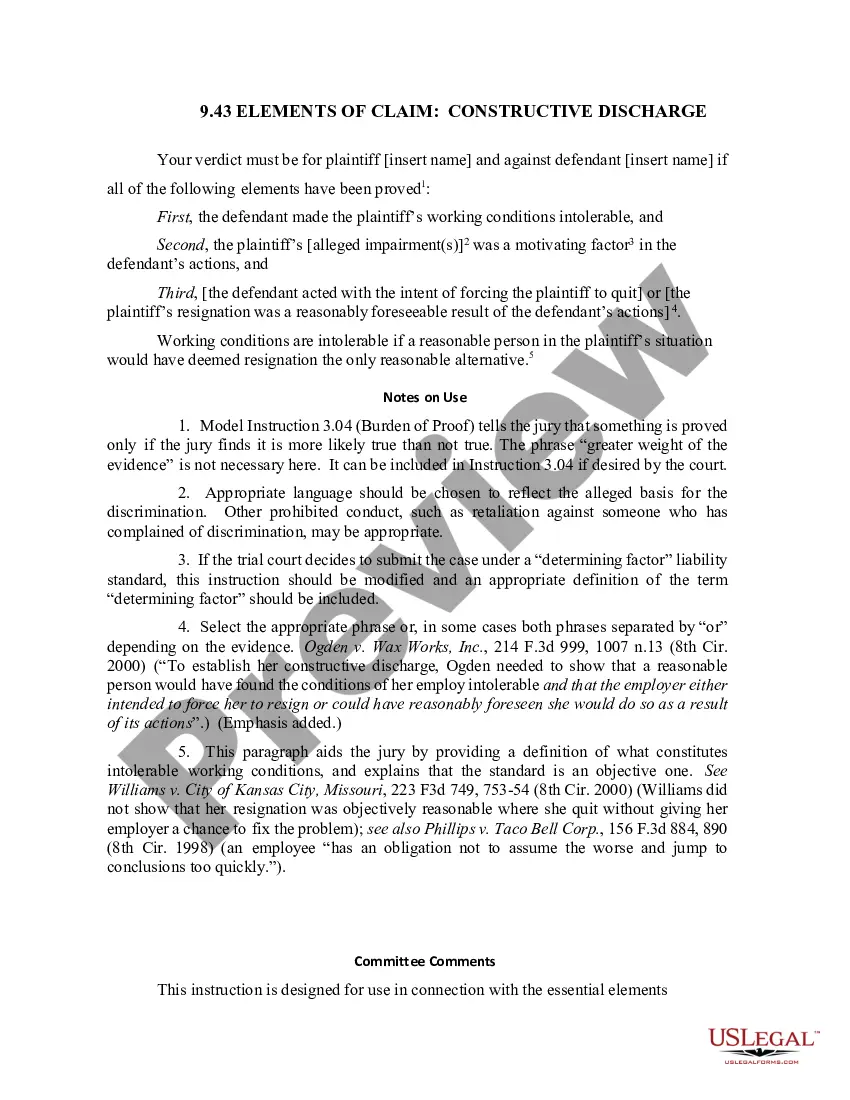
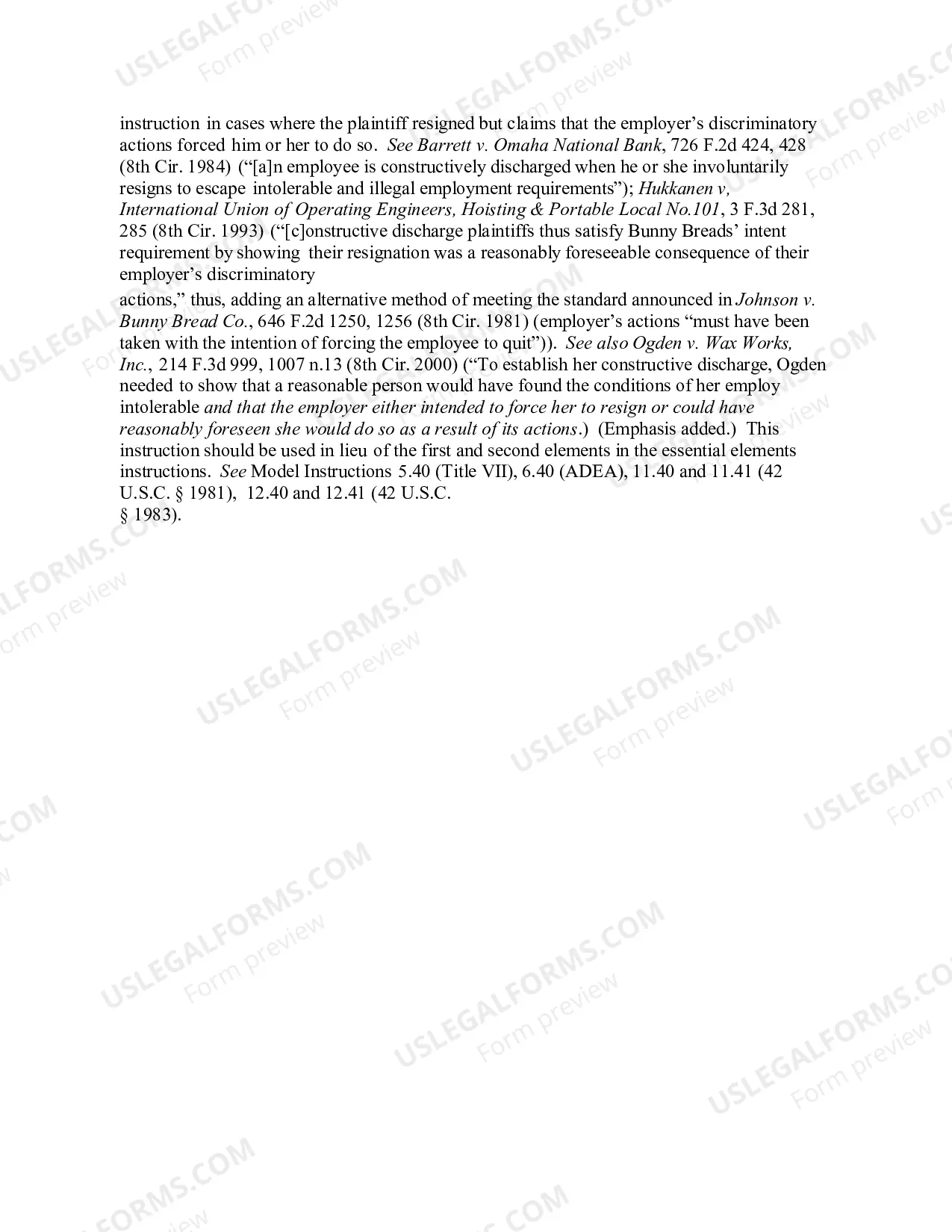
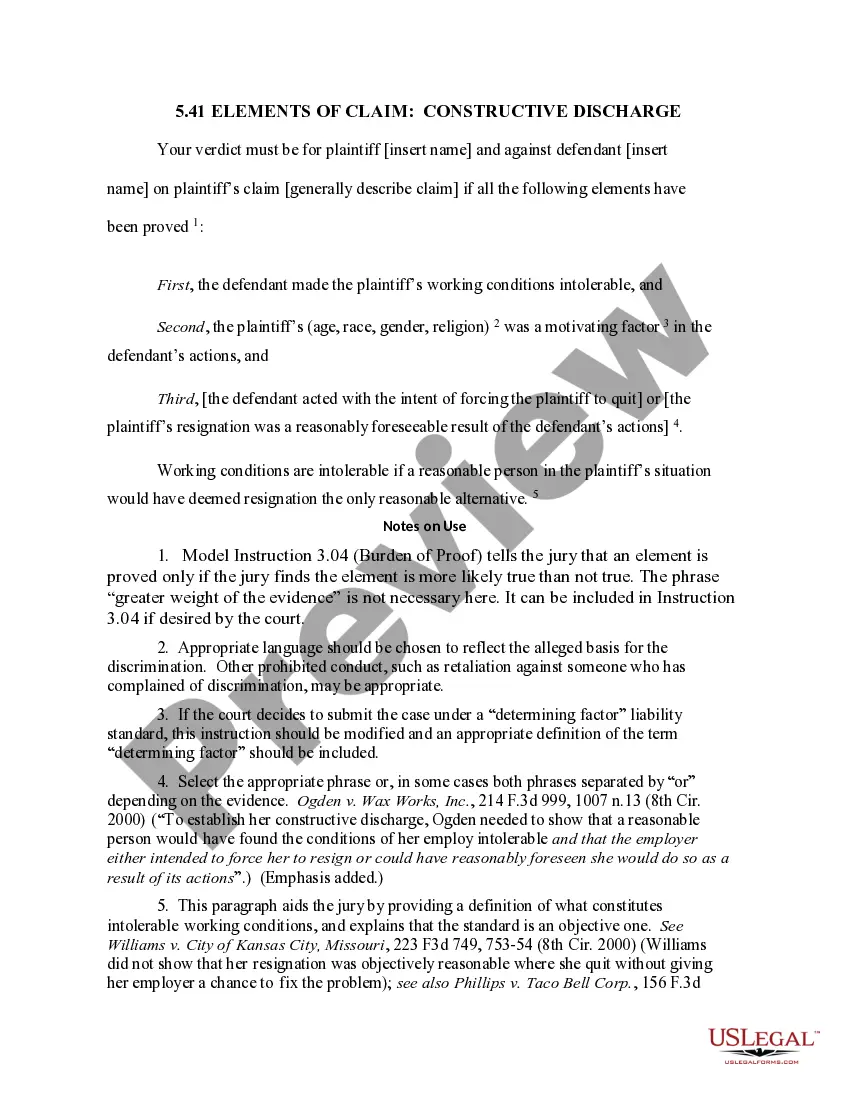
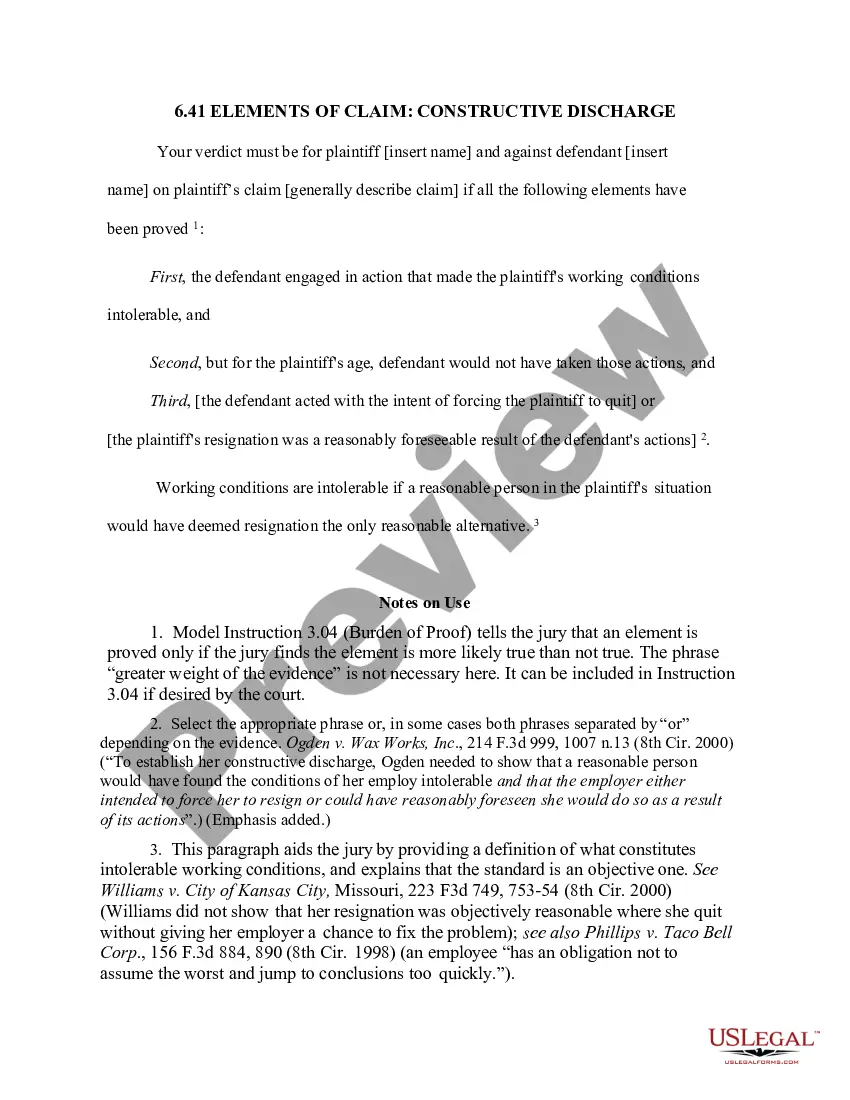
9.43 ELEMENTS OF CLAIM: CONSTRUCTIVE DISCHARGE
What this document covers
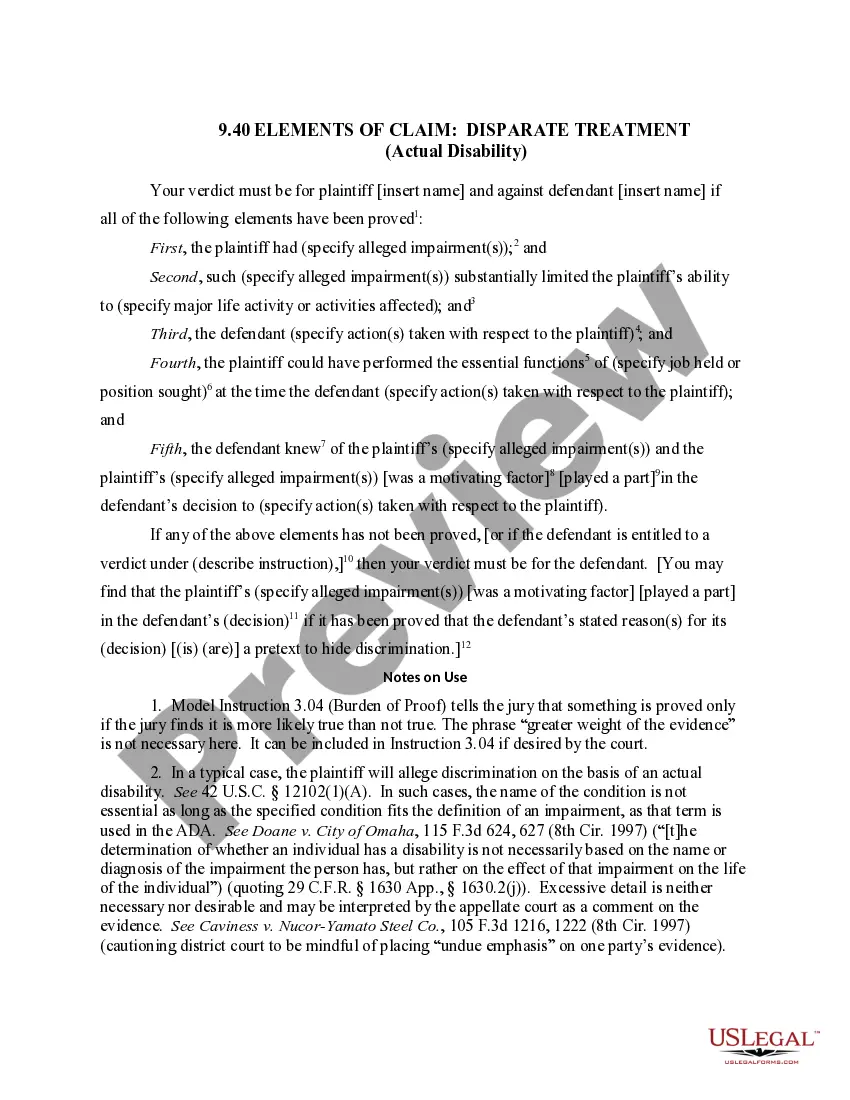
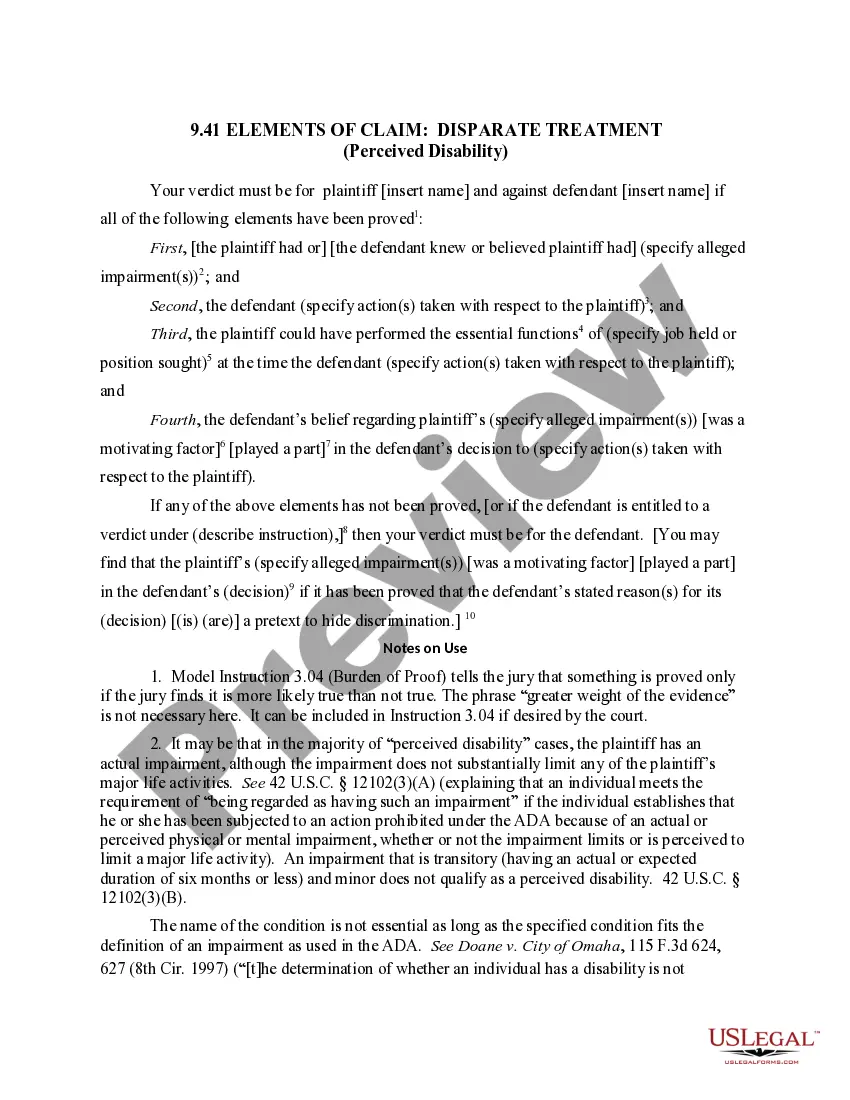
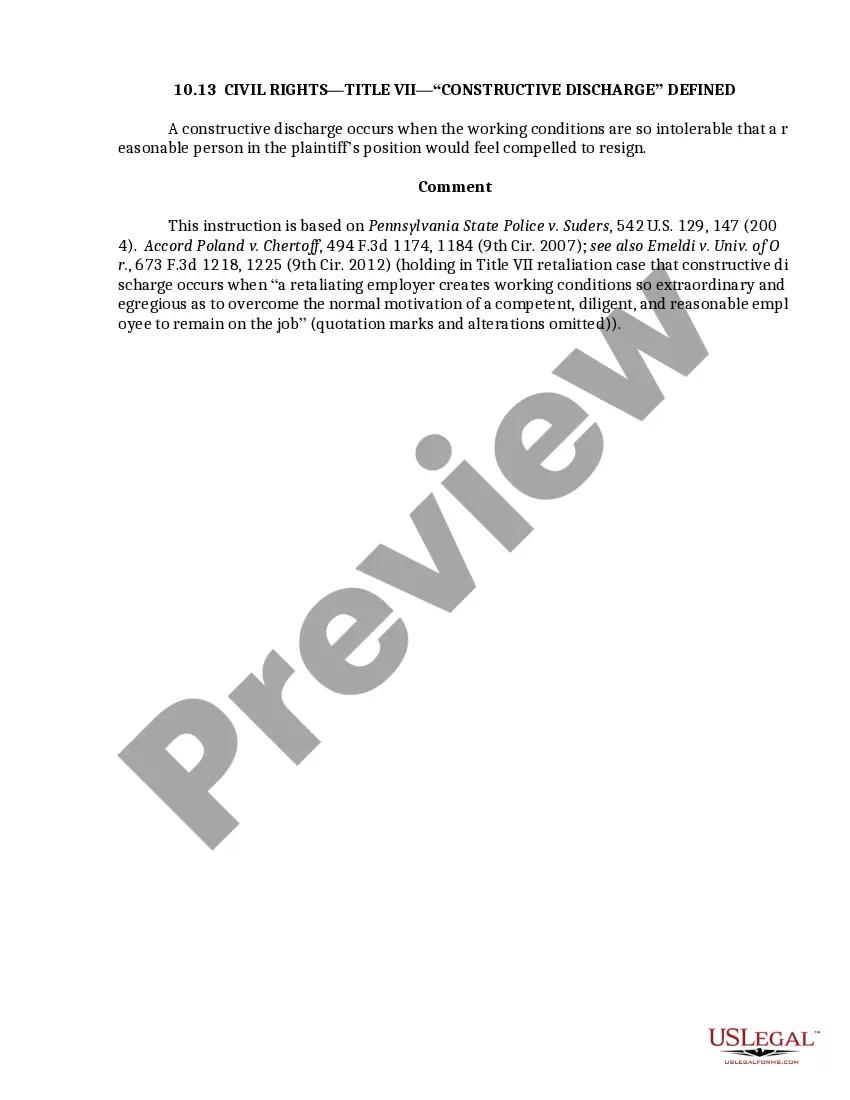
The 9.43 Elements of Claim: Constructive Discharge form is a legal template designed to assist individuals in asserting their rights in cases where they believe they have been forced to resign due to intolerable working conditions. This form outlines the essential elements that must be proven to establish a constructive discharge claim, differentiating it from other employment-related forms. By utilizing this document, plaintiffs can clearly define their claims in accordance with established legal standards.
What’s included in this form
- Definition of intolerable working conditions.
- Criteria for establishing the employer's intention or foreseeability of the resignation.
- Clarification on the plaintiff's burden of proof.
- Options for wording according to specific impairments or allegations.
- Guidance on tailoring the instruction based on trial court decisions.
When this form is needed
This form should be used in situations where an employee believes that the conditions at their workplace have become unbearable, compelling them to resign. Common scenarios include experiences of harassment, discrimination, or retaliation that create an environment where resignation seems like the only option. It serves as a crucial tool for employees seeking to outline the basis of their constructive discharge claims in legal proceedings.
Who can use this document
- Individuals who have recently resigned due to unbearable work conditions.
- Employees who believe they have been subjected to illegal discrimination or retaliation.
- Legal representatives or attorneys preparing a case for a client claiming constructive discharge.
Instructions for completing this form
- Identify the parties involved by filling in the names of the plaintiff and defendant.
- Specify the intolerable working conditions that led to the resignation.
- State the alleged impairment or basis for the claim explicitly.
- Clarify whether the defendant intended to force the plaintiff to resign or if the resignation was a foreseeable consequence of their actions.
- Ensure all details are accurate and sign the document where required.
Notarization guidance
This form does not typically require notarization unless specified by local law. However, having a notarized document can enhance its credibility in legal proceedings.
Get your form ready online
Our built-in tools help you complete, sign, share, and store your documents in one place.
Make edits, fill in missing information, and update formatting in US Legal Forms—just like you would in MS Word.
Download a copy, print it, send it by email, or mail it via USPS—whatever works best for your next step.
Sign and collect signatures with our SignNow integration. Send to multiple recipients, set reminders, and more. Go Premium to unlock E-Sign.
If this form requires notarization, complete it online through a secure video call—no need to meet a notary in person or wait for an appointment.
We protect your documents and personal data by following strict security and privacy standards.

Make edits, fill in missing information, and update formatting in US Legal Forms—just like you would in MS Word.

Download a copy, print it, send it by email, or mail it via USPS—whatever works best for your next step.

Sign and collect signatures with our SignNow integration. Send to multiple recipients, set reminders, and more. Go Premium to unlock E-Sign.

If this form requires notarization, complete it online through a secure video call—no need to meet a notary in person or wait for an appointment.

We protect your documents and personal data by following strict security and privacy standards.
Common mistakes
- Failing to clearly articulate the intolerable conditions.
- Not providing sufficient evidence to support the claim.
- Neglecting to state the specific impairment or basis for the discrimination.
- Using vague language that could weaken the claim's validity.
Benefits of using this form online
- Convenience of immediate access to legal templates from anywhere.
- Editability allows for customization to fit personal circumstances accurately.
- Reliability as the forms are created by licensed attorneys, ensuring compliance with legal standards.
Legal use & context
- This form is applicable in constructive discharge cases under federal and state employment laws.
- Claims based on this form must demonstrate that the employerâs actions were discriminatory and created a hostile work environment.
- The plaintiff has the responsibility to prove their case, which requires clear and convincing evidence.
Looking for another form?
Form popularity
FAQ
The burden of proof lies with the employee, so they must prove that they were constructively dismissed. To be successful in a claim the employee must also demonstrate that the reasonable person in the employees position would also have resigned.
Courts focus on the following factors to determine whether or not an employer's conduct has created a hostile working environment that subsequently led to the employee voluntarily quitting their job: Whether or not the employee was asked or forced to participate in an illegal activity.
Elements of a Constructive Discharge Claim Their working environment was so unusually adverse that a reasonable employee in their position would have felt compelled to resign, and. The employer either intended to force such resignation or had actual knowledge of the intolerable working conditions.
The standard for proving a constructive discharge is to show that the environment in the workplace was so intolerable that any reasonable person employed in the plaintiff's position would have been compelled to quit.
California Constructive Discharge Examples The mere existence of a legal violation in the workplace.An isolated instance of employment discrimination.A poor performance rating accompanied by a demotion and reduction in pay.Changing an instructor's schedule from full-time to part-time.
In general, the term "constructive discharge" is when a worker's resignation or retirement may be found not to be voluntary because the employer has created a hostile or intolerable work environment or has applied other forms of pressure or coercion which forced the employee to quit or resign.
There are two ways to prove a constructive discharge: (1) either the employee was given an ultimatum to resign or get fired , or (2), the employee was in working conditions so terrible that any reasonable person would feel compelled to resign.
The standard for determining whether constructive discharge has occurred is whether or not a. a reasonable person in the employee's position would feel compelled to quit.