Restructuring Troubled Companies in Tax Planning
Overview of this form
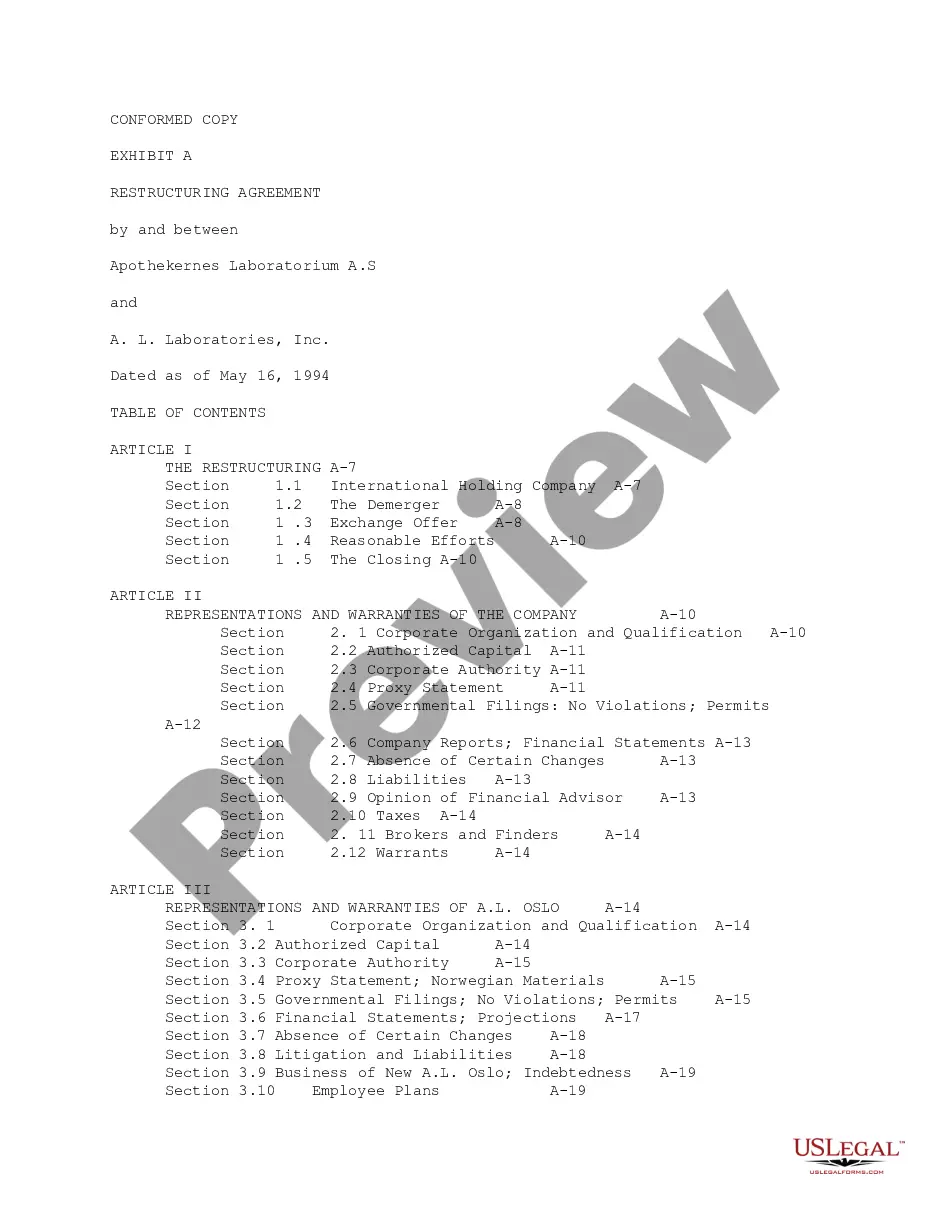
This form, titled "Restructuring Troubled Companies through Tax Planning," provides a comprehensive legal template for companies looking to reorganize their financial structures effectively. It is designed specifically for use by partnerships, LLCs, joint ventures, and other strategic alliances facing financial difficulties. This form helps distinguish itself from standard tax planning documents by focusing on strategies tailored for distressed companies.
Form components explained
- Options for restructuring debt, including cancellation or reduction of debt.
- Legal definitions and implications surrounding modified debt and exchanges.
- Exclusions for income from canceled debts under Section 108.
- Guidelines on tax-free restructurings involving insolvent companies.
- Special considerations for disregarded entities and S corporations.
When to use this form
This form is essential for businesses looking to navigate complex tax implications while restructuring their debts under challenging financial conditions. It should be used when seeking to understand the tax consequences of debt modifications, when considering bankruptcy options, or when aiming to maximize tax advantages during a reorganization. It provides a roadmap for companies that are struggling financially and need to implement effective tax planning strategies.
Intended users of this form
- Business owners of partnerships, LLCs, and joint ventures facing financial difficulties.
- Corporate financiers and tax advisors involved in restructuring plans.
- Legal professionals assisting companies in financial distress.
- Accountants seeking to provide tax planning solutions for troubled companies.
Steps to complete this form
- Gather all relevant financial documents indicating debts and obligations.
- Identify the specific restructuring strategy to be employed.
- Complete the sections detailing the debts to be modified or canceled.
- Make the necessary declarations per your corporate structure and tax regulations.
- Review the completed form with legal and tax professionals before submission.
Notarization guidance
This form does not typically require notarization unless specified by local law. It is advisable to check with applicable state regulations or consult a legal professional if any uncertainty arises.
Get your form ready online
Our built-in tools help you complete, sign, share, and store your documents in one place.
Make edits, fill in missing information, and update formatting in US Legal Forms—just like you would in MS Word.
Download a copy, print it, send it by email, or mail it via USPS—whatever works best for your next step.
Sign and collect signatures with our SignNow integration. Send to multiple recipients, set reminders, and more. Go Premium to unlock E-Sign.
If this form requires notarization, complete it online through a secure video call—no need to meet a notary in person or wait for an appointment.
We protect your documents and personal data by following strict security and privacy standards.
Make edits, fill in missing information, and update formatting in US Legal Forms—just like you would in MS Word.
Download a copy, print it, send it by email, or mail it via USPS—whatever works best for your next step.
Sign and collect signatures with our SignNow integration. Send to multiple recipients, set reminders, and more. Go Premium to unlock E-Sign.

If this form requires notarization, complete it online through a secure video call—no need to meet a notary in person or wait for an appointment.
We protect your documents and personal data by following strict security and privacy standards.
Common mistakes to avoid
- Failing to accurately represent the company's financial status.
- Not consulting with tax professionals for proper disclosures and implications.
- Overlooking state-specific requirements that might affect the restructuring.
- Neglecting to follow up on amendments made to the debts post-restructuring.
Benefits of using this form online
- Convenience of downloading and completing forms at any time.
- Editable templates that allow for tailoring to specific business needs.
- Access to legal resources and support through US Legal Forms.
- Ensured compliance with current legal standards due to regular updates.
Legal use & context
- The form is used to facilitate a tax-efficient restructuring process for troubled companies.
- It ensures compliance with IRS regulations regarding canceled debts and modified financial instruments.
- Proper use can help protect against detrimental tax implications during financial restructuring.
Quick recap
- This form is crucial for businesses undergoing financial restructuring.
- Consultation with tax professionals is highly recommended to optimize outcomes.
- Understanding tax implications is vital for avoiding penalties or losses.
- Unique considerations for partnerships and LLCs emphasize the formâs targeted application.
Looking for another form?
Form popularity
FAQ
There are many options for restricting debt and many can create cancellation of debt income (CODI) for tax purposes, which could significantly impact the debtor's current and future after-tax cash flow.
For purposes of section 469 of the Code, COD income is characterized as income from a passive activity to the extent that, at the time the indebtedness is discharged, the debt is allocated to passive activity expenditures and as income from a nonpassive activity to the extent that, at the time indebtedness is
Cancellation of indebtedness income (CODI) is income recognized by a borrower when all or a portion of its existing debt is actually cancelled or deemed to be cancelled for tax purposes.
Adjusted issue price. The adjusted issue price at the beginning of any subsequent accrual period is the sum of the issue price and all the OID includible in income before that accrual period minus any payment previously made on the debt instrument, other than a payment of qualified stated interest.
Even if you receive a Form 1099-C from a lender, you still may be able to avoid taxation on the forgiveness of a debt. If your debt was discharged in a Title 11 bankruptcy proceeding, such as a Chapter 7 or Chapter 13 case, you're not responsible for taxes on that debt.
EXCEPTIONS to Cancellation of Debt Income: Amounts canceled as gifts, bequests, devises, or inheritances. Certain qualified student loans canceled under the loan provisions that the loans would be canceled if you work for a certain period of time in certain professions for a broad class of employers.
Tax Restructuring means any reorganization and other activity related to tax planning and tax reorganization (as determined by the Company in good faith) entered into after the Issue Date so long as such reorganization or other activity does not materially impair the rights of the holders of the Notes.
?Black hole? CODI: If the debtor consolidated group's CODI exceeds the amount of attributes of the group, this excess CODI generally is referred to as ?black hole CODI.? Black hole CODI generally means that the taxpayer can exclude the CODI from taxable income without any corresponding reduction in attributes.