Lobbyist Agreement - Self-Employed Independent Contractor
Understanding this form
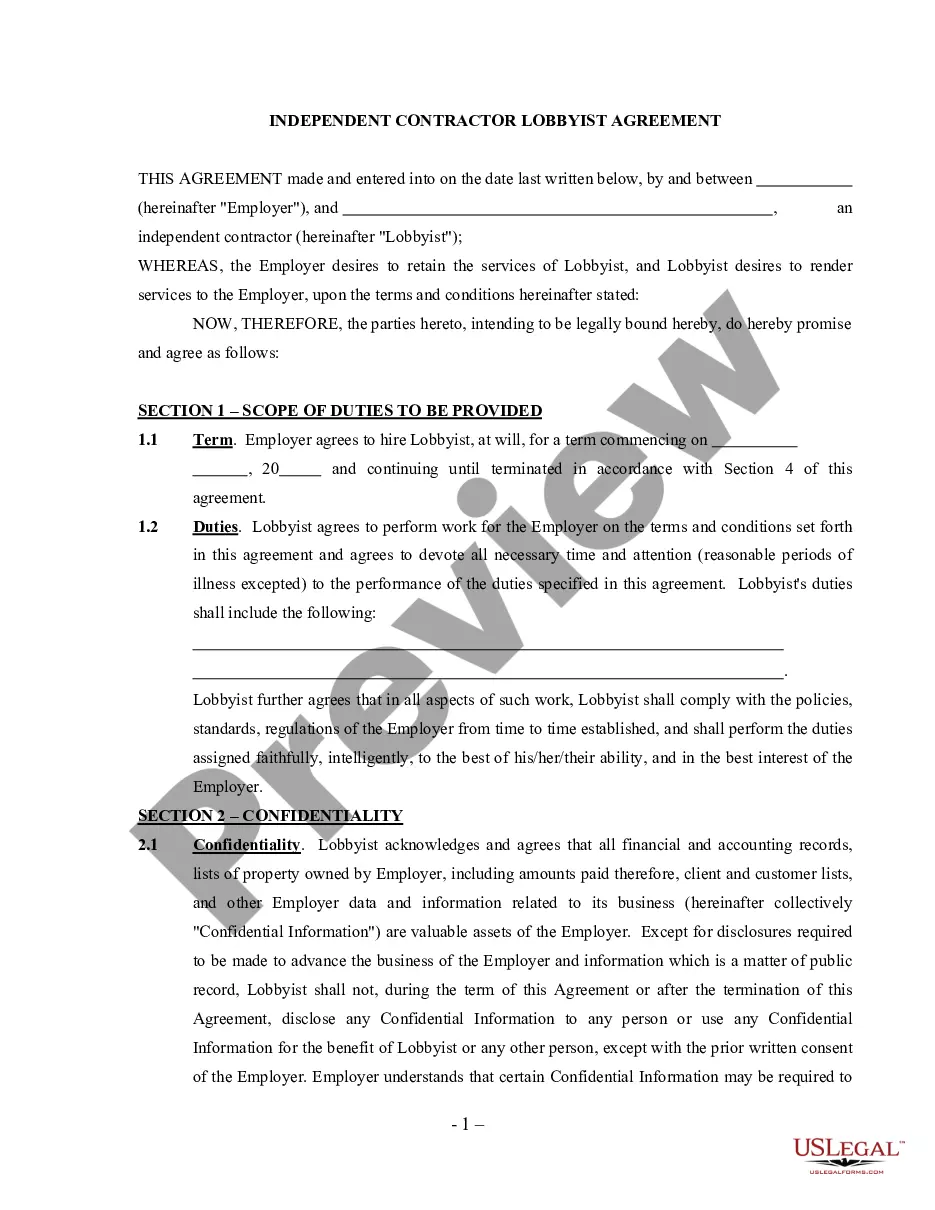
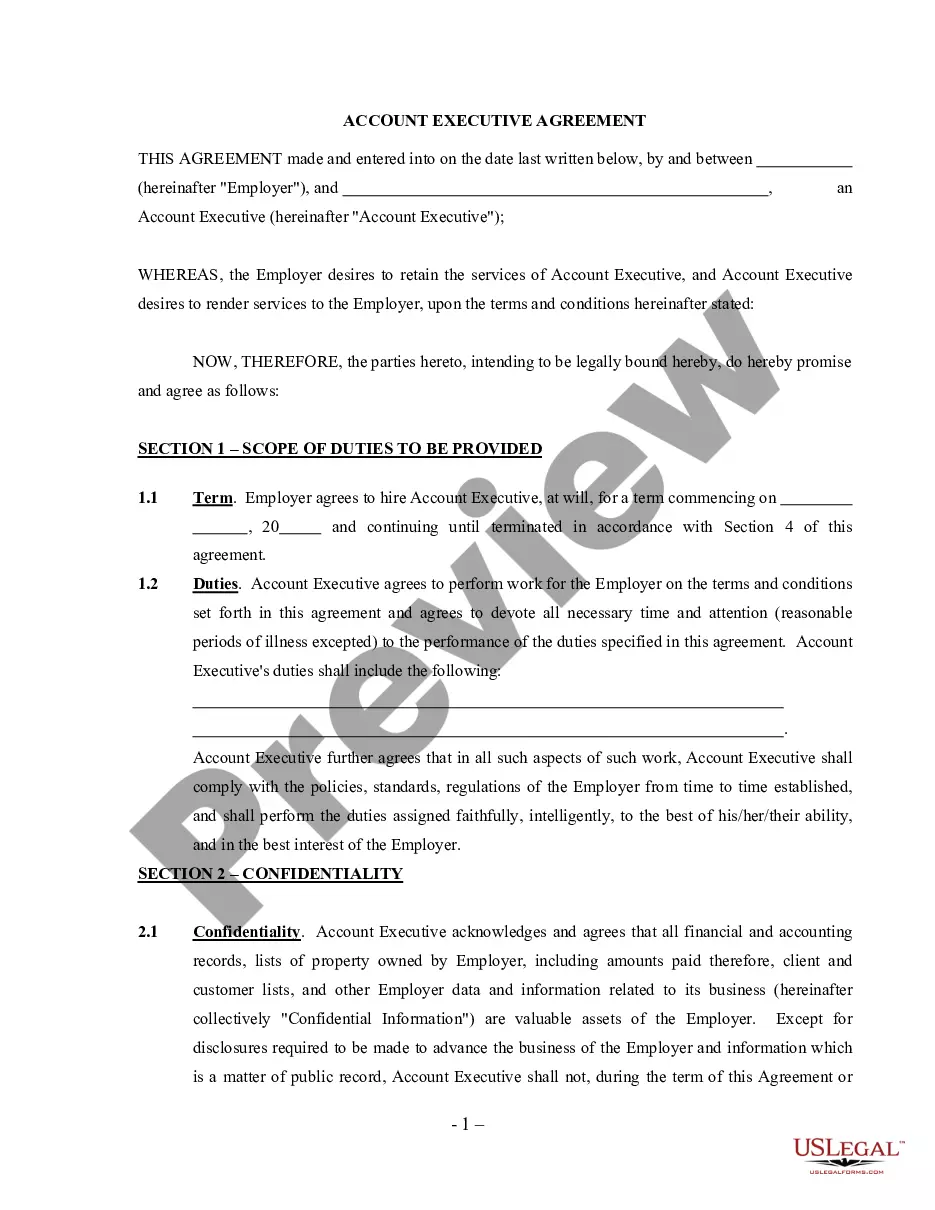
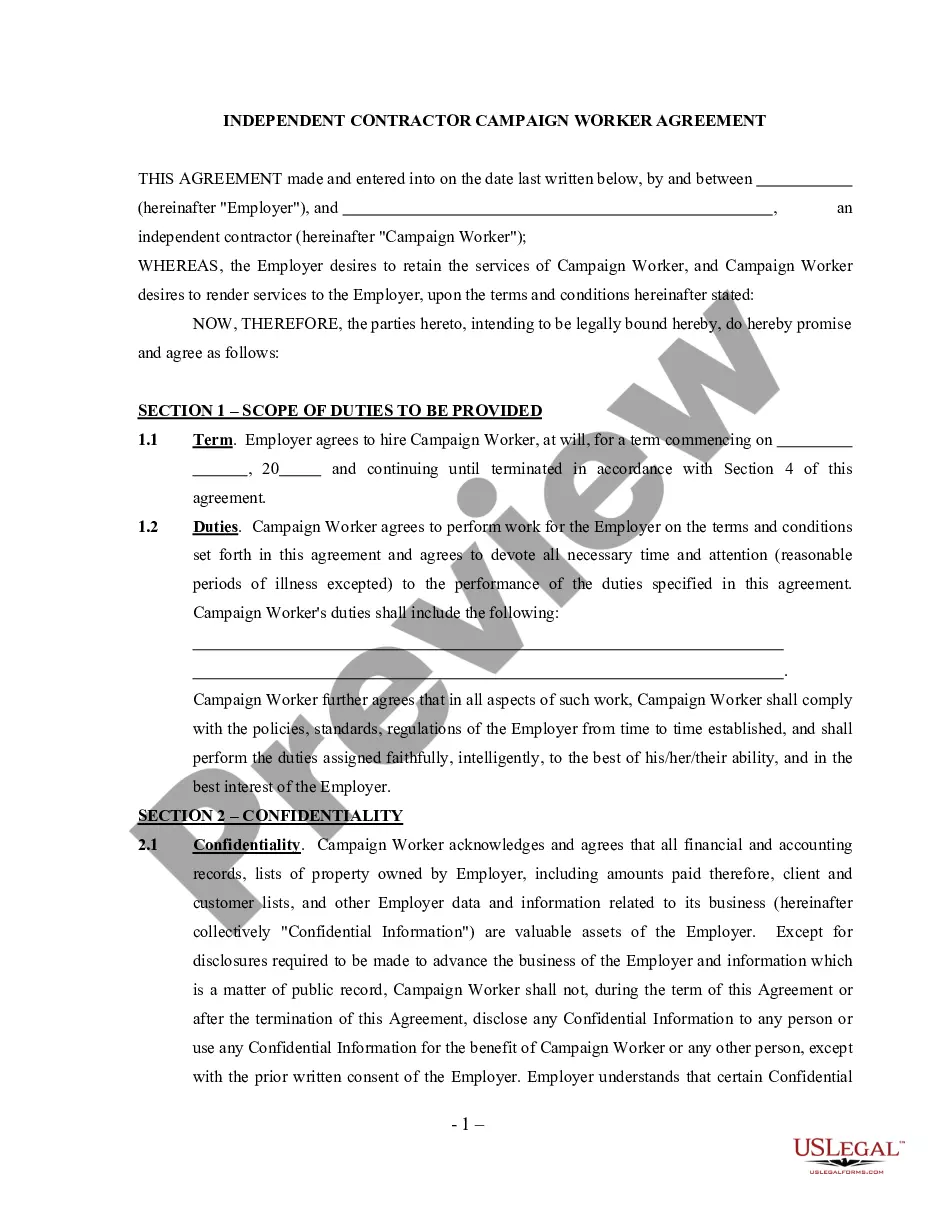
The Lobbyist Agreement - Self-Employed Independent Contractor is a legal document that formalizes the relationship between an employer and a self-employed lobbyist. This agreement details the lobbying services the lobbyist will provide, their independent contractor status, and the confidentiality obligations that protect the employer's sensitive information. Unlike traditional employee agreements, this form outlines specific roles and responsibilities while emphasizing that the lobbyist operates independently.
What’s included in this form
- SCOPE OF DUTIES: Defines the specific services the lobbyist will perform for the employer.
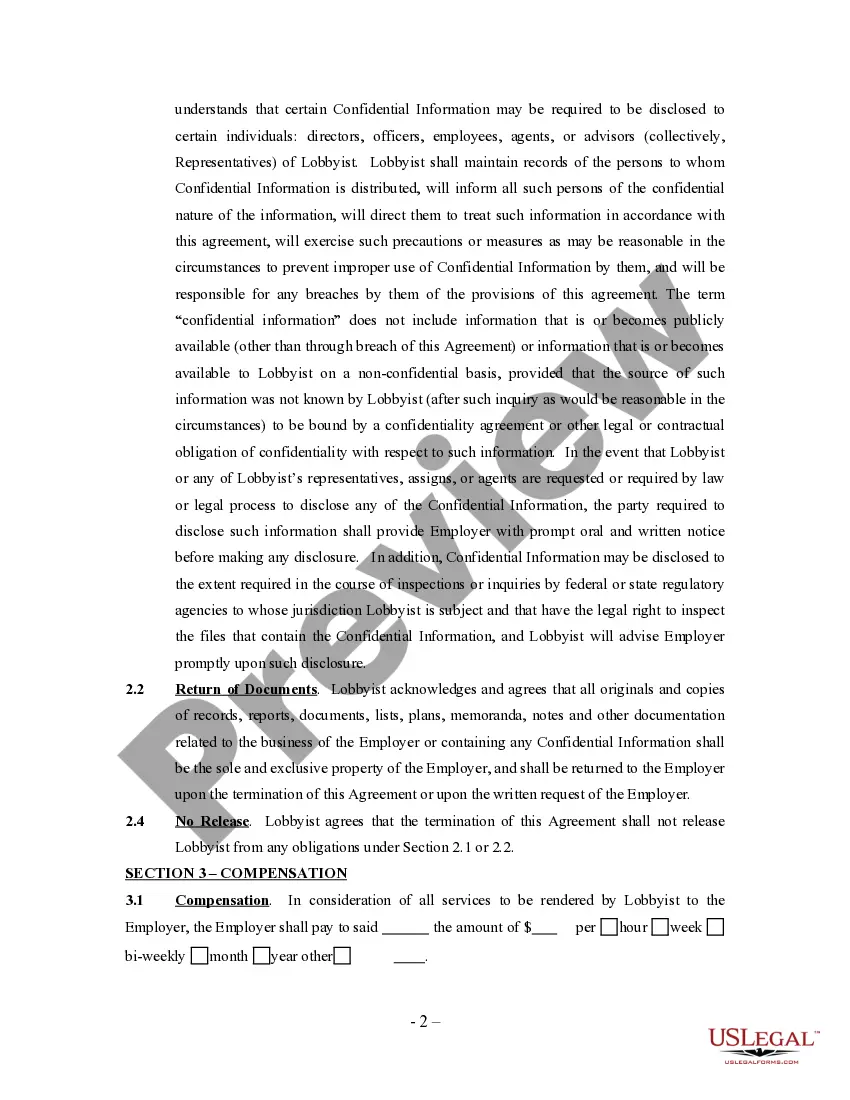
- CONFIDENTIALITY: Establishes requirements for keeping sensitive information private and outlines the procedures for handling confidential data.
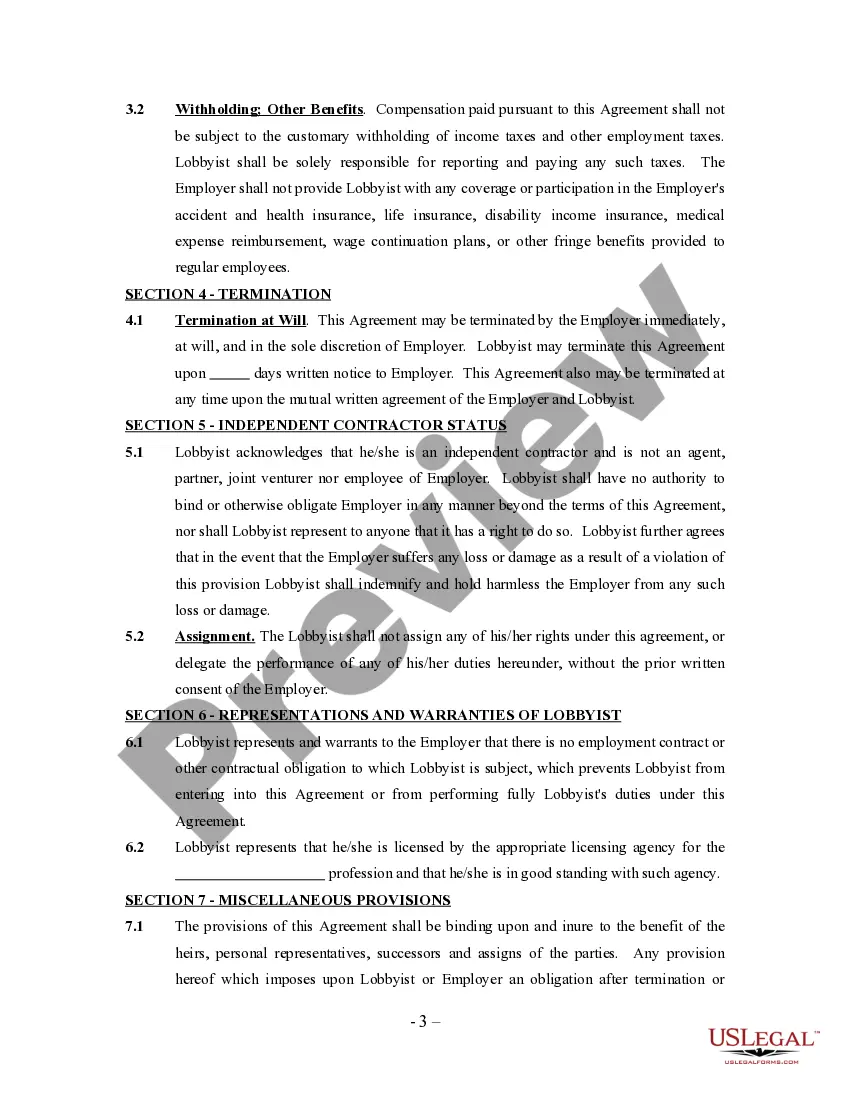
- TERMINATION: Clarifies the conditions under which the agreement can be ended and the continued obligations post-termination.
- INDEPENDENT CONTRACTOR STATUS: Specifies that the lobbyist is not an employee and cannot legally bind the employer in other matters.
- ASSIGNMENT: States that the lobbyist cannot transfer their rights or delegate their responsibilities without the employer's consent.
When this form is needed
This form is essential when an employer wishes to engage a lobbyist as an independent contractor. It is typically used in scenarios where businesses, organizations, or individuals require lobbying services to influence legislation or policy decisions. The agreement helps clarify expectations, protect sensitive information, and outline the terms of engagement.
Who needs this form
- Employers looking to hire a lobbyist for specific lobbying tasks.
- Lobbyists seeking to formalize their relationship with an employer while maintaining independent contractor status.
- Organizations or individuals needing to outline duties, confidentiality, and termination terms for lobbying services.
How to prepare this document
- Identify the parties involved: clearly state the names of the employer and the lobbyist.
- Define the scope of duties: specify the lobbying services the lobbyist will provide.
- Include confidentiality obligations: outline how confidential information will be managed.
- Enter termination conditions: clearly state the circumstances under which the agreement can be terminated.
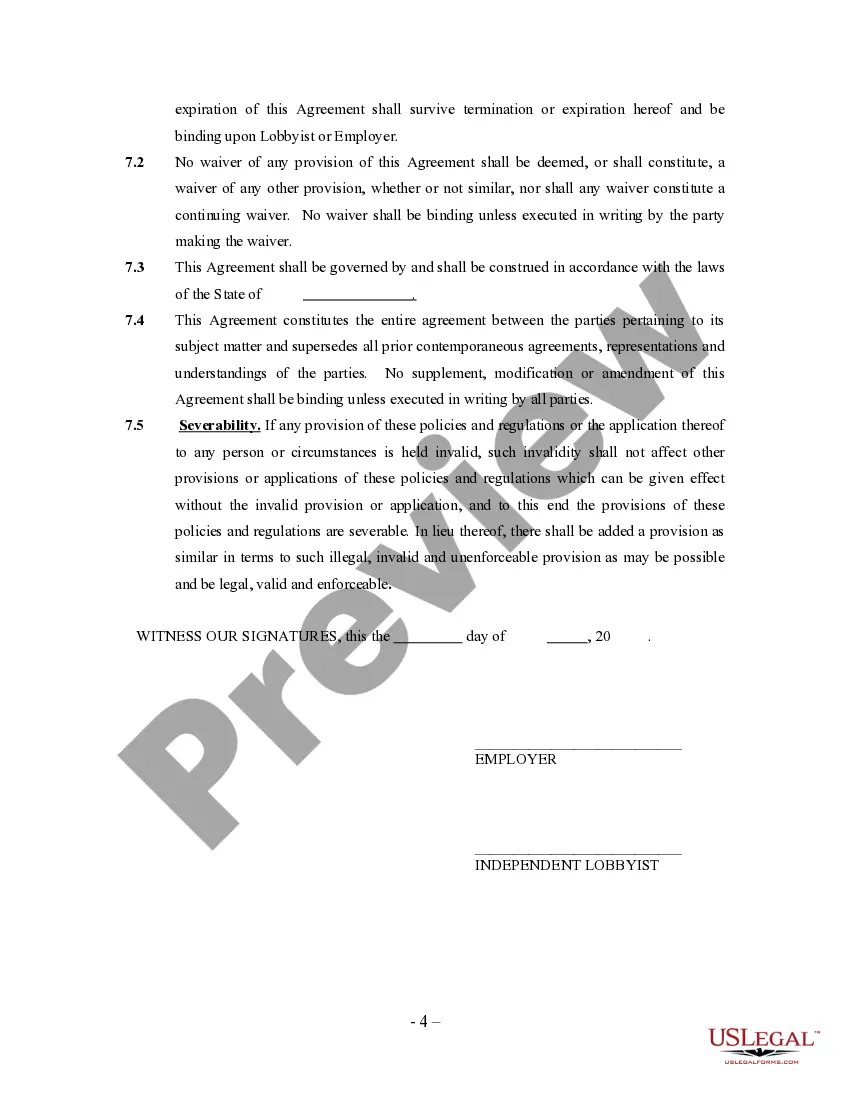
- Ensure signatures are included: both the employer and lobbyist must sign to validate the agreement.
Notarization requirements for this form
In most cases, this form does not require notarization. However, some jurisdictions or signing circumstances might. US Legal Forms offers online notarization powered by Notarize, accessible 24/7 for a quick, remote process.
Get your form ready online
Our built-in tools help you complete, sign, share, and store your documents in one place.
Make edits, fill in missing information, and update formatting in US Legal Forms—just like you would in MS Word.
Download a copy, print it, send it by email, or mail it via USPS—whatever works best for your next step.
Sign and collect signatures with our SignNow integration. Send to multiple recipients, set reminders, and more. Go Premium to unlock E-Sign.
If this form requires notarization, complete it online through a secure video call—no need to meet a notary in person or wait for an appointment.
We protect your documents and personal data by following strict security and privacy standards.
Make edits, fill in missing information, and update formatting in US Legal Forms—just like you would in MS Word.
Download a copy, print it, send it by email, or mail it via USPS—whatever works best for your next step.
Sign and collect signatures with our SignNow integration. Send to multiple recipients, set reminders, and more. Go Premium to unlock E-Sign.
If this form requires notarization, complete it online through a secure video call—no need to meet a notary in person or wait for an appointment.
We protect your documents and personal data by following strict security and privacy standards.
Common mistakes to avoid
- Failing to specify the duties of the lobbyist, leading to ambiguity.
- Neglecting to outline confidentiality terms, which can result in information leaks.
- Not including signatures from both parties, making the agreement invalid.
- Overlooking the independent contractor status, which can lead to misclassification issues.
Why use this form online
- Easy access: Download and fill out the form at your convenience without the need for physical paperwork.
- Editable template: Customize the form to meet your specific needs and requirements.
- Reliable legal framework: The form is drafted by licensed attorneys for accuracy and compliance.
Key takeaways
- The Lobbyist Agreement formalizes the relationship between an employer and a lobbyist as an independent contractor.
- It is crucial to include specific duties and confidentiality obligations in the agreement.
- This form is appropriate for multiple states, but local regulations should be verified.
Looking for another form?
Form popularity
FAQ
The law was amended substantially by the Honest Leadership and Open Government Act of 2007. Under provisions which took effect on January 1, 1996, federal lobbyists are required to register with the Clerk of the United States House of Representatives and the Secretary of the United States Senate.
An organization employing in-house lobbyists is exempt from registration if its total expenses for An organization employing in-house lobbyists is exempt from registration if its total expenses for lobbying activities do not exceed and are not expected to exceed $13,000 during a quarterly period.
Contract lobbyists have a vested interest in seeing their clients succeed: retaining their business. Most in-house lobbyists are judged by more than just their lobbying performance.
Regulating Lobbying and Interest Group Activity. While the Supreme Court has paved the way for increased spending in politics, lobbying is still regulated in many ways. The 1995 Lobbying Disclosure Act defined who can and cannot lobby, and requires lobbyists and interest groups to register with the federal government.
A person who provides lobbying services on a contract basis is a contract lobbyist. These lobbyists are not employees of the client-employers on whose behalf they work. Contract lobbyists may have one or more lobbying employers. These lobbyists may receive a fee plus expenses or simply a flat fee.
Lobbying firms and lobbyist employers register with the Office of the Secretary of State. Lobbyists do not independently register apart from their affiliated firm or employer. Rather, lobbyists supply a certification statement to be included with their own firm's or employer's registration.
Who exactly must register? Most often lobbyists must file registration paperwork. However, some states require those who hire lobbyists, sometimes called principals, to file either in addition to lobbyists or instead of them. The definitions of lobbying and lobbyist also may vary.
There are essentially three types of lobbying legislative lobbying, regulatory advocacy lobbying, and budget advocacy.
In politics, lobbying, persuasion, or interest representation is the act of lawfully attempting to influence the actions, policies, or decisions of government officials, most often legislators or members of regulatory agencies.