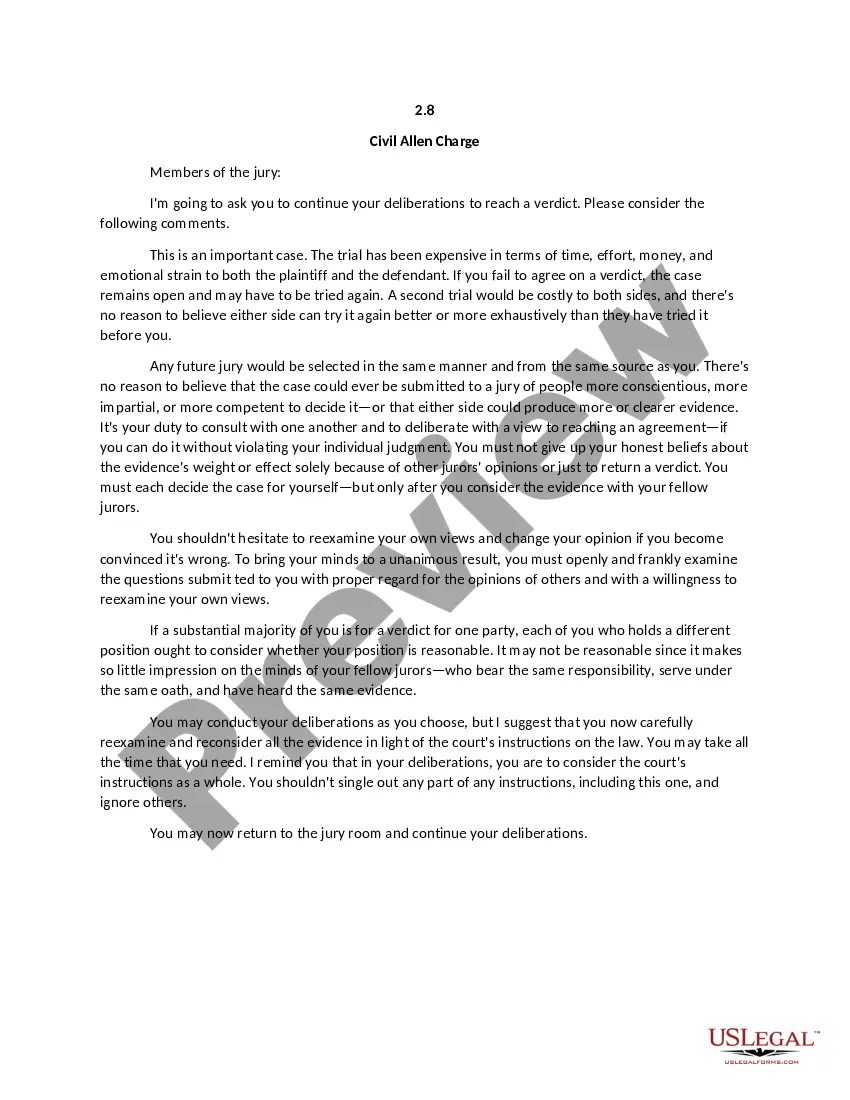
Civil Allen Charge
Understanding this form
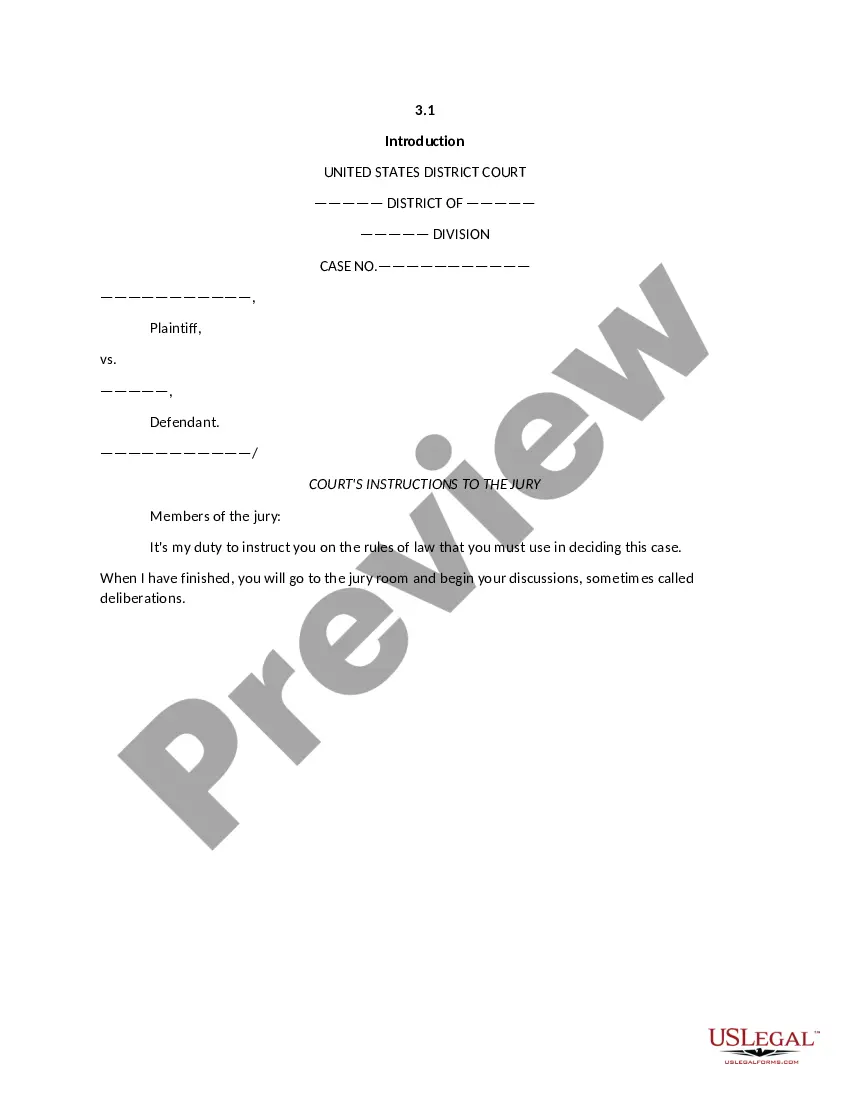
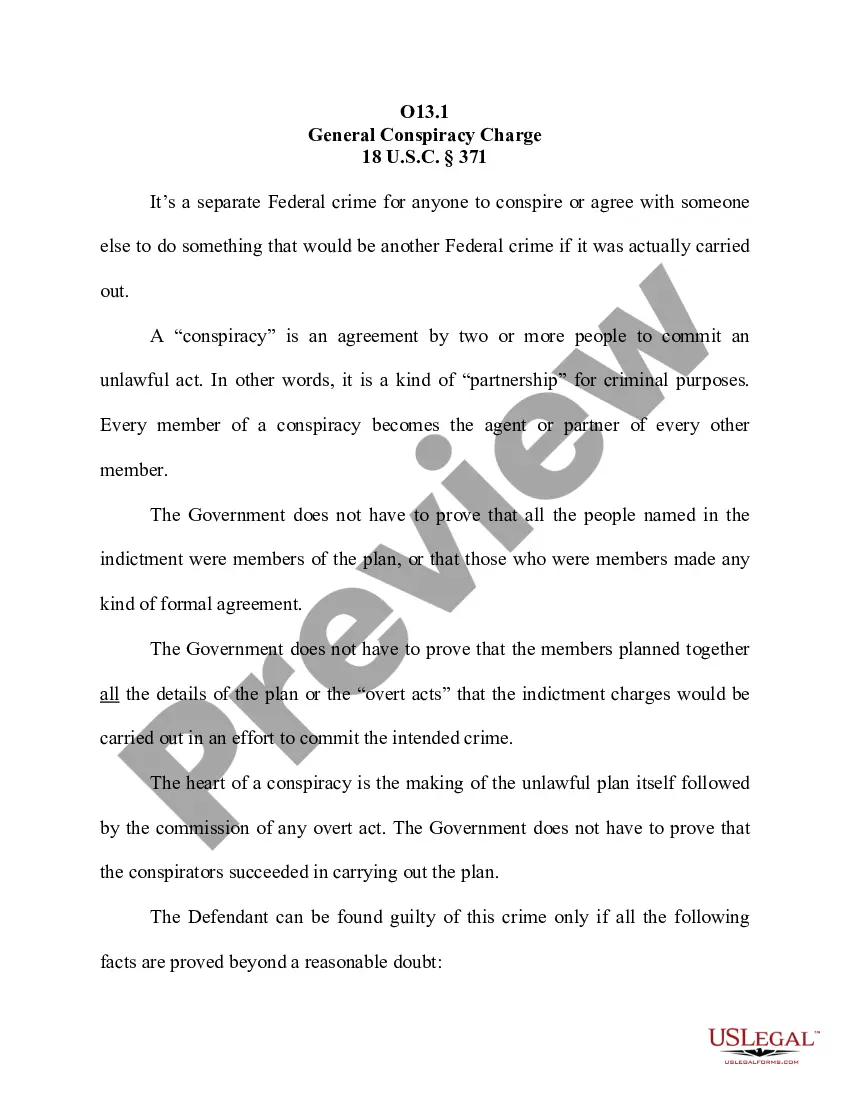
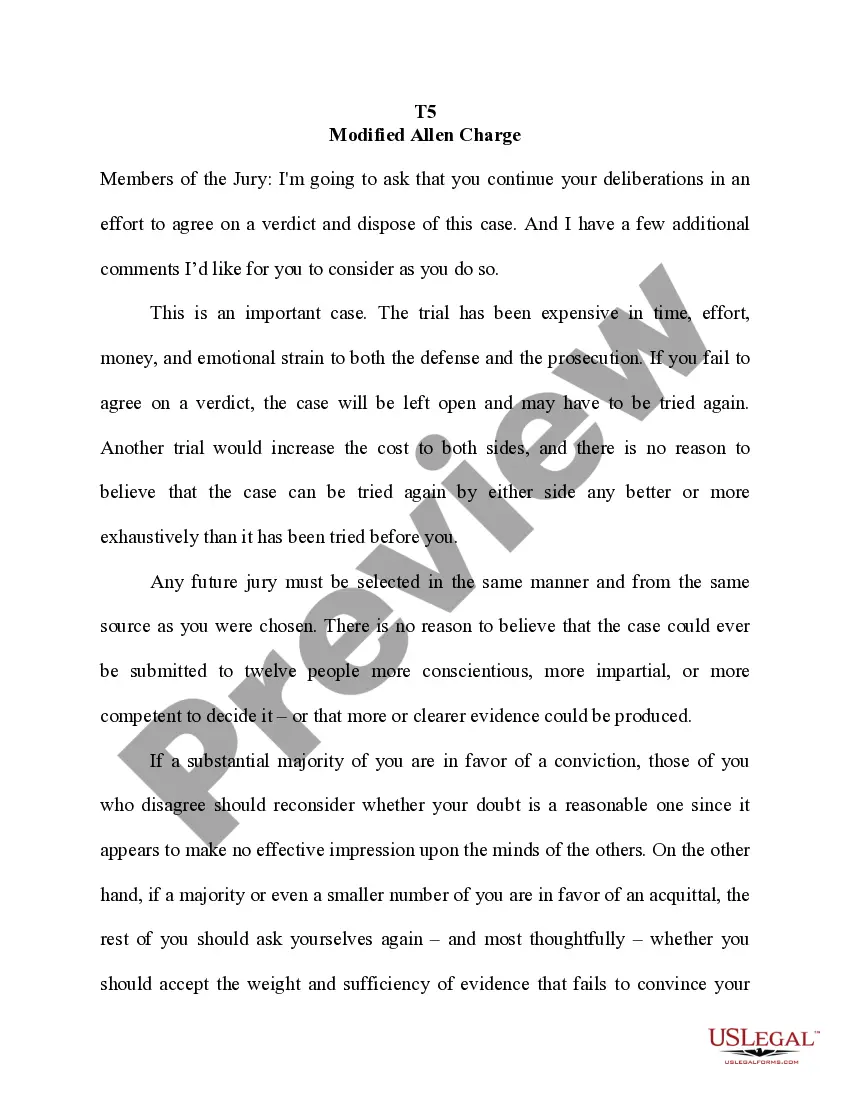
The Civil Allen Charge is a set of jury instructions from the 11th Circuit Federal Court of Appeals designed to guide jurors during their deliberations. This form serves to encourage jurors to reach a unanimous verdict while emphasizing the importance of consulting with each other and reconsidering their individual viewpoints. It differs from regular jury instructions by specifically addressing the challenges jurors might face in achieving consensus and the implications of a hung jury.
Form components explained
- Instructions for jurors to engage in deliberation and reach a verdict.
- Emphasis on the importance of the case and the need for a unanimous decision.
- Encouragement to consult fellow jurors and reconsider personal viewpoints.
- Warning about the potential costs and consequences of a hung jury.
When to use this form
The Civil Allen Charge is used when jurors are struggling to reach a unanimous verdict in a civil trial. It provides guidance on the necessity of deliberation and emphasizes the responsibilities jurors have to each other and the court. This form is essential in situations where a jury may be at risk of becoming deadlocked, helping them to refocus on their duty to evaluate the evidence collectively.
Who needs this form
- Jury members in civil trials within jurisdictions that follow the 11th Circuit guidelines.
- Judges looking to provide clear instructions to juries when they struggle with decision-making.
- Legal professionals seeking to understand the implications of a Civil Allen Charge for jury deliberations.
Instructions for completing this form
- Review the provided jury instructions thoroughly before deliberation.
- Consider the significance of the case and the implications of a hung jury.
- Engage in discussions with fellow jurors to exchange viewpoints and information.
- Reassess your individual stance in light of the evidence and opinions of others.
- Work towards a consensus while respecting each juror's perspective and reasoning.
Notarization requirements for this form
Notarization is not commonly needed for this form. However, certain documents or local rules may make it necessary. Our notarization service, powered by Notarize, allows you to finalize it securely online anytime, day or night.
Get your form ready online
Our built-in tools help you complete, sign, share, and store your documents in one place.
Make edits, fill in missing information, and update formatting in US Legal Forms—just like you would in MS Word.
Download a copy, print it, send it by email, or mail it via USPS—whatever works best for your next step.
Sign and collect signatures with our SignNow integration. Send to multiple recipients, set reminders, and more. Go Premium to unlock E-Sign.
If this form requires notarization, complete it online through a secure video call—no need to meet a notary in person or wait for an appointment.
We protect your documents and personal data by following strict security and privacy standards.

Make edits, fill in missing information, and update formatting in US Legal Forms—just like you would in MS Word.

Download a copy, print it, send it by email, or mail it via USPS—whatever works best for your next step.

Sign and collect signatures with our SignNow integration. Send to multiple recipients, set reminders, and more. Go Premium to unlock E-Sign.

If this form requires notarization, complete it online through a secure video call—no need to meet a notary in person or wait for an appointment.

We protect your documents and personal data by following strict security and privacy standards.
Common mistakes to avoid
- Not fully understanding the implications of a hung jury.
- Ignoring the importance of considering fellow jurors' opinions.
- Failing to reexamine personal views based on jury discussions.
Why complete this form online
- Convenient access to recognized jury instructions with clear guidelines.
- Ability to modify instructions as needed for specific cases.
- Reliable legal formatting that complies with the 11th Circuit standards.
Legal use & context
- The Civil Allen Charge is intended to ease the deliberation process in civil trials.
- It serves as a legal tool to help jurors understand their responsibilities and the necessity of reaching a verdict.
- Historically, it has been upheld as a valid instruction by numerous courts within the jurisdiction.
Looking for another form?
Form popularity
FAQ
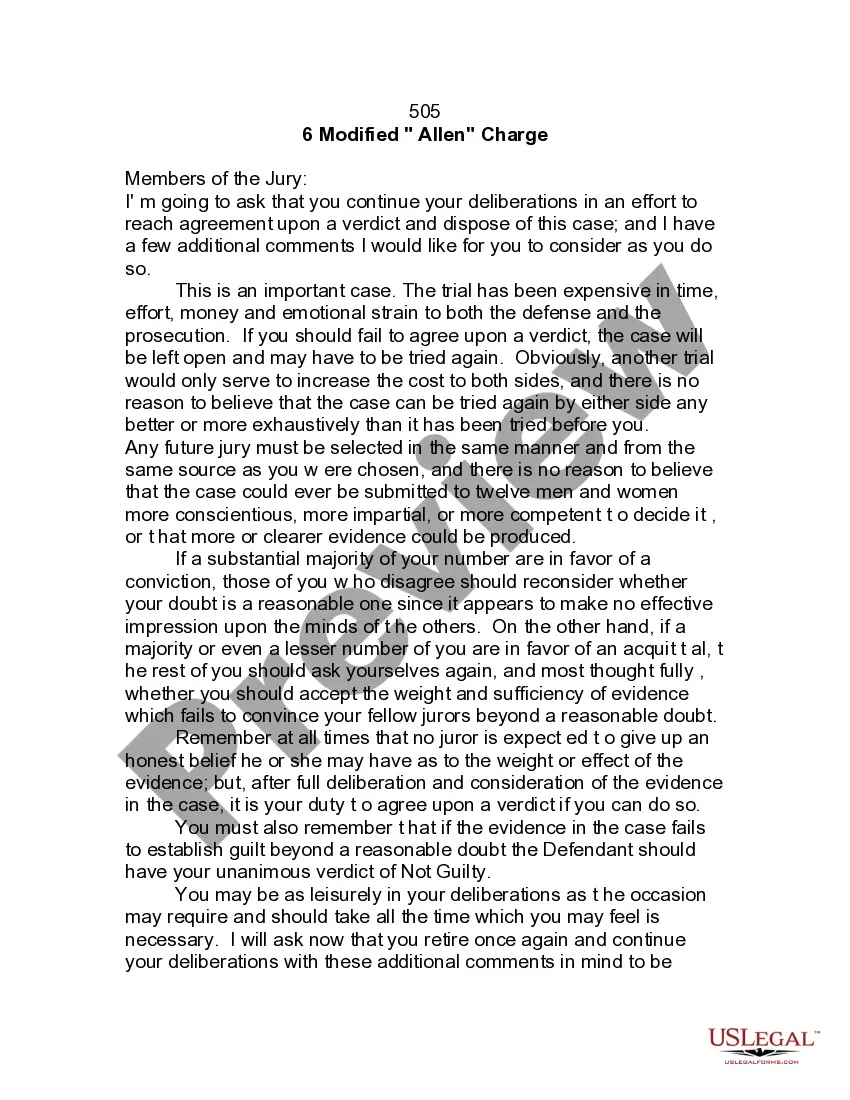
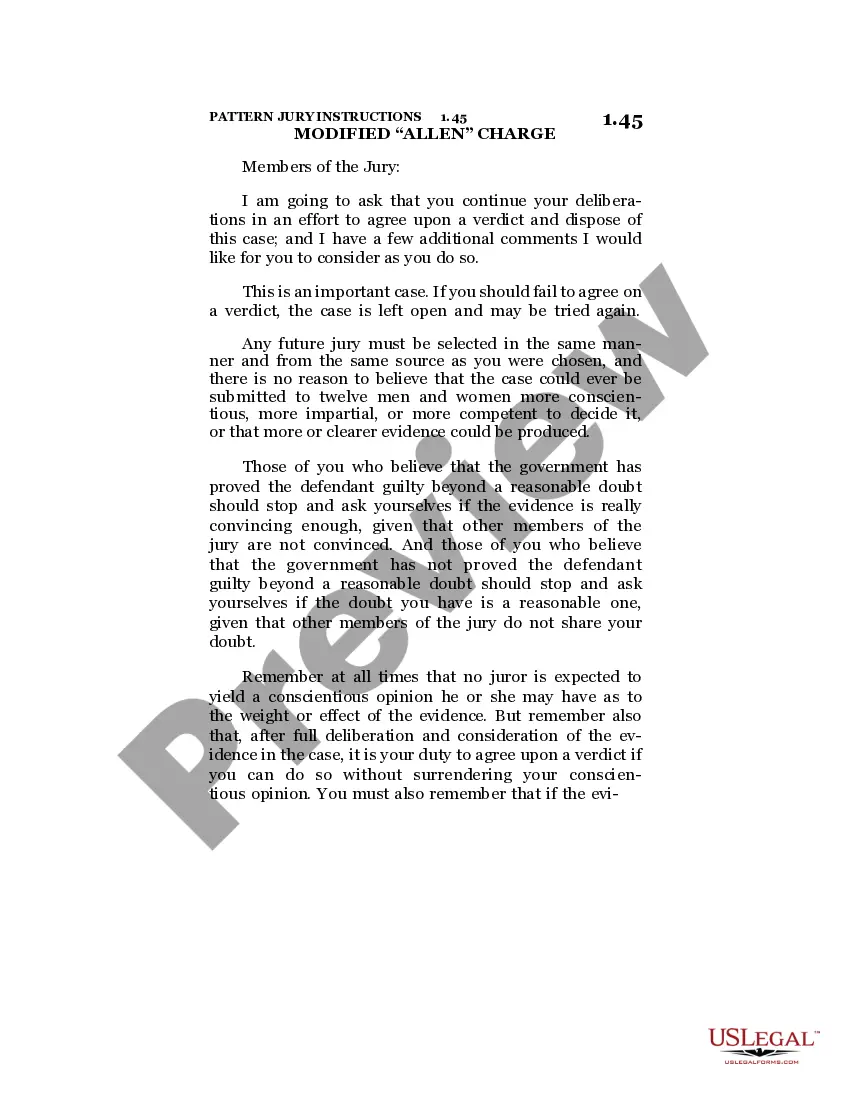
An example of a modified Allen Charge follows: Members of the Jury: I'm going to ask that you continue your deliberations in an effort to reach agreement upon a verdict and dispose of this case; and I have a few additional comments I would like for you to consider as you do so. This is an important case.
When jurors cannot agree on a verdict and report this to a judge, the judge may issue further instruction to them to encourage those in the minority to reconsider their position. These instructions are known as an Allen charge or, more casually, as a dynamite charge.
Named after the case Allen vs. United States, 164 U.S. 492 (1896), an Allen charge is a supplemental jury instruction given by the court to encourage a dead-locked jury to try harder to reach a verdict.
Allen charges (also referred to as dynamite, nitroglycerin, shotgun, or third-degree charges) refer to jury instructions given to a hung jury urging them to agree on a verdict.
In assessing the coerciveness of an Allen charge, the Ninth Circuit considers "(1) the form of the instruction, (2) the time the jury deliberated after receiving the charge as compared to the total time of deliberation, and (3) any other indicia of coerciveness." United States v.
Allen Charge refers to a set of instructions given to a jury when, after deliberation, it is unable to decide on a verdict. The purpose of the instruction is to encourage jurors to re-examine their opinions and attempt to reach a unanimous verdict if possible. Allen Charge is named after the case, Allen v.
If there is a hung jury, the judge may order the jurors to deliberate further. This is known as an Allen charge and is generally only given once or twice. Often, juries will report that they are deadlocked after only deliberating for a short period of time.