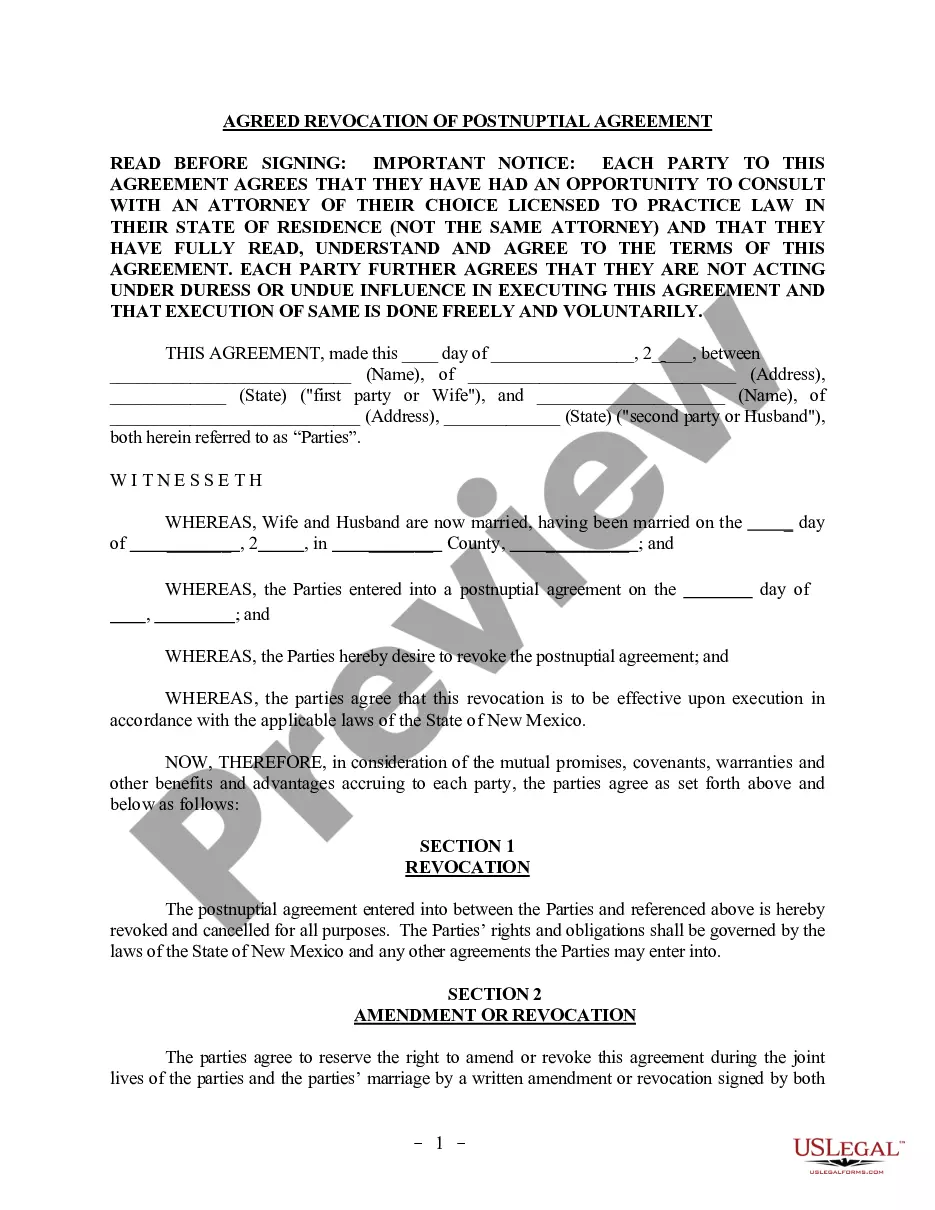
Theft Concerning Programs Receiving Federal Funds
About this form
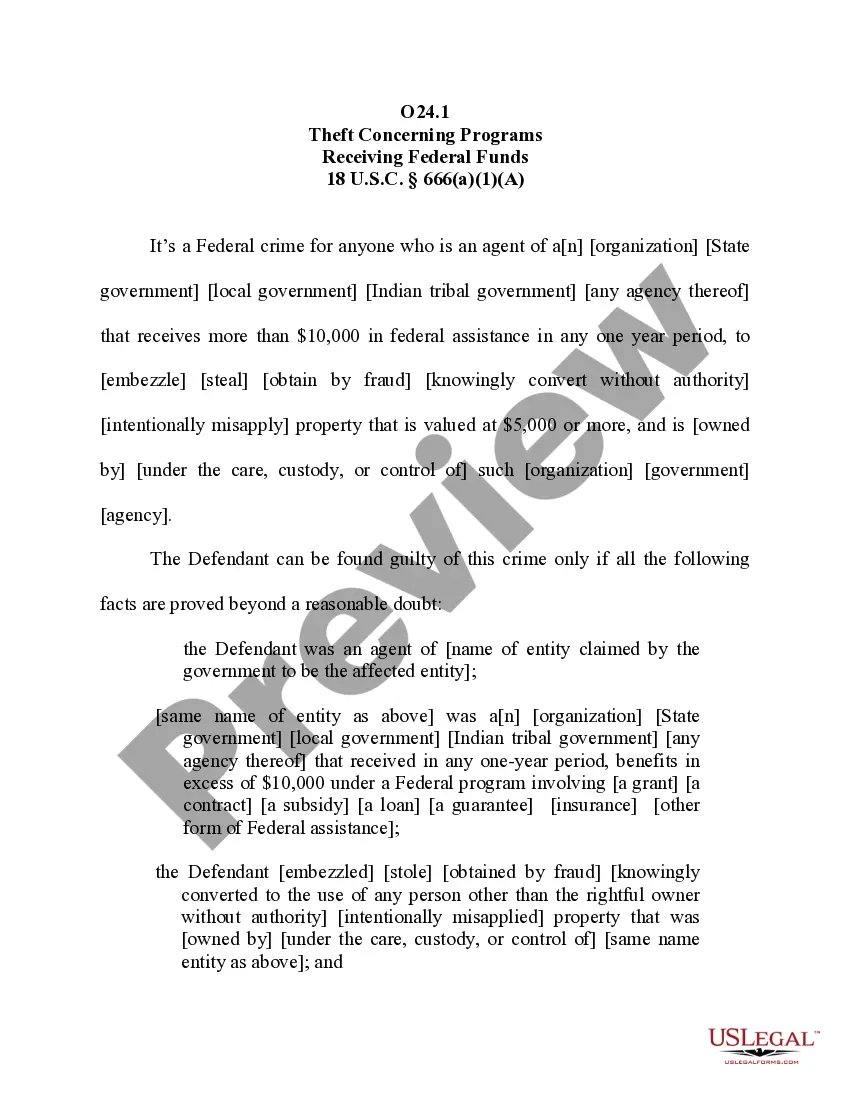
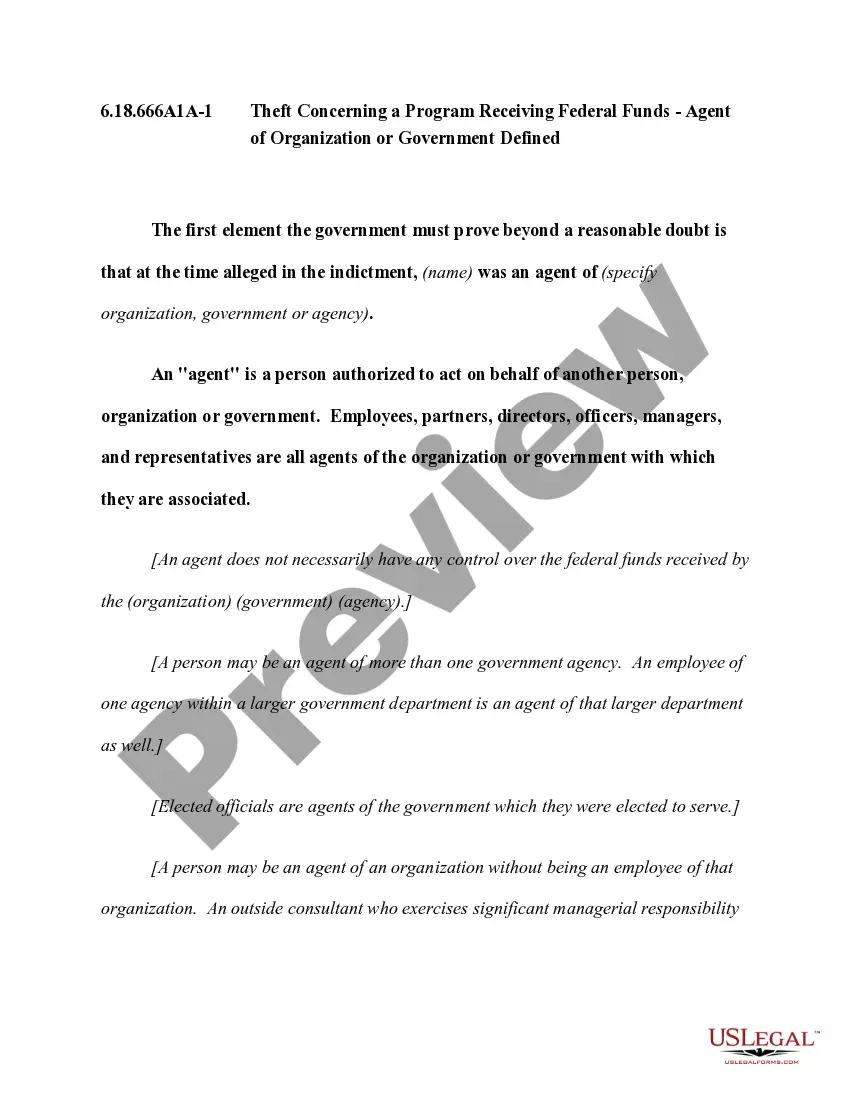
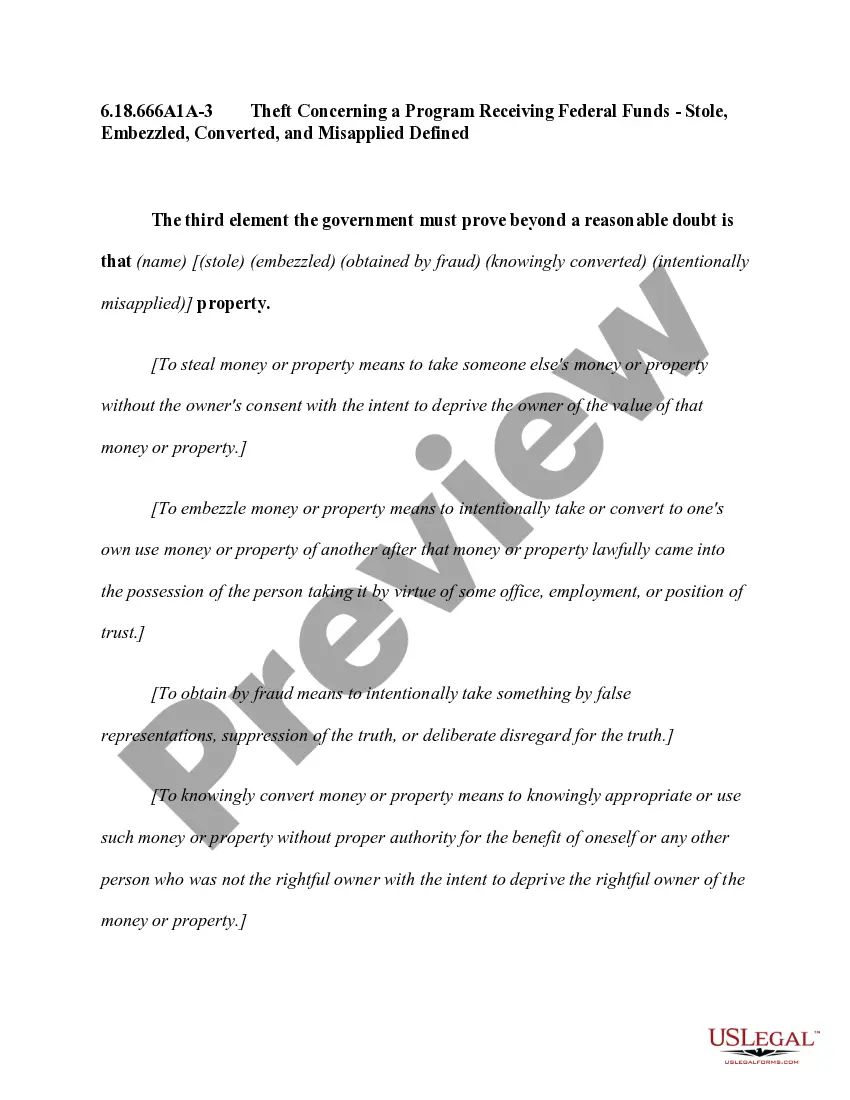
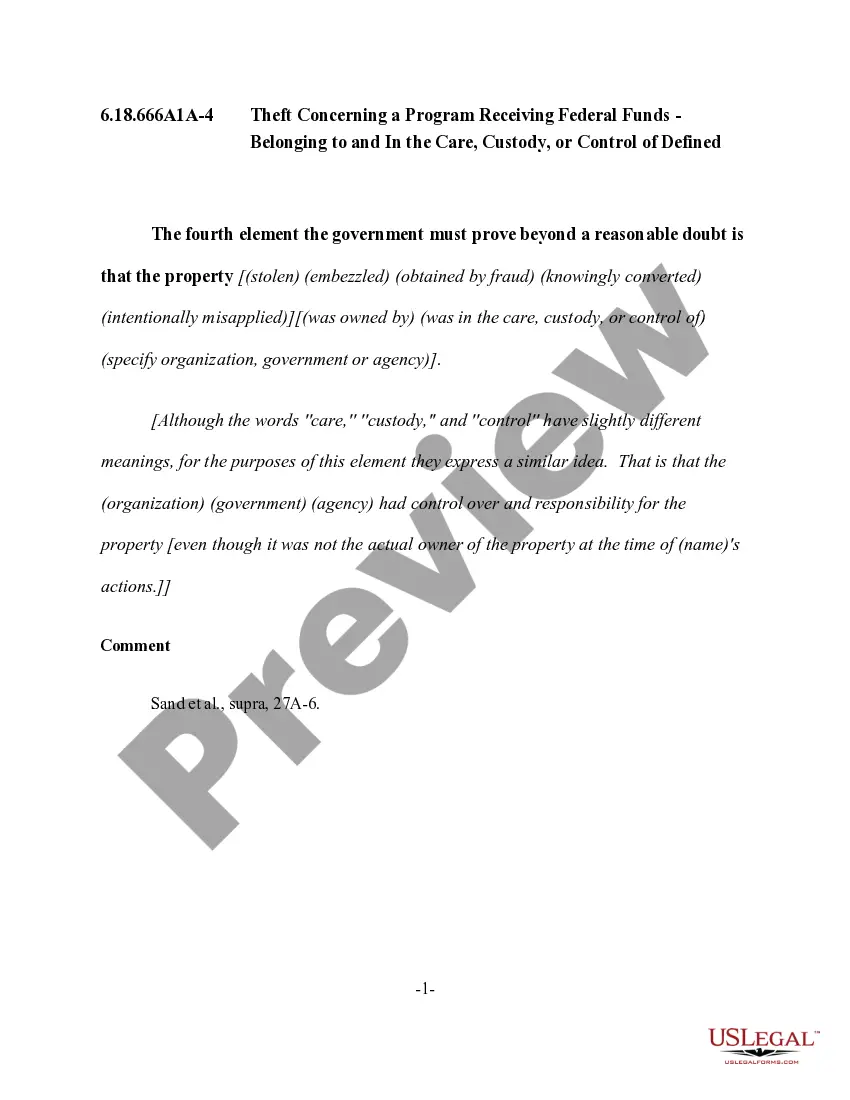
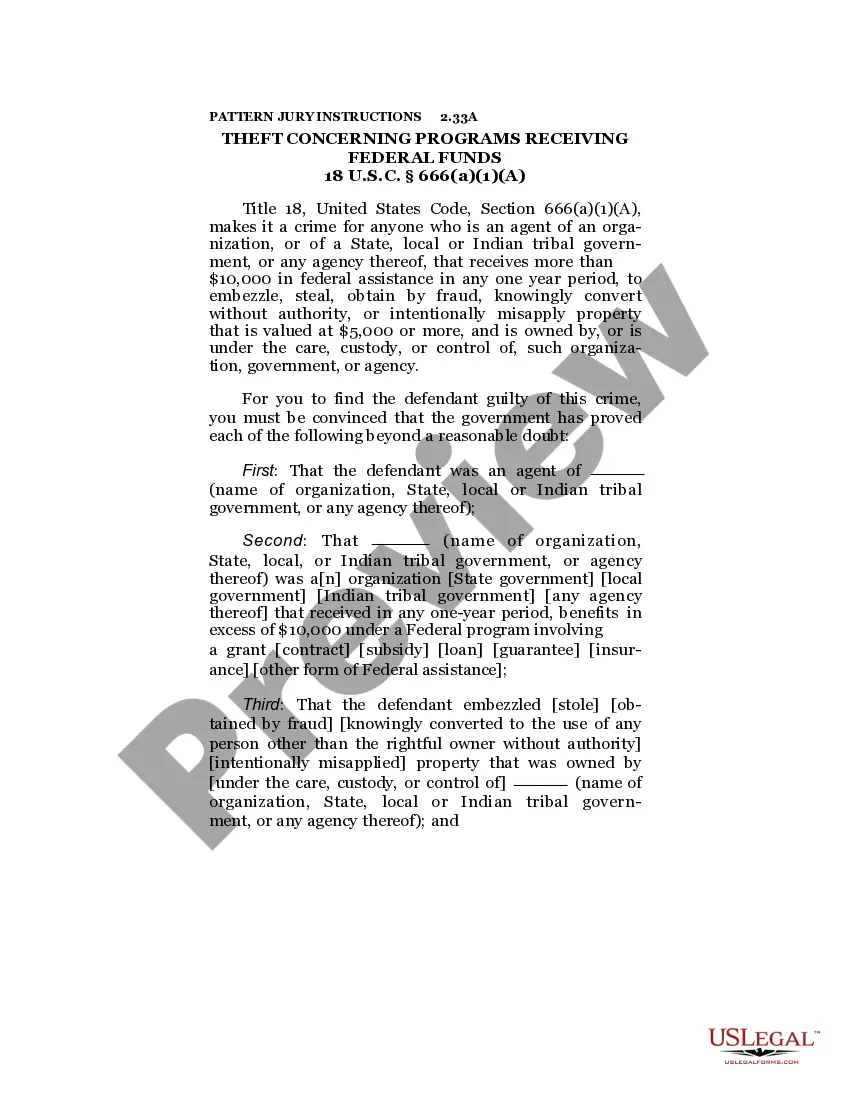
The Theft Concerning Programs Receiving Federal Funds form is used in federal criminal cases to address theft committed by agents of organizations or governments that receive federal funds. This form outlines the necessary legal standards and definitions needed to establish the crime under 18 U.S.C. § 666(a)(1)(A). Unlike other theft-related forms, this one specifically pertains to federal funding scenarios, making it critical for defendants and legal representatives involved in such cases.
Key components of this form
- Definition of theft in relation to federal assistance.
- Criteria for establishing the defendant as an agent of the organization or government.
- Clarification of federal funding thresholds and property value requirements.
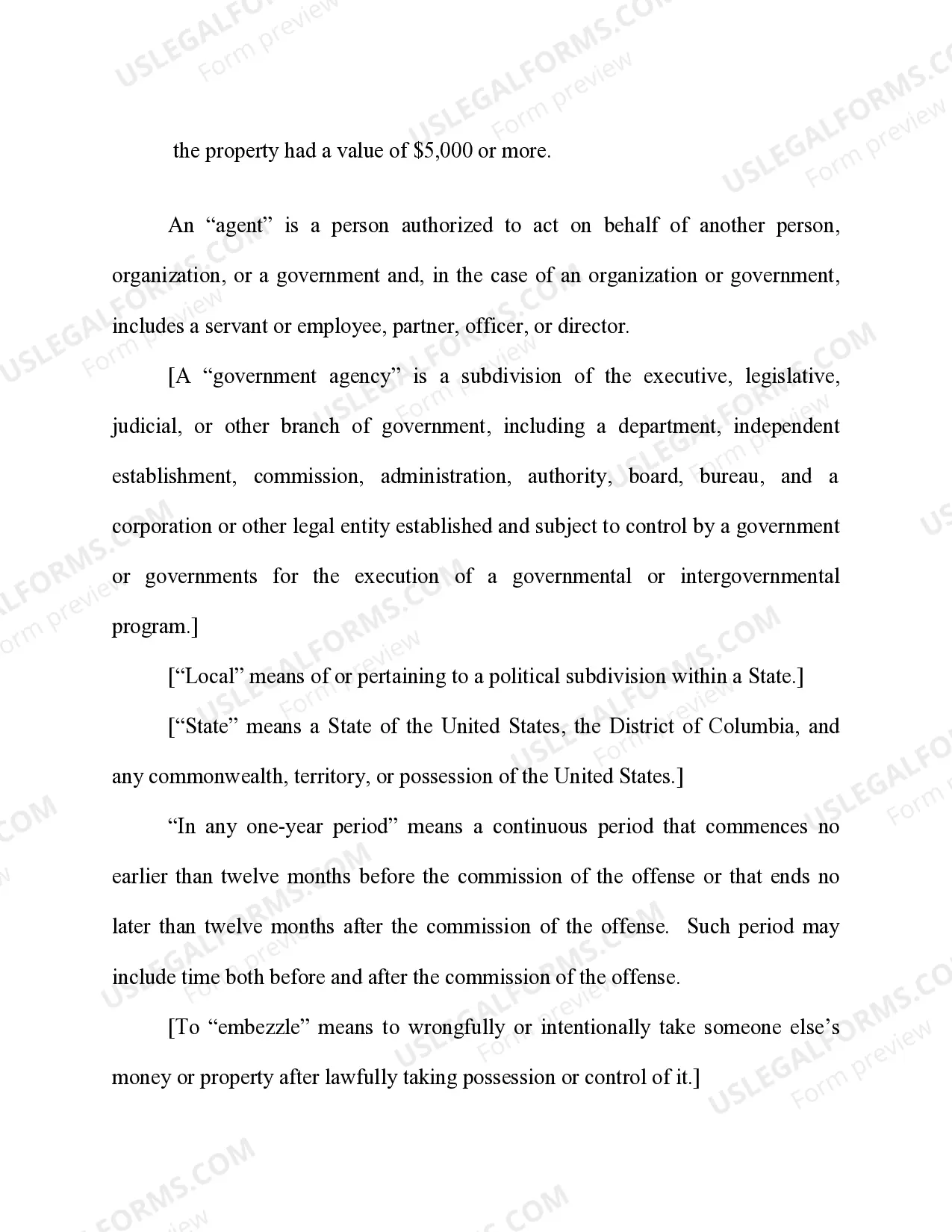
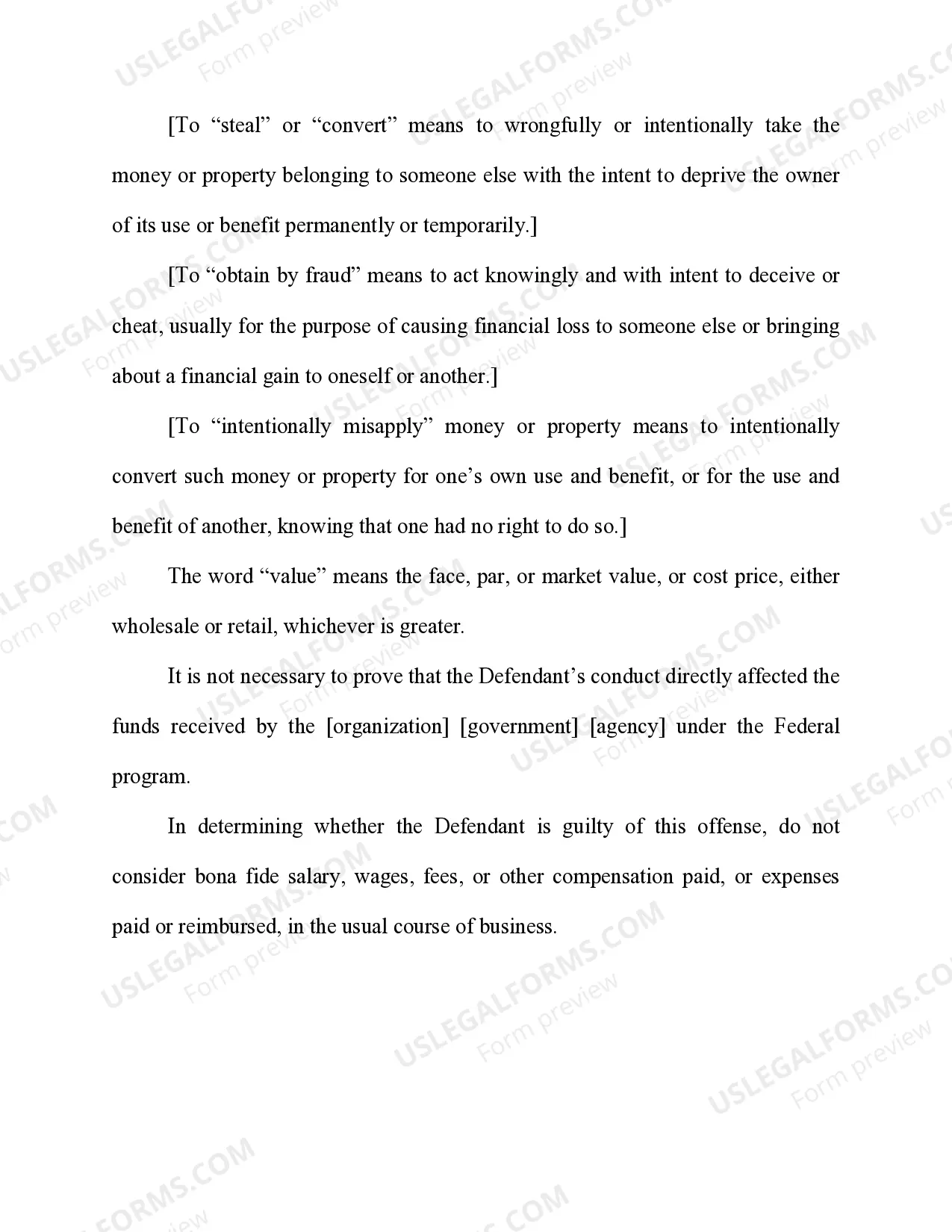
- Detailed explanation of terms such as "embezzle," "steal," and "obtain by fraud."
- Standards for proving guilt beyond a reasonable doubt.
When to use this document
This form is used when a person needs to understand the legal definition and implications of committing theft involving federal funds. It is applicable in cases where an agent of a government or organization that receives more than $10,000 in federal assistance has allegedly engaged in theft or misappropriation of property valued at $5,000 or more. Legal counsel may use this form to build a case or defense based on the jurisdiction-specific criteria provided.
Who needs this form
This form is intended for the following individuals:
- Defendants accused of theft concerning federal funds.
- Attorneys representing clients in theft-related cases.
- Federal prosecutors handling cases of fraud or theft against organizations receiving federal assistance.
- Legal professionals seeking comprehensive guidelines on the federal theft statutes.
Completing this form step by step
- Identify the accused party as the agent of the organization or government involved.
- Confirm that the organization received federal assistance exceeding the $10,000 threshold.
- Detail the nature of the theft or fraudulent activity, including the type of property involved.
- Specify the value of the stolen property, ensuring it meets or exceeds $5,000.
- Gather evidence to support claims of the accused partyâs actions and intentions.
Notarization guidance
This form does not typically require notarization to be legally valid. However, some jurisdictions or document types may still require it. US Legal Forms provides secure online notarization powered by Notarize, available 24/7 for added convenience.
Get your form ready online
Our built-in tools help you complete, sign, share, and store your documents in one place.
Make edits, fill in missing information, and update formatting in US Legal Forms—just like you would in MS Word.
Download a copy, print it, send it by email, or mail it via USPS—whatever works best for your next step.
Sign and collect signatures with our SignNow integration. Send to multiple recipients, set reminders, and more. Go Premium to unlock E-Sign.
If this form requires notarization, complete it online through a secure video call—no need to meet a notary in person or wait for an appointment.
We protect your documents and personal data by following strict security and privacy standards.

Make edits, fill in missing information, and update formatting in US Legal Forms—just like you would in MS Word.

Download a copy, print it, send it by email, or mail it via USPS—whatever works best for your next step.

Sign and collect signatures with our SignNow integration. Send to multiple recipients, set reminders, and more. Go Premium to unlock E-Sign.

If this form requires notarization, complete it online through a secure video call—no need to meet a notary in person or wait for an appointment.

We protect your documents and personal data by following strict security and privacy standards.
Avoid these common issues
- Failing to establish that the organization received federal funds exceeding $10,000.
- Misunderstanding the definitions of terms like "embezzle" and "obtain by fraud."
- Not providing sufficient evidence to prove the value of the property involved.
- Ignoring the importance of proving the defendant's status as an agent of the organization.
Benefits of completing this form online
- Convenience of accessing legal information and instructions from anywhere.
- Editability allows for customization of details specific to each case.
- Reliable templates drafted by licensed attorneys, ensuring legal accuracy.
- Quick downloading for immediate use in legal proceedings or consultations.
Legal use & context
- This form establishes the federal legal framework for prosecuting theft involving federal funds.
- It is specifically designed to address the nuances of federal criminal law.
- Proper use of this form may influence the outcome of cases related to federal program funds.
Looking for another form?
Form popularity
FAQ
Federal Embezzlement Laws Depending on the situation, embezzlement can be tried as a state or federal crime. Under federal law, embezzlement may be prosecuted as theft of public money or property, theft by government employees, or through theft of money from a bank or financial institution.
As with all theft crimes, embezzlement is a specific intent crime. This means that the defendant must have intended to deprive the owner of the item to be guilty. A person who wrongfully keeps property temporarily, but intends to return it later, is not guilty of common-law embezzlement.
Section 641 protects "any record, voucher, money, or thing of value of the United States or any department or agency thereof, or any property made or being made under contract for the United States or any department or agency thereof."
Theft of government property under 18 U.S.C. § 641 makes it a crime to steal, embezzle, or knowing convert with intent for your own personal gain the property, or to sell, convey, or dispose of any record, voucher, money, or something of value issued by a department of the United States government.
18 U.S. Code Chapter 31 - EMBEZZLEMENT AND THEFT.
United States, 160 U.S. 268, 269 (1895), the Supreme Court defined embezzlement in the following terms: Embezzlement is the fraudulent appropriation of property by a person to whom such property has been entrusted, or into whose hands it has lawfully come.
18 U.S. Code § 666 - Theft or bribery concerning programs receiving Federal funds U.S. Code US Law LII / Legal Information Institute.
Public corruption is a federal crime. Several federal statutes provide for federal prosecution of public corruption in the United States. Prosecutors regularly use most often use the Hobbs Act, Travel Act, RICO, the program bribery statute, and mail and wire fraud statutes to prosecute people for public corruption.