Receiving and Distributing Material Involving Sexual Exploitation of Minors
About this form
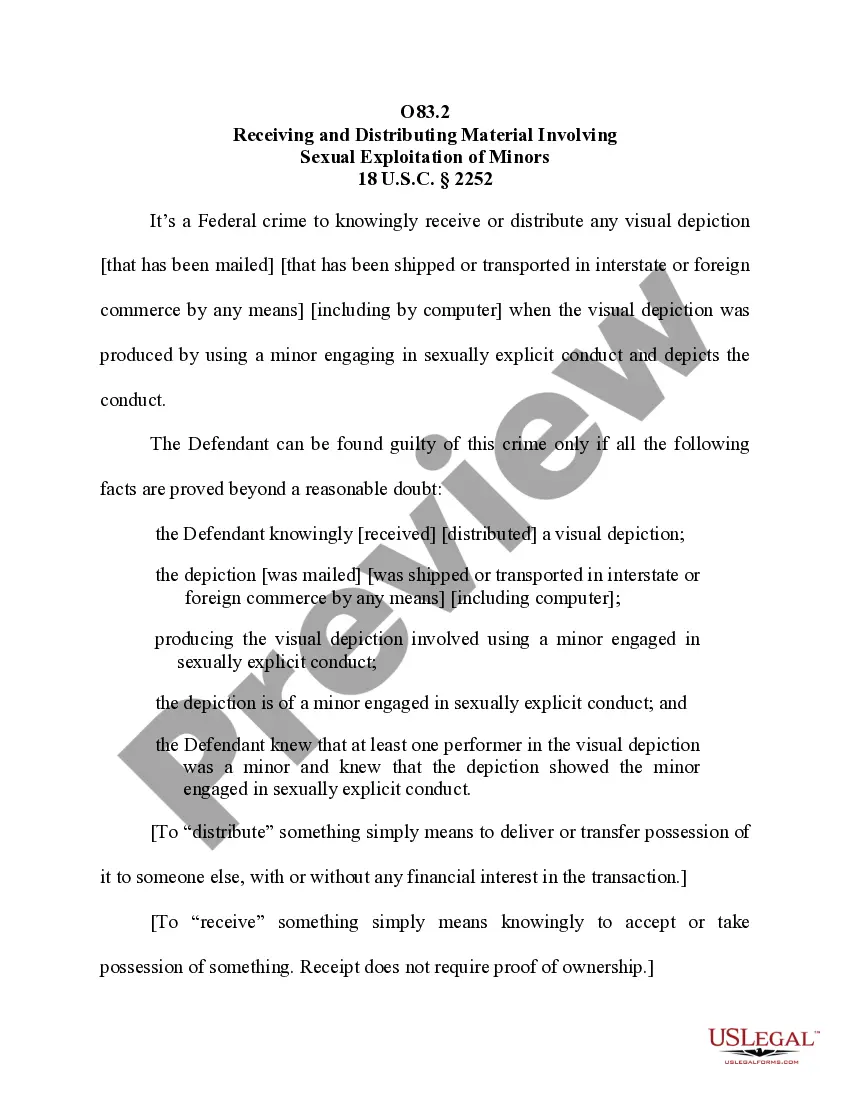
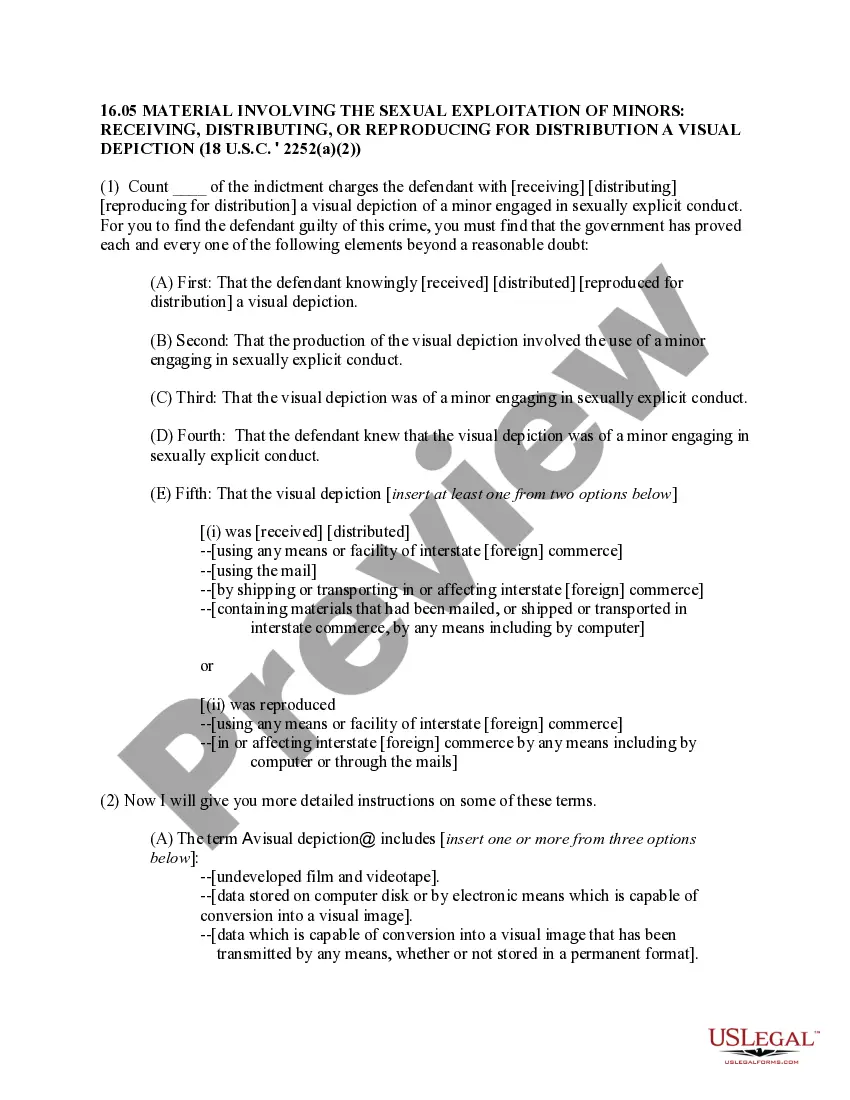
The Receiving and Distributing Material Involving Sexual Exploitation of Minors form is a legal document used in cases regarding the federal offense outlined under 18 U.S.C. § 2252. This form specifically addresses the unlawful receipt or distribution of visual depictions that involve minors in sexually explicit conduct. It serves to clarify the components required to establish guilt in such cases and is distinct from other legal forms by focusing specifically on this serious crime involving minors.
Key parts of this document
- The definition of "knowingly" receiving or distributing a visual depiction.
- Criteria for establishing that the visual depiction was produced using a minor engaged in sexually explicit conduct.
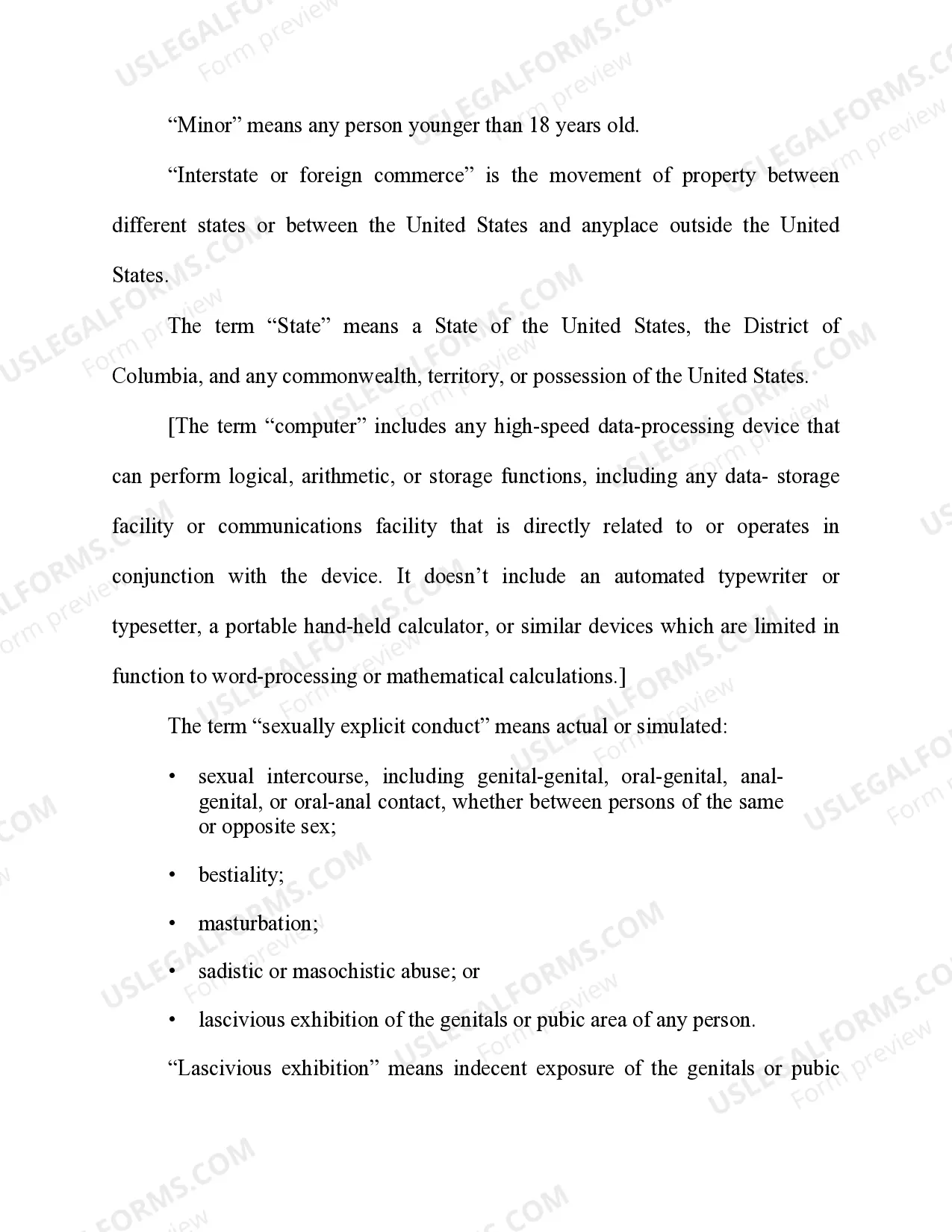
- Clarification of what constitutes a "minor" and "interstate or foreign commerce."
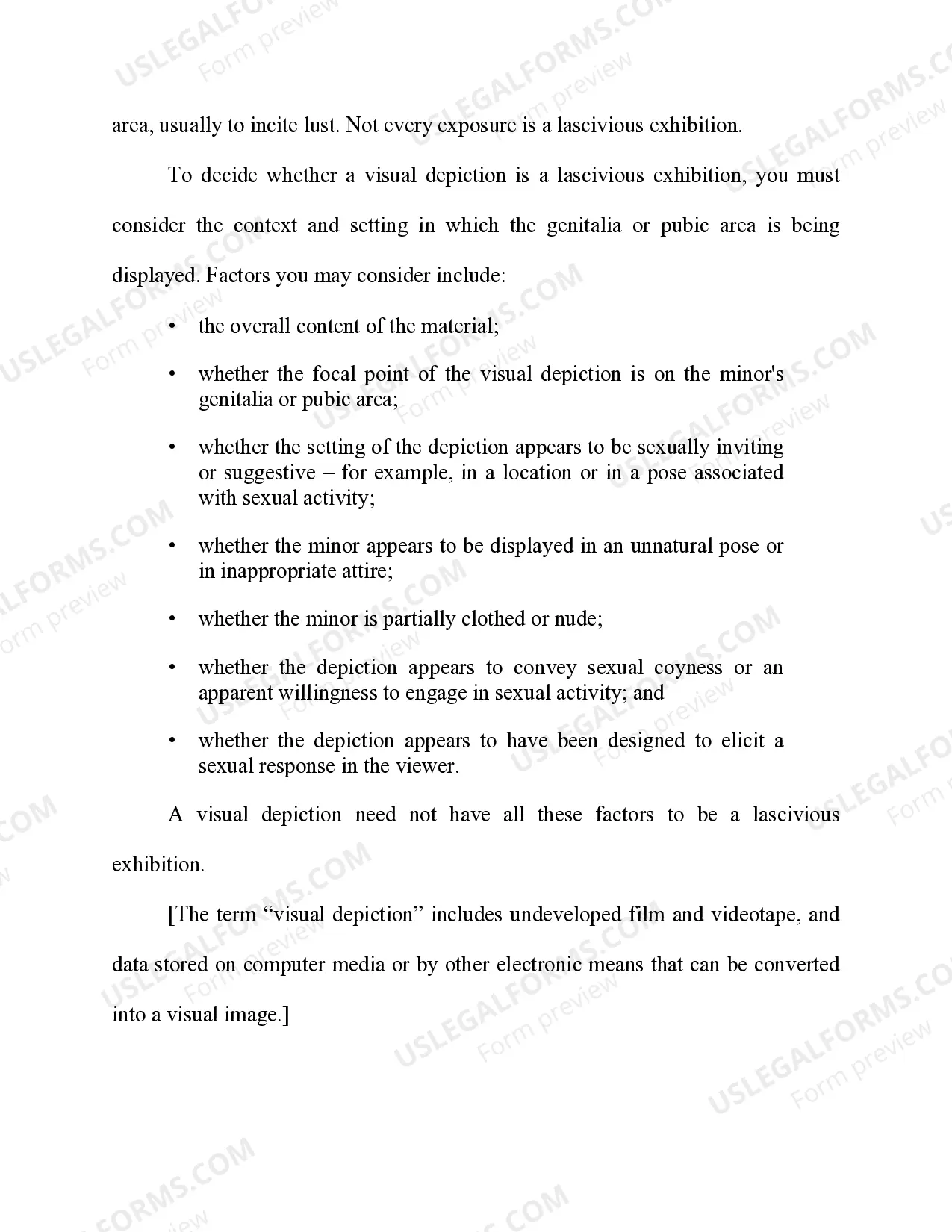
- Explanation of "sexually explicit conduct" and "lascivious exhibition."
- Parameters for evaluating visual depictions as lascivious exhibitions.
Situations where this form applies
This form is necessary in instances where an individual faces charges for receiving or distributing material that exploits minors sexually. Legal professionals may utilize this form when preparing for federal court cases related to these offenses. Additionally, defendants may need it to understand the specific elements of the charges against them and the legal definitions related to their case.
Who needs this form
This form is intended for:
- Individuals accused of receiving or distributing inappropriate material involving minors.
- Legal professionals representing clients in federal criminal cases.
- Law enforcement agencies investigating violations of child exploitation laws.
- Educators and parents interested in understanding the legal implications of such offenses.
Steps to complete this form
- Identify the parties involved, including the defendant and any applicable legal representation.
- Specify the nature of the received or distributed material.
- Outline the circumstances under which the material was received or distributed.
- Confirm understanding of the definitions related to minors and sexually explicit conduct included in the instructions.
- Sign and date the form where required, ensuring all fields are accurately filled.
Notarization requirements for this form
This form does not typically require notarization unless specified by local law. Ensure all provided information is accurate and complete before submission to the relevant authorities.
Get your form ready online
Our built-in tools help you complete, sign, share, and store your documents in one place.
Make edits, fill in missing information, and update formatting in US Legal Forms—just like you would in MS Word.
Download a copy, print it, send it by email, or mail it via USPS—whatever works best for your next step.
Sign and collect signatures with our SignNow integration. Send to multiple recipients, set reminders, and more. Go Premium to unlock E-Sign.
If this form requires notarization, complete it online through a secure video call—no need to meet a notary in person or wait for an appointment.
We protect your documents and personal data by following strict security and privacy standards.

Make edits, fill in missing information, and update formatting in US Legal Forms—just like you would in MS Word.

Download a copy, print it, send it by email, or mail it via USPS—whatever works best for your next step.

Sign and collect signatures with our SignNow integration. Send to multiple recipients, set reminders, and more. Go Premium to unlock E-Sign.

If this form requires notarization, complete it online through a secure video call—no need to meet a notary in person or wait for an appointment.

We protect your documents and personal data by following strict security and privacy standards.
Avoid these common issues
- Failing to clearly identify the depicted material, including relevant details about its content.
- Not specifying the nature or method of distribution accurately.
- Overlooking the requirement to acknowledge understanding of the laws regarding minors.
- Incomplete signatures or dates which may render the form invalid.
Benefits of completing this form online
- Convenience of immediate access to legal resources and templates.
- Ability to edit and tailor the form to specific circumstances before downloading.
- Reliability of templates that are drafted by licensed attorneys to ensure compliance with legal standards.
Looking for another form?
Form popularity
FAQ
When a child or young person is exploited they're given things, like gifts, drugs, money, status and affection, in exchange for performing sexual activities. Children and young people are often tricked into believing they're in a loving and consensual relationship. This is called grooming.
A student may be vulnerable to sexual exploitation if you notice, or they report any of the following in their relationships: threats to end their relationship if they don't have sex. demands that they have sex with other people. expectations to provide sex in return for food, a place to stay, or drugs or gifts.
Additionally, poverty, classism, racism, social isolation, marginalization, peer pressure, past abuse and trauma, sex-based discrimination, mental health issues, neurological and developmental disorders, systemic gaps, inaccessible services and other social and financial inequalities can all contribute to children's,
Sexual exploitation involves a person profiting from the use of another person's body in a sexual manner in order to benefit (financially or otherwise). In general, the perpetrator of sexual exploitation takes advantage of their victim's vulnerable or dependent state, including addictions to drugs or alcohol.
Forcing sex or someone to have sex with anyone. ography. Unwanted touching of a sexual nature. Refusing to use safe sex practices.
Distribution of child ography is a criminal charge appropriate when someone transports, duplicates, and sends out ography to others. In California, ?child ography? is defined as images, data, computer files, and other depictions that show a person under the age of 18 engaged in a sexual act.
The requirements in section 2252(a)(1)(A), (2)(A), (3)(B)(i), and (4)(B)(i) that the production of a visual depiction involve the use of a minor engaging in 'sexually explicit conduct' of the kind described in section 2256(2)(E) are satisfied if a person photographs a minor in such a way as to exhibit the child in a
Sexual exploitation crimes include solicitation of minors and production of child ography. Anyone who attempts to induce, entice, or persuade a minor (under 18) to engage in a sexual act for pictures or videos can be found guilty of sexual exploitation, defined under 18 U.S.C. §2251.