STATEMENTS BY CO-CONSPIRATORS
About this form
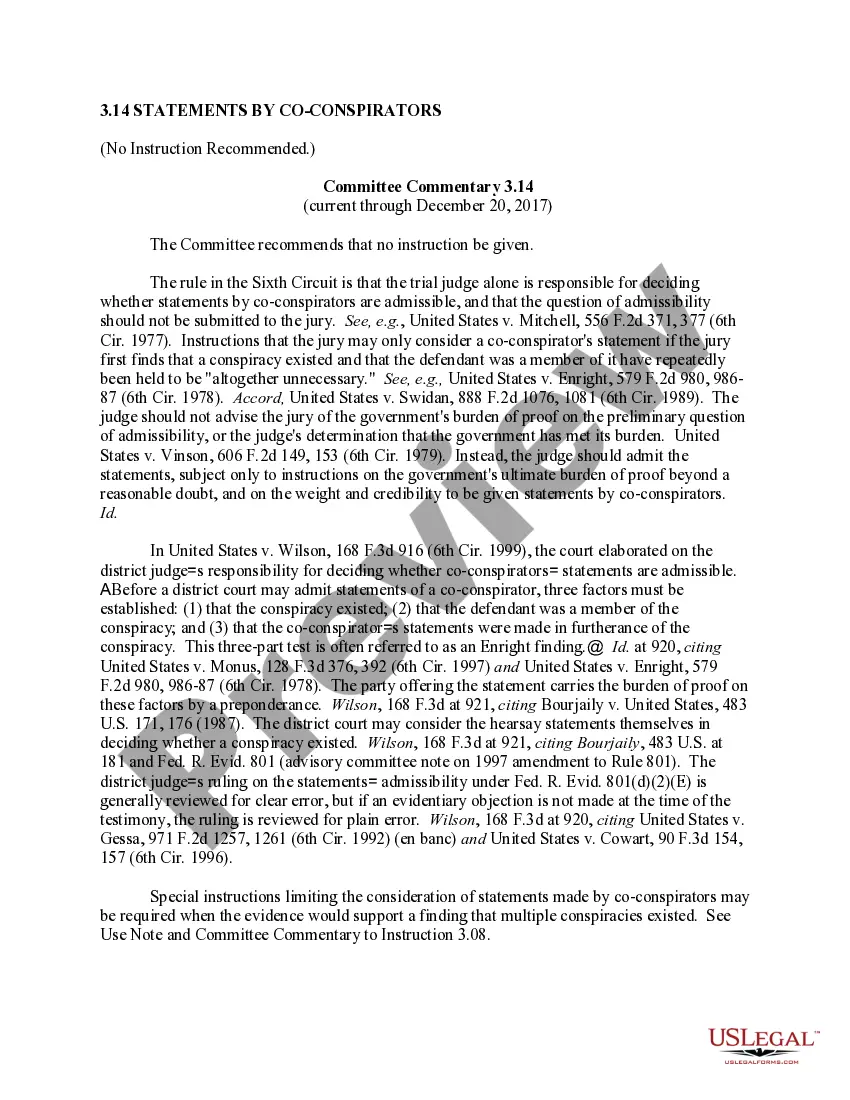
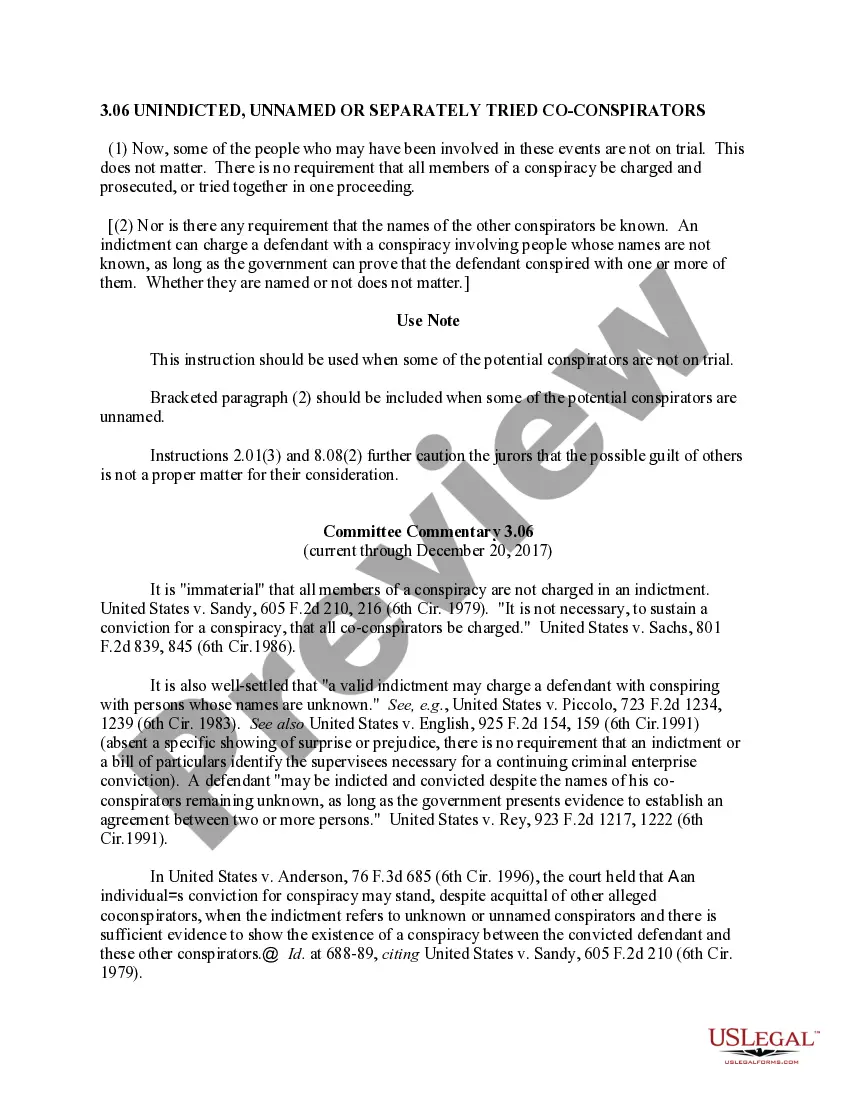
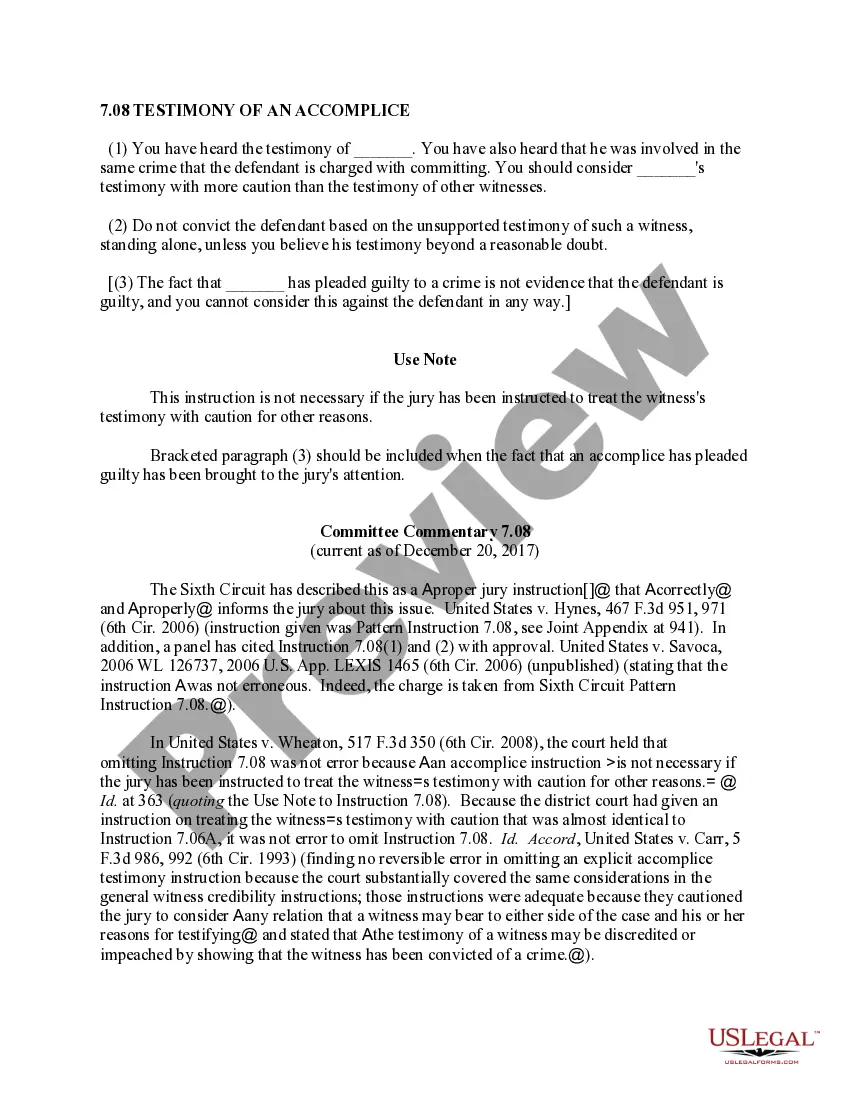
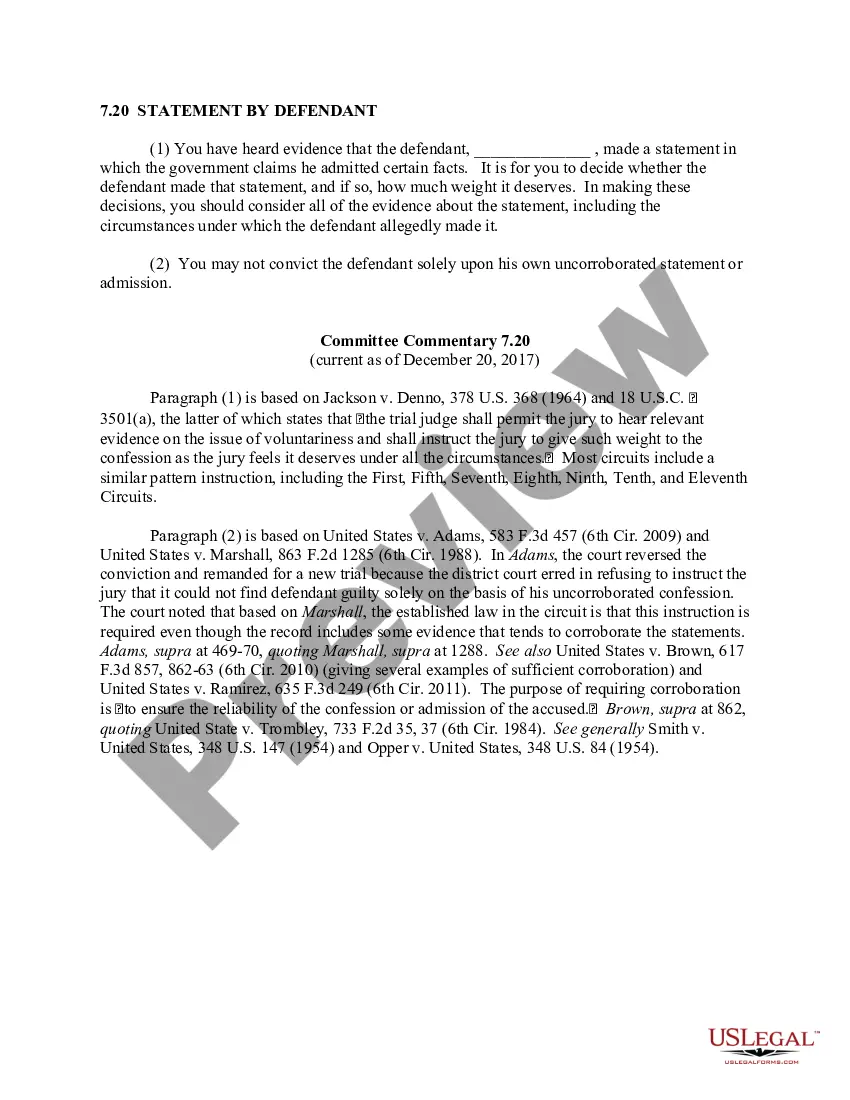
The Statements by Co-Conspirators form is a legal document used in criminal cases to address the admissibility of statements made by individuals involved in a conspiracy. This form is pivotal as it ensures that only relevant and corroborated evidence regarding co-conspirators' statements is admitted in court. Unlike other legal forms, this one specifically focuses on the rules of evidence in criminal proceedings, particularly within the jurisdiction of the Sixth Circuit.
Key components of this form
- Definitions of conspiracy and co-conspirators' roles in legal proceedings.
- Court's responsibilities regarding the admissibility of statements.
- Criteria for establishing the existence of a conspiracy and the membership of defendants.
- Guidance on how hearsay statements relate to conspiracy evidence.
- Judicial instructions regarding the government's burden of proof.
Common use cases
This form should be utilized during criminal trials when a defendant's case involves statements made by alleged co-conspirators. It is relevant in situations where the admissibility of such statements is challenged, particularly concerning the establishment of the conspiracy and the defendant's involvement in it.
Who needs this form
- Attorneys representing defendants in criminal conspiracy cases.
- Judges presiding over trials where co-conspirator statements are presented as evidence.
- Prosecutors seeking to introduce co-conspirator statements in court.
- Legal scholars studying evidentiary rules related to conspiracies.
Steps to complete this form
- Identify the parties involved, including the defendant and co-conspirators.
- Clarify the nature of the conspiracy and present relevant evidence.
- Establish the membership of defendants within the conspiracy.
- Gather hearsay statements from co-conspirators made in furtherance of the conspiracy.
- Ensure that all necessary court guidelines for admissibility are followed.
Is notarization required?
This form usually doesn’t need to be notarized. However, local laws or specific transactions may require it. Our online notarization service, powered by Notarize, lets you complete it remotely through a secure video session, available 24/7.
Get your form ready online
Our built-in tools help you complete, sign, share, and store your documents in one place.
Make edits, fill in missing information, and update formatting in US Legal Forms—just like you would in MS Word.
Download a copy, print it, send it by email, or mail it via USPS—whatever works best for your next step.
Sign and collect signatures with our SignNow integration. Send to multiple recipients, set reminders, and more. Go Premium to unlock E-Sign.
If this form requires notarization, complete it online through a secure video call—no need to meet a notary in person or wait for an appointment.
We protect your documents and personal data by following strict security and privacy standards.

Make edits, fill in missing information, and update formatting in US Legal Forms—just like you would in MS Word.

Download a copy, print it, send it by email, or mail it via USPS—whatever works best for your next step.

Sign and collect signatures with our SignNow integration. Send to multiple recipients, set reminders, and more. Go Premium to unlock E-Sign.

If this form requires notarization, complete it online through a secure video call—no need to meet a notary in person or wait for an appointment.

We protect your documents and personal data by following strict security and privacy standards.
Common mistakes to avoid
- Failing to establish the criteria for admissibility of statements clearly.
- Confusing the roles of the judge and jury regarding admissibility decisions.
- Neglecting to provide sufficient evidential support for the existence of a conspiracy.
- Overlooking the necessity of timely evidentiary objections during the trial.
Why complete this form online
- Easy access to updated legal formats drafted by licensed attorneys.
- Convenient downloading and printing options for quick preparation.
- Editable templates that allow for customization to fit specific cases.
- Secure online storage and retrieval of completed forms.
Legal use & context
- Statements by co-conspirators must meet specific legal thresholds for admissibility.
- Judges have discretion in determining if the criteria for a conspiracy are met.
- Legal counsel should be prepared to argue both for and against the admissibility of such statements in court.
- The form is vital for preserving the integrity of evidential processes in criminal trials.
Looking for another form?
Form popularity
FAQ
The following are not excluded by the rule against hearsay, regardless of whether the declarant is available as a witness: (1) Present Sense Impression.(2) Excited Utterance.(3) Then-Existing Mental, Emotional, or Physical Condition.(4) Statement Made for Medical Diagnosis or Treatment.
802. In short, ?hearsay? is a statement made by a declarant, not while testifying at a current trial or hearing, offered by a party to prove the truth of the matter asserted in the statement.
13 If courts enforced the Confrontation Clause literally, they would exclude from evidence any hearsay statement made by a declarant who was not present or who did not testify at trial.
Evidence Code § 1200 is a California law that defines hearsay evidence as any statement by someone other than the witness who is testifying, and is offered to prove the truth of the matter asserted.
Rule 801 ? Definition of Hearsay. The following definitions apply under this Article: (a) Statement. - A "statement" is (1) an oral or written assertion or (2) nonverbal conduct of a person, if it is intended by him as an assertion.
Key Concepts. An admission by a party-opponent is an exception to the prohibition against hearsay evidence in Rule 801. The exception applies to the party's own statements and any statements that were authorized or adopted by the party as well as certain statements made by an agent or coconspirator of the party.
In United States law, a declaration (or statement) against interest is an exception to the rule on hearsay in which a person's statement may be used, where generally the content of the statement is so prejudicial to the person making it that they would not have made the statement unless they believed the statement was
In a legal context, conspiracy refers to an agreement by two or more people to commit a crime. In any of these cases, the people involved can be called conspirators. The word co-conspirator refers to a conspirator conspiring with one or more other conspirators in the same conspiracy.