1.04 EVIDENCE
About this form
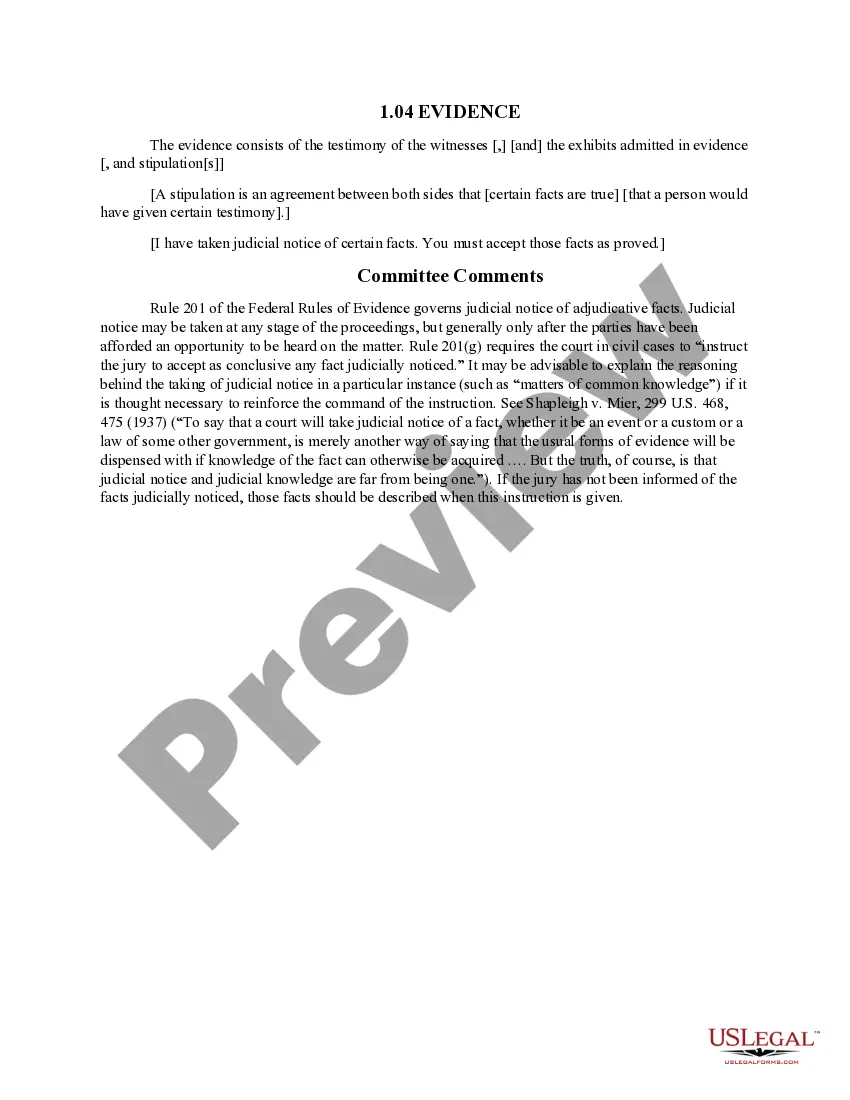
The 1.04 Evidence form is an official pattern jury instruction established by the Federal 7th Circuit Court. This form outlines the components of evidence in a trial, including witness testimony, exhibits, and stipulations. Unlike other legal forms, this instruction specifically guides juries on how to evaluate evidence presented in court, adhering to established federal rules of evidence.
Key components of this form
- Definition of evidence, including testimony, exhibits, and stipulations.
- Explanation of stipulations as agreements between parties regarding facts.
- Judicial notice details, instructing jurors to accept certain facts as proven.
- Reference to Rule 201 of the Federal Rules of Evidence regarding judicial notice.
- Committee comments on the application of these rules in court proceedings.
Common use cases
This form is used during trial proceedings to instruct juries on how to assess evidence. It is essential in cases where jurors need clarity on what constitutes admissible evidence and how to treat agreed-upon facts or judicially noticed facts. This instruction helps ensure that jurors can make unbiased decisions based purely on the evidence presented to them.
Who can use this document
- Judges overseeing trial proceedings who need to inform juries about evidence rules.
- Attorneys seeking to clarify the nature of evidence for jurors.
- Jury consultants involved in trials who want to ensure jurors understand evidence evaluation.
Instructions for completing this form
- Review the definitions of evidence provided in the instruction.
- Ensure clarity on the role of stipulations within the trial.
- Confirm any judicial notice taken by the court and the facts involved.
- Instruct jurors on accepting judicially noticed facts as established.
- Deliver the instruction at an appropriate point in the trial proceedings.
Notarization guidance
This form does not typically require notarization unless specified by local law. However, as it is an instruction for jury use in a federal setting, notarization is generally not applicable.
Get your form ready online
Our built-in tools help you complete, sign, share, and store your documents in one place.
Make edits, fill in missing information, and update formatting in US Legal Forms—just like you would in MS Word.
Download a copy, print it, send it by email, or mail it via USPS—whatever works best for your next step.
Sign and collect signatures with our SignNow integration. Send to multiple recipients, set reminders, and more. Go Premium to unlock E-Sign.
If this form requires notarization, complete it online through a secure video call—no need to meet a notary in person or wait for an appointment.
We protect your documents and personal data by following strict security and privacy standards.

Make edits, fill in missing information, and update formatting in US Legal Forms—just like you would in MS Word.

Download a copy, print it, send it by email, or mail it via USPS—whatever works best for your next step.

Sign and collect signatures with our SignNow integration. Send to multiple recipients, set reminders, and more. Go Premium to unlock E-Sign.

If this form requires notarization, complete it online through a secure video call—no need to meet a notary in person or wait for an appointment.

We protect your documents and personal data by following strict security and privacy standards.
Common mistakes
- Failing to adequately explain stipulations and their significance.
- Overlooking the importance of judicial notice and how it applies to the case.
- Not providing enough context for jurors about the nature of evidence presented.
Advantages of online completion
- Easy access to a legally sound template drafted by experts.
- Convenient editing options to tailor the instructions for specific cases.
- Quick download makes it readily available for trial preparation.
- Trustworthy content that reflects federal legal standards.
- This form helps establish the legal standard for evidence in jury trials.
- It reinforces the importance of proper jury instructions in the trial process.
- The clarity provided by this form aids in reducing potential legal challenges related to jury misunderstandings.
Quick recap
- The 1.04 Evidence form provides essential guidelines for juries regarding the evaluation of evidence.
- It includes vital components such as stipulations and judicial notice.
- Using the form ensures clarity and compliance with federal legal standards.
Looking for another form?
Form popularity
FAQ
Witness testimony. Rule 901(b)(1) allows for authentication through the testimony of a witness with knowledge that a matter is what it is claimed to be. For non-electronic documents, the witness providing such testimony may be the person who drafted the document or who is responsible for maintaining the record.
Rule 104 - Preliminary Questions (a)Questions of Admissibility Generally. Preliminary questions concerning the qualification of a person to be a witness, the existence of a privilege, or the admissibility of evidence shall be determined by the court, subject to the provisions of subdivision (b).
(1)Originals Lost or Destroyed. All originals are lost or have been destroyed, unless the proponent lost or destroyed them in bad faith; or (2)Original Not Obtainable. No original can be obtained by any available judicial process or procedure; or (3)Original in Possession of Opponent.
Rule 104 - Preliminary Questions (a) In General. The court must decide any preliminary question about whether a witness is qualified, a privilege exists, or evidence is admissible. In so deciding, the court is not bound by evidence rules, except those on privilege.
(b) Relevance That Depends on a Fact. When the relevance of evidence depends on whether a fact exists, proof must be introduced sufficient to support a finding that the fact does exist. The court may admit the proposed evidence on the condition that the proof be introduced later.
104(a) applies when the question is whether ?evidence is admissible.? Rule 104(b) applies when the relevance of evidence turns on whether another fact exists.
When evidence which is admissible as to one party or for one purpose but not admissible as to another party or for another purpose is admitted, the court, upon request, shall restrict the evidence to its proper purpose or scope and instruct the jury ingly.