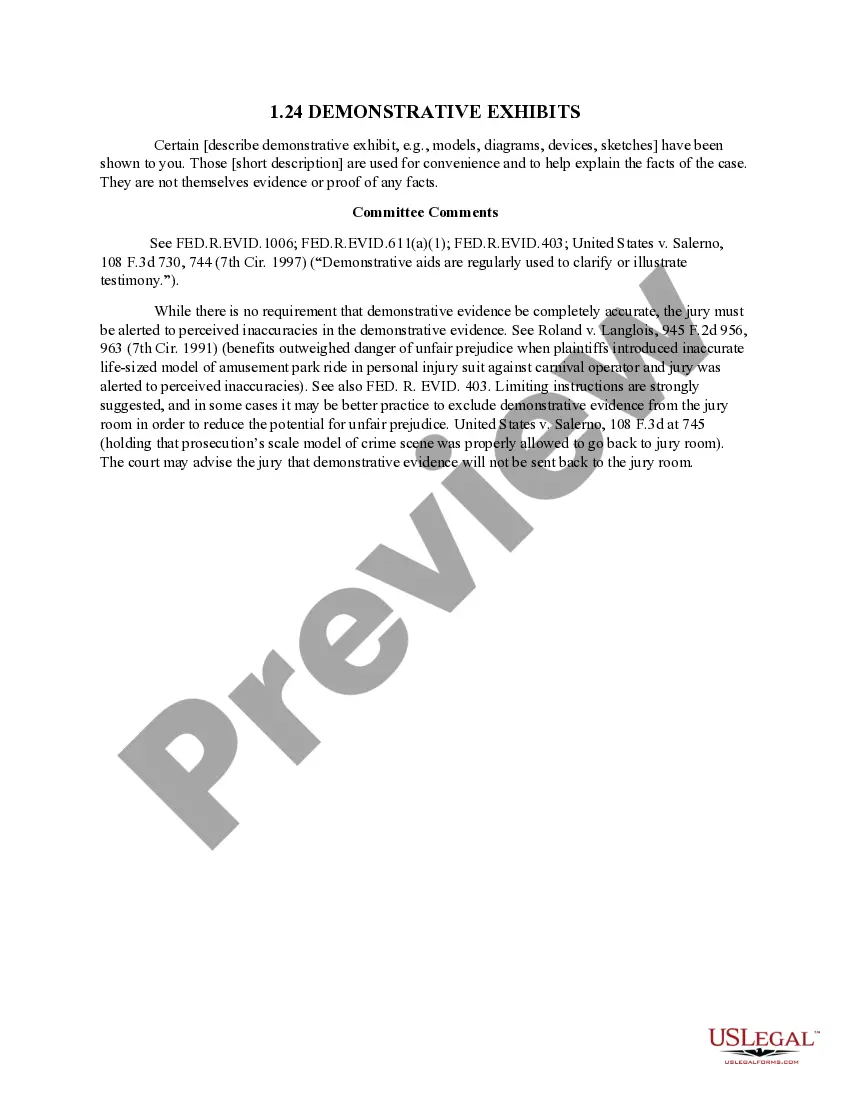
1.24 Demonstrative Evidence
What is this form?
The 1.24 Demonstrative Evidence form provides official pattern jury instructions for the use of demonstrative exhibits in legal cases. This form is crucial as it outlines how certain visual aids, such as models and diagrams, can assist in clarifying testimony during a trial. Unlike other forms, this one specifically addresses the role of demonstrative evidence, emphasizing that these aids are not evidence themselves but serve to illustrate the facts of the case.
What’s included in this form
- Description of the demonstrative exhibit to be used in court.
- Clarification that demonstrative exhibits are not evidence on their own.
- Guidelines on handling perceived inaccuracies in demonstrative evidence.
- Committee comments reflecting legal precedents and rules.
- Recommendations for limiting instructions during jury deliberation.
Situations where this form applies
This form is useful in situations where visual aids are integral to understanding complex testimony or facts in a case. For example, in personal injury lawsuits, a demonstrative exhibit can help jurors visualize the scenario, such as the layout of an accident scene or the mechanics of an injury. Additionally, it may be employed in cases involving technical evidence, presenting models or diagrams to clarify expert testimony.
Intended users of this form
- Attorneys involved in trial cases that require demonstrative evidence.
- Legal teams preparing for jury trials where visual aids will enhance understanding.
- Defendants and plaintiffs seeking clarity in presenting their cases.
How to complete this form
- Identify the demonstrative exhibit and provide a clear description.
- Explain the purpose of the exhibit in relation to the facts of the case.
- Highlight any potential inaccuracies associated with the exhibit.
- Include references to relevant federal rules and legal cases.
- Draft limiting instructions to guide the jury on how to use the demonstrative evidence appropriately.
Does this document require notarization?
Notarization is generally not required for this form. However, certain states or situations might demand it. You can complete notarization online through US Legal Forms, powered by Notarize, using a verified video call available anytime.
Get your form ready online
Our built-in tools help you complete, sign, share, and store your documents in one place.
Make edits, fill in missing information, and update formatting in US Legal Forms—just like you would in MS Word.
Download a copy, print it, send it by email, or mail it via USPS—whatever works best for your next step.
Sign and collect signatures with our SignNow integration. Send to multiple recipients, set reminders, and more. Go Premium to unlock E-Sign.
If this form requires notarization, complete it online through a secure video call—no need to meet a notary in person or wait for an appointment.
We protect your documents and personal data by following strict security and privacy standards.

Make edits, fill in missing information, and update formatting in US Legal Forms—just like you would in MS Word.

Download a copy, print it, send it by email, or mail it via USPS—whatever works best for your next step.

Sign and collect signatures with our SignNow integration. Send to multiple recipients, set reminders, and more. Go Premium to unlock E-Sign.

If this form requires notarization, complete it online through a secure video call—no need to meet a notary in person or wait for an appointment.

We protect your documents and personal data by following strict security and privacy standards.
Mistakes to watch out for
- Failing to properly describe the demonstrative exhibit.
- Not clarifying that the exhibit is not actual evidence.
- Overlooking the need for limiting instructions to prevent jury confusion.
- Neglecting to mention perceived inaccuracies that may affect jury perception.
Why complete this form online
- Convenience of accessing legal forms from any device at any time.
- Editability allows legal practitioners to customize the form to suit specific cases.
- Reliable templates drafted by licensed attorneys ensure legal compliance.
Legal use & context
- Demonstrative exhibits are used to aid jurors in understanding complex concepts.
- Use of such exhibits is governed by federal rules of evidence (FED.R.EVID.).
- Courts have established guidelines to ensure prejudicial effects are minimized.
Looking for another form?
Form popularity
FAQ
Examples of demonstrative evidence include photos, x-rays, videotapes, movies, sound recordings, diagrams, forensic animation, maps, drawings, graphs, animation, simulations, and models.
Demonstrative evidence can take a variety of forms: models, graphs, diagrams, charts, drawing, photographs, videos, scientific tests, computer reconstruction or any other object that can explain or illustrate issues in the case.
Demonstrative evidence is used to illustrate or clarify witness testimony. Examples of this type of evidence include photographs, videotapes, models, maps, graphs, computer graphics and animations.
Just a few examples of demonstrative evidence include: Photos. X-rays. Videotapes. Movies. Sound recordings. Text messages. Diagrams. Forensic animation.
The four types of evidence recognized by the courts include demonstrative, real, testimonial and documentary.
Demonstrative evidence can be objects, pictures, models, displays, or other devices used in a trial or hearing to support facts that the party is trying to prove.
There are four types evidence by which facts can be proven or disproven at trial which include: Real evidence; Demonstrative evidence; Documentary evidence; and. Testimonial evidence.
(1) Definition. ?Demonstrative evidence? refers to a visual, graphic, or sound aid used to explain or illustrate a witness's testimony or the presentation of the proponent's case. (b) it helps the factfinder to better understand the testimony of a witness or the presentation of a party's case.