11.3.2.2 Specification Requirements - Enablement .
Understanding this form
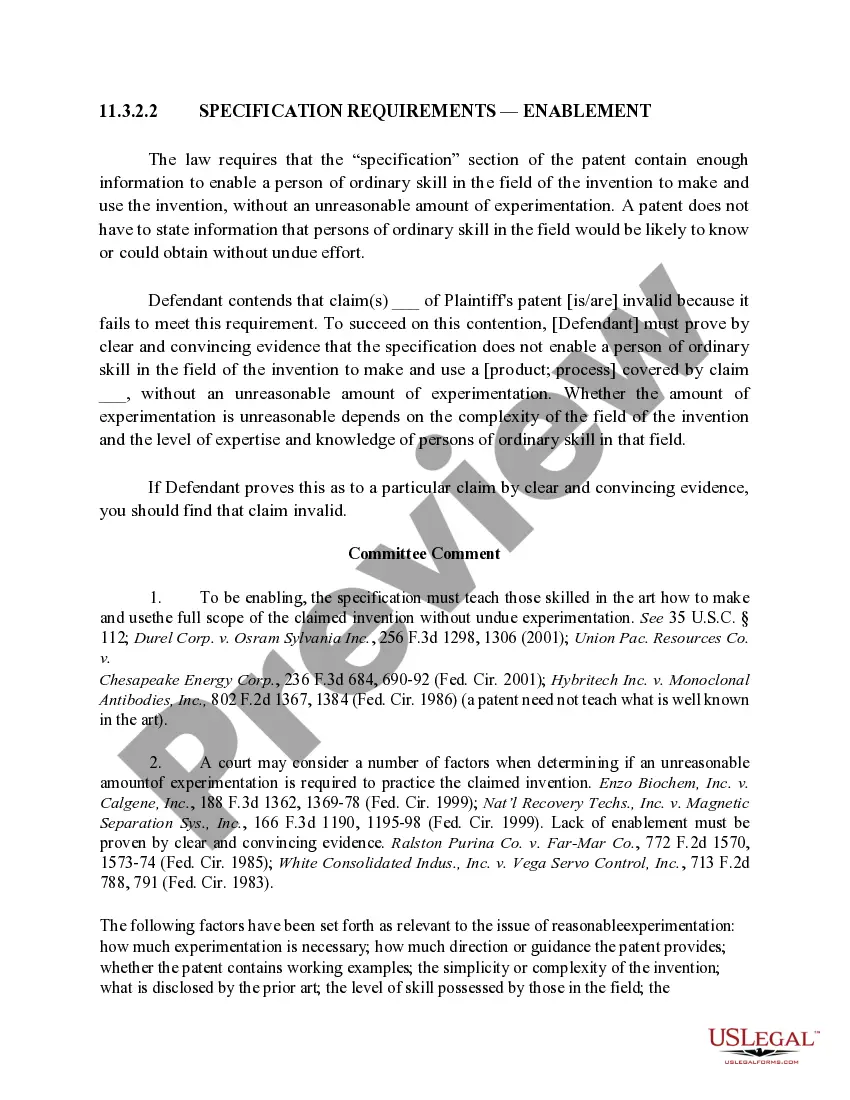
The 11.3.2.2 Specification Requirements - Enablement form provides essential guidelines regarding the specification section of a patent. This form is used to determine if a patent claim is valid based on the requirement that it must enable a person of ordinary skill in the field to make and use the invention without undue experimentation. This form is distinct from other patent-related forms as it specifically addresses the legal standard for enablement under 35 U.S.C. § 112.
Key parts of this document
- Definition of the enablement requirement as per patent law.
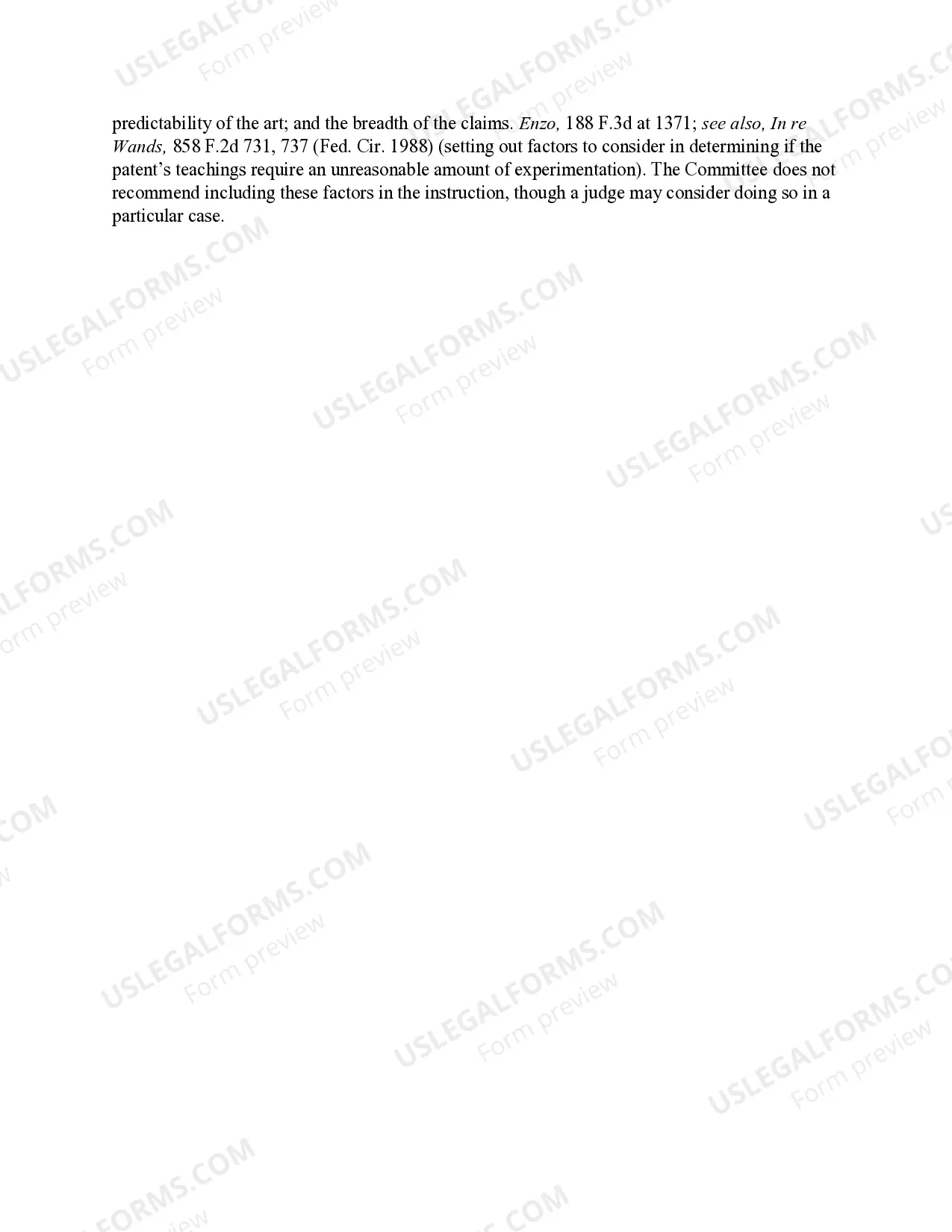
- Criteria for determining whether experimentation is unreasonable.
- Arguments for validity or invalidity of patent claims based on enablement.
- Citations of relevant case law that guide the interpretation of enablement.
- Commentary on factors influencing the enablement determination.
Situations where this form applies
This form is necessary when disputing the validity of a patent claim based on its enablement. If a defendant asserts that a claim does not provide sufficient information for a skilled person to make and use the invention, this form can guide the court or jury in evaluating those claims. It can be particularly relevant in patent litigation contexts where enablement is a key issue.
Who can use this document
- Attorneys involved in patent litigation.
- Individuals or entities challenging the validity of a patent.
- Patent professionals assessing the robustness of patent claims.
- Judges and juries tasked with making determinations about patent enablement.
How to prepare this document
- Identify the defendant and plaintiff involved in the patent dispute.
- Clearly state the claim or claims being challenged for validity.
- Gather evidence regarding the enablement of the patent specification.
- Present arguments regarding the complexity of the invention and required experimentation.
- Conclude with a summary of whether the claim is found invalid based on the provided enablement evidence.
Notarization guidance
This form does not typically require notarization unless specified by local law. Users should review specific jurisdictional requirements to confirm any additional notarization needs.
Get your form ready online
Our built-in tools help you complete, sign, share, and store your documents in one place.
Make edits, fill in missing information, and update formatting in US Legal Forms—just like you would in MS Word.
Download a copy, print it, send it by email, or mail it via USPS—whatever works best for your next step.
Sign and collect signatures with our SignNow integration. Send to multiple recipients, set reminders, and more. Go Premium to unlock E-Sign.
If this form requires notarization, complete it online through a secure video call—no need to meet a notary in person or wait for an appointment.
We protect your documents and personal data by following strict security and privacy standards.

Make edits, fill in missing information, and update formatting in US Legal Forms—just like you would in MS Word.

Download a copy, print it, send it by email, or mail it via USPS—whatever works best for your next step.

Sign and collect signatures with our SignNow integration. Send to multiple recipients, set reminders, and more. Go Premium to unlock E-Sign.

If this form requires notarization, complete it online through a secure video call—no need to meet a notary in person or wait for an appointment.

We protect your documents and personal data by following strict security and privacy standards.
Common mistakes to avoid
- Failing to adequately define what constitutes undue experimentation.
- Neglecting to include relevant case law citations for support.
- Inadequately assessing the skill level of the intended audience in the field.
- Overlooking the significance of prior art in discussing enablement.
Why use this form online
- Convenient access to legal templates anytime, allowing for timely submissions.
- Editability ensures the form can be tailored to specific patent disputes.
- Reliability, backed by licensed attorneys who draft and review the templates.
Looking for another form?
Form popularity
FAQ
§ 112(1/a). Enablement requires that the disclosure teach PHOSITA to make or carry out (use) the claimed invention without undue experimentation, including disclosing a practical utility for the invention.
PRIOR ART IS PRESUMED TO BE OPERABLE/ENABLING When the reference relied on expressly anticipates or makes obvious all of the elements of the claimed invention, the reference is presumed to be operable. Once such a reference is found, the burden is on applicant to rebut the presumption of operability.
A Section 112 rejection in a patent Office Action means that the examiner considers certain claim language indefinite. The good news is that, in most cases, indefiniteness under Section 112 may be resolved by a fairly simple response correcting whatever objections raised by the examiner.
Cir. 1988) ("The test of enablement is whether one reasonably skilled in the art could make or use the invention from the disclosures in the patent coupled with information known in the art without undue experimentation."). A patent need not teach, and preferably omits, what is well known in the art.
The written description requirement and the enablement requirement are found within 35 USC 112. In essence, it states that to secure a patent, the patent specification must include a written description that enables others to make and use the claimed invention. They work hand in hand with each other.
§ 112(1/a). Enablement requires that the disclosure teach PHOSITA to make or carry out (use) the claimed invention without undue experimentation, including disclosing a practical utility for the invention.