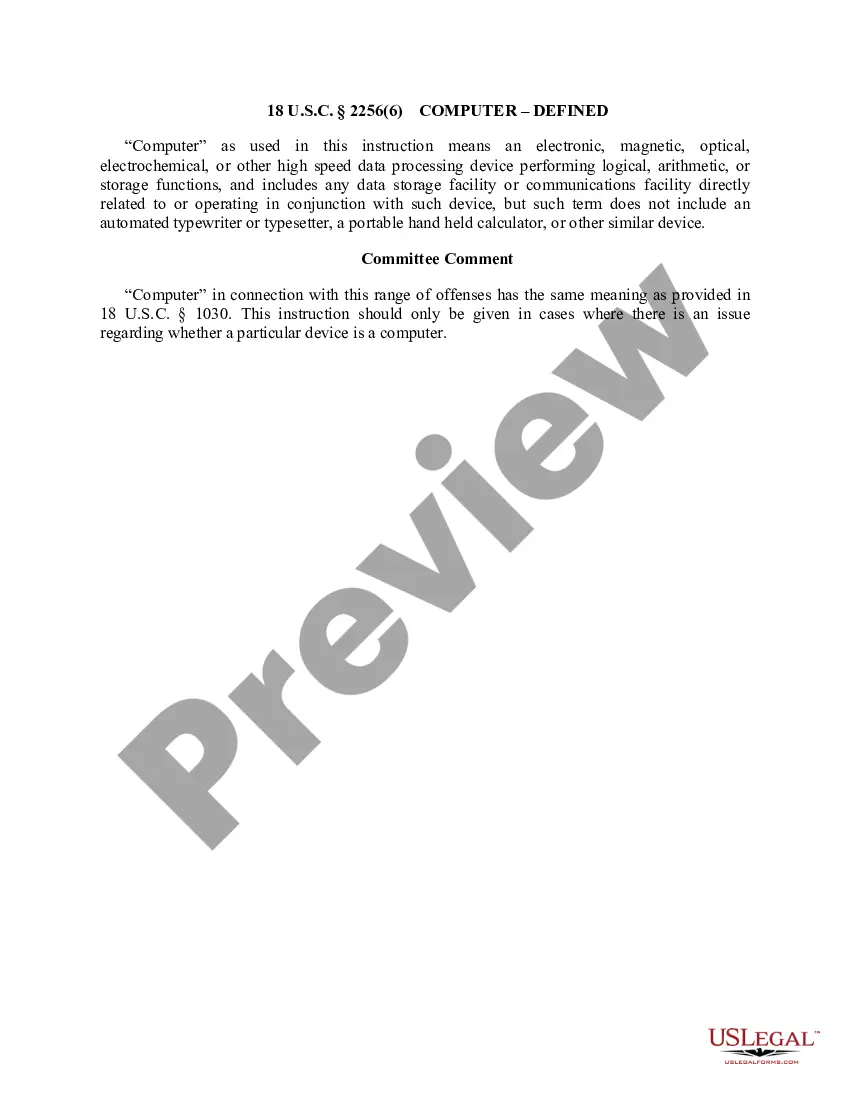
18 U.S.C. Sec. 2256(6) COMPUTER - DEFINED
Notarization requirements for this form
Notarization is not commonly needed for this form. However, certain documents or local rules may make it necessary. Our notarization service, powered by Notarize, allows you to finalize it securely online anytime, day or night.
Get your form ready online
Our built-in tools help you complete, sign, share, and store your documents in one place.
Make edits, fill in missing information, and update formatting in US Legal Forms—just like you would in MS Word.
Download a copy, print it, send it by email, or mail it via USPS—whatever works best for your next step.
Sign and collect signatures with our SignNow integration. Send to multiple recipients, set reminders, and more. Go Premium to unlock E-Sign.
If this form requires notarization, complete it online through a secure video call—no need to meet a notary in person or wait for an appointment.
We protect your documents and personal data by following strict security and privacy standards.

Make edits, fill in missing information, and update formatting in US Legal Forms—just like you would in MS Word.

Download a copy, print it, send it by email, or mail it via USPS—whatever works best for your next step.

Sign and collect signatures with our SignNow integration. Send to multiple recipients, set reminders, and more. Go Premium to unlock E-Sign.

If this form requires notarization, complete it online through a secure video call—no need to meet a notary in person or wait for an appointment.

We protect your documents and personal data by following strict security and privacy standards.
Looking for another form?
Form popularity
FAQ
The legal age is also known as the age of legal majority. This is the age at which a person gains the legal status of an adult. The legal age is set by state law and can differ from state to state. However, almost all states set the base legal age as 18 years old.
? The IRS defines a dependent as a qualifying child (under age 19 or under 24 if a full-time student, or any age if permanently and totally disabled) or a qualifying relative. ? A qualifying dependent can have income but cannot provide more than half of their own annual support.
A minor is defined as an individual who is under the age of 18. A legal incompetent is an individual who has been declared to be under a legal disability, other than being a minor, by a court of competent jurisdiction, including tribal justice systems or as established by the tribe. Return to List of FAQs.
All states define an "age of majority", usually 18. Persons younger than this age are considered minors, and must be under the care of a parent or guardian unless they are emancipated.
Sexual or genital area" means the genitals, pubic area, buttocks, anus or perineum of any person, or the vulva or breasts of a female.
People under the age of eighteen are referred to as minors. Minors are under the control of their parents or legal guardians until they attain the age of majority.