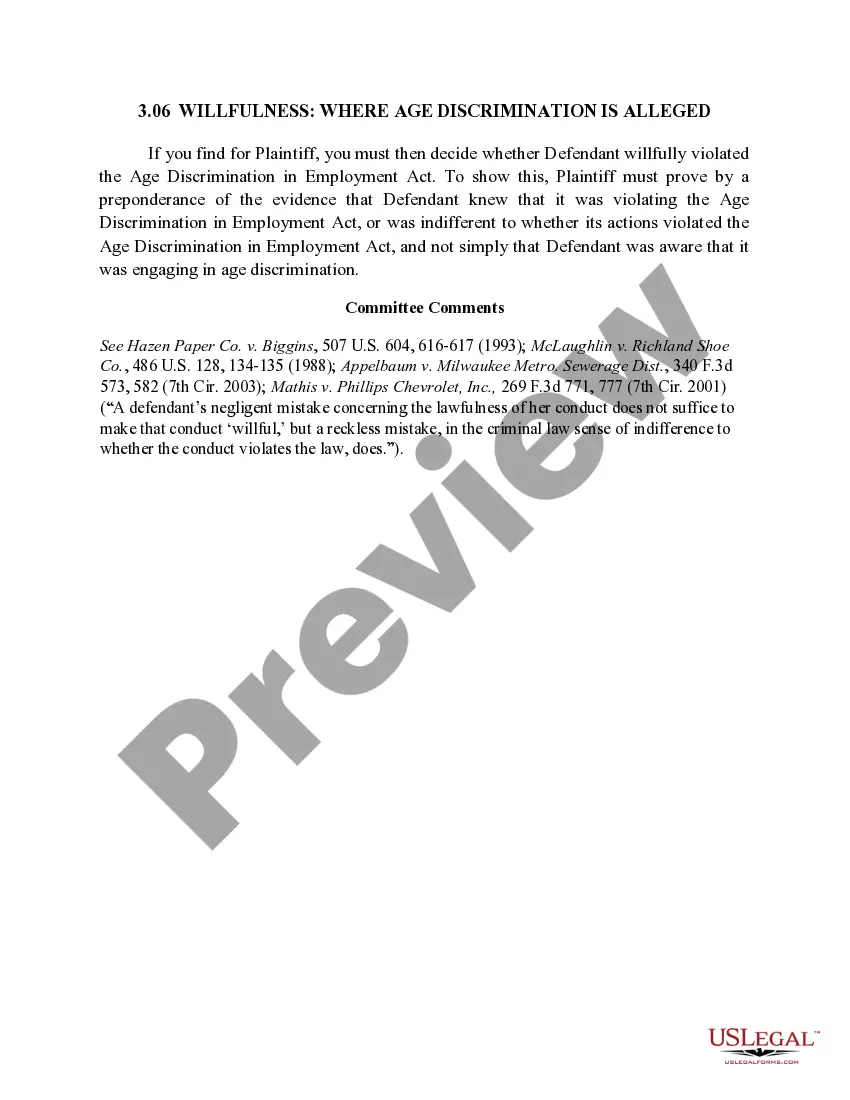
3.06 Willfulness: Where Age Discrimination is Alleged
Overview of this form
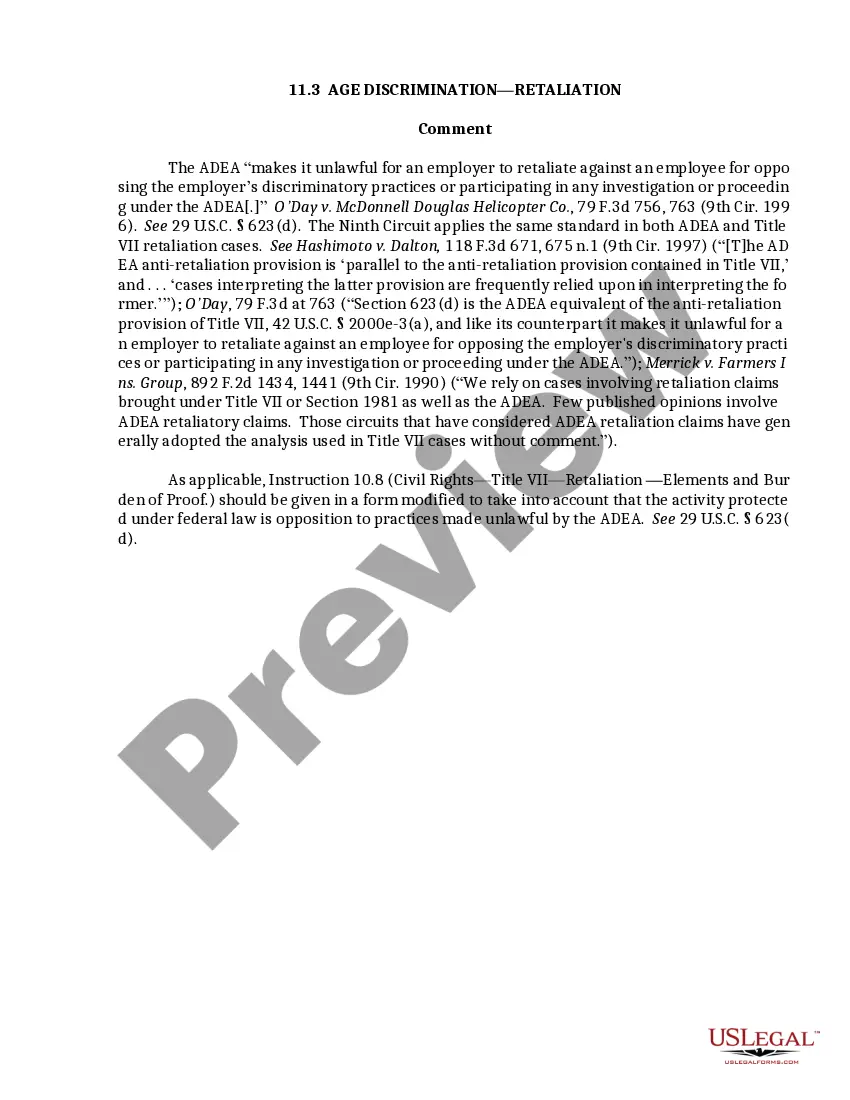
The 3.06 Willfulness: Where Age Discrimination is Alleged form is an official jury instruction used in cases involving alleged violations of the Age Discrimination in Employment Act (ADEA). This form differentiates itself by guiding the jury in determining whether a defendant's actions were willful in regard to age discrimination, emphasizing the defendant's knowledge or indifference to the law. Understanding this form is crucial for ensuring fair deliberation in age discrimination cases.
Main sections of this form
- Definition of willfulness in the context of the Age Discrimination in Employment Act.
- Criteria to establish if the defendant knowingly violated or was indifferent to the law.
- Instructions for the jury regarding the burden of proof for the plaintiff.
- Citations to relevant case law that provide context and precedent.

When to use this document
This form should be used in court during cases where a plaintiff alleges that an employer has intentionally discriminated against them based on age. It is essential when the jury must decide if the employer acted willfully in violating age discrimination laws, serving as a guide for proper deliberation on the evidence presented.
Who can use this document
- Plaintiffs in age discrimination cases alleging willful violations of the ADEA.
- Legal teams preparing for jury trials in cases involving age discrimination.
- Judges who provide jury instructions during trials related to the ADEA.
How to complete this form
- Review the contents and understand the legal definitions of willfulness.
- Assess the evidence presented in the case to determine if the defendant acted with knowledge of the law.
- Ensure all jury instructions include necessary citations to case law.
- Provide clear guidelines on the burden of proof required for the plaintiff.
Is notarization required?
Notarization is not commonly needed for this form. However, certain documents or local rules may make it necessary. Our notarization service, powered by Notarize, allows you to finalize it securely online anytime, day or night.
Get your form ready online
Our built-in tools help you complete, sign, share, and store your documents in one place.
Make edits, fill in missing information, and update formatting in US Legal Forms—just like you would in MS Word.
Download a copy, print it, send it by email, or mail it via USPS—whatever works best for your next step.
Sign and collect signatures with our SignNow integration. Send to multiple recipients, set reminders, and more. Go Premium to unlock E-Sign.
If this form requires notarization, complete it online through a secure video call—no need to meet a notary in person or wait for an appointment.
We protect your documents and personal data by following strict security and privacy standards.

Make edits, fill in missing information, and update formatting in US Legal Forms—just like you would in MS Word.

Download a copy, print it, send it by email, or mail it via USPS—whatever works best for your next step.

Sign and collect signatures with our SignNow integration. Send to multiple recipients, set reminders, and more. Go Premium to unlock E-Sign.

If this form requires notarization, complete it online through a secure video call—no need to meet a notary in person or wait for an appointment.

We protect your documents and personal data by following strict security and privacy standards.
Mistakes to watch out for
- Failing to properly establish the defendant's knowledge of the ADEA violations.
- Not citing relevant legal precedents that clarify the meaning of willfulness.
- Providing vague instructions that may confuse the jury regarding their deliberation process.
Why use this form online
- Immediate access to a professionally drafted legal form, ensuring accuracy and compliance with legal standards.
- Easy to download and customize, allowing for quick adjustments to meet specific case requirements.
- Convenience of obtaining a legal form right from your home or office, saving time and resources.
Legal use & context
- This jury instruction is recognized in federal age discrimination litigation.
- It helps the jury understand the legal threshold for determining willful violations of the ADEA.
- Proper use of this form can impact the outcome of age discrimination cases significantly.
Looking for another form?
Form popularity
FAQ
State law provides for a variety of remedies for victims of employment discrimination, including: Back pay (past lost earnings) Front pay (future lost earnings) Hiring / Reinstatement. Promotion. Out-of-pocket expenses. Policy changes. Training. Reasonable accommodation(s)
It shall be unlawful for an employment agency to fail or refuse to refer for employment, or otherwise to discriminate against, any individual because of such individual's age, or to classify or refer for employment any individual on the basis of such individual's age.
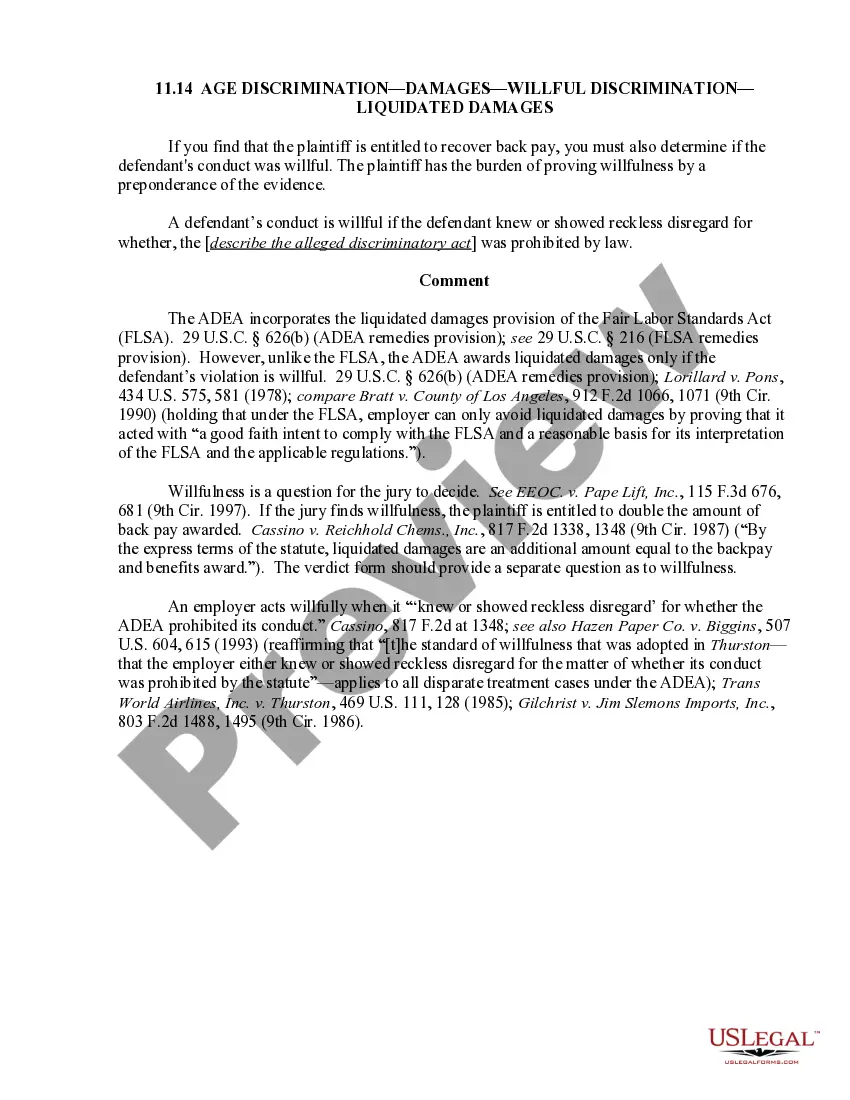
Punitive Damages However, the ADEA does allow an employee to recover "liquidated damages" where the employee proves that the employer's age discrimination was willful (that is, knowing and intentional). Liquidated damages under the ADEA can be up to the amount of lost back pay.
Compensatory damages pay victims for out-of-pocket expenses caused by the discrimination (such as costs associated with a job search or medical expenses) and compensate them for any emotional harm suffered (such as mental anguish, inconvenience, or loss of enjoyment of life).
A defendant's conduct is willful if the defendant knew or showed reckless disregard for whether, the describe the alleged discriminatory act was prohibited by law.
Under the ADEA it is unlawful to discriminate against any individual age 40 or older because of their age with respect to any term, condition, or privilege of employment, including but not limited to, recruitment, hiring, firing, promotion, layoff, compensation, benefits, job assignments, and training.
The Act, which applies to all ages, permits the use of certain age distinctions and factors other than age that meet the Act's requirements. The Age Discrimination Act is enforced by the Civil Rights Center.
Age Discrimination in Employment Act of 1967 (?ADEA?) Equal Pay Act The Equal Pay Act prohibits sex discrimination in compensation. Remedies available under the Equal Pay Act include injunctive relief and lost wages.