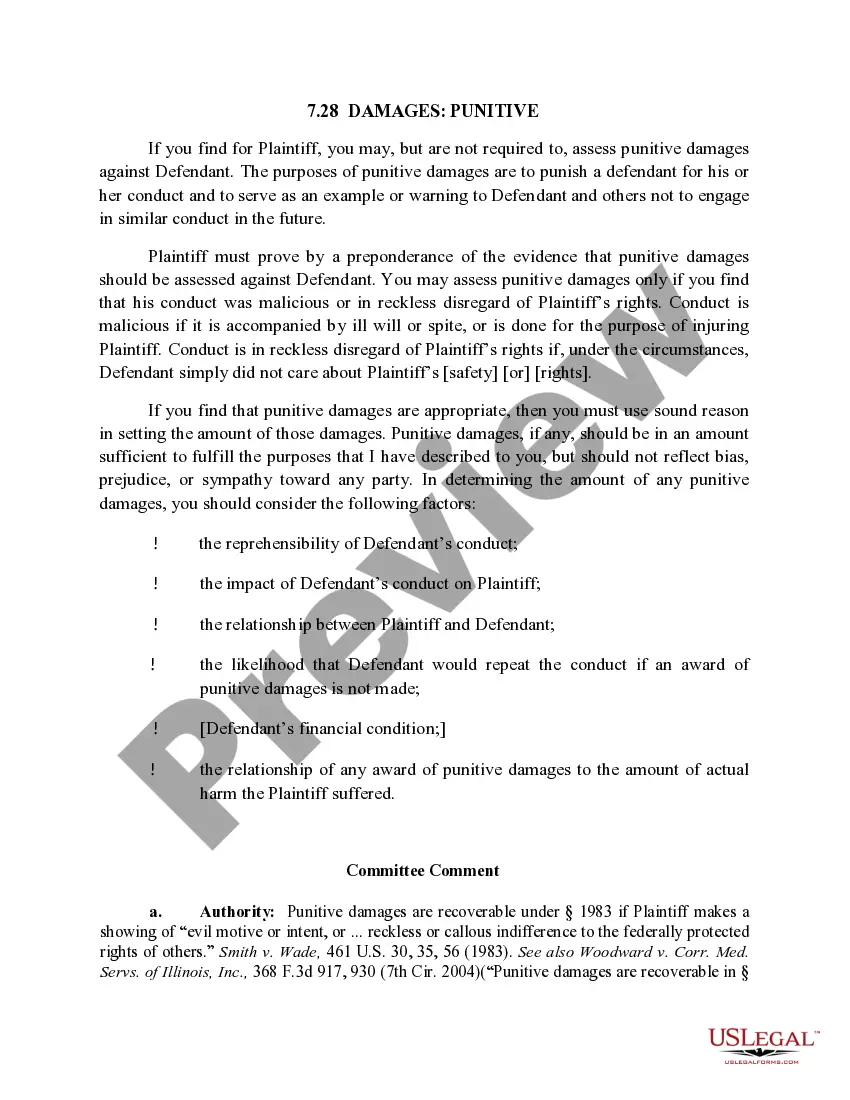
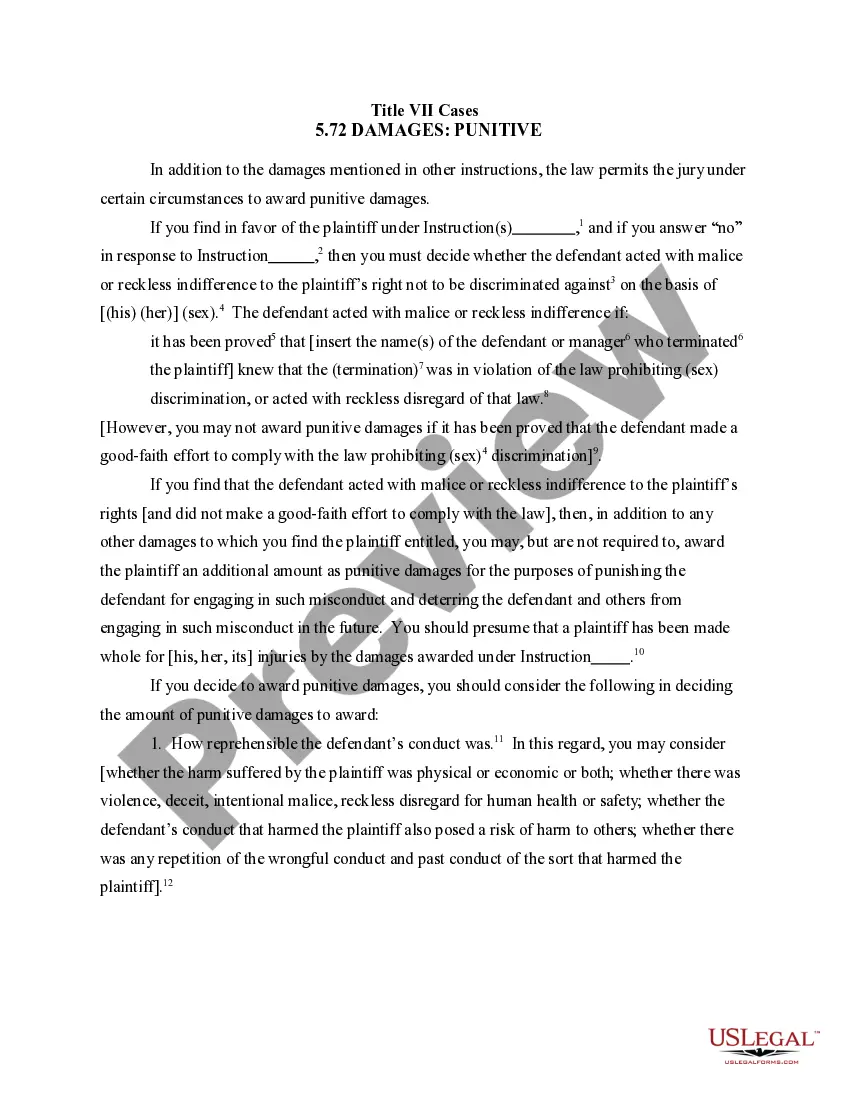
4.14 Punitive Damages are a form of civil damages that are awarded in addition to actual damages. Punitive damages are designed to punish a defendant and deter similar conduct in the future. There are two main types of punitive damages: compensatory and exemplary. Compensatory punitive damages are intended to compensate the plaintiff for the injury caused by the defendant’s wrongful conduct, while exemplary punitive damages are intended as a punishment for the defendant’s wrongful conduct. Punitive damages are awarded in addition to actual damages, and the amount of punitive damages awarded is typically greater than the amount of actual damages.
4.14 Punitive Damages
State:
Multi-State
Control #:
US-JURY-7THCIR-4-14
Format:
Word
Instant download
This website is not affiliated with any governmental entity
Public form
Description
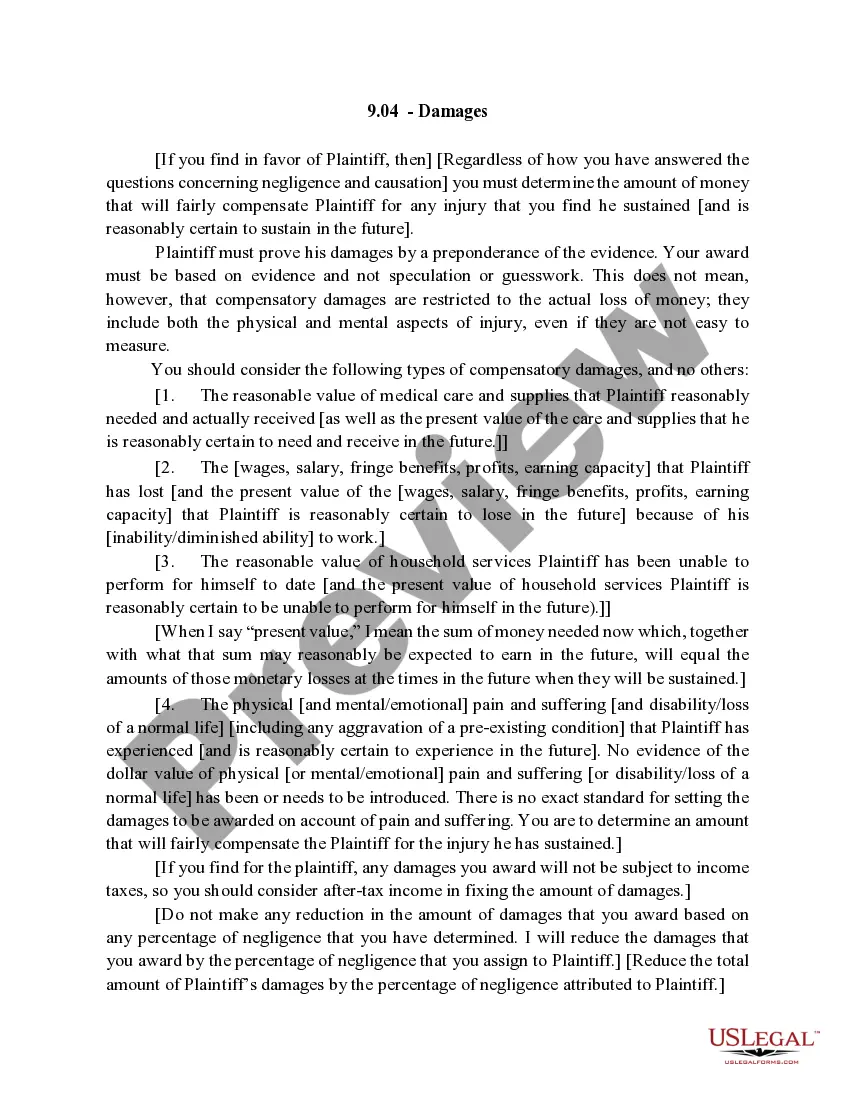
Official Pattern Jury Instructions adopted by Federal 7th Circuit Court. All converted to Word format. Please see the official site for addional information. www.ca7.uscourts.gov/pattern-jury-instructions/pattern-jury.htm

How to fill out 4.14 Punitive Damages?
How much time and resources do you usually spend on drafting formal paperwork? There’s a greater way to get such forms than hiring legal experts or wasting hours browsing the web for a proper blank. US Legal Forms is the premier online library that provides professionally drafted and verified state-specific legal documents for any purpose, including the 4.14 Punitive Damages.
To obtain and prepare a suitable 4.14 Punitive Damages blank, follow these easy steps:
- Examine the form content to make sure it complies with your state regulations. To do so, read the form description or utilize the Preview option.
- In case your legal template doesn’t meet your needs, locate a different one using the search tab at the top of the page.
- If you are already registered with our service, log in and download the 4.14 Punitive Damages. If not, proceed to the next steps.
- Click Buy now once you find the correct blank. Choose the subscription plan that suits you best to access our library’s full service.
- Register for an account and pay for your subscription. You can make a transaction with your credit card or via PayPal - our service is totally safe for that.
- Download your 4.14 Punitive Damages on your device and complete it on a printed-out hard copy or electronically.
Another advantage of our service is that you can access previously purchased documents that you securely store in your profile in the My Forms tab. Get them at any moment and re-complete your paperwork as frequently as you need.
Save time and effort preparing formal paperwork with US Legal Forms, one of the most reliable web solutions. Join us now!
Form popularity
FAQ
To determine the amount of punitive damages to award, the Book of Approved Jury Instructions (BAJI) states that the jury should consider: (1) The reprehensibility of the conduct of the defendant. (2) The defendant's financial condition and (3) the relationship to actual damages.
Punitive damages are given on top of compensatory damages when the misconduct was deemed grossly negligent, intentional, or malicious. These are designed to deter the defendant from repeating harm or misconduct in the future.
These are (1) how reprehensible the defendant's conduct was, (2) the disparity between the harm experienced by the plaintiff and the punitive damages award, and (3) the difference between the punitive damages award and the civil penalties and remedies imposed in similar cases.
There are three types of damage that form the foundation of most civil lawsuits: compensatory, nominal, and punitive.
It must be proven by clear and convincing evidence that a defendant acted with oppression, fraud, or malice. Clear and convincing evidence means that there must be a very high degree of probability that something is true.
To support an award of punitive damages you must find that plaintiff has proved, by clear and convincing evidence, that the harm suffered by plaintiff was the result of defendant's conduct21 and that either (1) defendant's conduct was malicious or (2) defendant acted in wanton and willful disregard of
Although there is no maximum sum, punitive damages typically do not exceed four times the amount of compensatory damages. For example, if a plaintiff recovers $100,000 in compensatory damages and is awarded punitive damages, they most likely will receive up to $400,000 in punitive damages.
Individuals can also be ordered to pay punitive damages that injure someone else due to negligent behavior. Examples of this would be drunk driving or distracted driving. In both cases, the defendant would have made a conscious decision to engage in behavior that could easily harm another person.