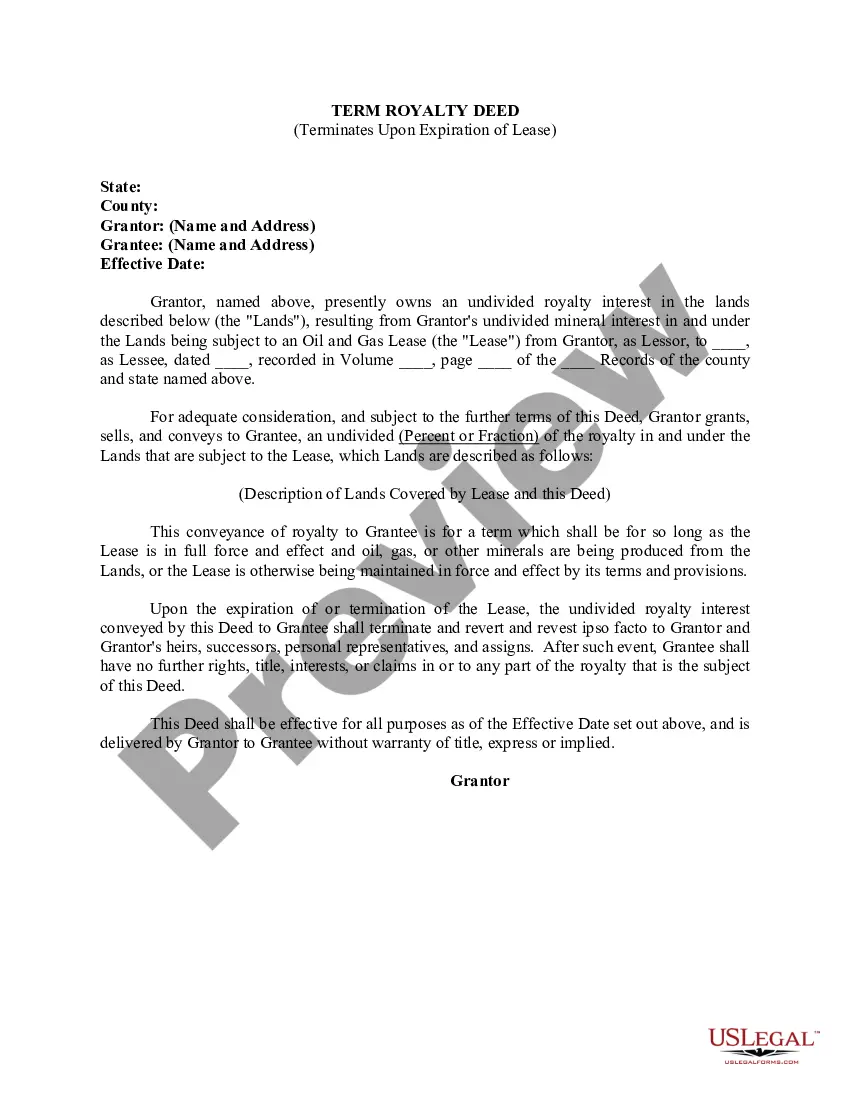
Term Royalty Deed that Terminates Upon Expiration of Lease
Overview of this form
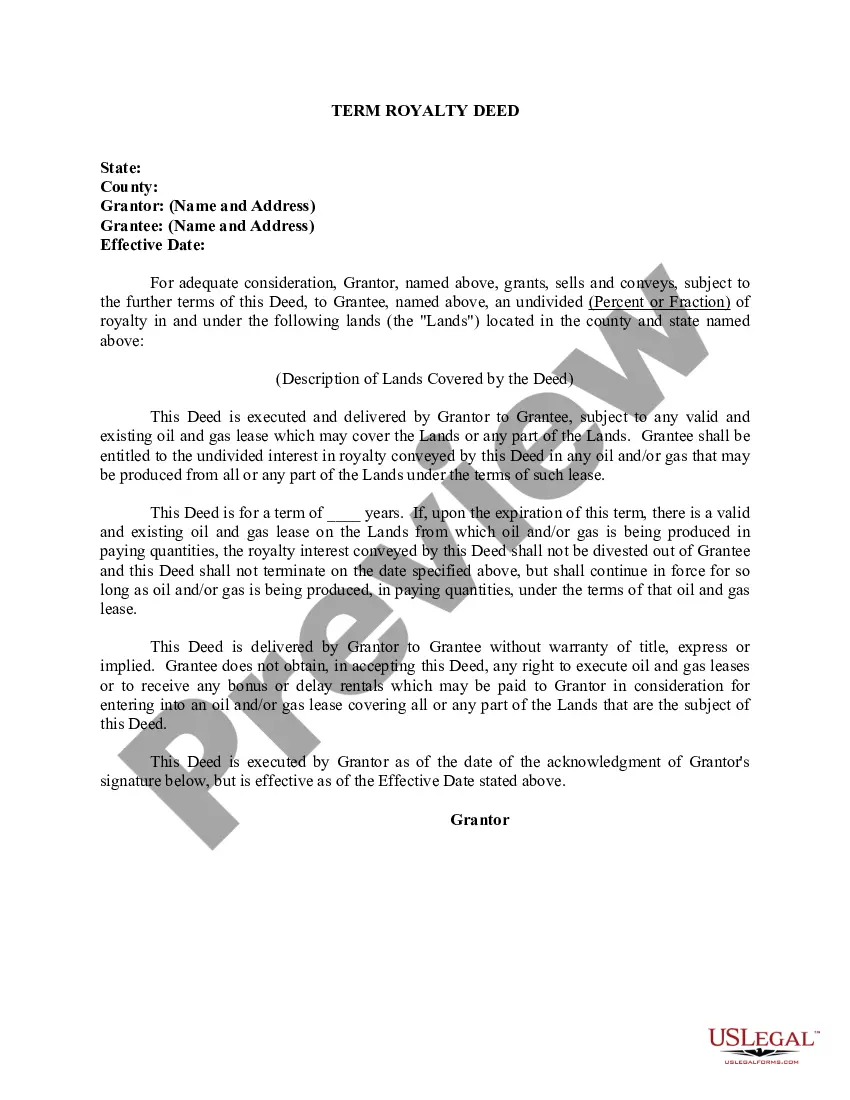
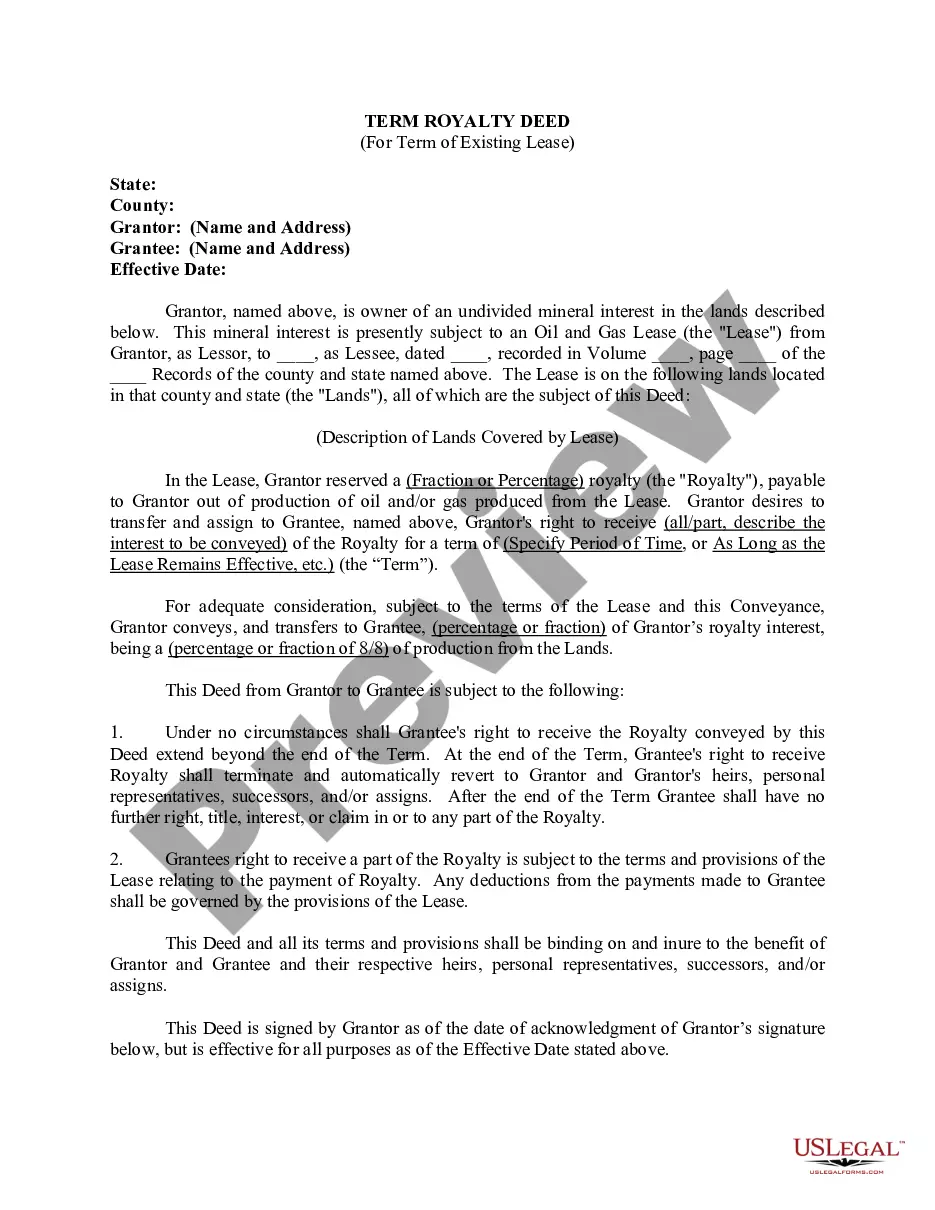
The Term Royalty Deed that Terminates Upon Expiration of Lease is a legal document that allows a grantor to convey a royalty interest in oil and gas for a limited period. Unlike permanent conveyances, this deed's interest automatically reverts to the grantor once the specified oil and gas lease ends, making it a key tool for managing mineral rights effectively.
What’s included in this form
- Grantor and Grantee information: Names and addresses of both parties involved.
- Effective date: The date when the deed takes effect.
- Description of lands: Detailed information about the lands covered by the oil and gas lease.
- Fractional interest: The percentage of royalty being conveyed to the grantee.
- Termination clause: Specifies that the conveyed interest reverts to the grantor upon lease expiration.
- Warranty disclaimer: States that the deed is delivered without warranty of title.
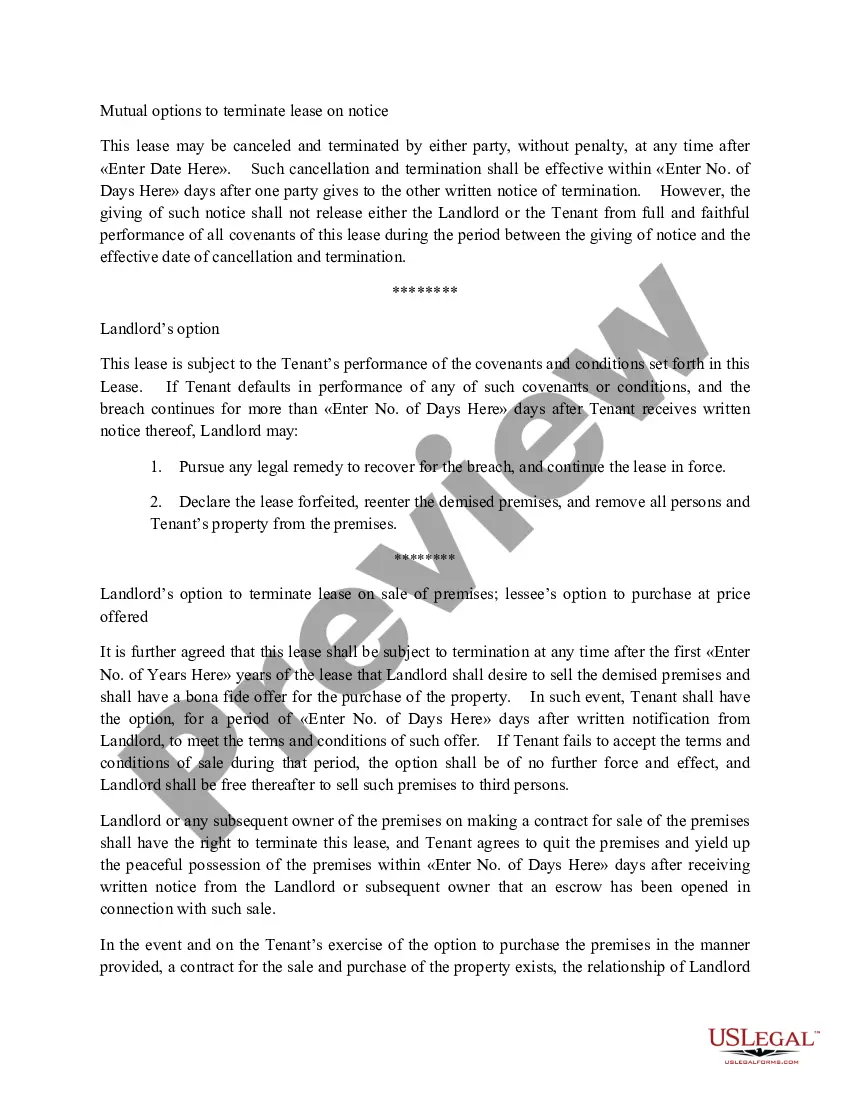
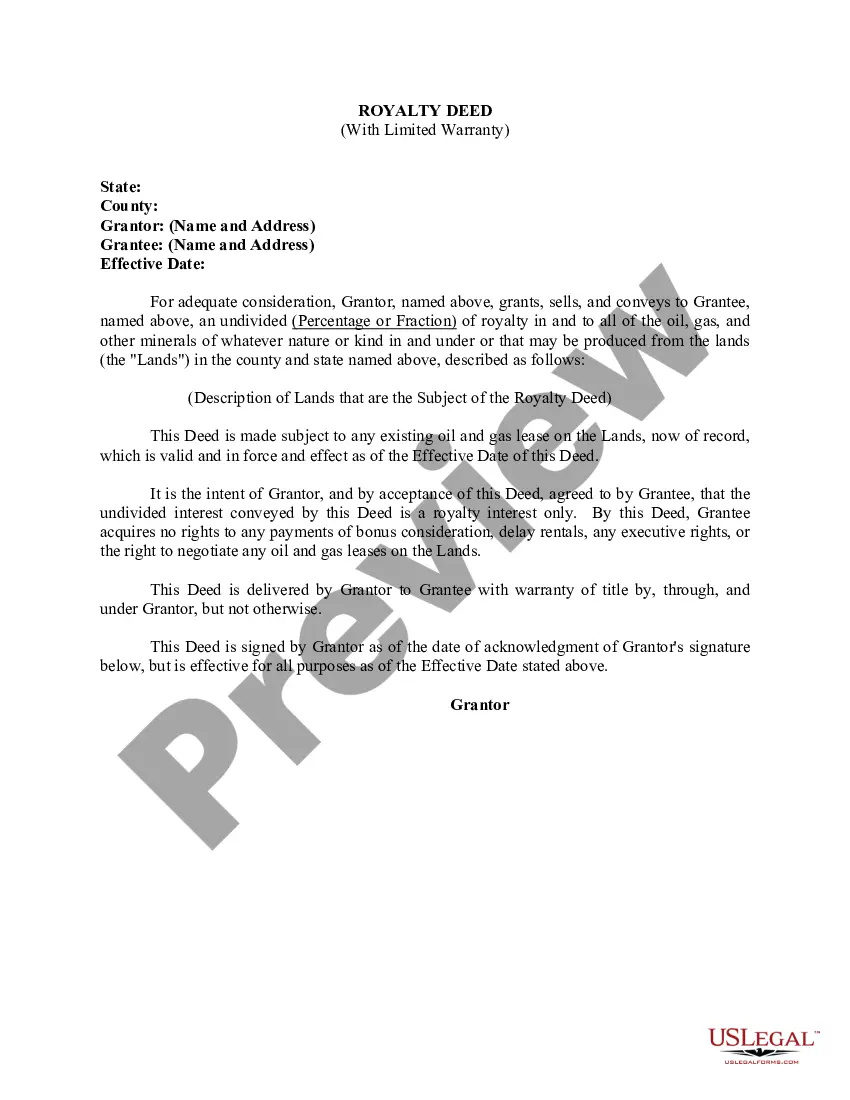
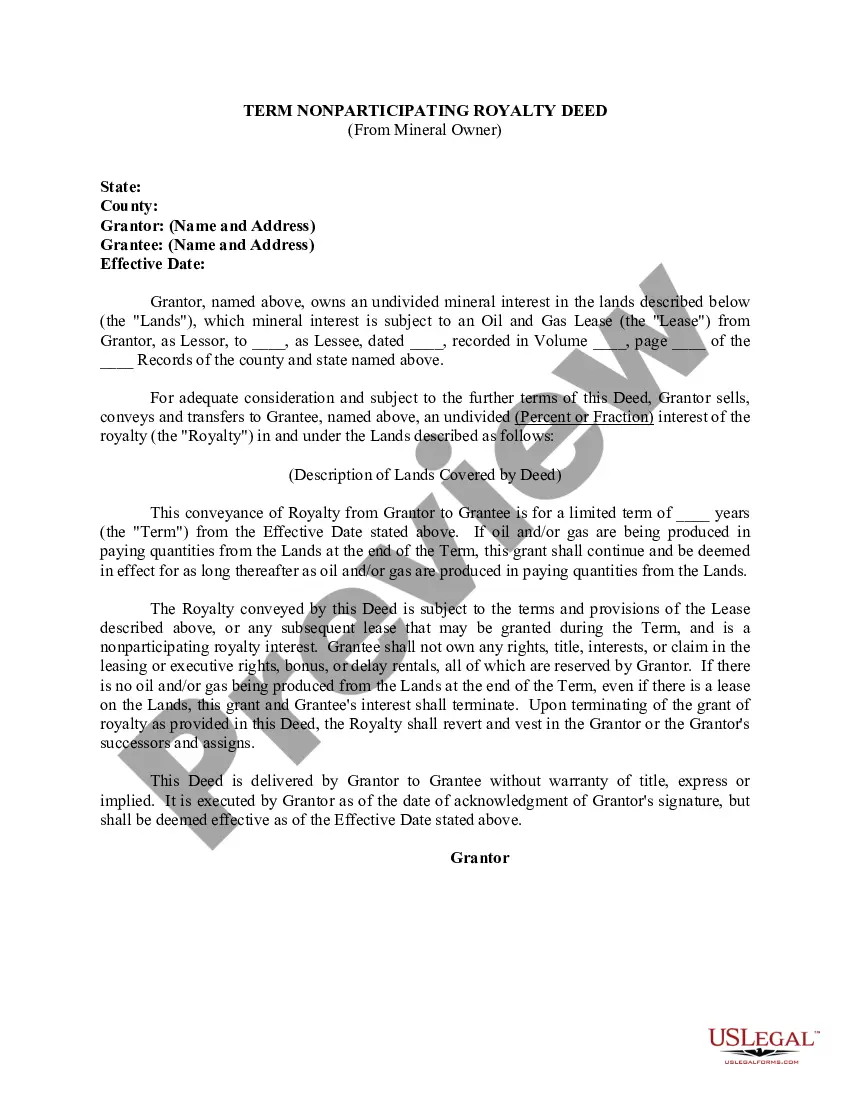
When this form is needed
This form is useful when a grantor wishes to temporarily convey royalty interests from an oil and gas lease to a grantee. It is particularly applicable in situations where the lease is active, and production is ongoing. This allows the grantor to provide financial benefits to the grantee while retaining ultimate ownership once the lease ends.
Intended users of this form
- Landowners looking to temporarily convey rights to royalties from their mineral interests.
- Individuals or companies involved in oil and gas leasing agreements.
- Attorneys or legal representatives handling mineral rights transactions.
Steps to complete this form
- Identify the parties: Enter the names and addresses of the grantor and grantee.
- Specify the effective date: Fill in the date when the deed will take effect.
- Describe the property: Provide a detailed description of the lands involved in the lease.
- Enter fractional interest: Indicate the percentage of royalty being conveyed.
- Include lease details: Provide the specifics of the oil and gas lease for reference.
- Sign and date the deed: Ensure both parties sign the document for legal validity.
Does this document require notarization?
This form must be notarized to be legally valid. US Legal Forms provides secure online notarization powered by Notarize, allowing you to complete the process through a verified video call.
Get your form ready online
Our built-in tools help you complete, sign, share, and store your documents in one place.
Make edits, fill in missing information, and update formatting in US Legal Forms—just like you would in MS Word.
Download a copy, print it, send it by email, or mail it via USPS—whatever works best for your next step.
Sign and collect signatures with our SignNow integration. Send to multiple recipients, set reminders, and more. Go Premium to unlock E-Sign.
If this form requires notarization, complete it online through a secure video call—no need to meet a notary in person or wait for an appointment.
We protect your documents and personal data by following strict security and privacy standards.

Make edits, fill in missing information, and update formatting in US Legal Forms—just like you would in MS Word.

Download a copy, print it, send it by email, or mail it via USPS—whatever works best for your next step.

Sign and collect signatures with our SignNow integration. Send to multiple recipients, set reminders, and more. Go Premium to unlock E-Sign.

If this form requires notarization, complete it online through a secure video call—no need to meet a notary in person or wait for an appointment.

We protect your documents and personal data by following strict security and privacy standards.
Typical mistakes to avoid
- Failing to provide accurate property descriptions can lead to disputes.
- Not including the effective date may cause confusion about when the deed applies.
- Neglecting to specify the correct percentage of royalty interest can result in financial discrepancies.
- Forgetting to obtain the necessary signatures can invalidate the deed.
Why use this form online
- Convenience: Access and complete the form from anywhere at any time.
- Editability: Make necessary changes easily without dealing with physical paperwork.
- Reliability: Forms are drafted by licensed attorneys, ensuring legal compliance.
Looking for another form?

Form popularity
FAQ
Under the cross-conveyancing theory of pooling, operator would allocate one-half of the horizontal well's production among all of the royalty owners in Unit A, and one-half to all of the royalty owners in Unit B, on the theory that, by creating Units A and B, operator has cross-conveyed all royalty owners' interests in
A mineral rights agreement may range from a few to 20 years. Oil and gas leases often have two terms: a primary and a secondary term. If no drilling or production activity has taken place at the end of a primary term, the lease will expire.
For many years, almost all oil and gas leases reserved a 1/8th royalty. Today, the royalty fraction is negotiable, and is usually between 1/8th and 1/4th. Bonus. The bonus is the amount paid to the Lessor as consideration for his/her execution of the lease.
In the event oil and gas were found and the wells produce, then the royalties kick in. So if the oil well produce 100 barrels a day, and the price of oil is $80 per barrel that month, then the cash flow is 100x$80 = $8,000/day The royalty owner, who agreed to 15% royalty, would receive $8,000 x 0.15 = $1,200/day.
A mineral servitude is the right to explore for minerals and bring them to the surface. The landowner usually leases this right to companies in the exploration business.
A royalty is the portion of production the landowner receives. A royalty clause in the oil or gas title process will typically give a percentage of the lease that the company pays to the owner of the mineral rights, minus production costs. Royalties are free from costs and charges, other than taxes.
Whenever oil or gas production begins, the landowner is entitled to part of the total production. A royalty is agreed upon as a percentage of the lease, minus what was reasonably used in the Lessee's production costs. The royalty is paid by the Lessee to the owner of the mineral rights, the Lessor in the Lease.
When it comes to mineral rights, the standard admonition has long been consistent and emphatic: Avoid selling them. After all, simply owning mineral rights costs you nothing. There are no liability risks, and in most cases, taxes are assessed only on properties that are actively producing oil or gas.
Oil & gas royalties are paid monthly, consistent with the normal accounting cycle of the producer, unless the obligation does not meet the minimum check requirement for that particular state. These laws are generally known as aggregate pay laws, usually set at either $25 or $100.