Partition Deed for Mineral / Royalty Interests
Overview of this form
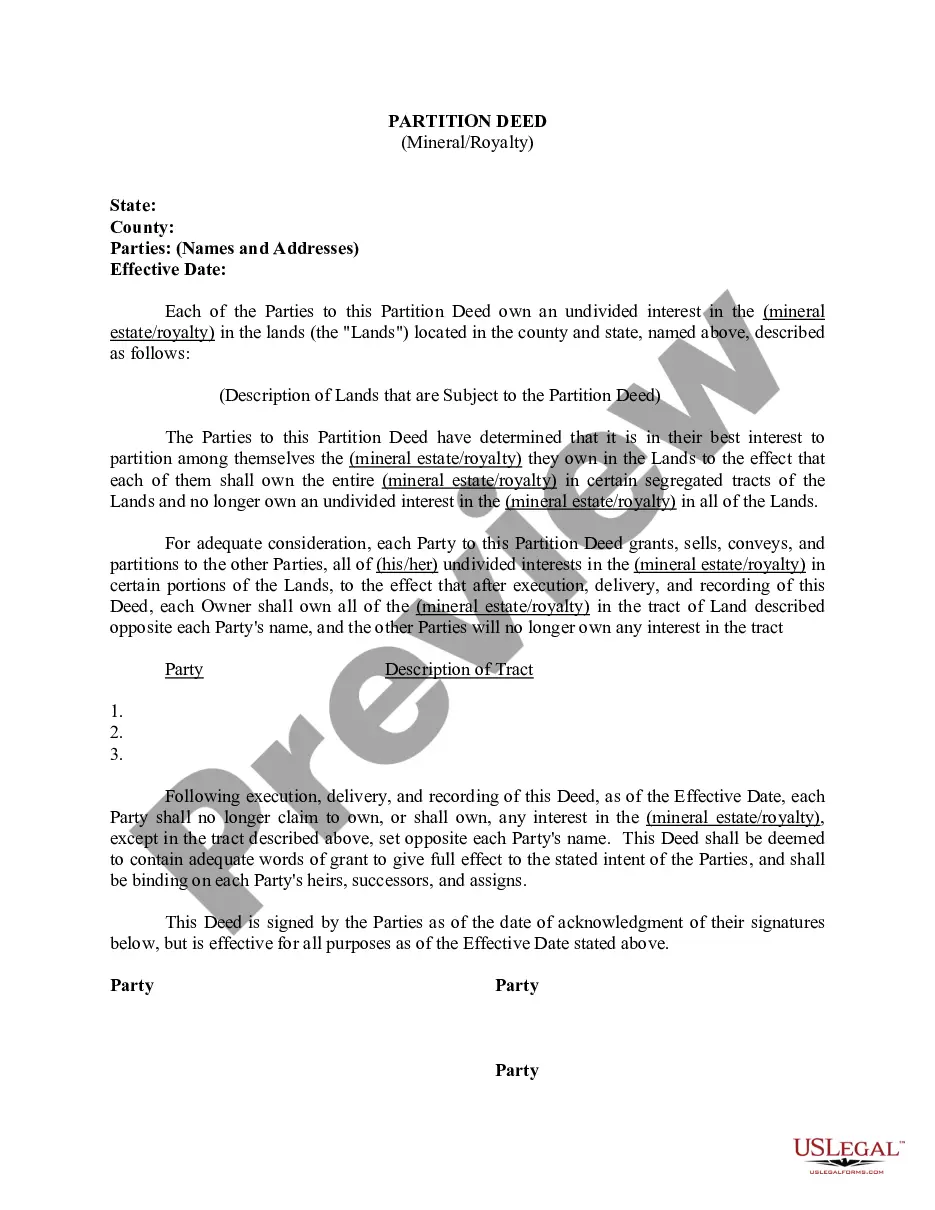
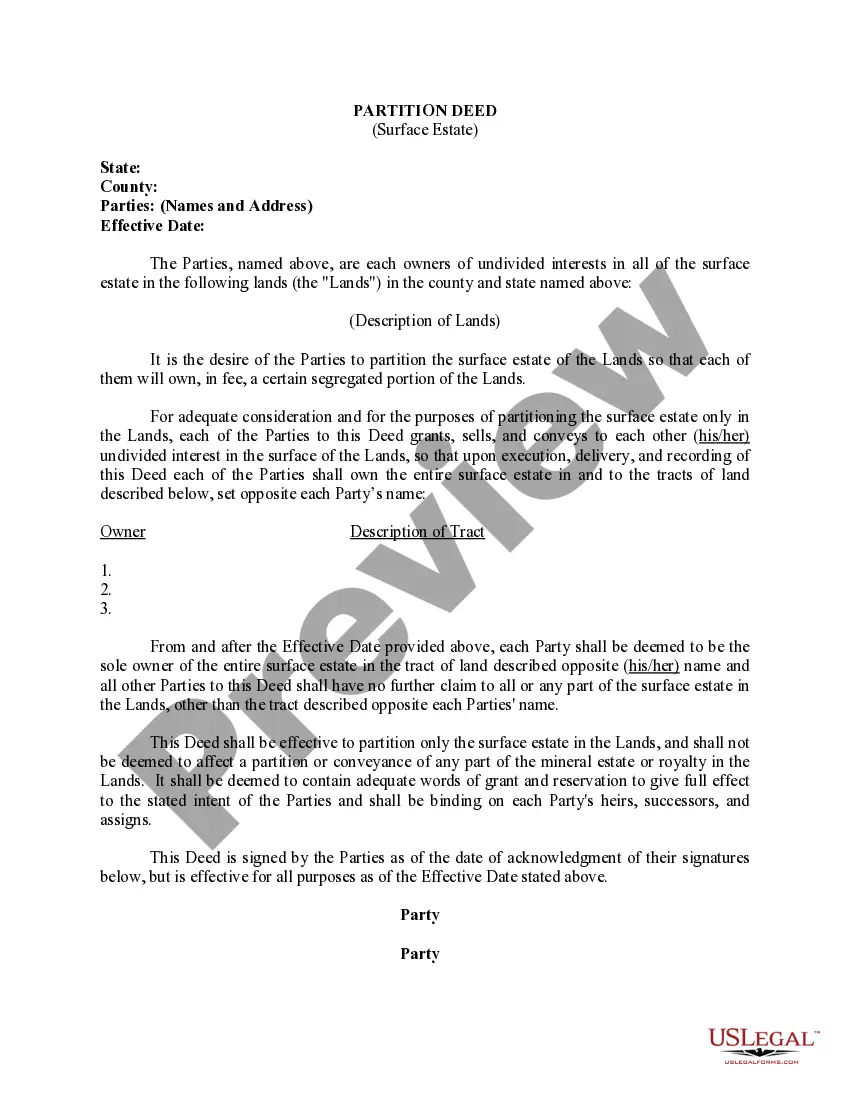
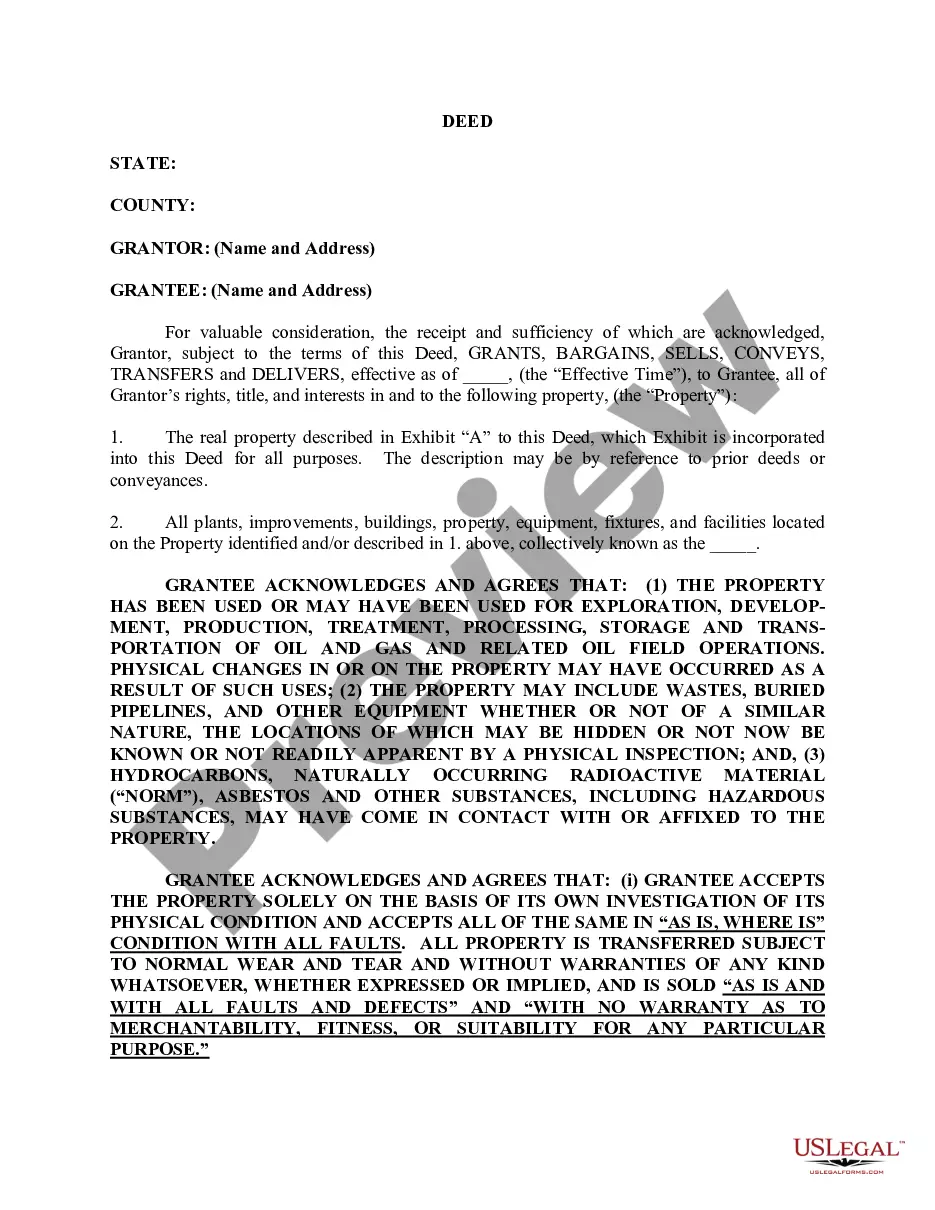
The Partition Deed for Mineral / Royalty Interests is a legal document used by parties who own undivided interests in mineral estates or royalty interests. This form allows these parties to partition their interests so that each individual owns a specific, whole interest in a designated tract of land. Unlike other property deeds, this partition deed specifically addresses the division of mineral and royalty rights, providing clarity and legal standing for all involved parties.
Main sections of this form
- Identification of parties, including names and addresses.
- Effective date of the partition agreement.
- Description of the mineral estate or royalty interests being partitioned.
- Specification of the tracts of land associated with each party's ownership.
- Legal provisions ensuring binding effect on heirs, successors, and assigns.
- Space for signatures and acknowledgment by the parties involved.

Situations where this form applies
This form is useful when two or more parties wish to clearly outline their ownership interests in mineral estates or royalty interests. It is particularly relevant in situations where co-owners want to define their respective ownership of specific tracts of land, ensuring that each party has exclusive rights to a particular area. This can arise in cases involving inherited property, investment partnerships, or business arrangements related to natural resources.
Who needs this form
- Individuals or entities with shared ownership of mineral or royalty interests.
- Co-owners looking to clarify and separate their interests in specific tracts.
- Legal representatives involved in estate planning or property management.
- Investors in oil, gas, and minerals seeking to delineate ownership rights.
Completing this form step by step
- Identify all parties involved by providing their full names and addresses.
- Enter the effective date for the partition deed.
- Specify the lands associated with the mineral or royalty interests.
- Detail the tracts of land that each party will own after the partition.
- Ensure all parties sign the deed, acknowledging their agreement to the terms.
Notarization requirements for this form
To make this form legally binding, it must be notarized. Our online notarization service, powered by Notarize, lets you verify and sign documents remotely through an encrypted video session.
Get your form ready online
Our built-in tools help you complete, sign, share, and store your documents in one place.
Make edits, fill in missing information, and update formatting in US Legal Forms—just like you would in MS Word.
Download a copy, print it, send it by email, or mail it via USPS—whatever works best for your next step.
Sign and collect signatures with our SignNow integration. Send to multiple recipients, set reminders, and more. Go Premium to unlock E-Sign.
If this form requires notarization, complete it online through a secure video call—no need to meet a notary in person or wait for an appointment.
We protect your documents and personal data by following strict security and privacy standards.

Make edits, fill in missing information, and update formatting in US Legal Forms—just like you would in MS Word.

Download a copy, print it, send it by email, or mail it via USPS—whatever works best for your next step.

Sign and collect signatures with our SignNow integration. Send to multiple recipients, set reminders, and more. Go Premium to unlock E-Sign.

If this form requires notarization, complete it online through a secure video call—no need to meet a notary in person or wait for an appointment.

We protect your documents and personal data by following strict security and privacy standards.
Typical mistakes to avoid
- Failing to accurately describe the tracts of land involved.
- Not including all co-owners in the document.
- Leaving out the effective date, which is crucial for legal clarity.
- Neglecting to have signatures acknowledged properly.
Benefits of using this form online
- Convenience of downloading the form at any time.
- Easy editing capabilities to customize the document as needed.
- Access to forms prepared by licensed attorneys, ensuring reliability.
Main things to remember
- A Partition Deed for Mineral/Royalty Interests clearly defines ownership for multiple parties.
- It must include detailed descriptions and signatures to be valid.
- It can help prevent disputes by clearly outlining each party's rights.
Looking for another form?
Form popularity
FAQ
Mineral rights are often sold separately from the land they are on. You may have title to the mineral rights on a property you own, or a previous owner may have sold or leased them in which case, they may not be yours to sell. But there is no need to abandon the idea of monetizing your mineral reserves!
If you want to sell the mineral rights to another person, you can transfer them by deed. You will need to create a mineral deed and have it recorded. You should check with the county Recorder of Deeds in the county where the land is located and ask if a printed mineral deed form is available to use.
A mineral deed form is a legal document, regarding the ownership of the minerals below the surface of the earth.A royalty owner will only benefit economically if the mineral owner decides to produce and sell the minerals.
The IRS classifies the sale of mineral rights as a capital gain event, which is one of the most favorable tax treatments in the U.S. tax code.Cost basis is the original value of an asset for tax purposes, usually the purchase price.
As a mineral rights value rule of thumb, the 3X cash flow method is often used. To calculate mineral rights value, multiply the 12-month trailing cash flow by 3. For a property with royalty rights, a 5X multiple provides a more accurate valuation (stout.com).
Are inherited mineral rights taxable? The federal government does not consider inherited mineral rights taxable. Still, any income you accumulate from those rights does have to be reported on your tax return.
After a divorce, mineral rights can be transferred by submitting the divorce decree and conveyances to the county (where the minerals are located) for recording. They usually go to the same agency that records titles and property deeds. The county will return the recorded original documents to the new owner.
The partition deed is required to be registered at the office of the sub-registrar of the place where the property is situated as in case of any other registration. The stamp duty payable in such a case is Rs 1,000 for each share of the property. Further, the registration fee will be Rs 500.
Mineral rights are ownership claims against the natural resources located beneath a plot of land. In the United States, mineral rights are separate from surface rights. 1feff Mineral rights are often "severed" from surface rights in states such as Texas, Oklahoma, Pennsylvania, Louisiana, Colorado, and New Mexico.