Order for Appointment of Special Commissioner for Sale of Real Property
What is this form?
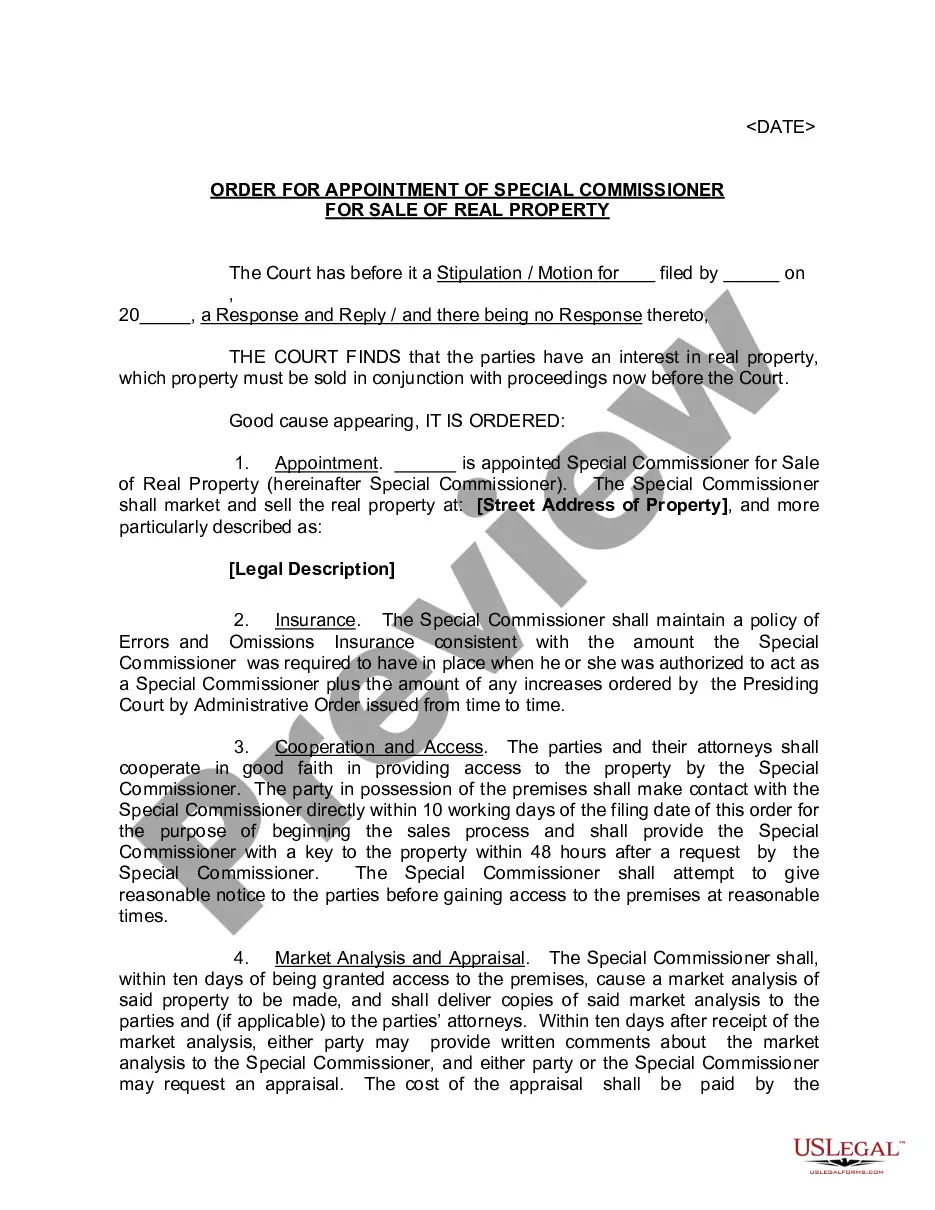
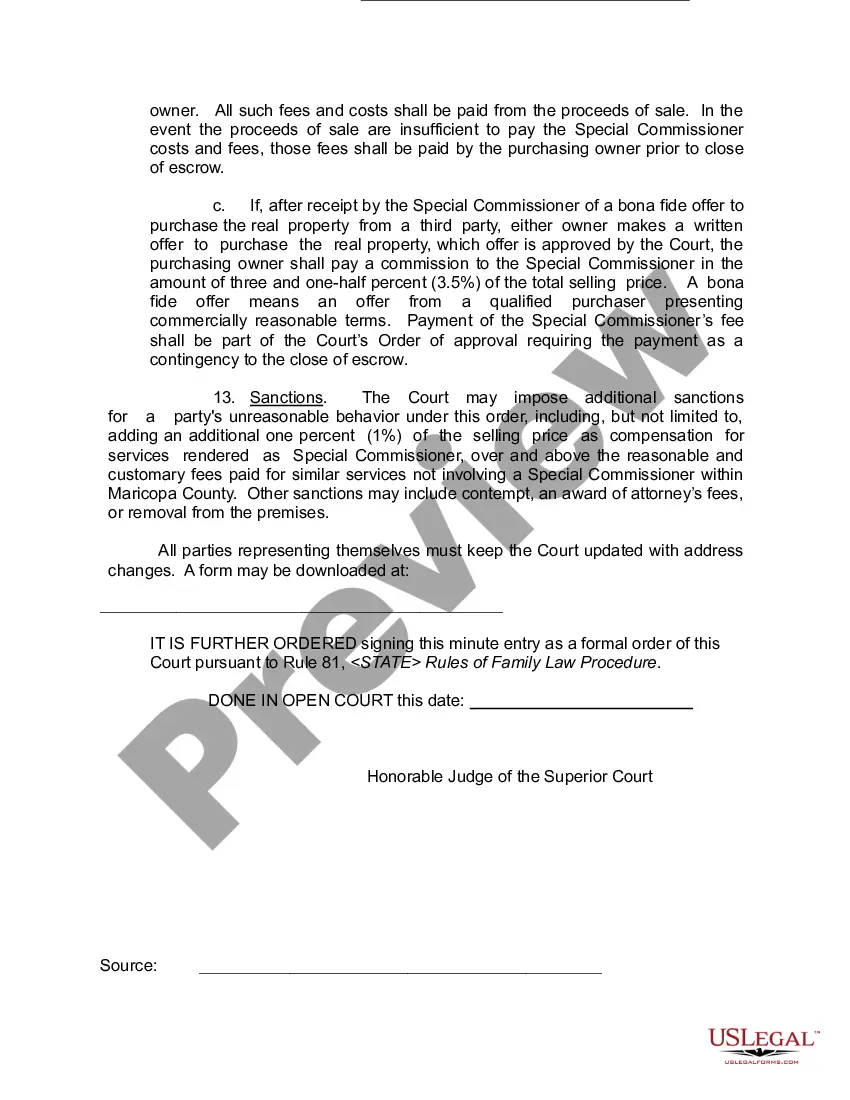
The Order for Appointment of Special Commissioner for Sale of Real Property is a legal document that appoints a Special Commissioner to oversee the sale of real estate when parties cannot agree on the terms. This form is crucial for ensuring a fair and legally compliant sale process, differentiating it from standard real estate agreements by involving court approval and oversight during disputes.
Form components explained
- Appointment of a Special Commissioner with specified duties.
- Insurance requirements for the Special Commissioner.
- Cooperation and access protocols for the property.
- Process for market analysis and appraisal of the property.
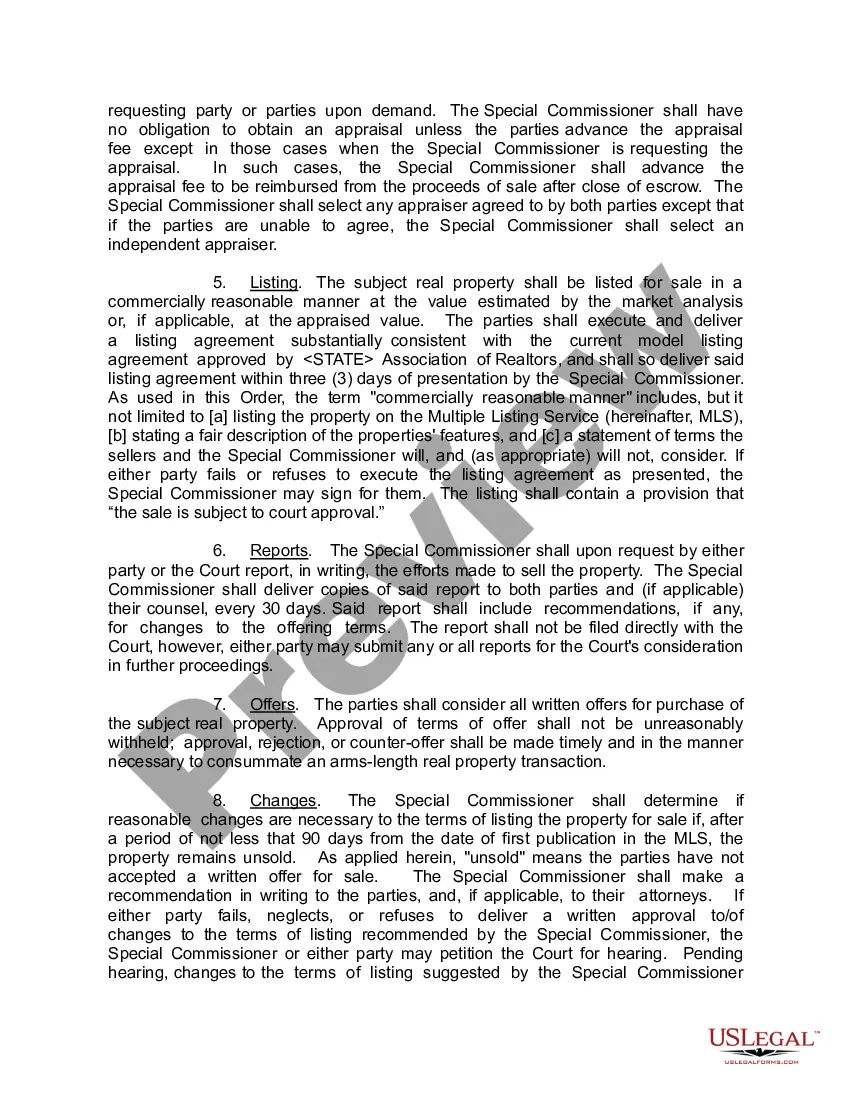
- Listing agreement stipulations for selling the property.
- Reporting requirements for the Special Commissionerâs activities.
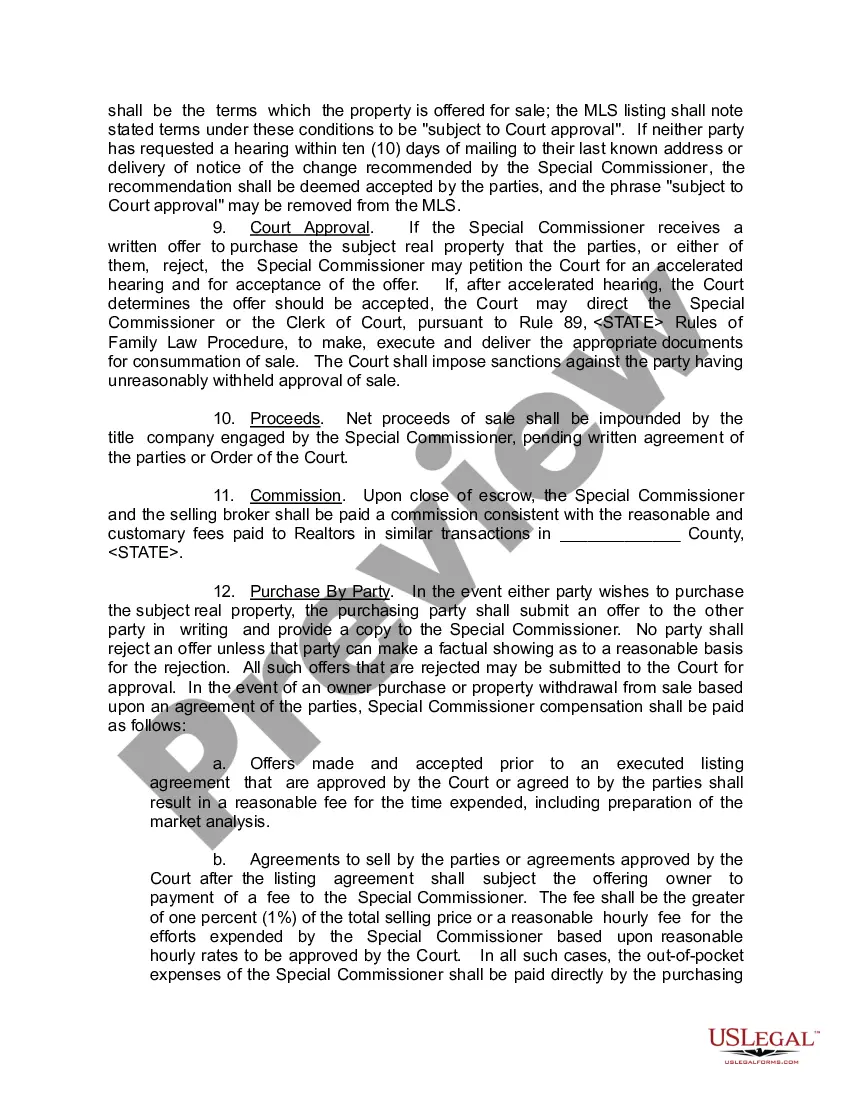
- Details on handling purchase offers from interested parties.
- Conditions for court approval and distribution of sale proceeds.
Situations where this form applies
This form is used when co-owners of real property are unable to agree on its sale. It is particularly applicable in divorce proceedings or disputes over inherited property. The order provides a structured process for appointing a Special Commissioner to facilitate the sale of the property, ensuring compliance with legal requirements and protecting the interests of all parties involved.
Who should use this form
- Individuals engaged in a legal dispute over property ownership.
- Divorcing couples who need to sell shared real estate.
- Heirs of inherited property facing disagreements on sale terms.
- Attorneys representing clients in real estate disputes.
Completing this form step by step
- Identify and list the parties involved in the property ownership.
- Specify the real property details, including the address and legal description.
- Designate and appoint the Special Commissioner within the form.
- Outline the terms for cooperation and access to the property.
- Include instructions for conducting market analysis and obtaining appraisals.
Does this document require notarization?
This form does not typically require notarization unless specified by local law. Ensure you check your specific state requirements to determine if notarization is necessary in your situation.
Get your form ready online
Our built-in tools help you complete, sign, share, and store your documents in one place.
Make edits, fill in missing information, and update formatting in US Legal Forms—just like you would in MS Word.
Download a copy, print it, send it by email, or mail it via USPS—whatever works best for your next step.
Sign and collect signatures with our SignNow integration. Send to multiple recipients, set reminders, and more. Go Premium to unlock E-Sign.
If this form requires notarization, complete it online through a secure video call—no need to meet a notary in person or wait for an appointment.
We protect your documents and personal data by following strict security and privacy standards.

Make edits, fill in missing information, and update formatting in US Legal Forms—just like you would in MS Word.

Download a copy, print it, send it by email, or mail it via USPS—whatever works best for your next step.

Sign and collect signatures with our SignNow integration. Send to multiple recipients, set reminders, and more. Go Premium to unlock E-Sign.

If this form requires notarization, complete it online through a secure video call—no need to meet a notary in person or wait for an appointment.

We protect your documents and personal data by following strict security and privacy standards.
Avoid these common issues
- Failing to provide accurate property descriptions and details.
- Neglecting to specify the terms of cooperation among parties.
- Omitting necessary signatures from all involved parties.
- Not adhering to deadlines for submitting market analysis or appraisals.
Benefits of completing this form online
- Convenient access to the form from anywhere, anytime.
- Easy customization to tailor the document to your needs.
- Reliable templates drafted by licensed attorneys for legal accuracy.
- Streamlined completion with step-by-step guidance available.
Legal Use & Context
- The form is used in court proceedings relating to real property disputes.
- It grants the Special Commissioner authority to manage the sale process legally.
- All transactions facilitated by the Special Commissioner are subject to court approval.
What to keep in mind
- The form appoints a Special Commissioner to manage the sale of shared real property.
- It addresses disputes and ensures compliance with legal standards.
- Utilizing the form can protect the interests of all parties involved in the sale.
Looking for another form?

Form popularity
FAQ
So, what is eminent domain? Basically, the government can force the sale of private property in the name of public use. For example, if your house is next to a freeway that's scheduled for widening, the government can force you to sell so long as you are paid fairly.
Texas courts are required to partition property even if only one co-owner makes such a request, and the courts have no wiggle room or discretion. The court must order the property partitioned. Partition is sometimes referred to as a ?forced sale.? Partition only applies to real property and not personal property.
A forced sale is an involuntary transaction in which the sale is based upon legal and not economic factors, such as a decree, execution, or something different than mere inability to maintain the property. If the sale is made for purely economic reasons, it is considered voluntary.
Sec. 21.0113. BONA FIDE OFFER REQUIRED. (a) An entity with eminent domain authority that wants to acquire real property for a public use must make a bona fide offer to acquire the property from the property owner voluntarily.
Section 21.014 - Special Commissioners (a) The judge of a court in which a condemnation petition is filed or to which an eminent domain case is assigned shall, not later than the 30th calendar day after the petition is filed, appoint three disinterested real property owners who reside in the county as special
In Texas, disputes involving jointly owned property are frequently settled through a legal process known as ?partition.? When co-owners of a home cannot agree on matters relating to the home, the court can force the sale of the real property and distribute the proceeds of the sale to the co-owners per their ownership
23.001. PARTITION. A joint owner or claimant of real property or an interest in real property or a joint owner of personal property may compel a partition of the interest or the property among the joint owners or claimants under this chapter and the Texas Rules of Civil Procedure.
Here are some of the most common ways to win a partition suit: Getting bought out at a fair price.The property being sold on the open market.Getting a co-owner to move out of the property so it can be rented.Getting reimbursed for the funds you put into the property.