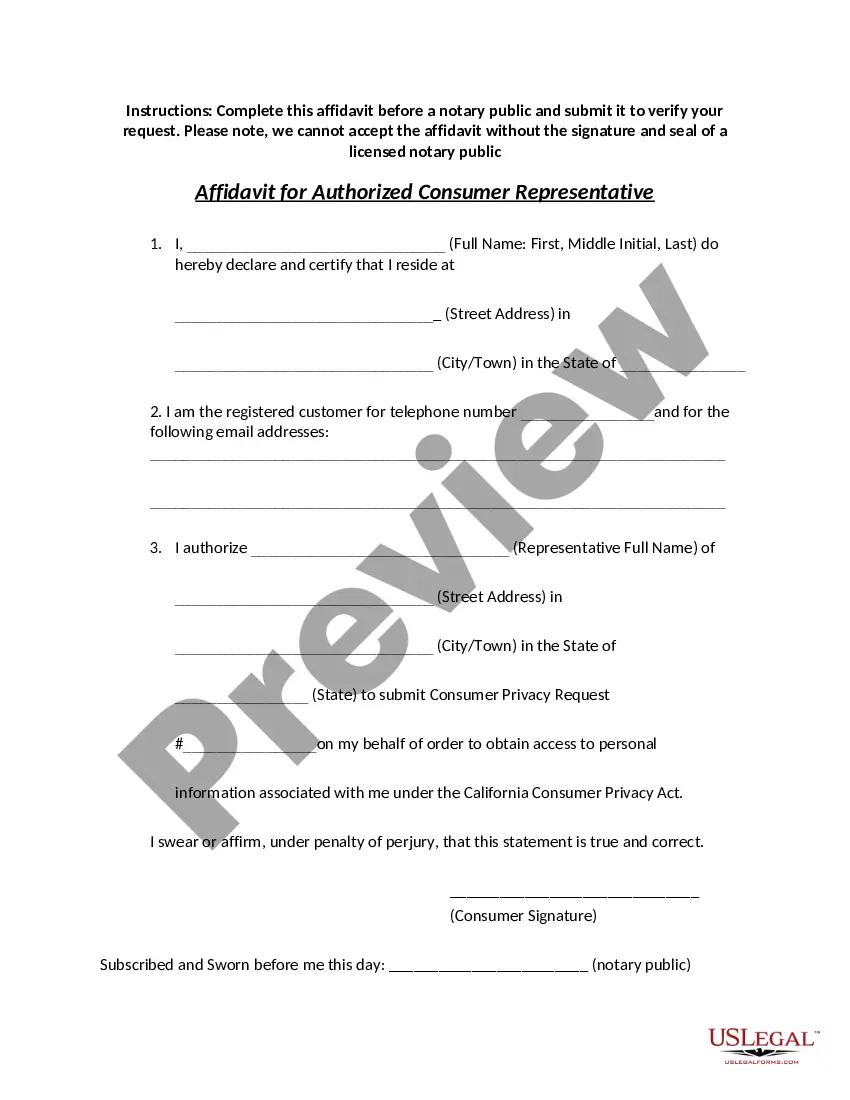
Affidavit for Authorized Consumer Representative
What is this form?
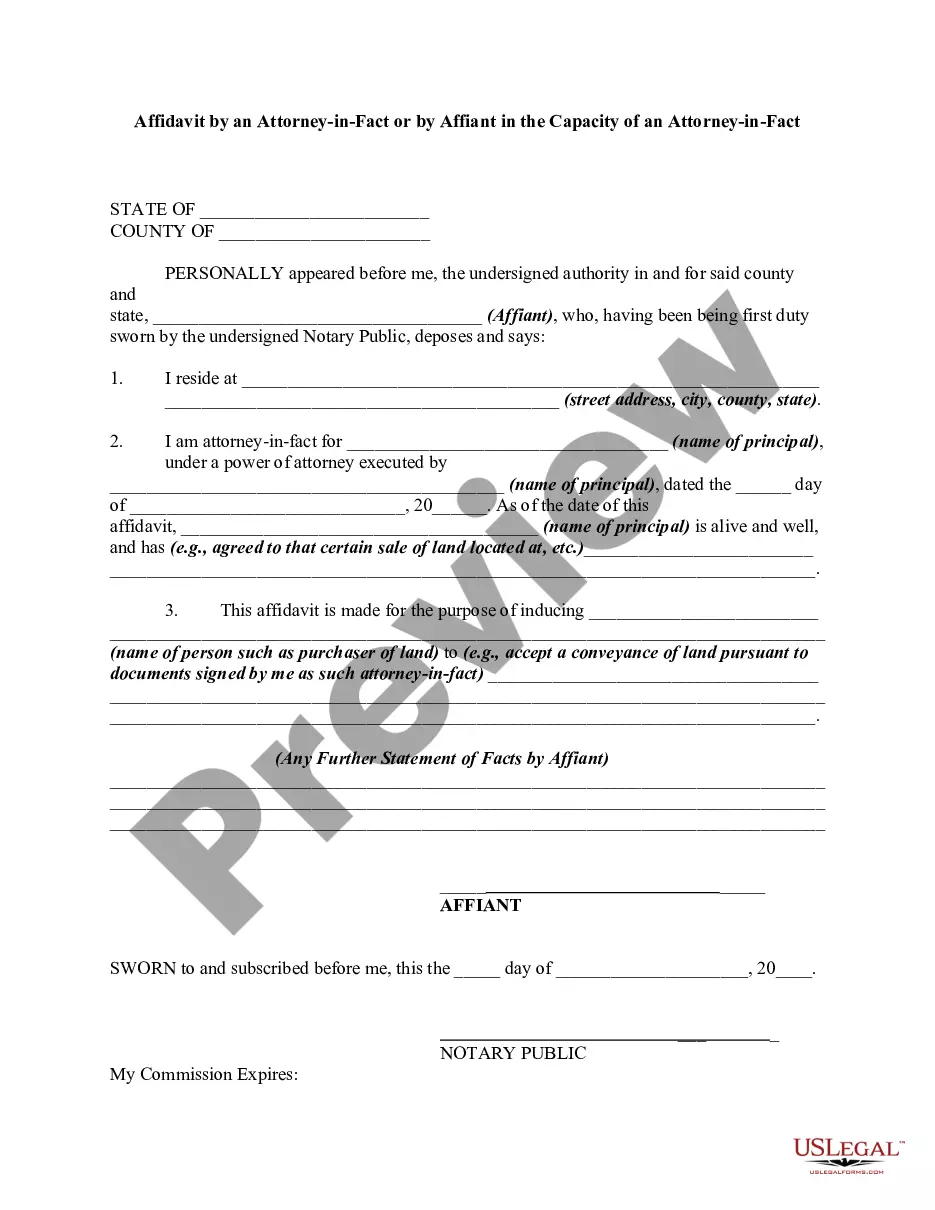
The Affidavit for Authorized Consumer Representative is a legal document that allows a designated individual to act on behalf of a client in specific consumer privacy matters. This form is particularly useful for individuals who wish to grant someone else the authority to obtain access to their personal information under the California Consumer Privacy Act. Unlike other affidavits that may serve general purposes, this document specifically addresses consumer privacy rights and authorizes a representative to make requests on behalf of the client.
Key parts of this document
- Full name and address of the client.
- Registered customer information, including telephone number and email addresses.
- Full name of the authorized representative and their address.
- Specific Consumer Privacy Request being authorized on behalf of the client.
- Signature of the consumer to confirm authenticity.
- Space for notarization to validate the affidavit.

When to use this form
This affidavit should be used when a client wishes to authorize another person to submit a Consumer Privacy Request on their behalf, particularly for accessing personal information as provided under the California Consumer Privacy Act. It is especially relevant if the client is unable to submit the request themselves due to constraints such as lack of time, legal knowledge, or if they are residing in a different location.
Intended users of this form
This form is intended for:
- Clients seeking to grant authority to a representative for privacy-related matters.
- Individuals concerned about their personal information and privacy rights under state law.
- Anyone needing assistance in managing their consumer privacy requests.
Completing this form step by step
- Begin by entering your full name and residential address at the beginning of the form.
- Provide your registered customer information, including your telephone number and any relevant email addresses.
- Clearly identify the representative by writing their full name and address.
- Specify the Consumer Privacy Request that you authorize your representative to submit on your behalf.
- Sign the affidavit in the designated area to validate your authorization.
- Have the affidavit notarized to ensure its legal validity, if required.
Is notarization required?
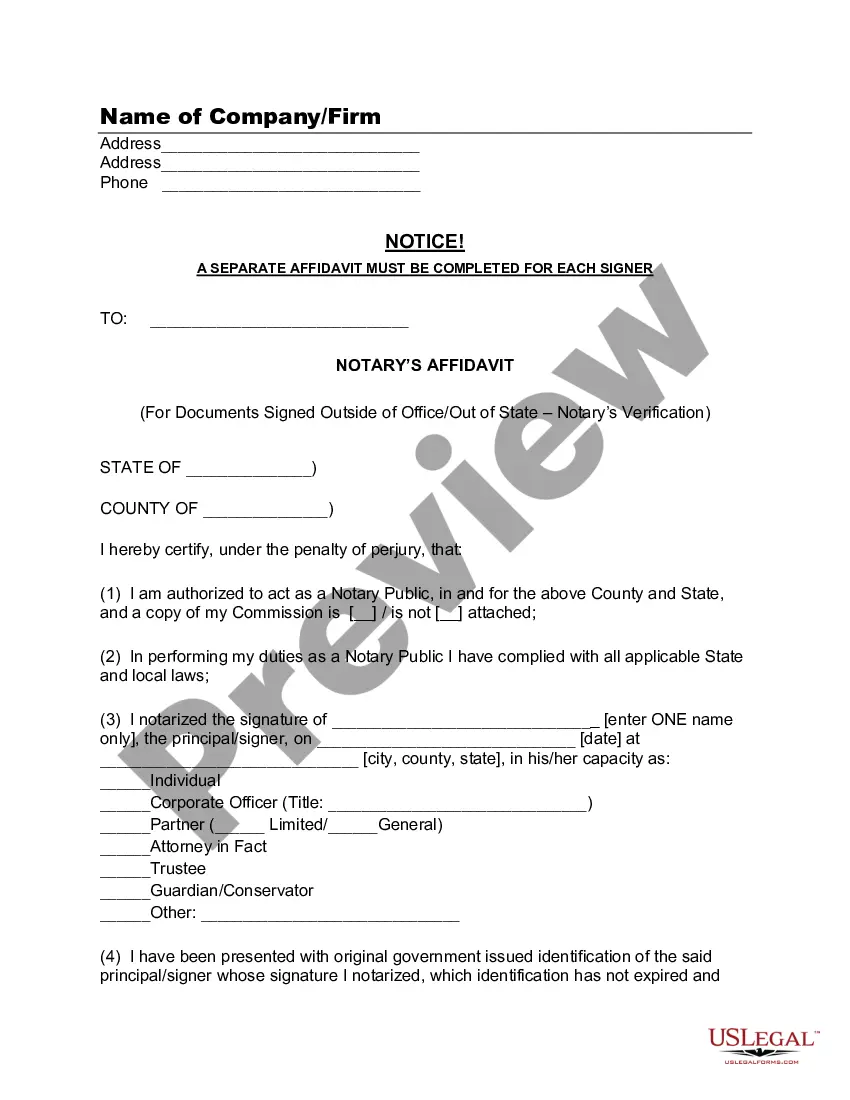
Yes, this form must be notarized to be legally valid. Notarization serves to confirm the authenticity of the signatures and declarations made in the affidavit. US Legal Forms offers an integrated online notarization service that is available around the clock, allowing you to complete this process securely from your home without the need for travel.
Get your form ready online
Our built-in tools help you complete, sign, share, and store your documents in one place.
Make edits, fill in missing information, and update formatting in US Legal Forms—just like you would in MS Word.
Download a copy, print it, send it by email, or mail it via USPS—whatever works best for your next step.
Sign and collect signatures with our SignNow integration. Send to multiple recipients, set reminders, and more. Go Premium to unlock E-Sign.
If this form requires notarization, complete it online through a secure video call—no need to meet a notary in person or wait for an appointment.
We protect your documents and personal data by following strict security and privacy standards.

Make edits, fill in missing information, and update formatting in US Legal Forms—just like you would in MS Word.

Download a copy, print it, send it by email, or mail it via USPS—whatever works best for your next step.

Sign and collect signatures with our SignNow integration. Send to multiple recipients, set reminders, and more. Go Premium to unlock E-Sign.

If this form requires notarization, complete it online through a secure video call—no need to meet a notary in person or wait for an appointment.

We protect your documents and personal data by following strict security and privacy standards.
Common mistakes to avoid
- Failing to complete all required fields accurately.
- Not providing complete information about the authorized representative.
- Omitting signatures or dates on the affidavit.
- Neglecting to have the document notarized, if necessary.
- Using outdated or incorrect contact information.
Why use this form online
- Convenient access to a downloadable legal template that can be filled out at your own pace.
- Editable format allows for easy customization to fit your specific needs.
- Reliable support from licensed attorneys who ensure that the forms meet legal standards.
Looking for another form?
Form popularity
FAQ
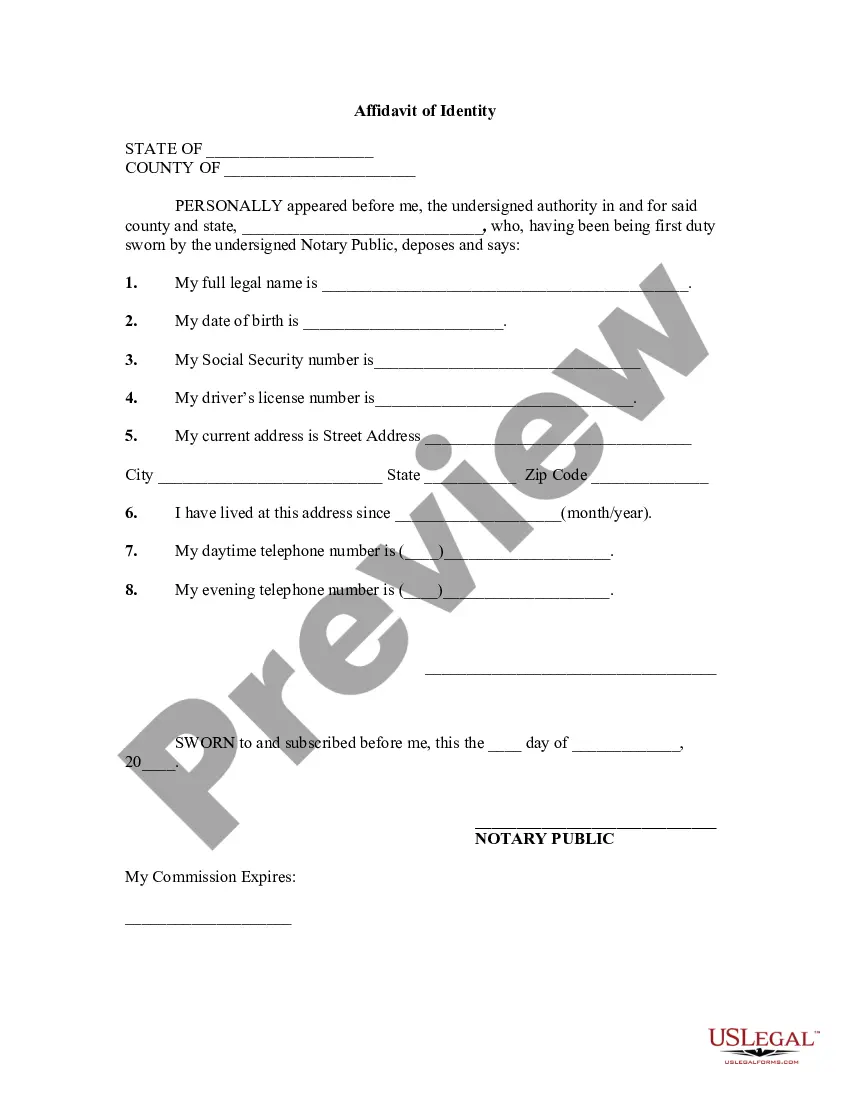
6 steps to writing an affidavit Title the affidavit. First, you'll need to title your affidavit.Craft a statement of identity. The very next section of your affidavit is what's known as a statement of identity.Write a statement of truth.State the facts.Reiterate your statement of truth.Sign and notarize.
Example: I, Jane Smith, swear that the information in my sworn statement is truthful to the best of my knowledge and understanding. Your statement of truth must be in the first person and you need to identify yourself in it. Keep it short and sweet.
Essential features of an affidavit An affidavit must be in writing. It needs to be a declaration by the deponent. The facts mentioned in an affidavit must be true to the best knowledge of the deponent. In order to make it valid, it needs to be sworn in under oath before an authorised officer or magistrate.
Documents required to execute affidavit as below, Any of your government approved ID proof like aadhar, passport or driving license. Any of the specific supporting document for your intended purpose to execute affidavit like degree certificate, mark sheet, employment letter, marriage certificate, bank statement etcetera.
If it is written, the affidavit must be signed by the person making the statement and must include the person's full name, address, and date of birth. If it is oral, the statement must be confirmed by an oath or affirmation before a notary public or other official authorized to take such oaths.
If it is written, the affidavit must be signed by the person making the statement and must include the person's full name, address, and date of birth. If it is oral, the statement must be confirmed by an oath or affirmation before a notary public or other official authorized to take such oaths.