Transfer Under the Virginia Uniform Custodial Trust Act
Overview of this form
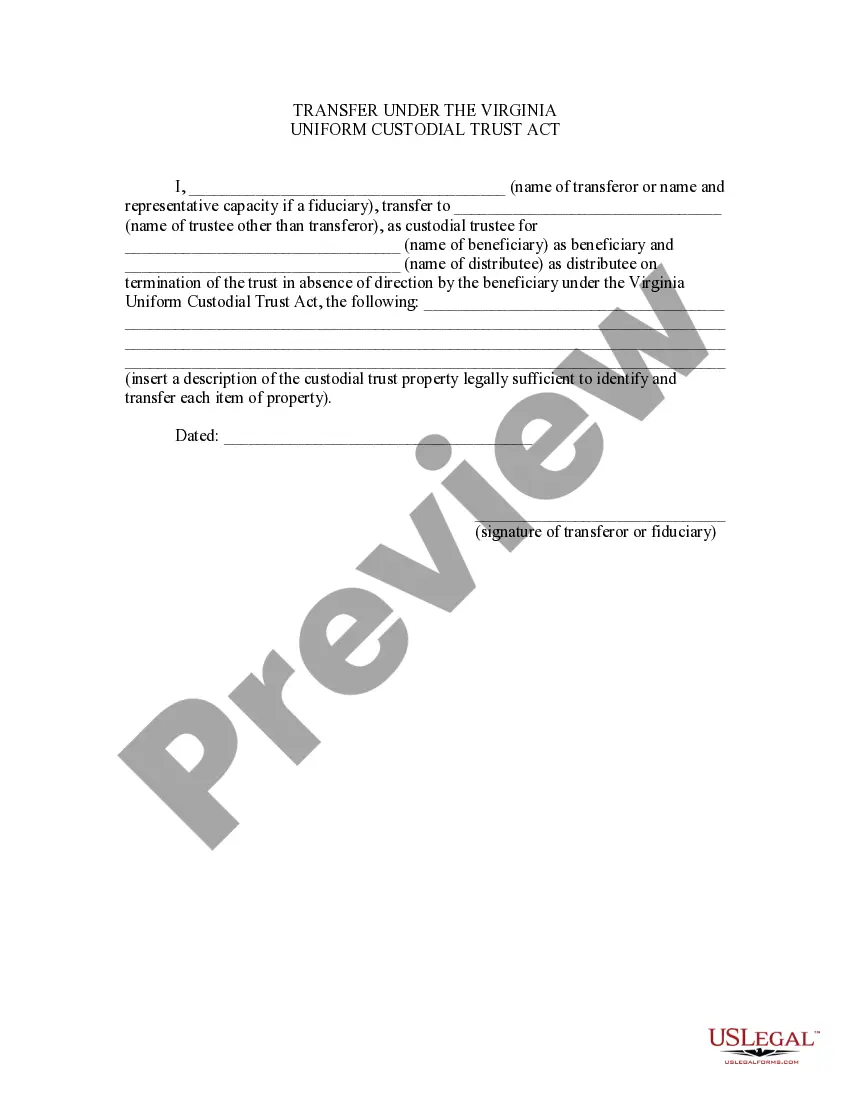
The Transfer Under the Virginia Uniform Custodial Trust Act is a legal document that allows a person to create a custodial trust for property. This trust is established by transferring property to a designated custodian, who manages it for a named beneficiary. This form is specifically tailored for use in Virginia, ensuring compliance with state laws regarding trusts and custodianship. Unlike general property transfer forms, this one specifically addresses the creation of custodial trusts, facilitating easier management of assets for beneficiaries.
Main sections of this form
- Name of the transferor, identifying who is transferring the assets.
- Name of the trustee, designating who will manage the custodial trust.
- Name of the beneficiary, specifying who will benefit from the trust.
- Description of the custodial trust property, detailing the assets involved.
- Signature of the transferor or fiduciary, providing legal authentication of the form.
When to use this form
This form should be used when an individual in Virginia wants to set up a custodial trust, which is often needed for managing assets for minors or beneficiaries who may not be able to handle the property themselves. It is suitable for situations where the transferor wishes to ensure that the trust property is properly managed and used for the benefit of the designated beneficiary.
Who can use this document
- Individuals wishing to establish a custodial trust in Virginia.
- Parents or guardians managing assets on behalf of minors.
- Fiduciaries acting on behalf of another individual in a trust arrangement.
- Anyone looking to clarify the management of specific assets for designated beneficiaries.
Completing this form step by step
- Identify the parties: name the transferor and the trustee.
- Specify the property: provide a detailed description of the custodial trust property.
- Designate the beneficiary: clearly name the beneficiary who will receive the trust funds.
- Enter dates: fill in the date of the transfer at the top of the form.
- Sign the document: the transferor or fiduciary must sign to validate the transfer.
Notarization requirements for this form
In most cases, this form does not require notarization. However, some jurisdictions or signing circumstances might. US Legal Forms offers online notarization powered by Notarize, accessible 24/7 for a quick, remote process.
Get your form ready online
Our built-in tools help you complete, sign, share, and store your documents in one place.
Make edits, fill in missing information, and update formatting in US Legal Forms—just like you would in MS Word.
Download a copy, print it, send it by email, or mail it via USPS—whatever works best for your next step.
Sign and collect signatures with our SignNow integration. Send to multiple recipients, set reminders, and more. Go Premium to unlock E-Sign.
If this form requires notarization, complete it online through a secure video call—no need to meet a notary in person or wait for an appointment.
We protect your documents and personal data by following strict security and privacy standards.

Make edits, fill in missing information, and update formatting in US Legal Forms—just like you would in MS Word.
Download a copy, print it, send it by email, or mail it via USPS—whatever works best for your next step.
Sign and collect signatures with our SignNow integration. Send to multiple recipients, set reminders, and more. Go Premium to unlock E-Sign.

If this form requires notarization, complete it online through a secure video call—no need to meet a notary in person or wait for an appointment.

We protect your documents and personal data by following strict security and privacy standards.
Avoid these common issues
- Failing to provide a clear description of the trust property.
- Not designating a trustee or leaving the beneficiary field blank.
- Omitting the signature of the transferor or fiduciary.
- Not dating the form at the time of completion.
Why complete this form online
- Instant access: download the form immediately after purchase.
- Editable content: customize the form to fit your specific needs.
- Accuracy and reliability: forms are prepared by licensed attorneys, ensuring legal compliance.
Legal use & context
- Custodial trusts are recognized under Virginia law, providing legal protection for beneficiaries.
- Properly executed forms enhance the enforceability of the trust arrangement.
Key takeaways
- The form establishes a custodial trust under Virginia law.
- It designates roles for the transferor, custodian, and beneficiary.
- Clear descriptions of property and signatures are essential for validity.
Looking for another form?
Form popularity
FAQ
Custodial trust is a revocable trust wherein a custodial trustee is named to manage the assets for a beneficiary who is incapacitated or disabled.
Generally, the President gets elected by the Board of Directors of the Trust. The Treasurer of Trust is known to be the chief financial officer of the trust. He is the person accountable for controlling monetary complications, making reports, recording finances, and managing the trust bank accounts.
In a custodial arrangement, the account is owned by the beneficiary, and he or she is entitled to the money upon reaching the proper age.A trust fund, on the other hand, provides the person giving the money with a great deal more control, since the assets are owned by the trust.
Custodial accounts can be thought of as a type of trust account, and are used to save money for children, their beneficiaries. These accounts are set up under the Uniform Gifts to Minors Act (UGMA) or the Uniform Transfers to Minors Act (UTMA).The responsibility of managing the account falls to the custodian.
Family trust can be searched using a stack of individual searches, including property search and people search. It can be challenging to find the trustee and it can take some detective work. The key is to use the last name of the family and the property address as your starting point for your search.
The trustees are the legal owners of the assets held in a trust. Their role is to: deal with the assets according to the settlor's wishes, as set out in the trust deed or their will.
A trust is an arrangement in which one person, called the trustee, controls property for the benefit of another person, called the beneficiary. The person who creates the trust is called the settlor, grantor, or trustor.
A custodial account is a means by which an adult can open a savings account for a child. The adult who opens the account is responsible for managing it, including making investment decisions, and deciding how the money is to be used, so long as it benefits the child in some way.
While you can technically withdraw money from a custodial account before your child reaches the age of majority, you can only do so for the direct benefit of the child.Keep in mind that any funds you take out may also create taxable gains for your child, and that withdrawn money won't have as much time to grow.