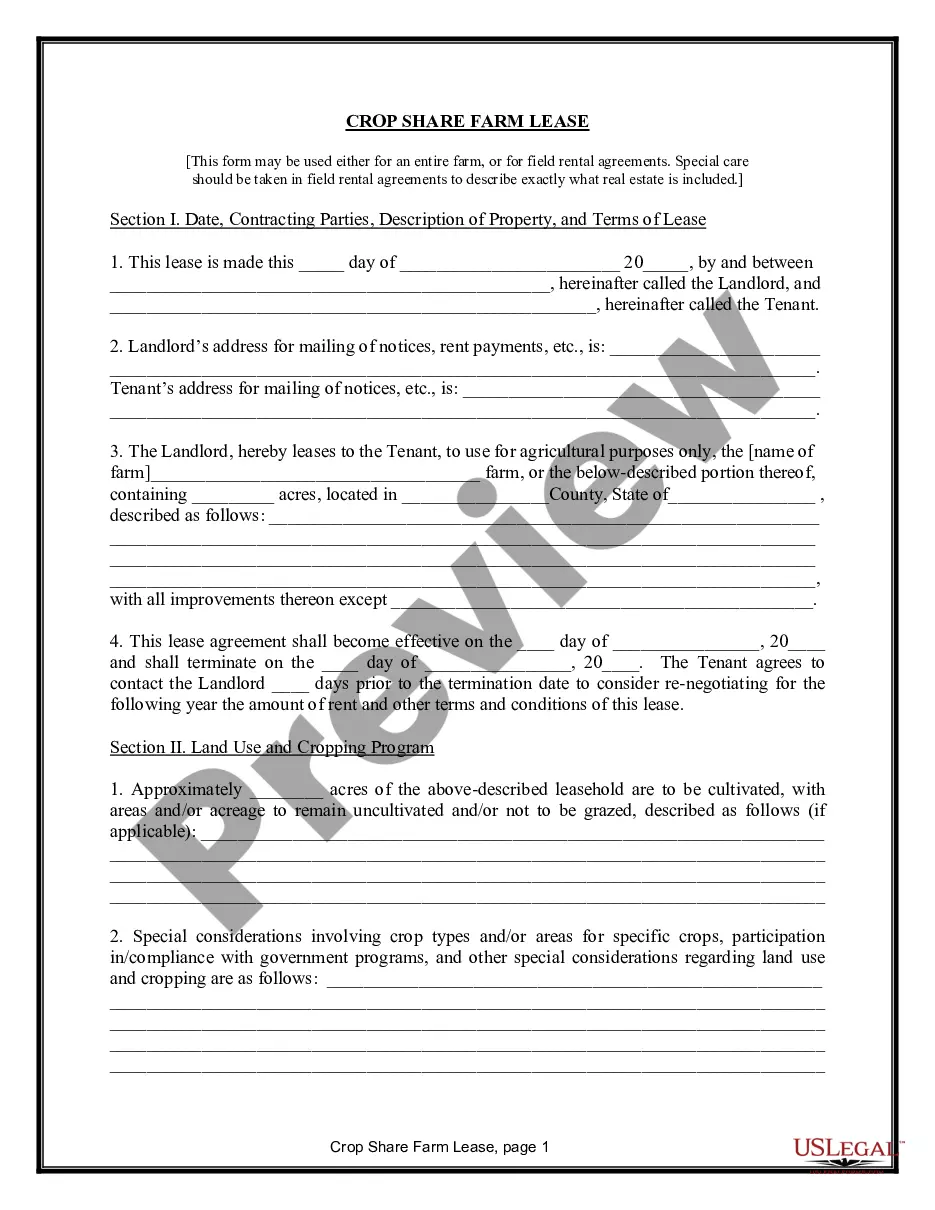
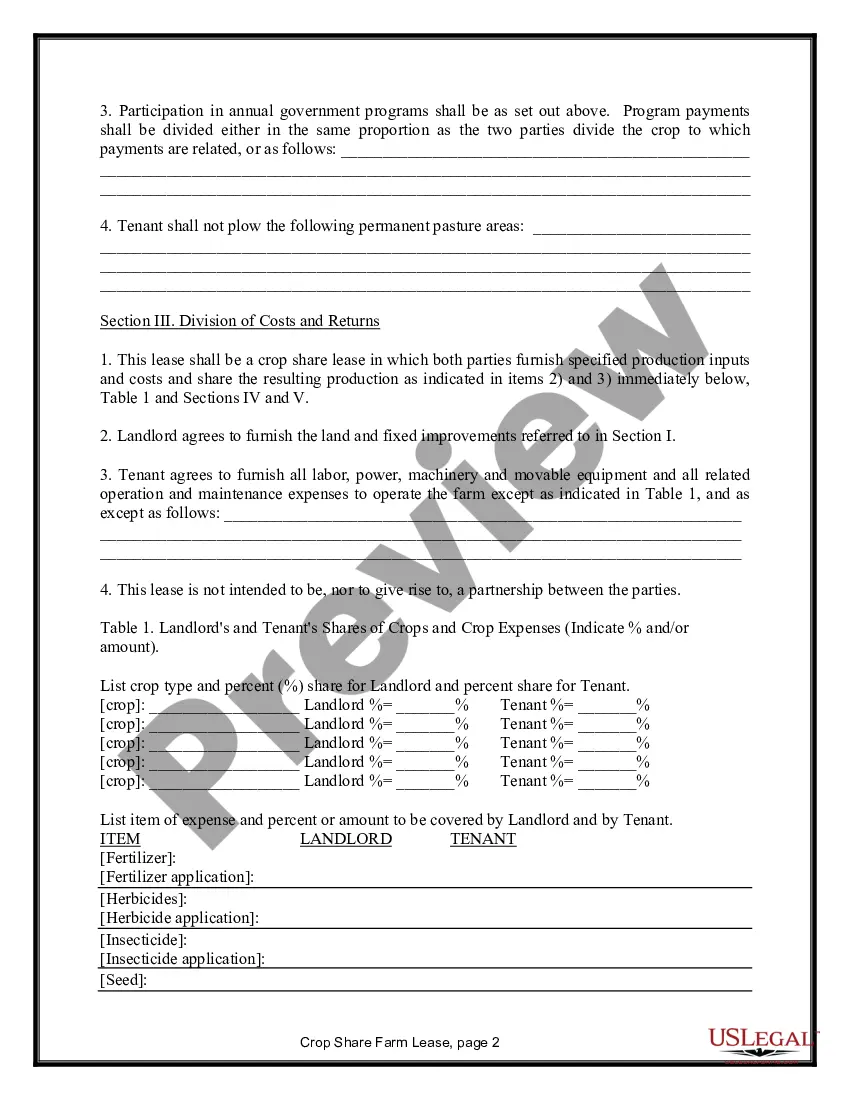
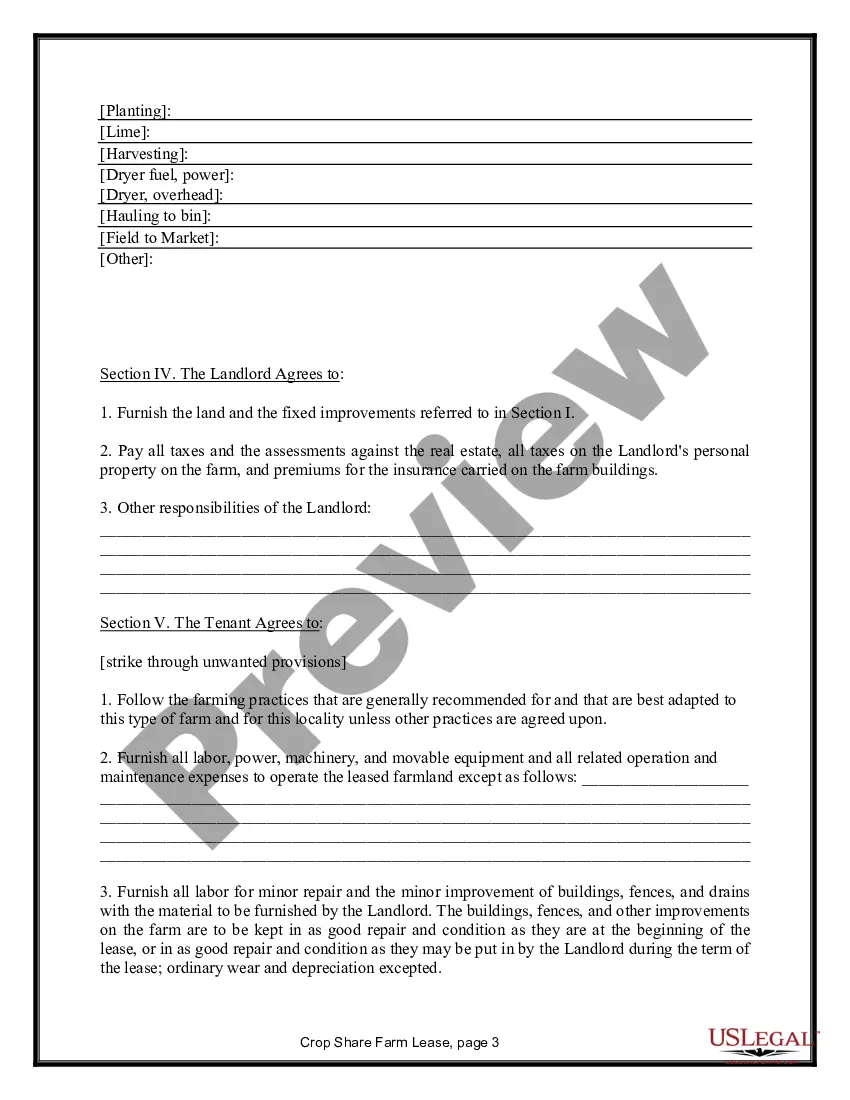
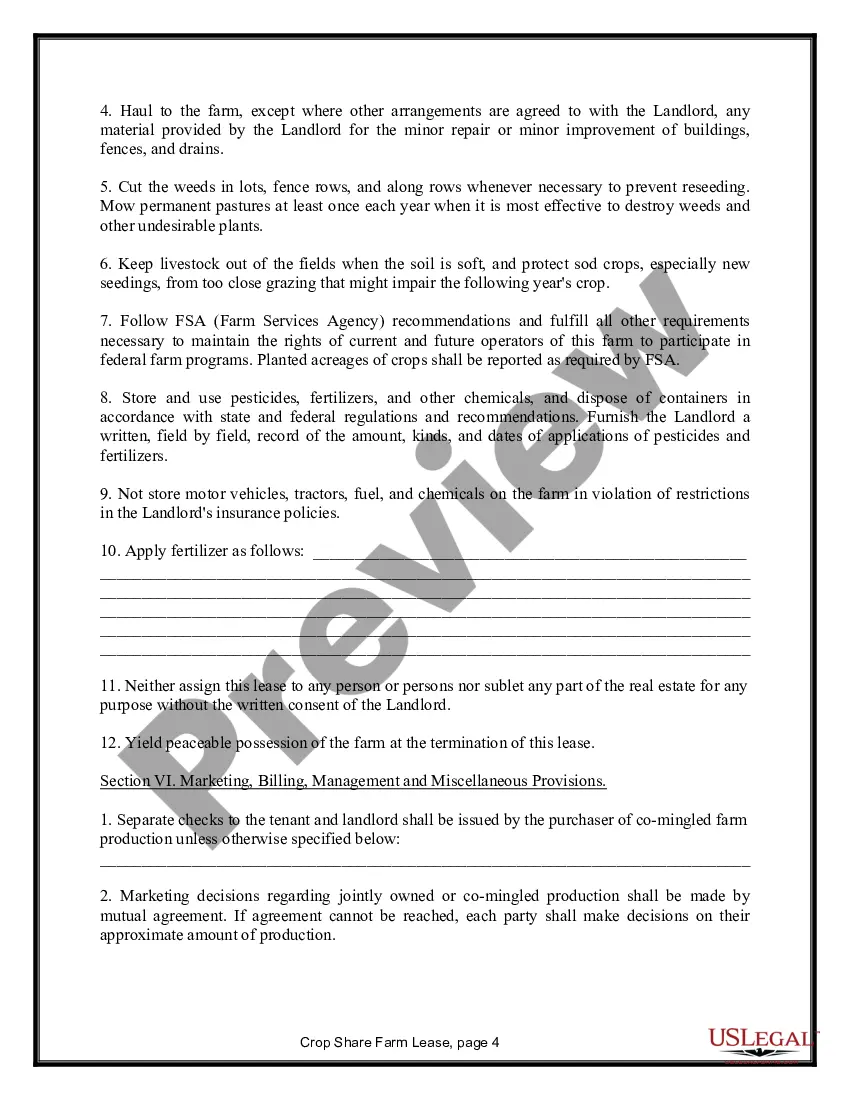
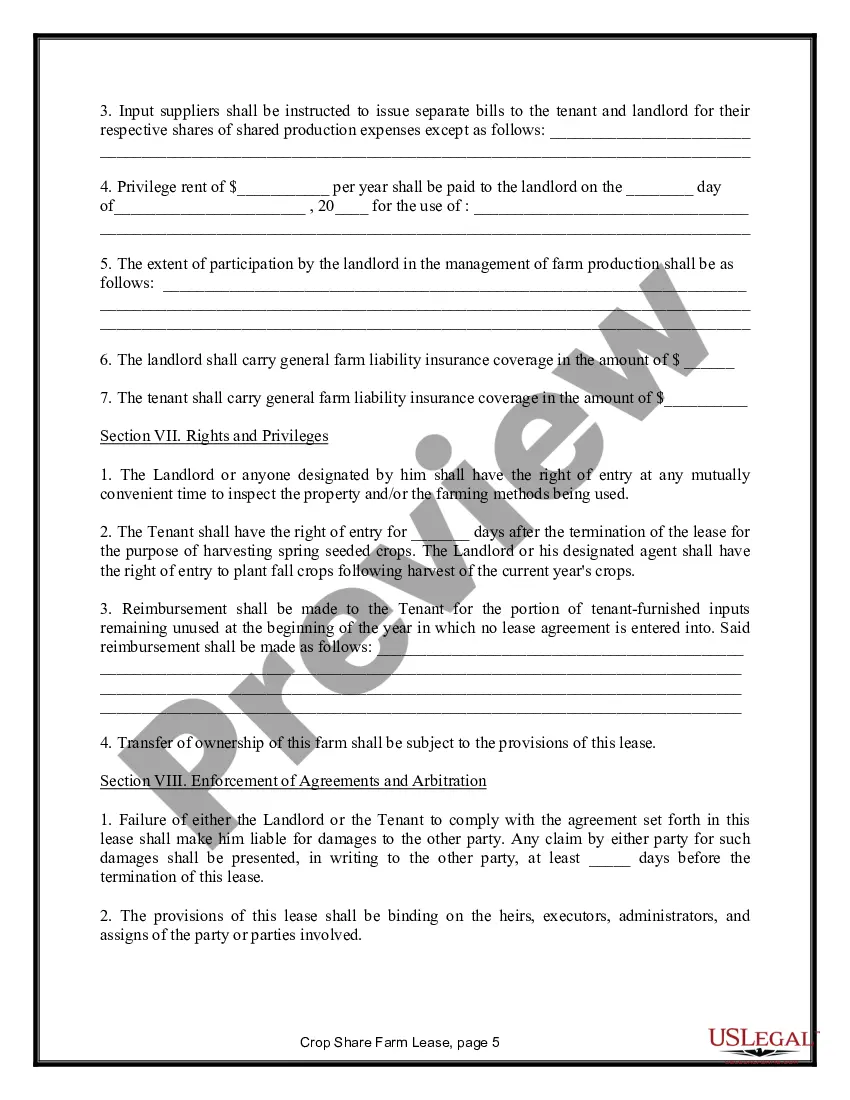
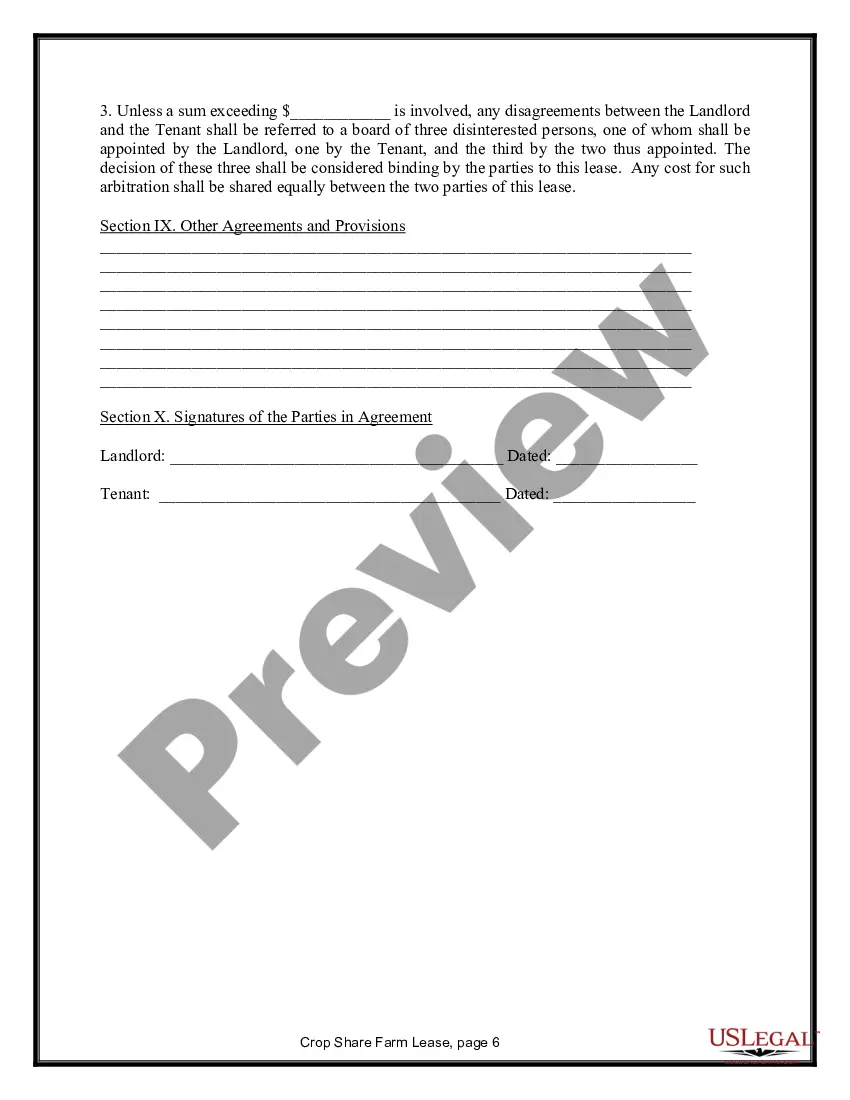
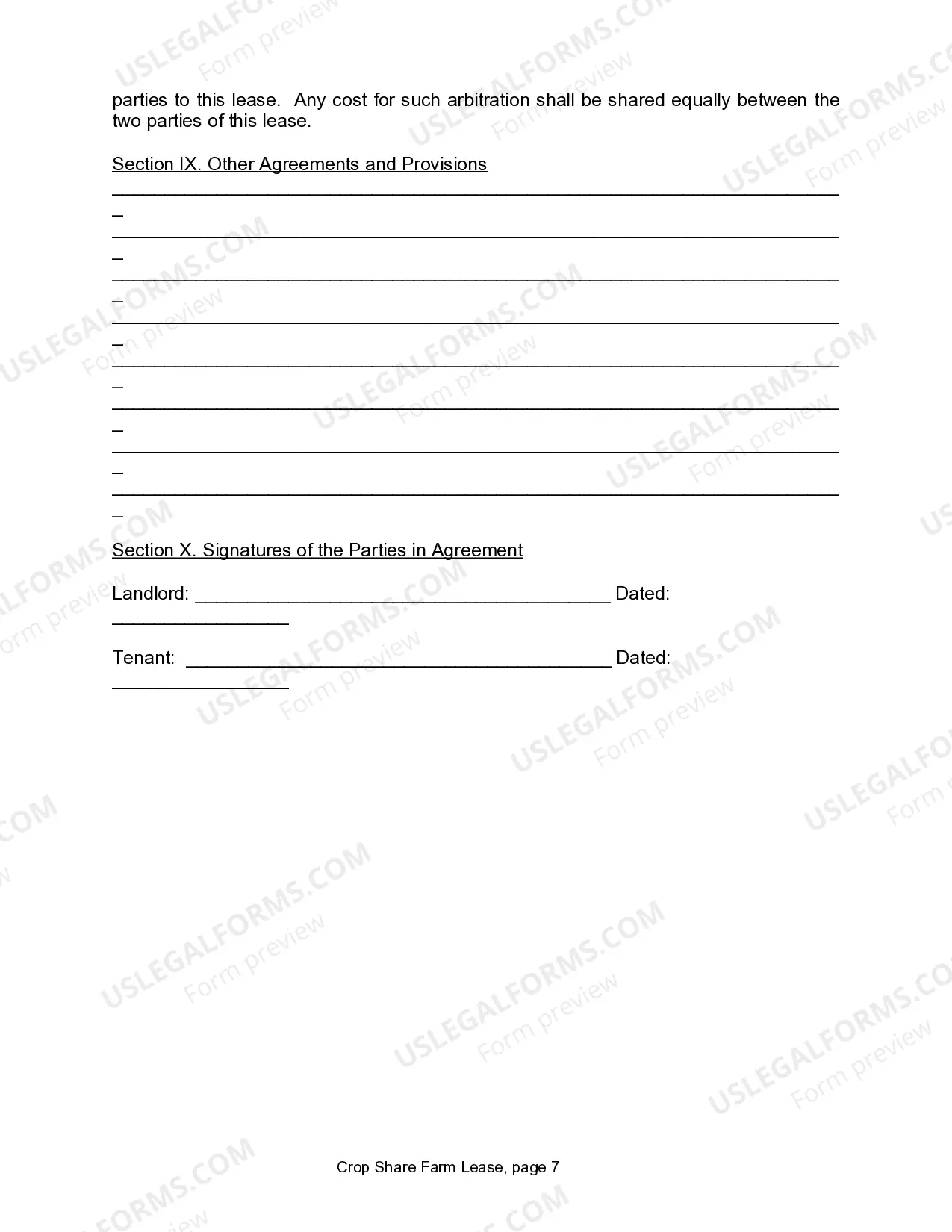
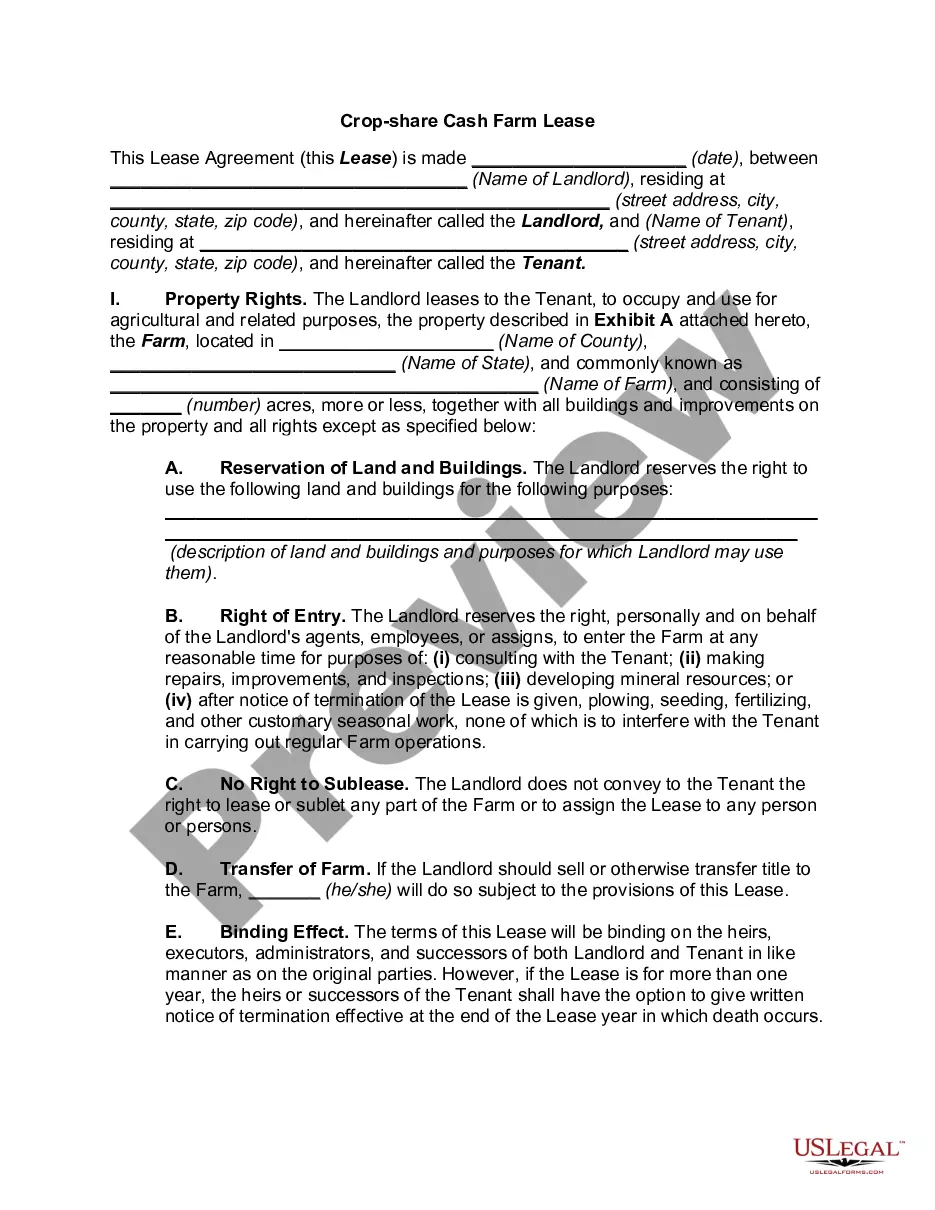
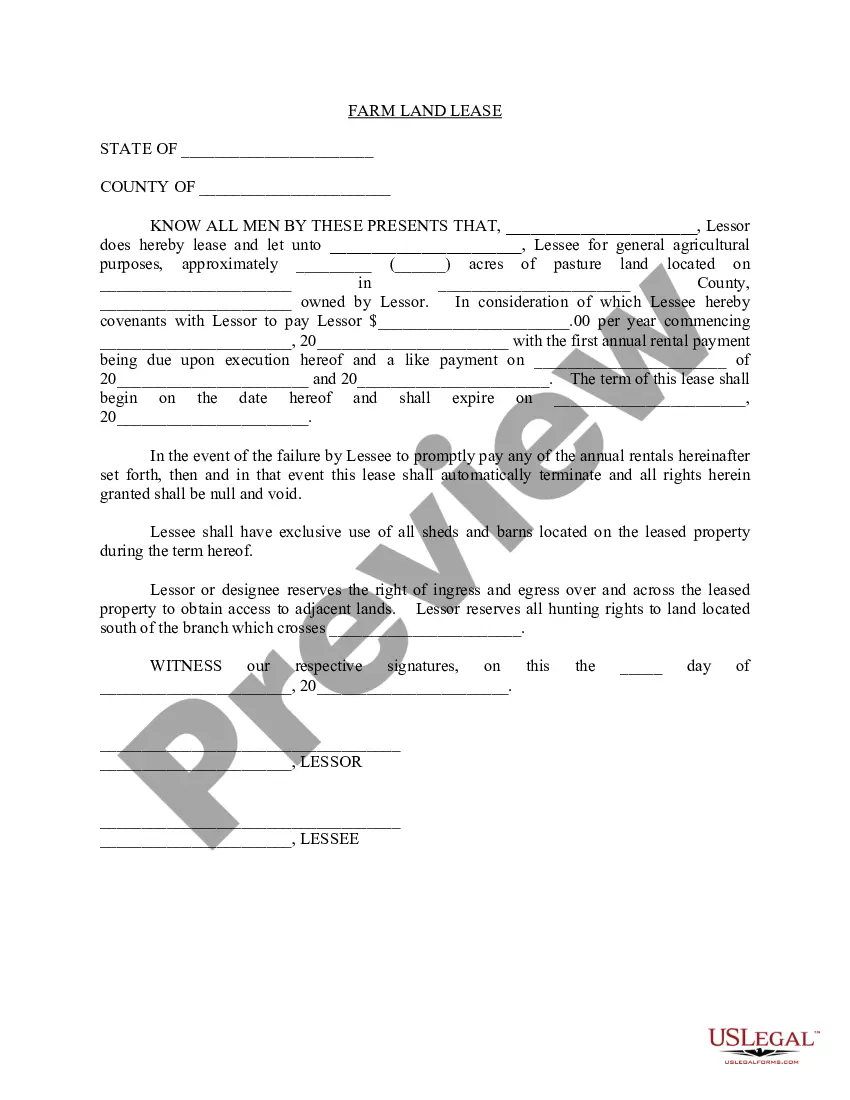
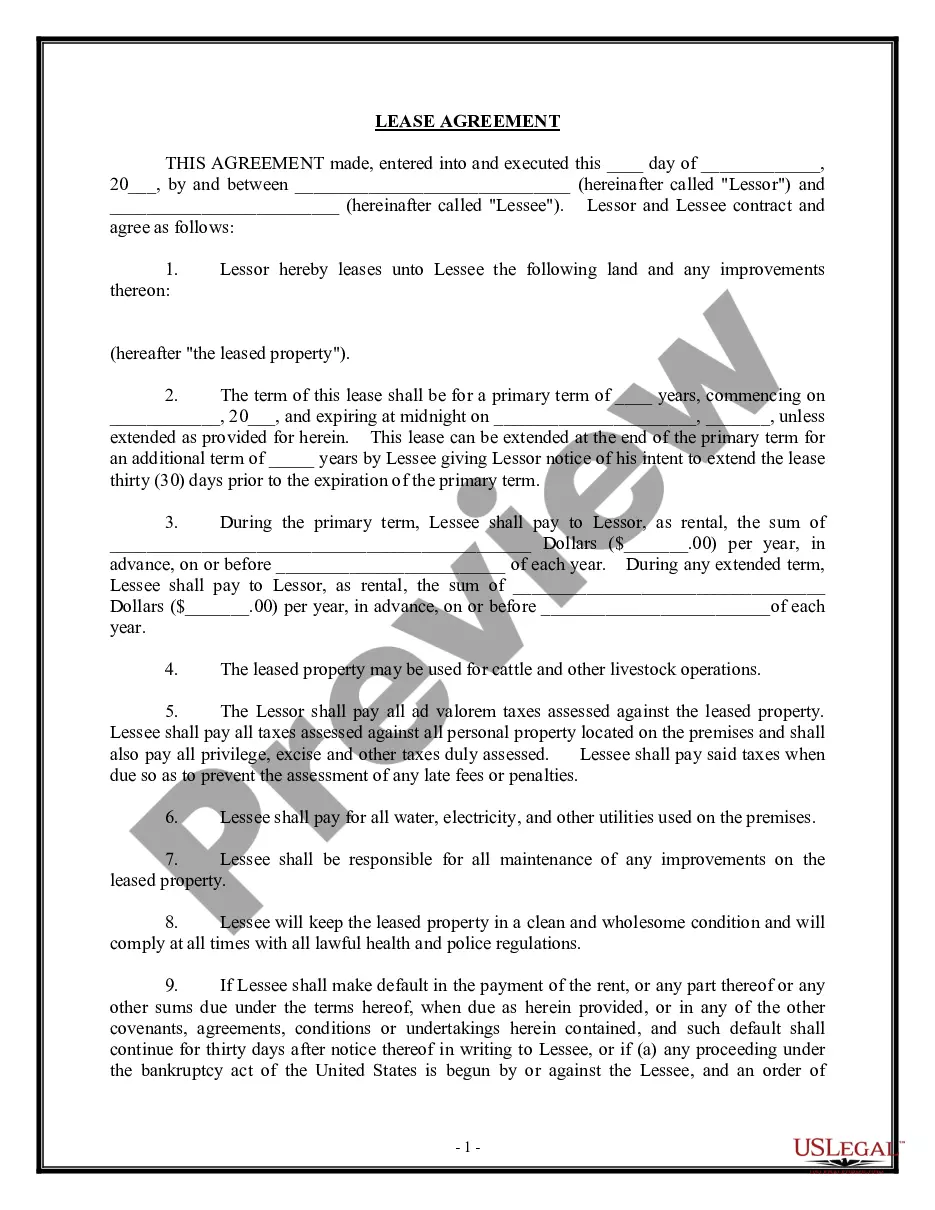
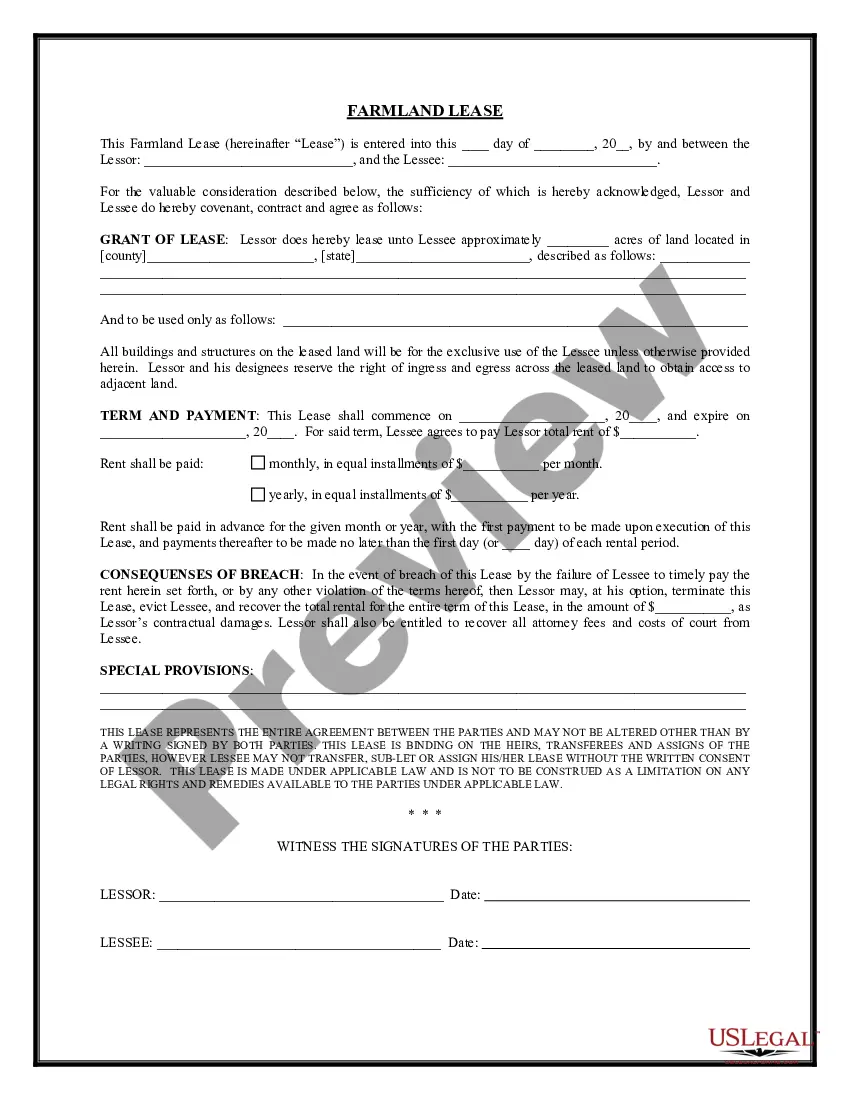
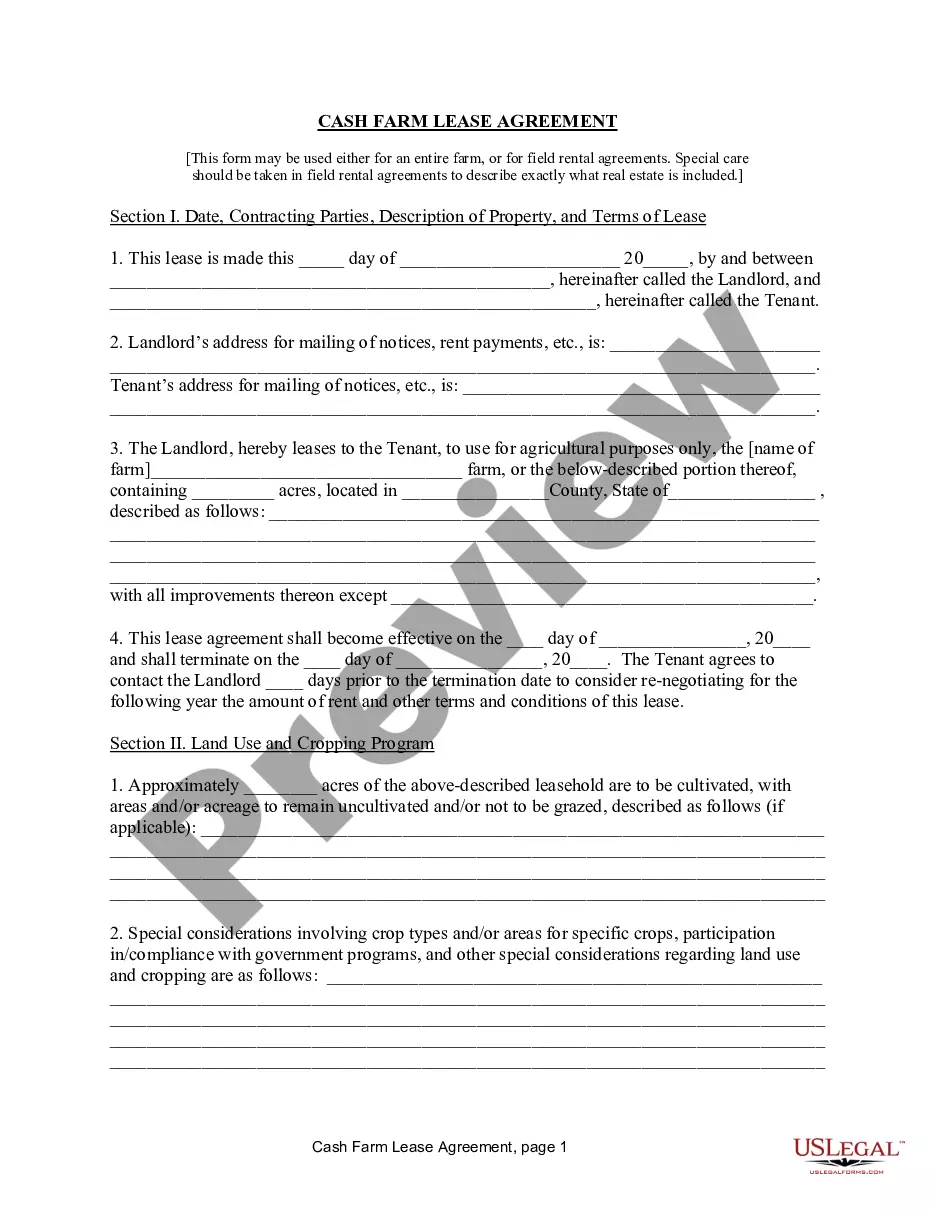
Detailed crop share farmland lease. Costs and crops are shared by landowner and tenant. Provides for detailed division of costs.
Virginia Farm Lease or Rental - Crop Share
State:
Multi-State
Category:
Control #:
US-854LT
Format:
Word;
Rich Text
120 downloads
Description
Free preview
Get your form ready online
Our built-in tools help you complete, sign, share, and store your documents in one place.
Built-in online Word editor
Make edits, fill in missing information, and update formatting in US Legal Forms—just like you would in MS Word.
Export easily
Download a copy, print it, send it by email, or mail it via USPS—whatever works best for your next step.
E-sign your document
Sign and collect signatures with our SignNow integration. Send to multiple recipients, set reminders, and more. Go Premium to unlock E-Sign.
Notarize online 24/7
If this form requires notarization, complete it online through a secure video call—no need to meet a notary in person or wait for an appointment.
Store your document securely
We protect your documents and personal data by following strict security and privacy standards.
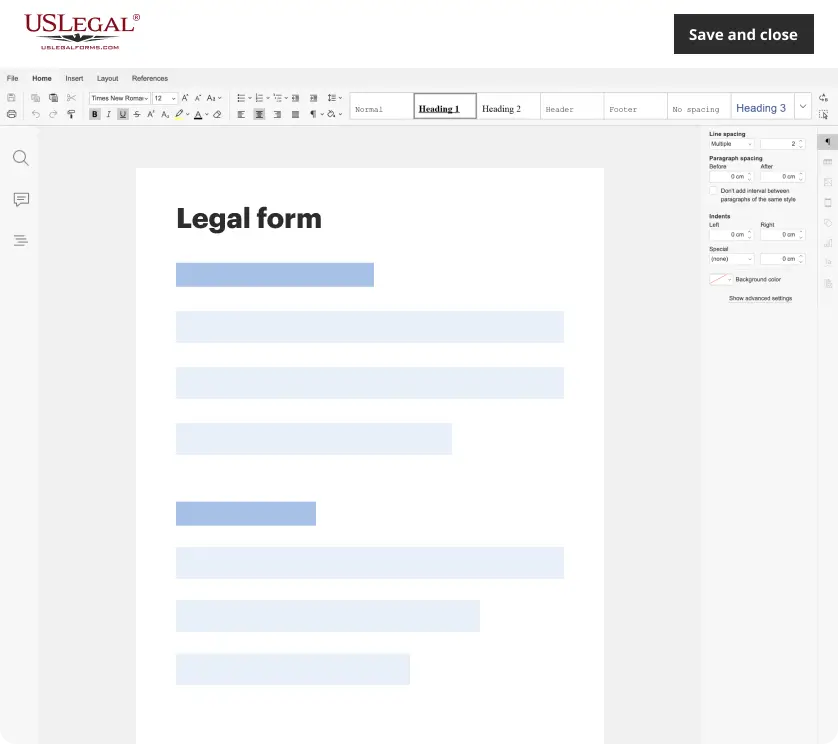
Make edits, fill in missing information, and update formatting in US Legal Forms—just like you would in MS Word.
Download a copy, print it, send it by email, or mail it via USPS—whatever works best for your next step.
Sign and collect signatures with our SignNow integration. Send to multiple recipients, set reminders, and more. Go Premium to unlock E-Sign.

If this form requires notarization, complete it online through a secure video call—no need to meet a notary in person or wait for an appointment.
We protect your documents and personal data by following strict security and privacy standards.
Looking for another form?
How to fill out Farm Lease Or Rental - Crop Share?
Are you currently in a situation where you frequently require documents for either business or personal purposes? There are numerous legal document templates available online, but locating reliable ones can be challenging.
US Legal Forms provides thousands of form templates, such as the Virginia Farm Lease or Rental - Crop Share, designed to comply with federal and state regulations.
If you are already acquainted with the US Legal Forms website and have an account, simply Log In. After that, you will be able to download the Virginia Farm Lease or Rental - Crop Share template.
Choose a suitable file format and download your copy.
Access all the document templates you've purchased in the My documents section. You can obtain another copy of the Virginia Farm Lease or Rental - Crop Share at any time, if needed. Simply click on the desired form to download or print the document template. Utilize US Legal Forms, the most extensive collection of legal forms, to save time and prevent mistakes. The service provides professionally crafted legal document templates for various purposes. Create an account on US Legal Forms and start making your life easier.
- If you do not have an account and want to start using US Legal Forms, follow these steps.
- Find the form you need and ensure it is intended for the right city/county.
- Use the Preview button to review the form.
- Read the description to confirm you have selected the correct form.
- If the form is not what you are looking for, use the Search area to find the form that meets your needs and preferences.
- Once you find the correct form, click Get now.
- Select the pricing plan you prefer, complete the required information to create your account, and process your order using PayPal or a credit card.
Form popularity
FAQ
NC farmland rental rates can vary widely from $30 to $285 per acre for cropland, with most pastureland rent from $15 to $50 per acre. In some situations, landowners may offer a no-cost lease to farmers who agree to keep the land in production.
The traditional share arrangement for a grain crop like corn or wheat is one-third to the landowner and two-thirds to the tenant. Usually, the expenses paid, and crop received, are equal to the share i.e. the landowner would pay one-third of the expenses and receive one-third of the crop.
The 7% increase in this category was the largest since 2014. Virginia cropland values came in ahead of the national average, increasing over 2% from $4,680 per acre in 2020 to $4,790 in 2021. Virginia's real estate value also was higher than the national average at $4,700 per acre, up 1.7% from 2020.
Crop-share arrangements refer to a method of leasing crop land where the production (crop) is shared between the landowner and the operator. Other income items, such as government payments and crop residue, are also often shared as are some of the production expenses.
The national cash rental rate for an acre of farmland is $140 a year, while in Virginia it currently averages $59.
Virginia Farm Facts Virginia has 43,225 farms. The typical Virginia farmer is 58.5 years old. The average farm size is 181 acres. Farms cover 7.8 million acres.
The national cash rental rate for an acre of farmland is $140 a year, while in Virginia it currently averages $59.
Sharecropping is a legal arrangement with regard to agricultural land in which a landowner allows a tenant to use the land in return for a share of the crops produced on that land.
With a crop-share lease, the landlord receives a share of the crops produced in exchange for the use of the land by the tenant. The amount of the share typically depends on local custom. The landlord usually agrees to pay a portion of the input costs under a crop-share lease.
Most farmers find that a combination of both ownership and leasing is desirable, especially when capital is limited. For many new farmers, especially in areas where land is quite expensive, leasing land is often the best option.