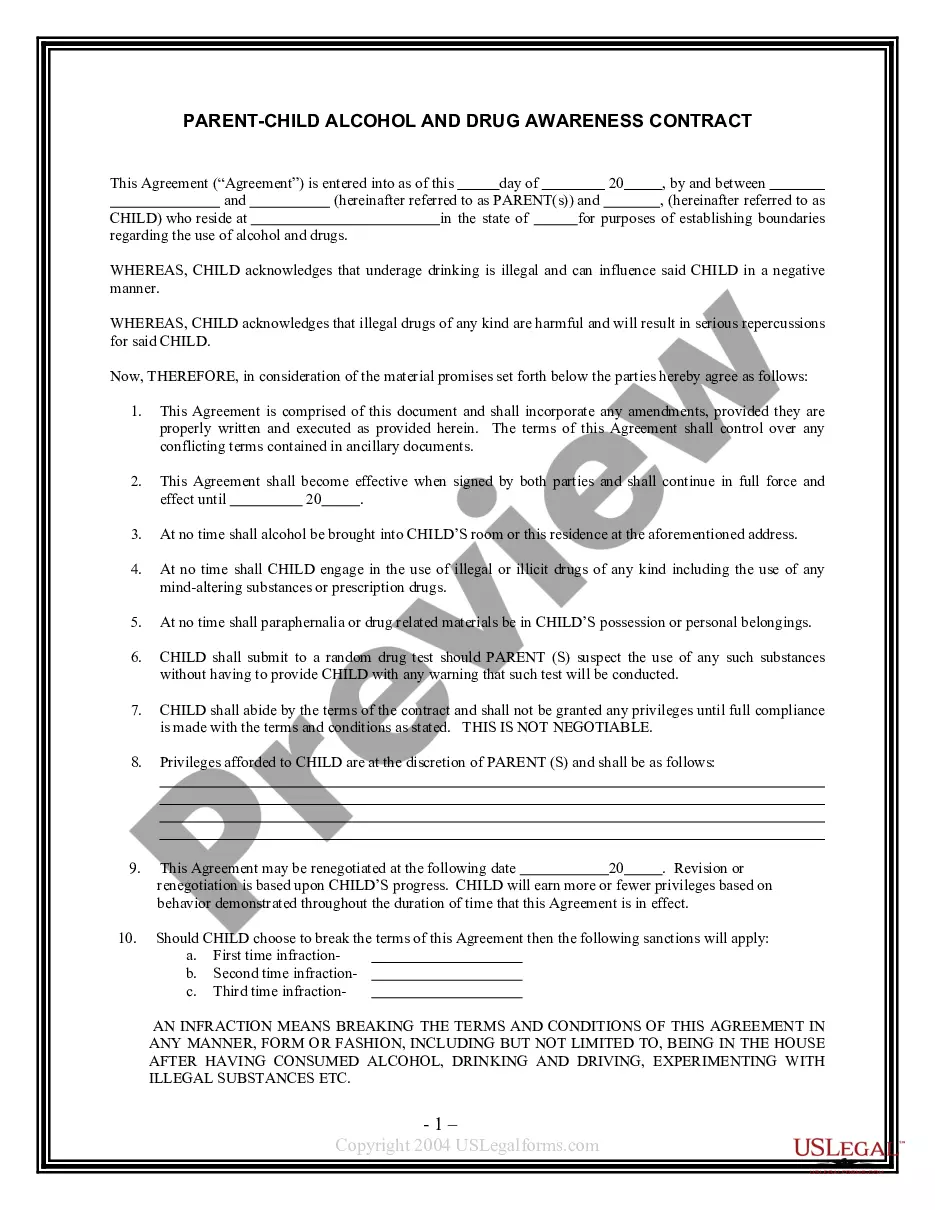
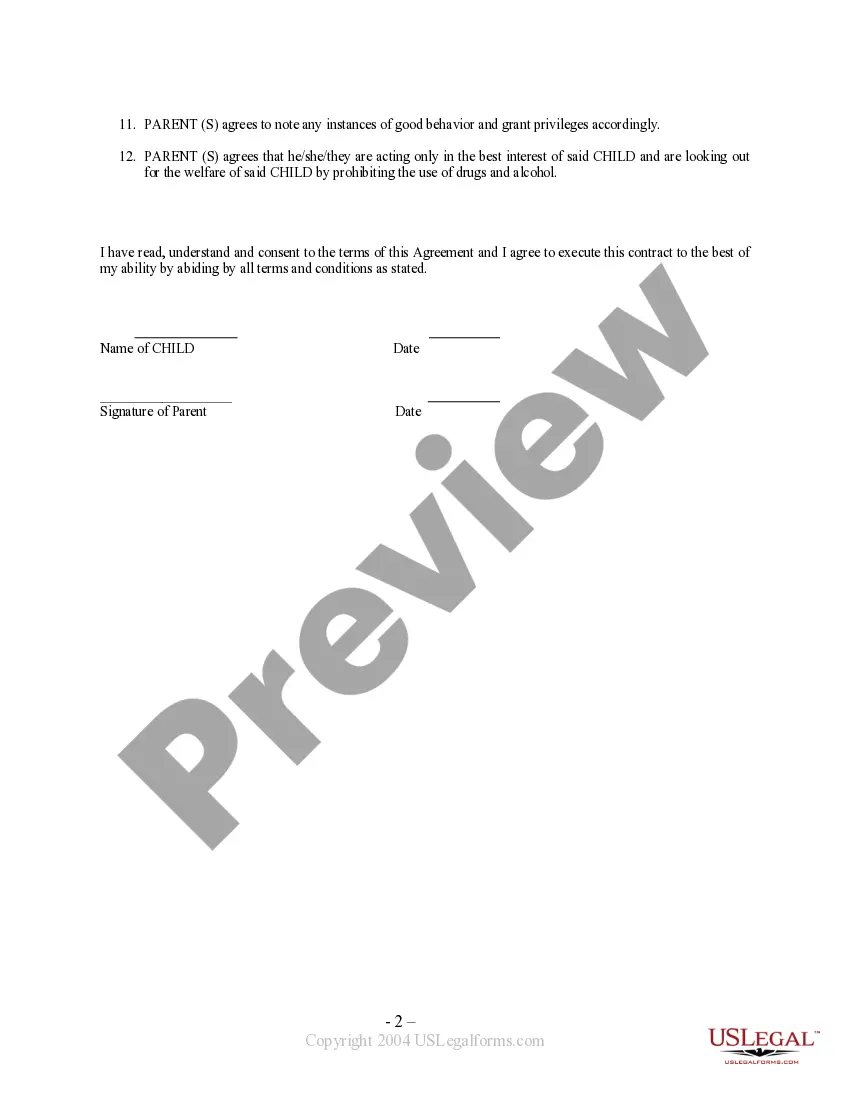
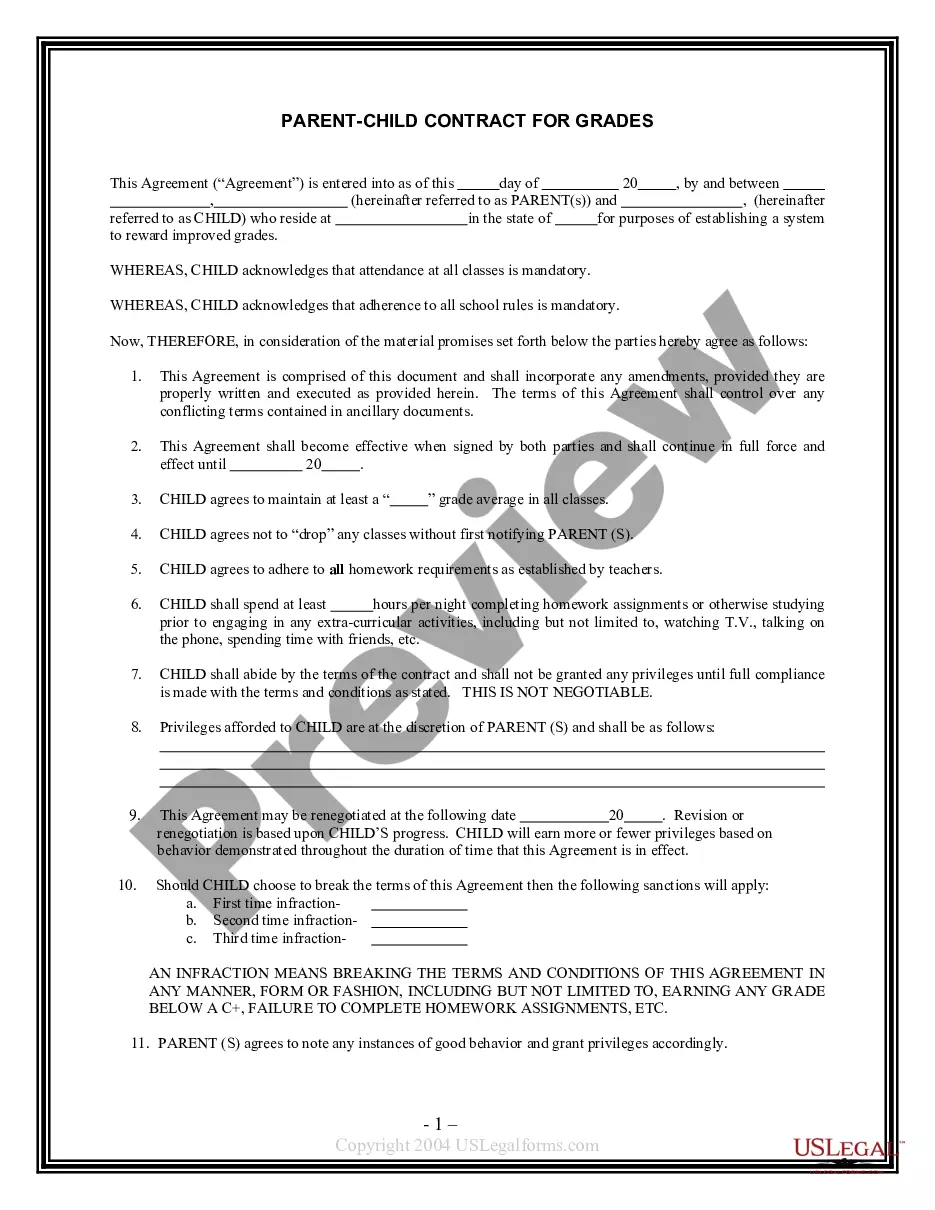
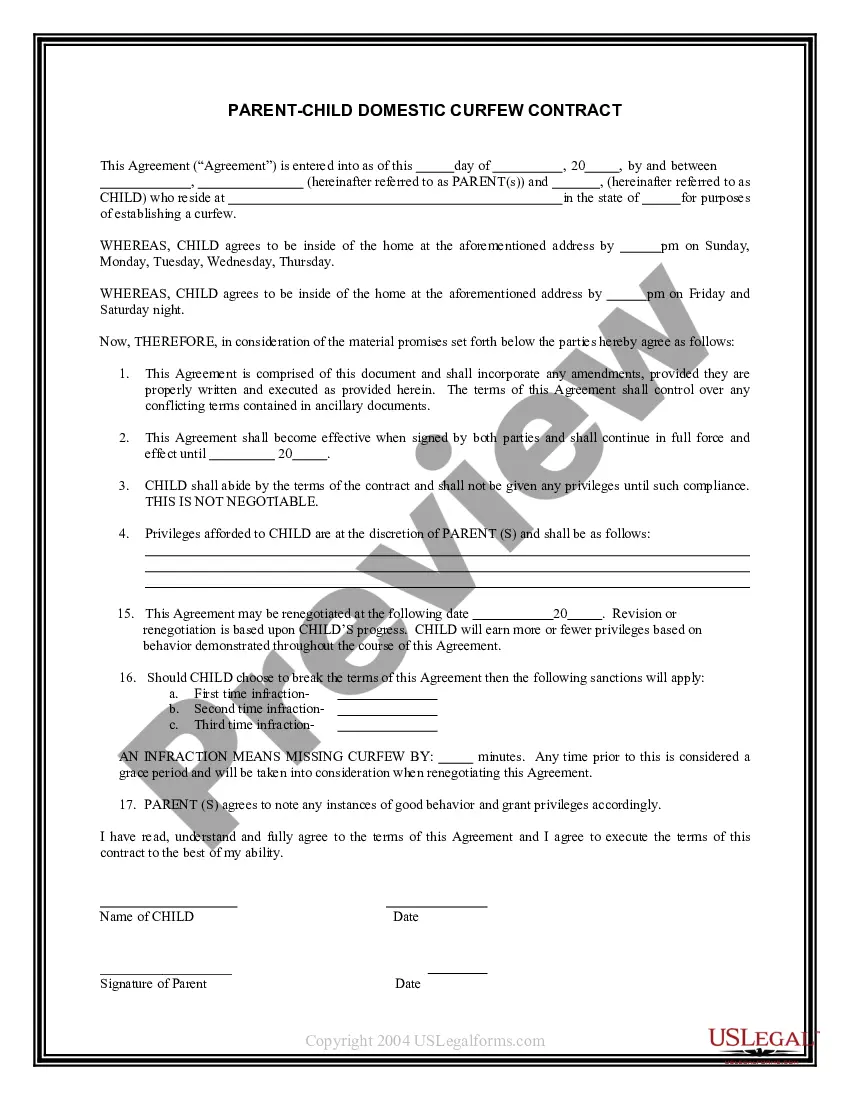
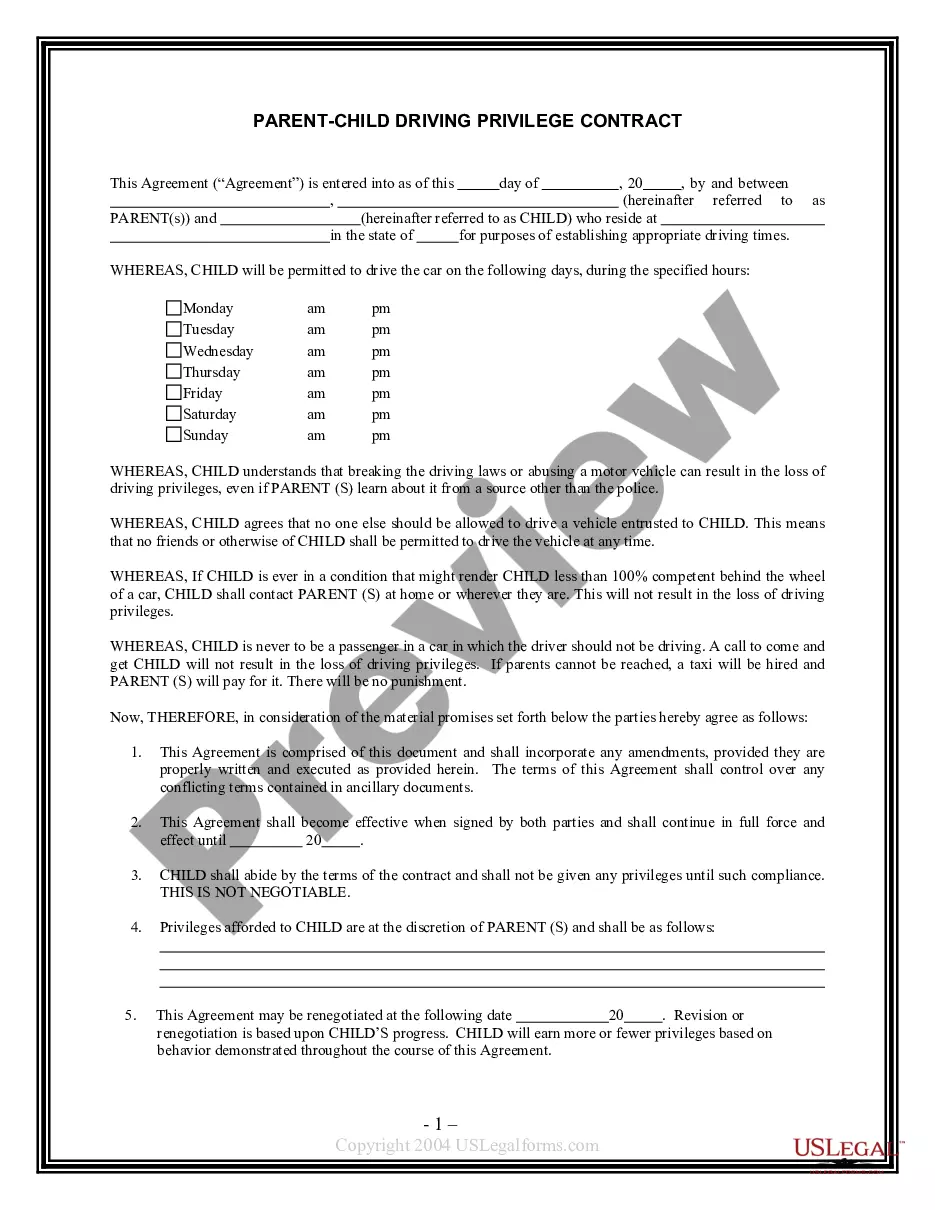
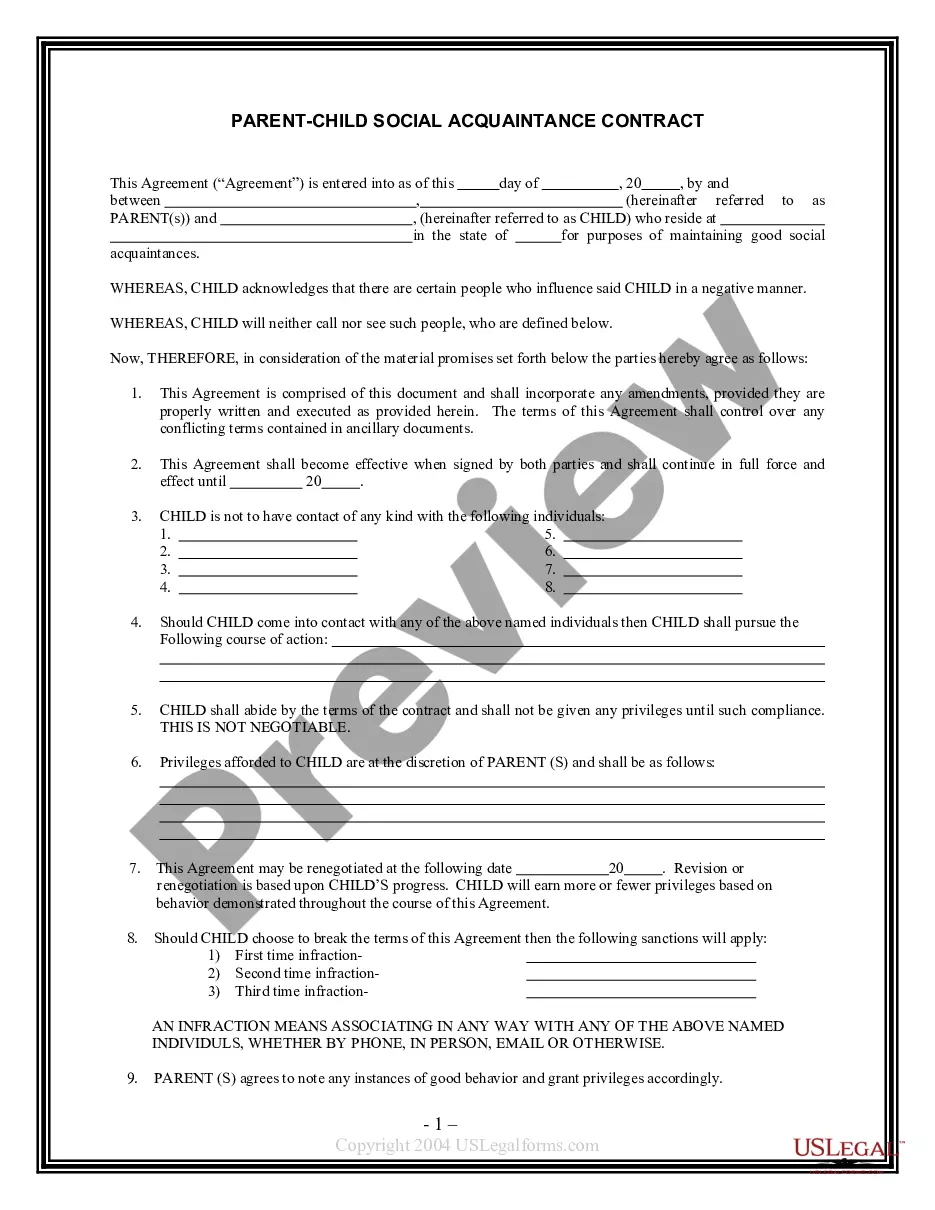
This is a contract between parent(s) and child regarding the use of drugs and alcohol and the repercussions for failing to abide by the terms as indicated. Child is also afforded certain privileges for good behavior as agreed upon by the parents.
Wisconsin Parent - Child Contract For Alcohol And Drug Awareness
Category:
State:
Multi-State
Control #:
US-PC02
Format:
Word;
Rich Text
Instant download
Description
Free preview




How to fill out Parent - Child Contract For Alcohol And Drug Awareness?
If you desire to complete, obtain, or print legal document templates, utilize US Legal Forms, the largest collection of legal forms available online.
Take advantage of the site's straightforward and user-friendly search function to find the documents you require.
Various templates for business and personal purposes are organized by categories and states, or keywords.
Step 4. Once you have located the form you want, click the Purchase now button. Choose the pricing plan you prefer and enter your details to register for an account.
Step 5. Complete the payment. You can use your Visa or MasterCard or PayPal account to finalize the transaction.
- Use US Legal Forms to find the Wisconsin Parent - Child Agreement For Alcohol And Drug Awareness in just a few clicks.
- If you are already a US Legal Forms member, Log In to your account and click the Download button to acquire the Wisconsin Parent - Child Agreement For Alcohol And Drug Awareness.
- You can also access forms you previously downloaded from the My documents section of your account.
- If you are using US Legal Forms for the first time, follow the steps below.
- Step 1. Ensure you have selected the form for the correct city/state.
- Step 2. Utilize the Preview option to review the form's content. Remember to check the summary.
- Step 3. If you are not pleased with the form, use the Search bar at the top of the screen to find other forms of the legal type template.
Form popularity
FAQ
To prove alcoholism in a custody case, gather evidence such as witness statements, records from treatment programs, and any relevant documentation of behavior changes. Courts may consider how the parent's alcohol use affects their ability to care for the child. By implementing a Wisconsin Parent - Child Contract For Alcohol And Drug Awareness, you can show your commitment to overcoming challenges related to alcohol, strengthening your position in custody matters.
Experts recommend starting conversations about drugs as early as elementary school, as children are curious and often encounter peer pressure. Initiating these discussions early allows you to establish a foundation of trust and education. A Wisconsin Parent - Child Contract For Alcohol And Drug Awareness can serve as a great tool to guide these conversations and reinforce the importance of making safe choices.
An AODA assessment, or Alcohol and Other Drug Abuse assessment, is a process to evaluate an individual's substance use and its impact on their life. In Wisconsin, this assessment can be crucial in legal matters, especially in custody cases. Utilizing a Wisconsin Parent - Child Contract For Alcohol And Drug Awareness may provide a proactive approach to addressing any substance-related issues that arise during the assessment.
A court typically views toxic co-parenting negatively, as it can harm the child's well-being and development. Courts prefer parents who can communicate and collaborate effectively for their child's sake. By establishing a Wisconsin Parent - Child Contract For Alcohol And Drug Awareness, you can illustrate your commitment to a positive co-parenting relationship, thereby enhancing your case.
The biggest mistake in a custody battle often involves failing to prioritize the child's best interests. Parents may focus too much on winning or use the child as a pawn, which can backfire in court. Implementing a Wisconsin Parent - Child Contract For Alcohol And Drug Awareness can demonstrate your dedication to fostering a healthy environment for your child during this challenging time.
To prove alcoholism in court, you must present evidence demonstrating a pattern of behavior linked to alcohol dependence. This may include medical records, testimony from family or friends, and documentation of treatment programs. Utilizing a Wisconsin Parent - Child Contract For Alcohol And Drug Awareness can support your case by showing your commitment to addressing alcohol issues responsibly.
Children with parents who use substances are at an increased risk for child maltreatment. Drugs and alcohol inhibit a parent's ability to function in a parental role and may lessen impulse control, allowing parents to behave abusively.
Substance abuse, as a recognized medical brain disorder, refers to the abuse of illegal substances, such as marijuana, heroin, cocaine, or methamphetamine. Or it may be the abuse of legal substances, such as alcohol, nicotine, or prescription medicines. Alcohol is the most common legal drug of abuse.
Contact your local child protective services office or law enforcement agency. Provides information on the Childhelp National Child Abuse Hotline (Call or text 1.800.
care professional who, after a routine newborn physical assessment of a newborn infant's health status or following notification of positive toxicology screens of a newborn infant, reasonably believes that the newborn infant may be affected by the presence of alcohol or a drug listed in § 133401 shall