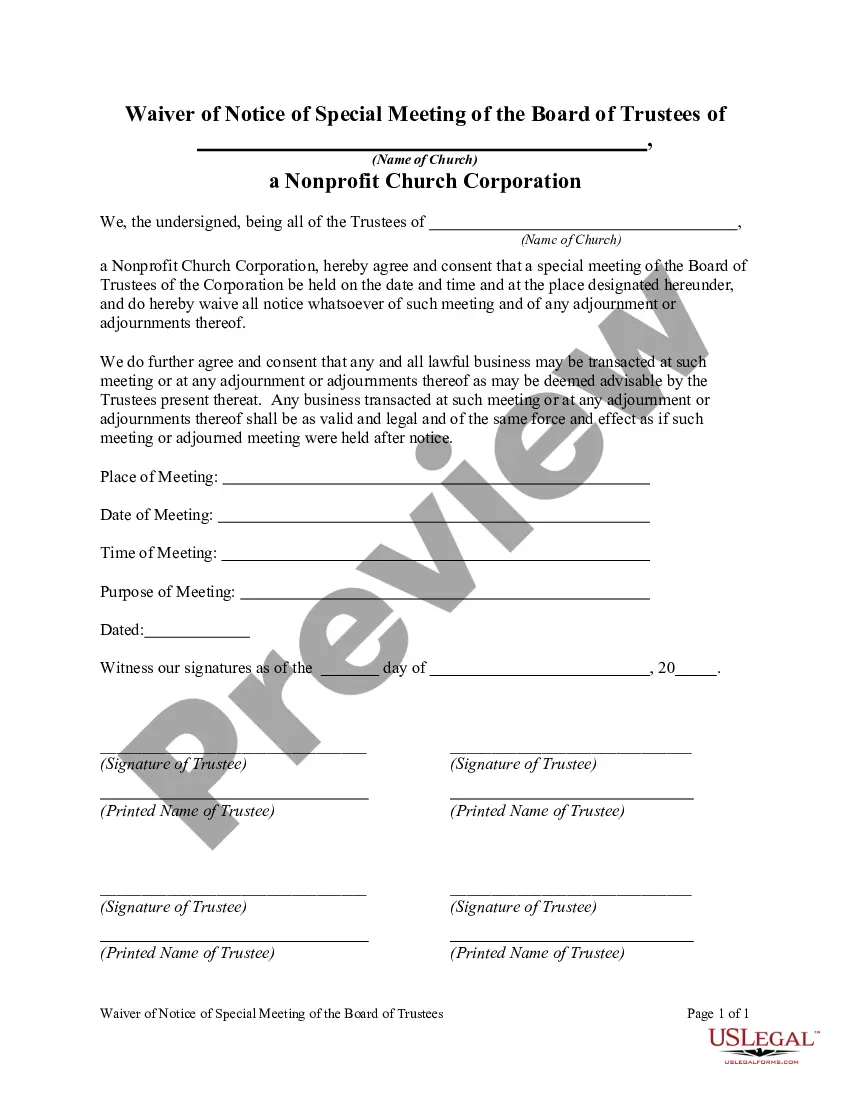
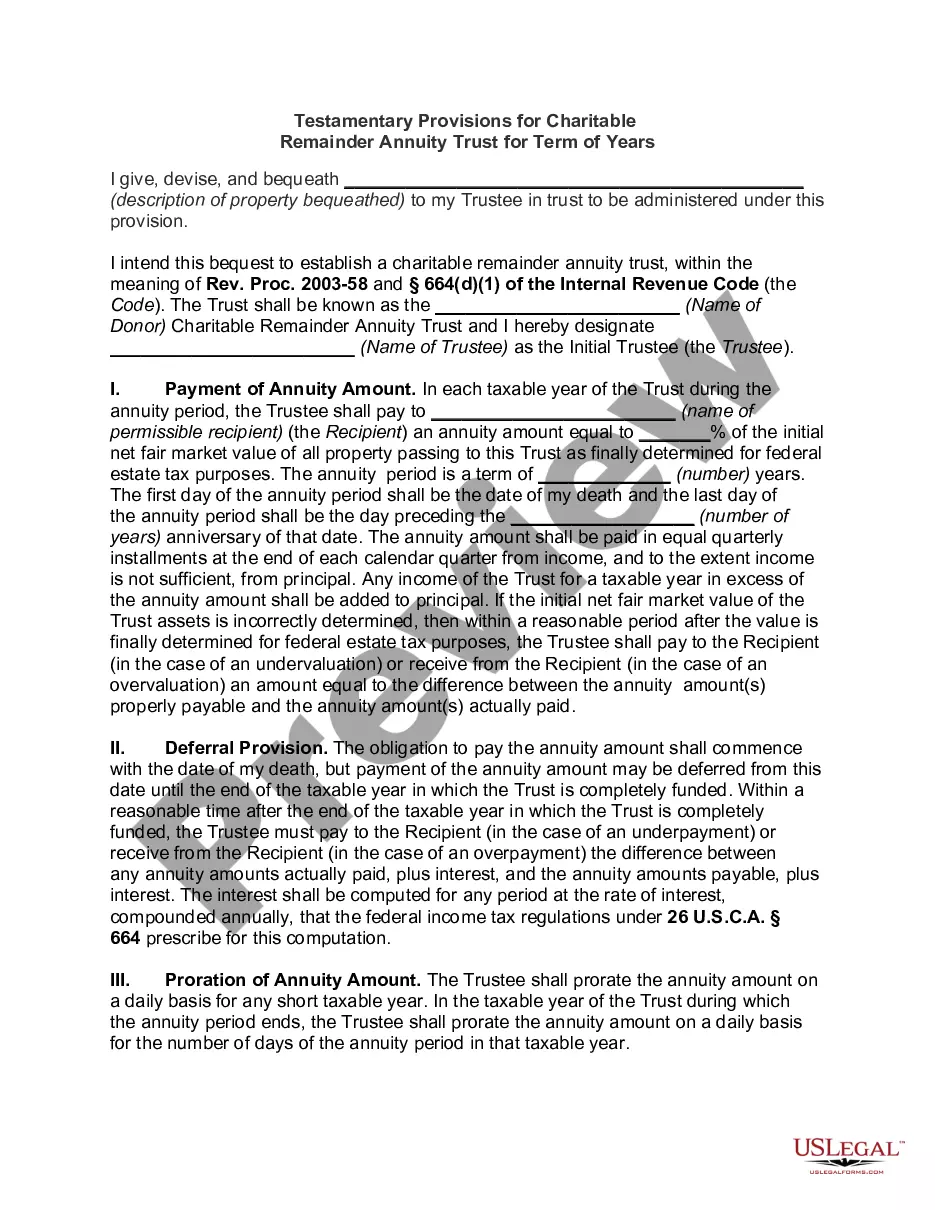
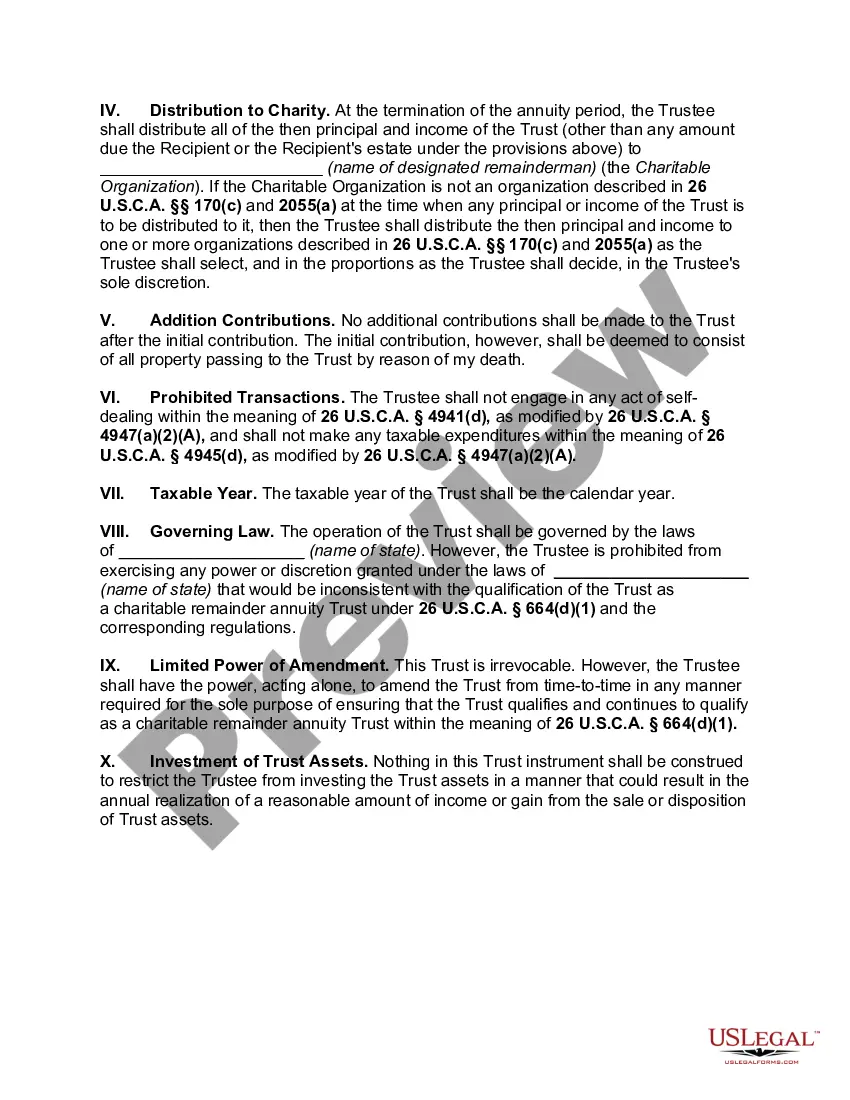
West Virginia Testamentary Provisions for Charitable Remainder Annuity Trust for Term of Years
Description
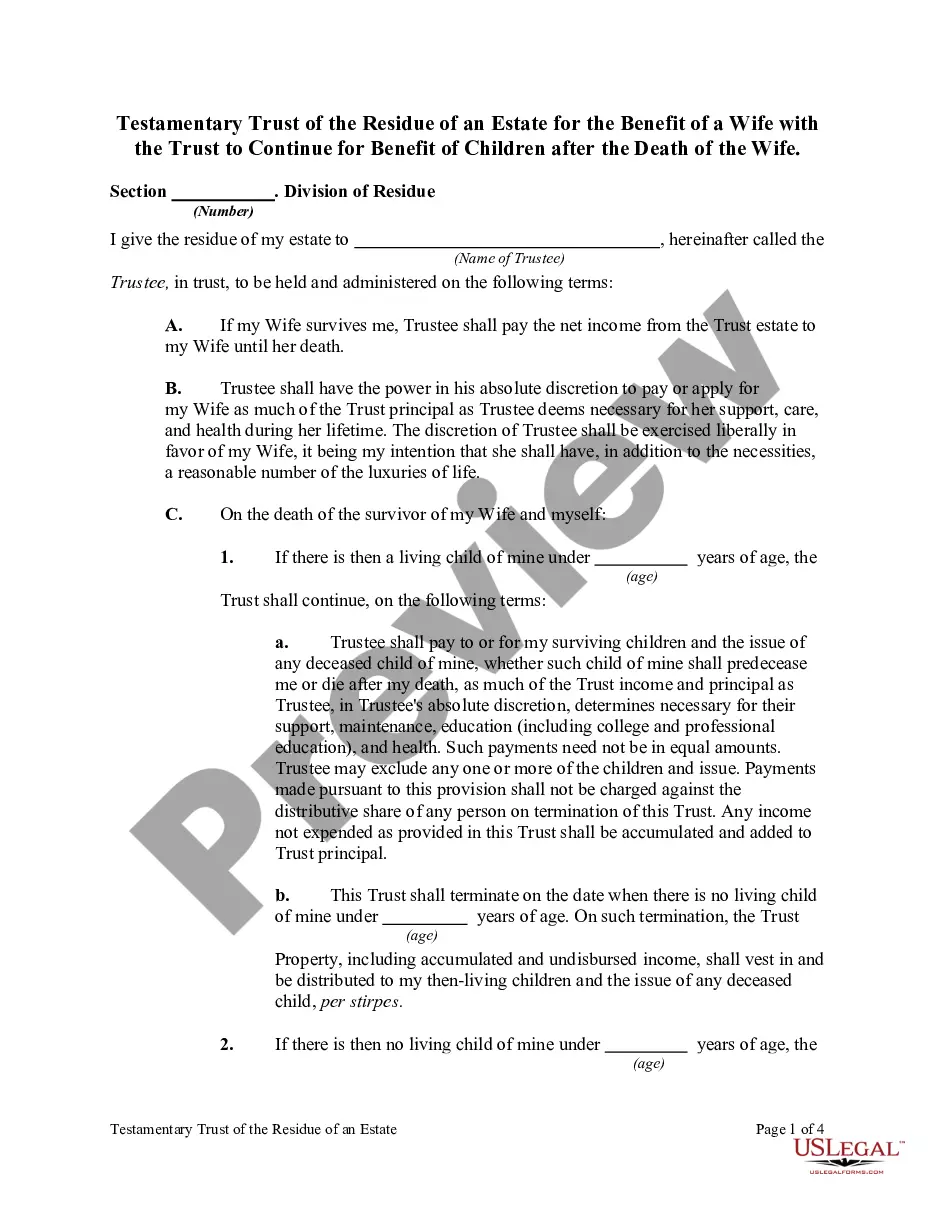
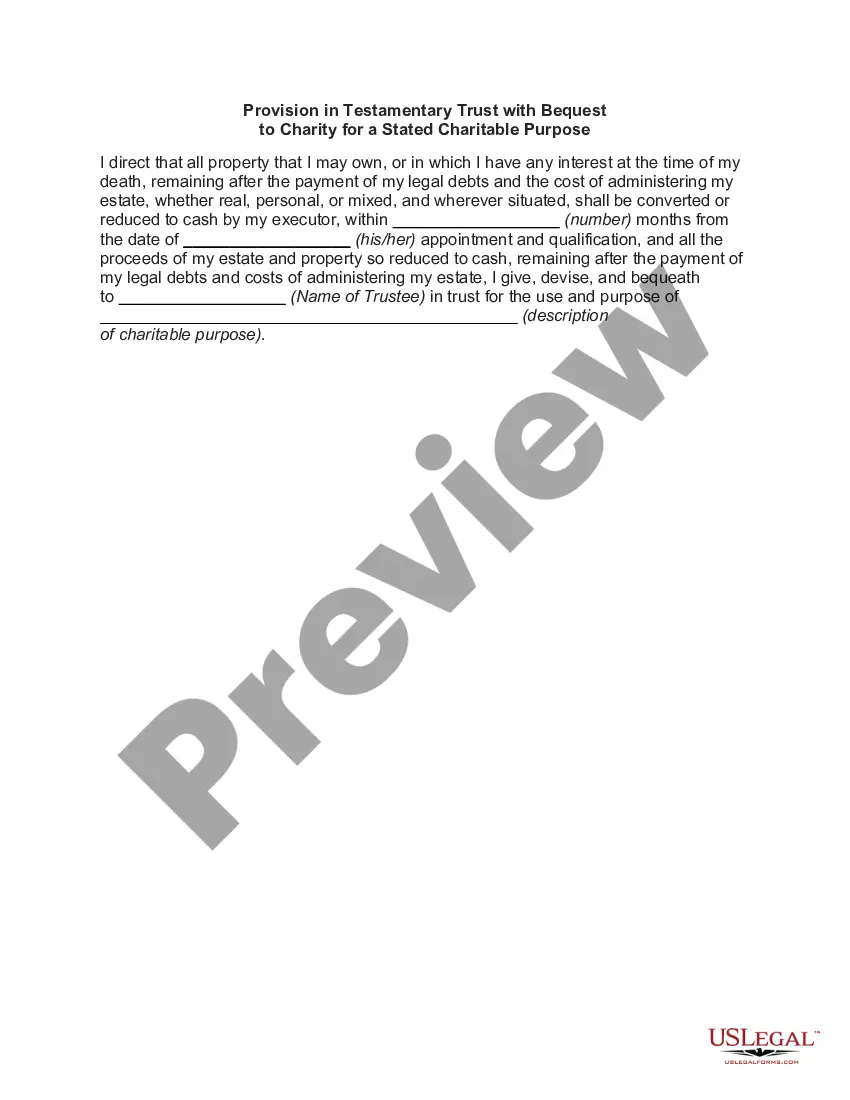
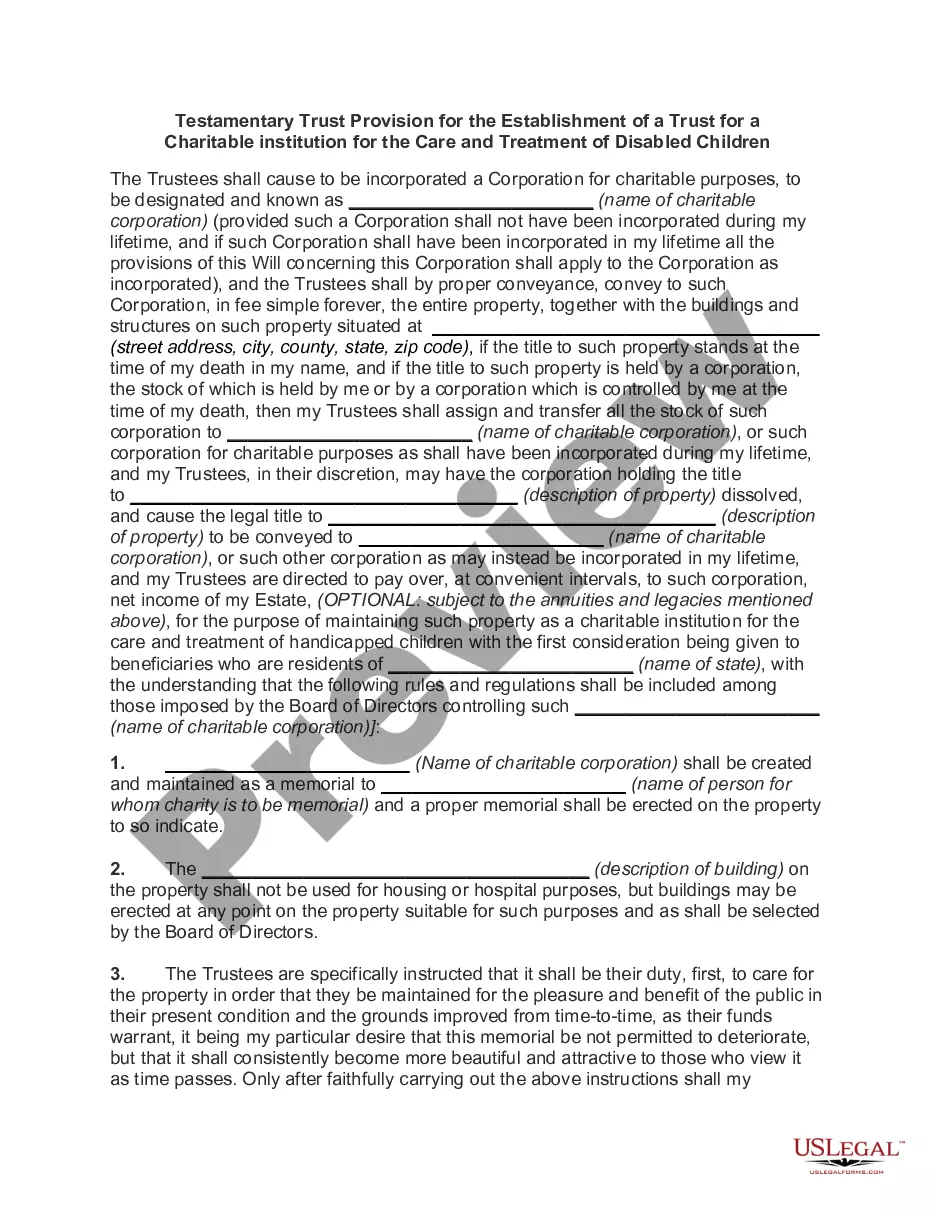
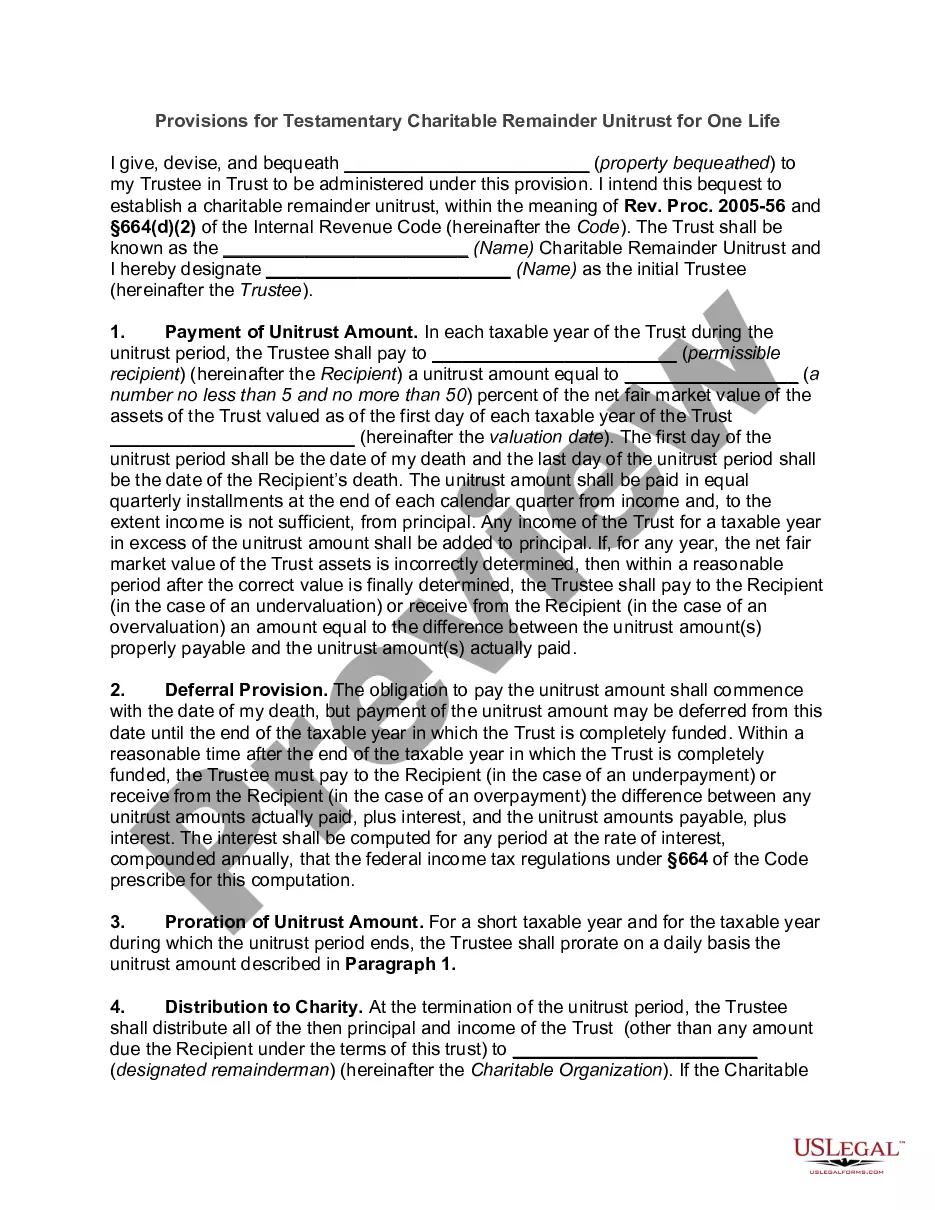
Get your form ready online
Our built-in tools help you complete, sign, share, and store your documents in one place.
Make edits, fill in missing information, and update formatting in US Legal Forms—just like you would in MS Word.
Download a copy, print it, send it by email, or mail it via USPS—whatever works best for your next step.
Sign and collect signatures with our SignNow integration. Send to multiple recipients, set reminders, and more. Go Premium to unlock E-Sign.
If this form requires notarization, complete it online through a secure video call—no need to meet a notary in person or wait for an appointment.
We protect your documents and personal data by following strict security and privacy standards.
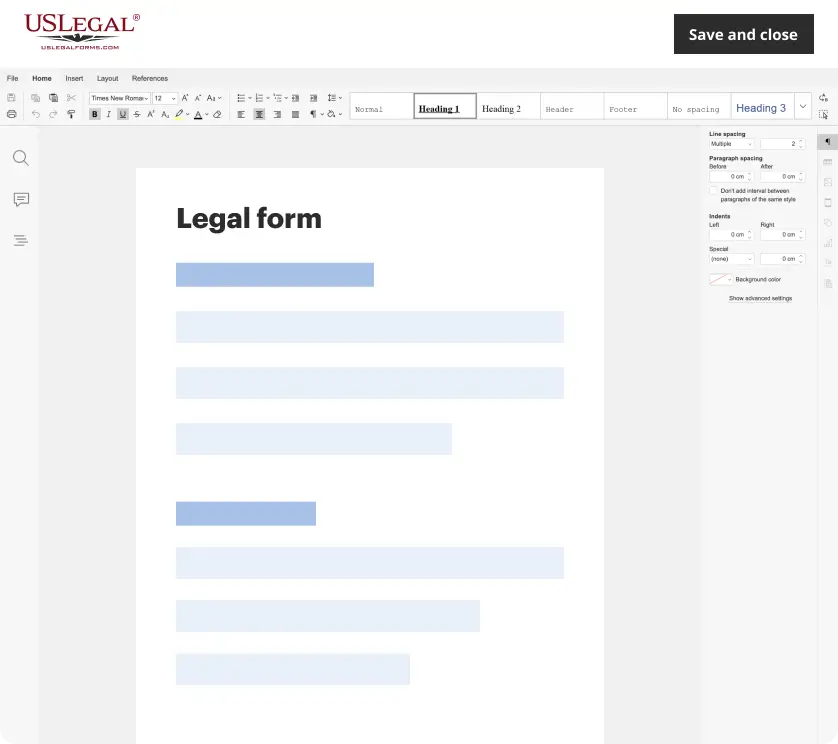
Make edits, fill in missing information, and update formatting in US Legal Forms—just like you would in MS Word.
Download a copy, print it, send it by email, or mail it via USPS—whatever works best for your next step.
Sign and collect signatures with our SignNow integration. Send to multiple recipients, set reminders, and more. Go Premium to unlock E-Sign.

If this form requires notarization, complete it online through a secure video call—no need to meet a notary in person or wait for an appointment.

We protect your documents and personal data by following strict security and privacy standards.
Looking for another form?
How to fill out Testamentary Provisions For Charitable Remainder Annuity Trust For Term Of Years?
If you wish to complete, acquire, or print official document templates, use US Legal Forms, the largest collection of legal forms, available online.
Utilize the site`s straightforward and user-friendly search to locate the documents you need.
A selection of templates for business and personal purposes are categorized by types and states, or keywords.
Step 4. Once you have found the form you desire, click on the Get now button. Choose the payment plan you prefer and enter your information to register for an account.
Step 5. Complete the purchase. You can use your Visa or MasterCard or PayPal account to finalize the transaction.
- Employ US Legal Forms to locate the West Virginia Testamentary Provisions for Charitable Remainder Annuity Trust for Term of Years in just a few clicks.
- If you are already a customer of US Legal Forms, sign in to your account and click the Obtain button to locate the West Virginia Testamentary Provisions for Charitable Remainder Annuity Trust for Term of Years.
- You may also access forms previously saved in the My documents section of your account.
- If you are using US Legal Forms for the first time, follow these steps.
- Step 1. Ensure you have selected the form for your correct city/state.
- Step 2. Use the Preview option to review the form`s details. Be sure to read through the description.
- Step 3. If you are not satisfied with the form, use the Search field at the top of the screen to find other versions of the legal form template.
Form popularity
FAQ
All trusts are required to contain at least the following elements:Trusts must identify the grantor, trustee and beneficiary. The grantor and trustee must be identified because they are parties to the contract.The trust res must be identified.The trust must contain the signature of both the grantor and the trustee.
Unitrust payouts are taxable. With a CRT, the donor must pay tax on the income stream, which is categorized into four tiers: (1) Ordinary income and qualified dividends, (2) capital gains (short-term, personal property, depreciation, long-term gain), (3) other tax-exempt income; and (4) return of principal.
How to Set up a Charitable Remainder TrustCreate a Charitable Remainder Trust.Check with the IRS that the charity you want to benefit is approved.Transfer assets into the Trust.Name the charity as Trustee.Create a provision that states who the lead beneficiary is - remember, this can be yourself or someone else.More items...
A will typically contains provision for the distribution of a testator's deceased estate after their death. There are some instances where a testator might choose to create a testamentary trust instead of bequeathing an asset directly to a beneficiary.
Unitrust payouts are taxable. With a CRT, the donor must pay tax on the income stream, which is categorized into four tiers: (1) Ordinary income and qualified dividends, (2) capital gains (short-term, personal property, depreciation, long-term gain), (3) other tax-exempt income; and (4) return of principal.
A testamentary trust is a trust contained in a last will and testament. It provides for the distribution of all or part of an estate and often proceeds from a life insurance policy held on the person establishing the trust. There may be more than one testamentary trust per will.
Testamentary Trusts are created under a Will and therefore come into effect only after the death of the person who made the Will, the testator....The types of assets held in a Testamentary TrustInvestments;Land or property;Cash; and.Other valuable assets, including paintings, furniture and jewelleries.
Generally, the charitable deduction for contributions to a CRT with a public charity as its remainder beneficiary is limited to 50% of adjusted gross income (AGI).
Living trusts and testamentary trustsA living trust (sometimes called an inter vivos trust) is one created by the grantor during his or her lifetime, while a testamentary trust is a trust created by the grantor's will.
One of the drawbacks of a testamentary trust is the considerable responsibility it puts on the trustee. He must meet regularly with the probate court to demonstrate his safe handling of the trust, and depending on your wishes, his tasks may go on for many years.