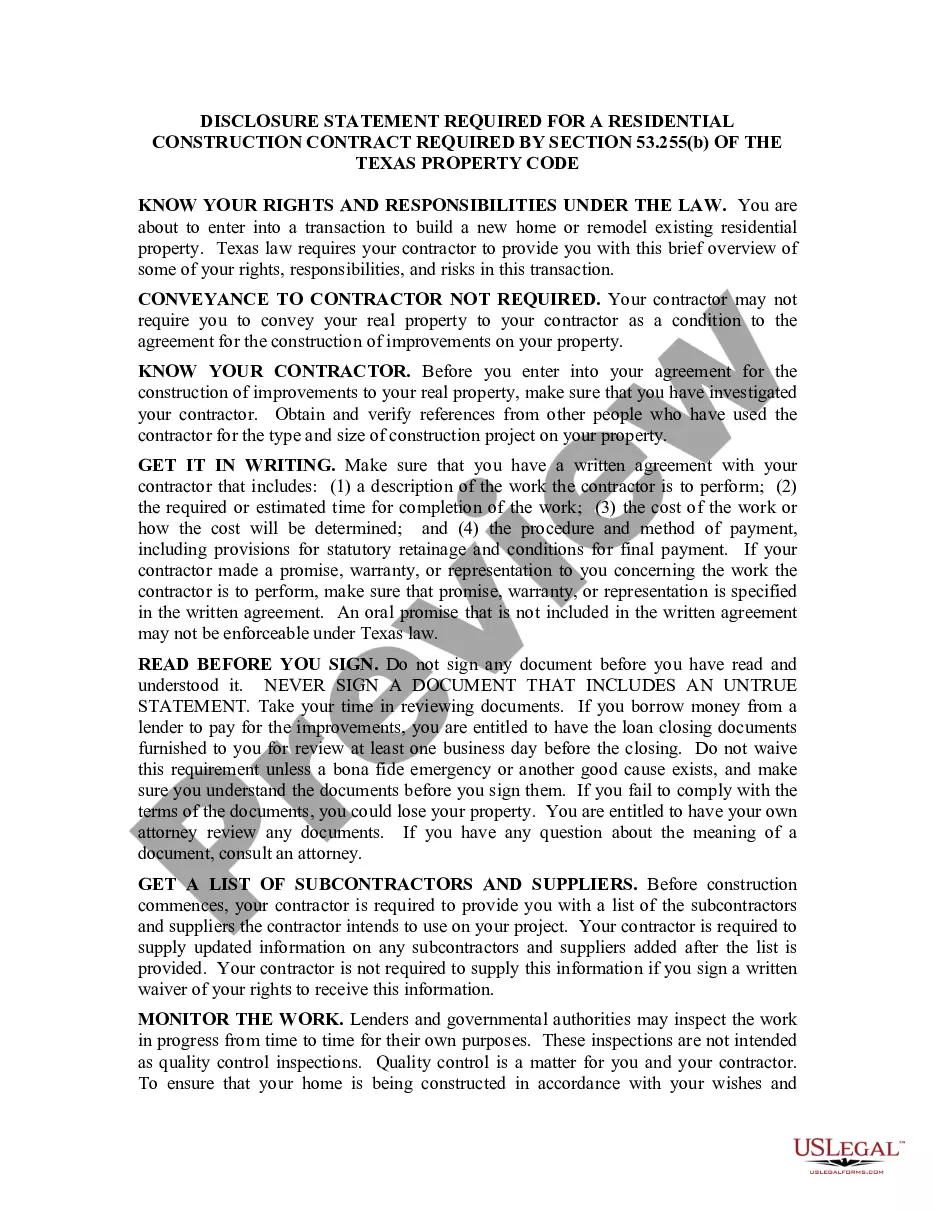
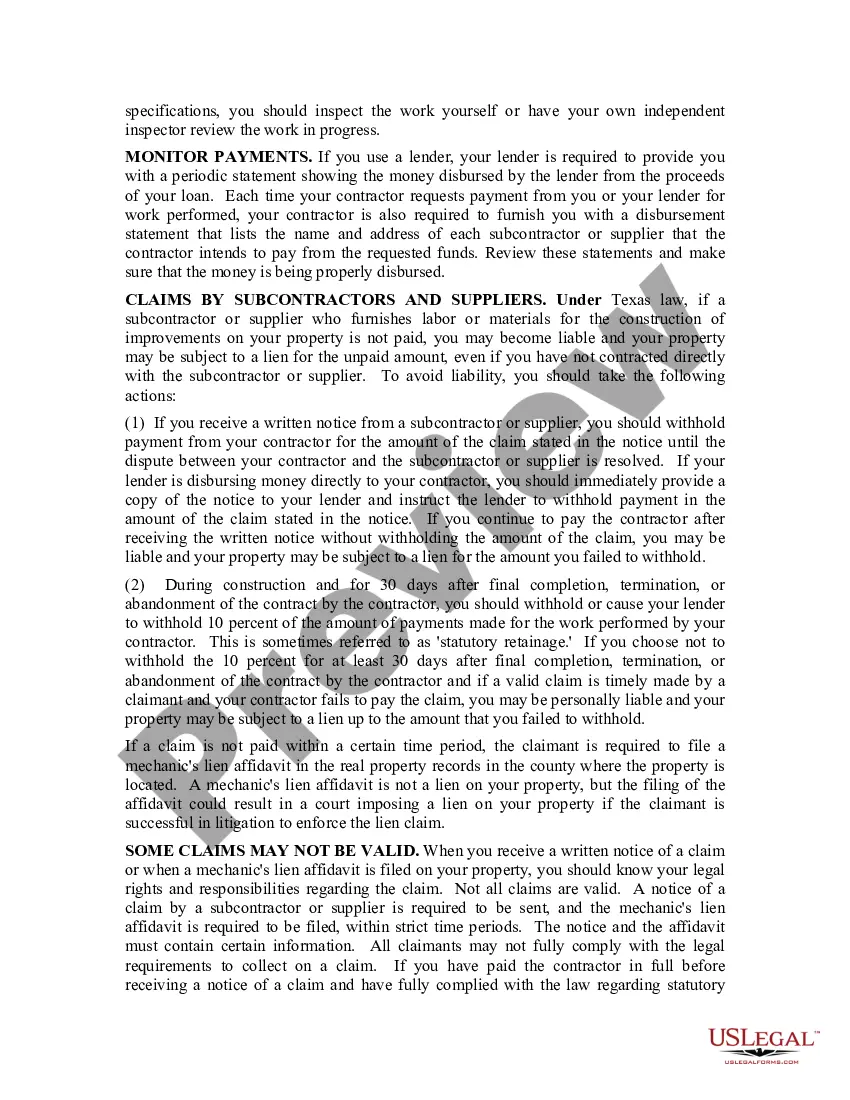
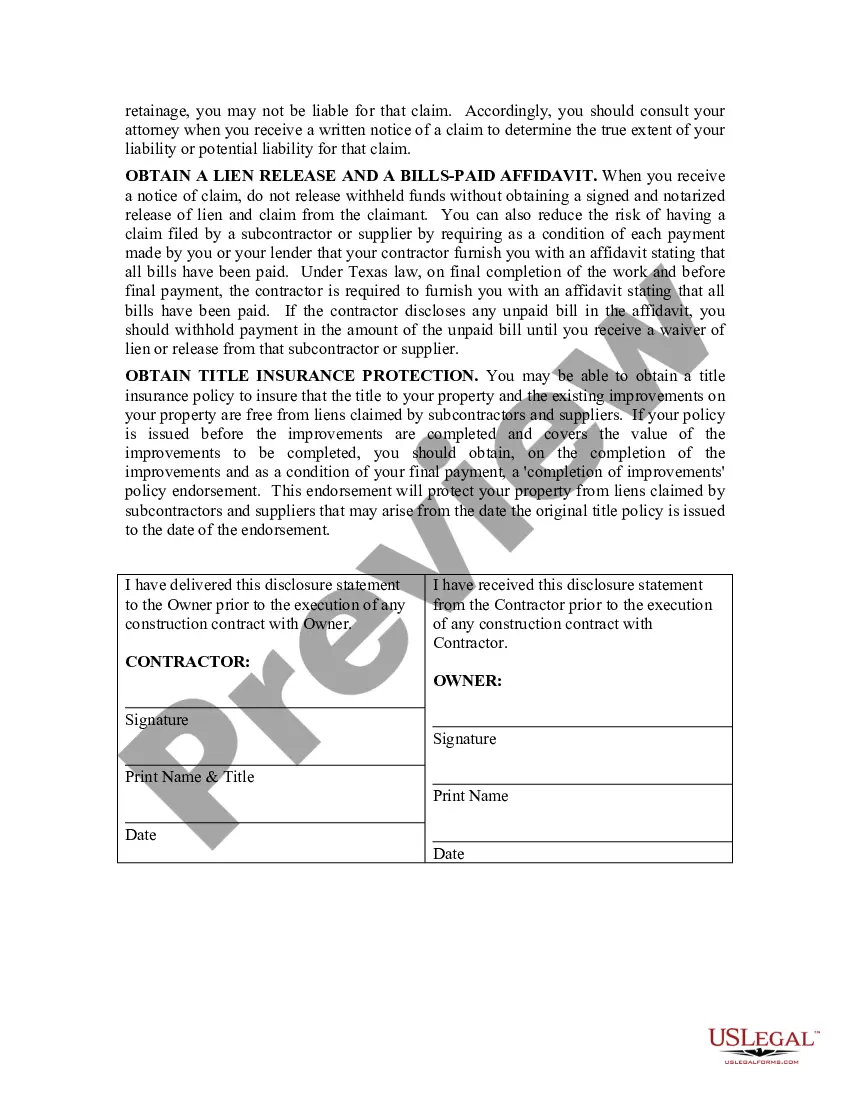
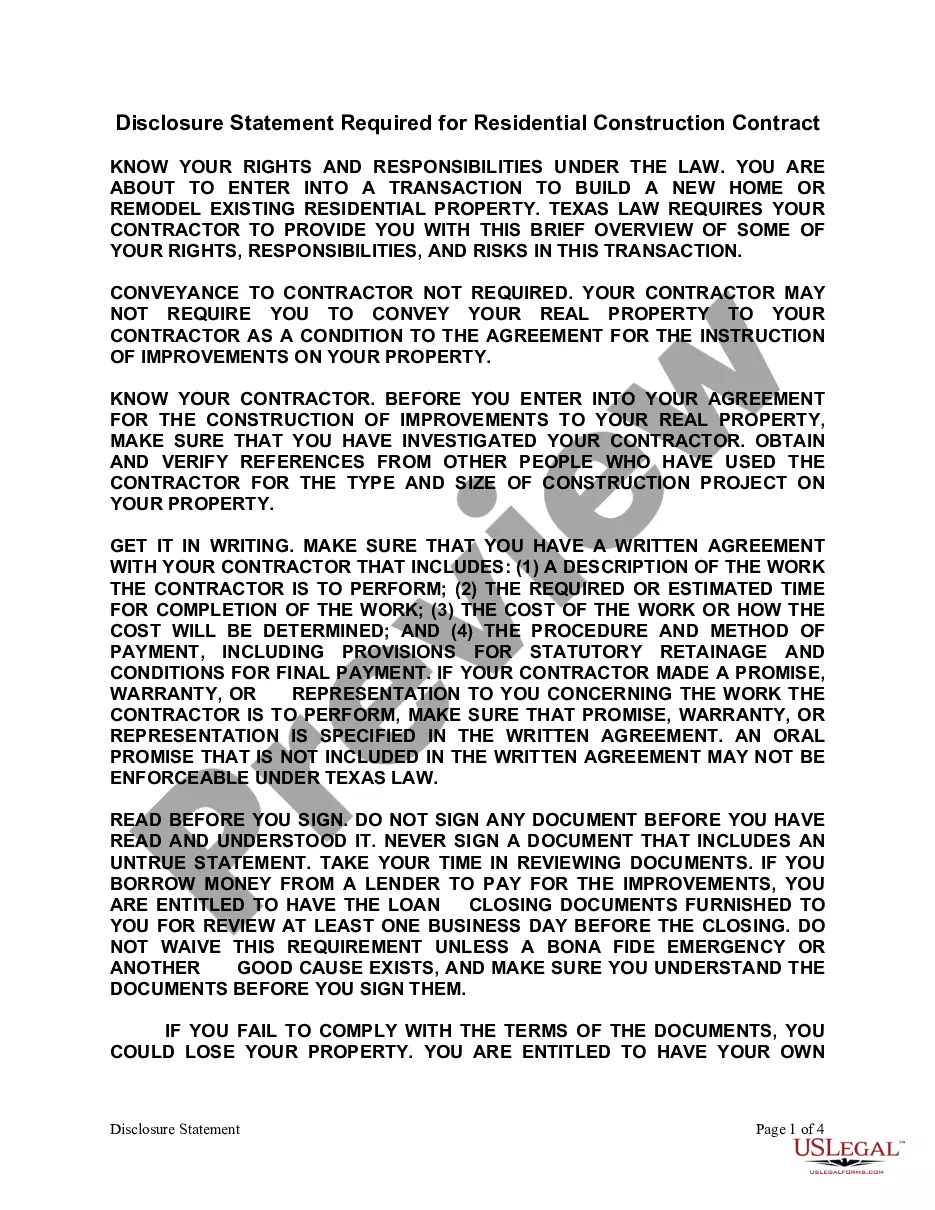
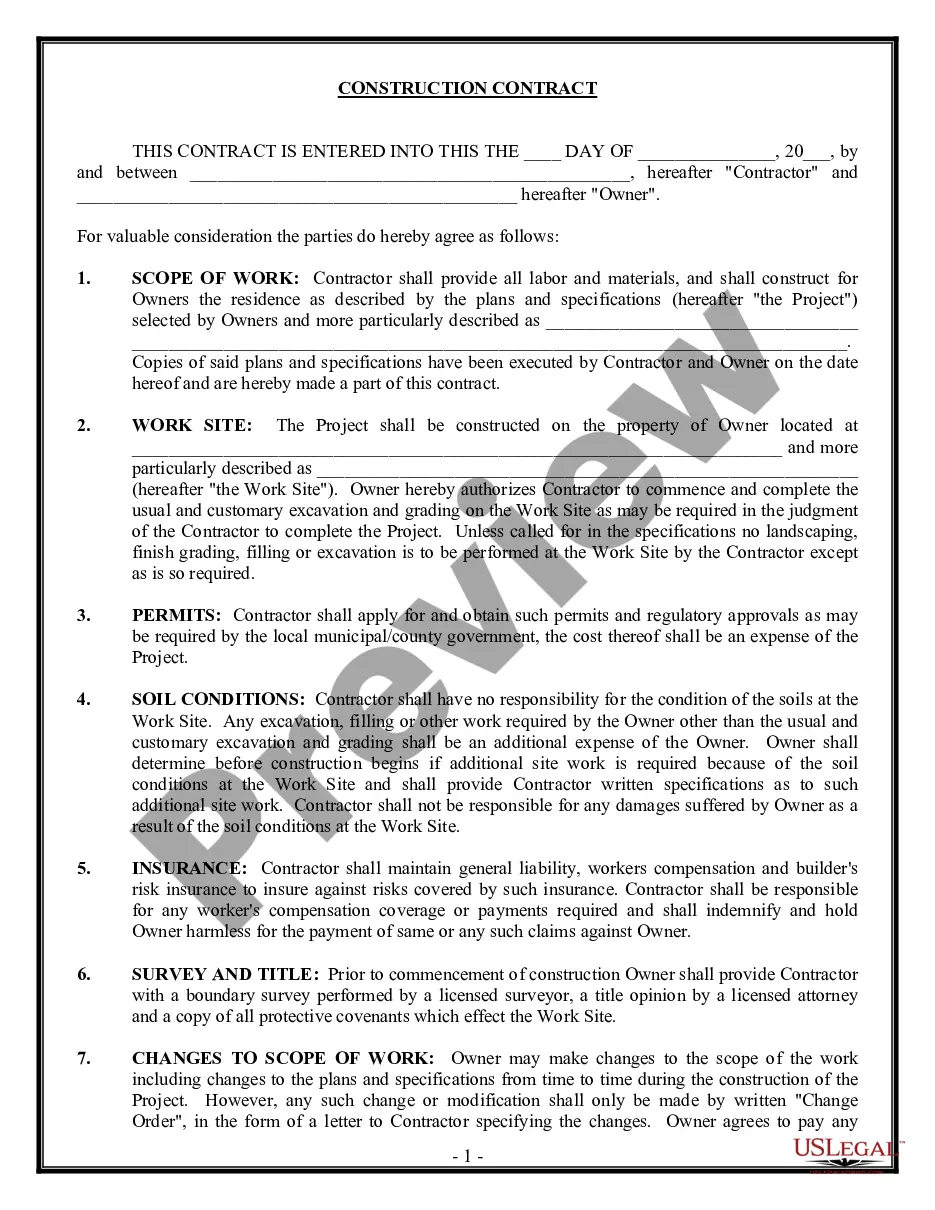
"Disclosure Statement Required for a Residential Construction Contract" is required and to be used for any residential construction contract required by the Texas Property Code 53.255(b).
Austin Texas Disclosure Statement Required for a Residential Construction Contract
50 downloads
Description
Free preview
Get your form ready online
Our built-in tools help you complete, sign, share, and store your documents in one place.
Built-in online Word editor
Make edits, fill in missing information, and update formatting in US Legal Forms—just like you would in MS Word.
Export easily
Download a copy, print it, send it by email, or mail it via USPS—whatever works best for your next step.
E-sign your document
Sign and collect signatures with our SignNow integration. Send to multiple recipients, set reminders, and more. Go Premium to unlock E-Sign.
Notarize online 24/7
If this form requires notarization, complete it online through a secure video call—no need to meet a notary in person or wait for an appointment.
Store your document securely
We protect your documents and personal data by following strict security and privacy standards.

Make edits, fill in missing information, and update formatting in US Legal Forms—just like you would in MS Word.

Download a copy, print it, send it by email, or mail it via USPS—whatever works best for your next step.

Sign and collect signatures with our SignNow integration. Send to multiple recipients, set reminders, and more. Go Premium to unlock E-Sign.

If this form requires notarization, complete it online through a secure video call—no need to meet a notary in person or wait for an appointment.

We protect your documents and personal data by following strict security and privacy standards.
Looking for another form?



How to fill out Texas Disclosure Statement Required For A Residential Construction Contract?
Regardless of one's societal or occupational position, completing legal paperwork is a regrettable requirement in the modern world.
Often, it’s nearly unfeasible for someone lacking any legal background to create these kinds of documents from the ground up, primarily due to the complex terminology and legal nuances involved.
This is where US Legal Forms steps in to assist.
Ensure that the form you’ve located is valid for your area as the regulations of one region do not apply to another.
Examine the form and, if available, review a brief summary of situations for which the document can be utilized.
- Our site provides an extensive catalog featuring over 85,000 ready-to-use state-specific forms that cater to nearly every legal situation.
- US Legal Forms is also an outstanding tool for paralegals or legal advisors who wish to enhance their efficiency by using our DIY templates.
- Regardless of whether you require the Austin Texas Disclosure Statement Needed for a Residential Construction Contract or any other applicable document for your region, US Legal Forms puts everything at your disposal.
- Here’s how you can quickly obtain the Austin Texas Disclosure Statement Needed for a Residential Construction Contract in mere minutes using our dependable platform.
- If you're already a subscriber, you can proceed to Log In to your account and download the relevant form.
- However, if you’re new to our platform, please follow these instructions before acquiring the Austin Texas Disclosure Statement Needed for a Residential Construction Contract.
Form popularity
FAQ
What are the types of Construction Contracts? Lump Sum Contract. Cost Plus. Contract. Small Jobs. Contract. Large Jobs Contract.
In Washington, all contractors who perform work or who advertise or submit bids in this state must be registered with the Department of Labor & Industries (L&I), post a bond and carry general liability insurance coverage. A general contractor must maintain a $12,000 bond.
Federal government contracts are commonly divided into two main types, fixed-price and cost-reimbursement. Other contract types include incentive contracts, time-and-materials, labor-hour contracts, indefinite-delivery contracts, and letter contracts.
Disclosure statement contents information about any guarantees or warranties the contractor offers in relation to the building work ? they must specify the time period the guarantee or warranty is offered for and any limits or exclusions on coverage.
It provides full information on what is to be done, how and when it will be done, the cost and payments required, and the warranty provided. It clearly defines all aspects of the business relationship between you and your contractor in relation to the project. A good contract treats both parties fairly.
The eight types of construction contracts include: cost-plus construction contract. design and build contract. guaranteed maximum price contract. incentive construction contract. integrated project delivery contract. lump-sum contract. time and materials contract. unit price contract.
Some common kinds of construction documents include: Bidding documents. Architectural drawings. Schedules. Work orders. Safety reports. Certificates of insurance. Subcontractor applications.
Texas law obligates construction owners to withhold 10% of the value of the work during the course of a project and for 30 days after final completion. This is generally known as statutory retainage.
On design and build projects, the contract documents may comprise: The articles of agreement and conditions of contract. The employer's requirements. The contractor's proposals. The contract sum analysis. Possibly bills of quantities (for some or all of the design).