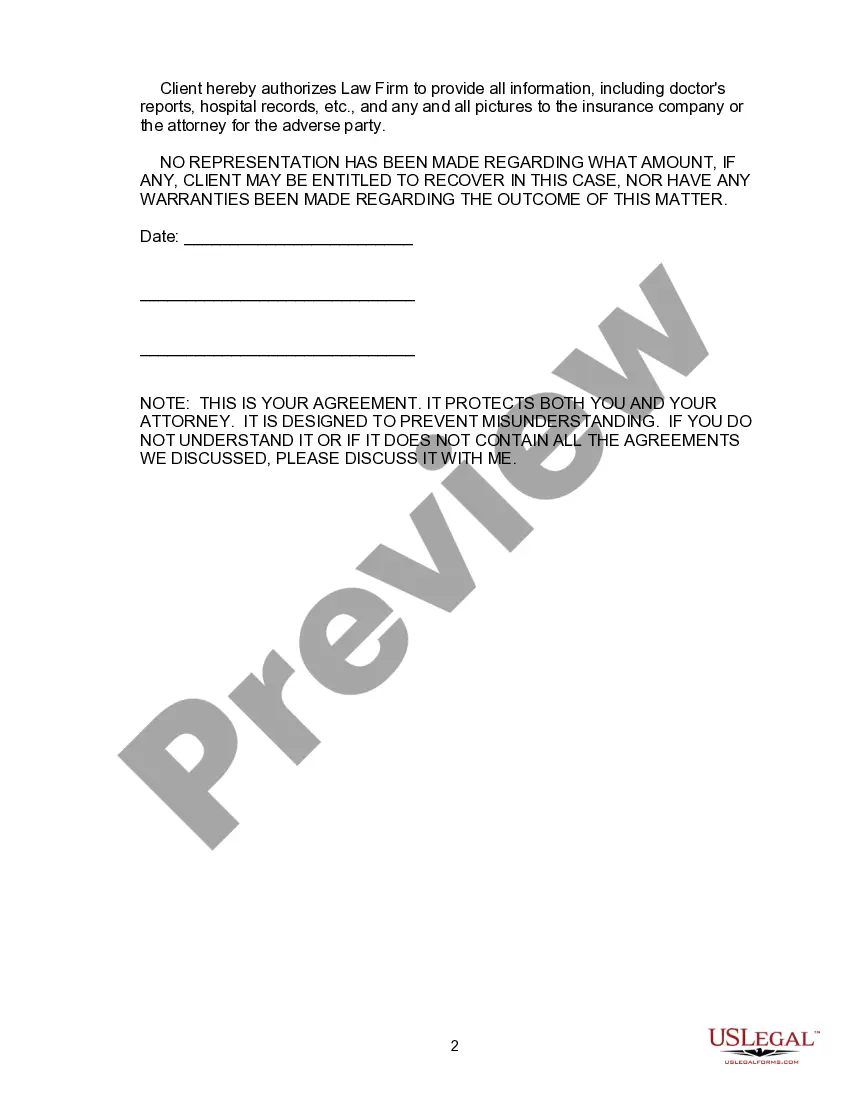
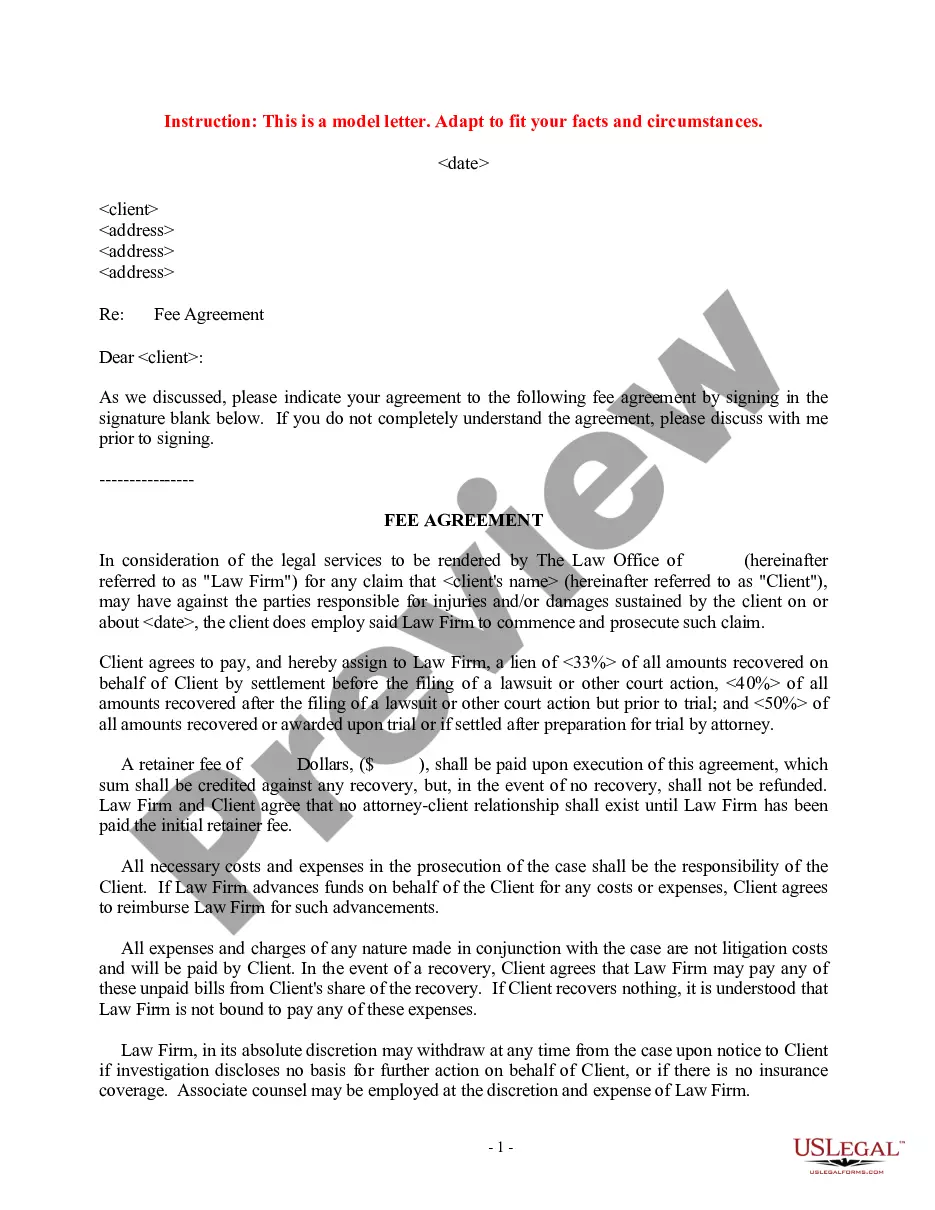
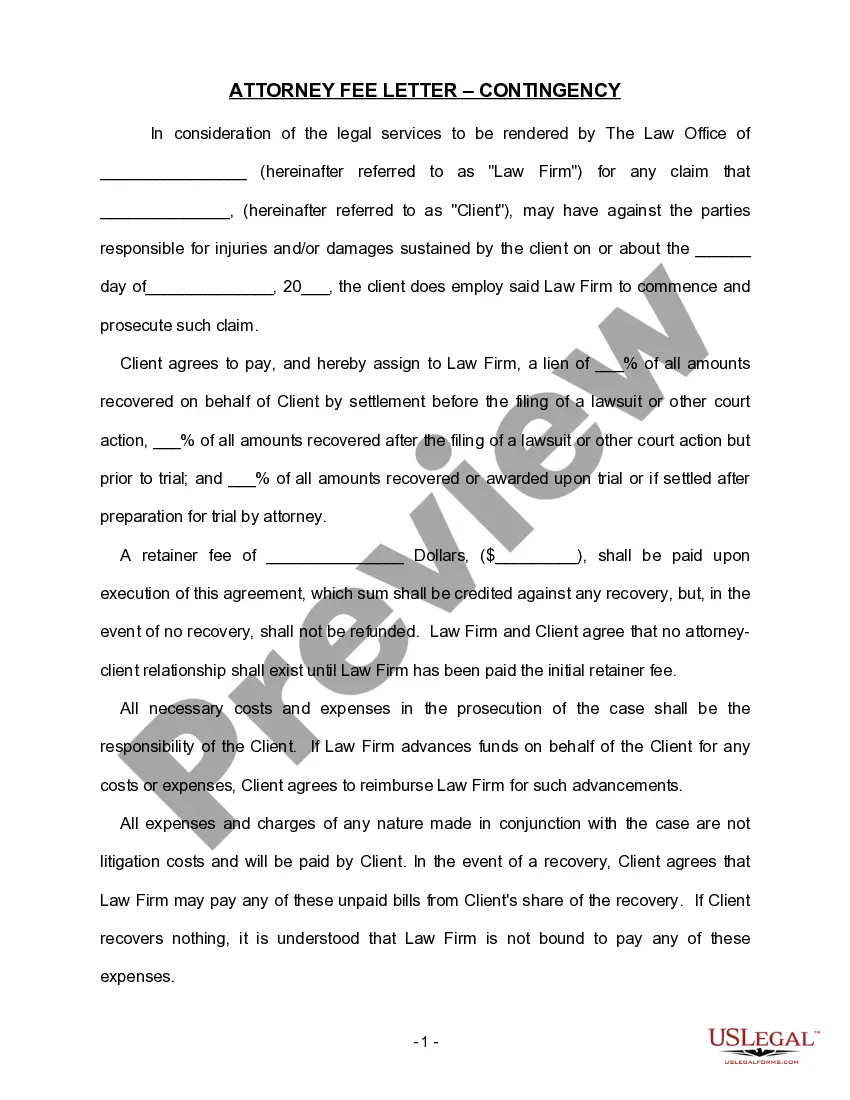
The attorney fee letter states that the client agrees to pay, and assign to the law firm prosecuting his/her claim, a lien of 33% of all amounts recovered on behalf of client by settlement before the filing of a lawsuit or other court action, 40% of all amounts recovered after the filing of a lawsuit or other court action but prior to trial; and 50% of all amounts recovered or awarded upon trial or if settled after preparation for trial by attorney.
Travis Texas Attorney Fee Letter - Contingency Agreement
Category:
State:
Multi-State
County:
Travis
Control #:
US-01193
Format:
Word;
Rich Text
Instant download
Description
Free preview


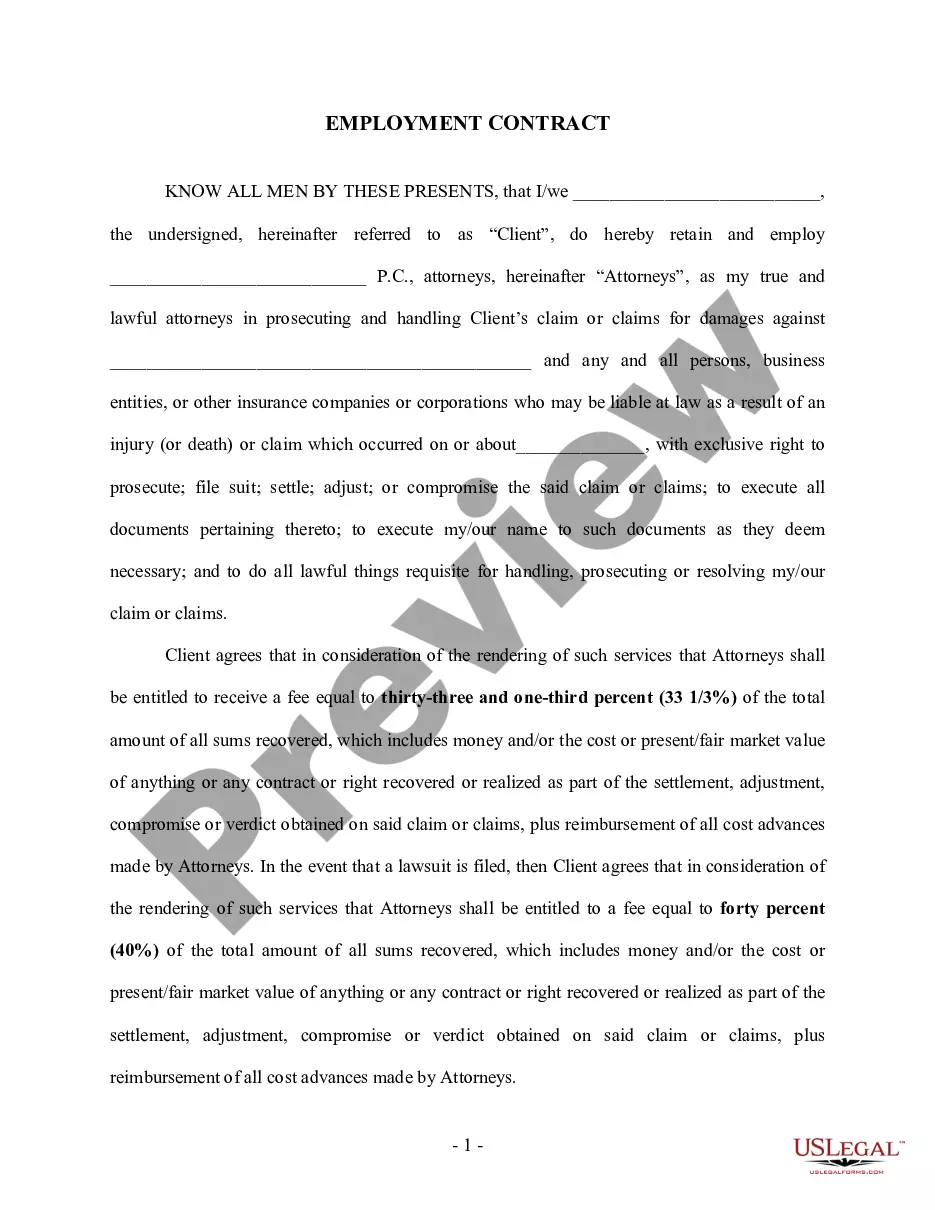

How to fill out Attorney Fee Letter - Contingency Agreement?
Managing legal documents is essential in the contemporary era. Nonetheless, it's not always necessary to seek expert assistance to develop some of them from scratch, including the Travis Attorney Fee Letter - Contingency Agreement, through a platform such as US Legal Forms.
US Legal Forms offers more than 85,000 templates to choose from across various categories, ranging from living wills to real estate documents to divorce agreements. All forms are organized according to their applicable state, simplifying the searching experience. Additionally, you can discover informational resources and guides on the site to streamline any processes associated with the completion of paperwork.
Here’s how you can acquire and download the Travis Attorney Fee Letter - Contingency Agreement.
If you are already a subscriber to US Legal Forms, you can locate the suitable Travis Attorney Fee Letter - Contingency Agreement, Log In to your account, and download it. Naturally, our website cannot entirely substitute for a legal expert. If you find yourself facing an exceptionally complex case, we recommend utilizing the services of an attorney to review your form prior to execution and submission.
With over 25 years in the industry, US Legal Forms has become a preferred resource for numerous legal documents for millions of clients. Join them today and obtain your state-compliant papers with ease!
- Review the document's preview and description (if available) to grasp a basic understanding of what you will receive after obtaining the document.
- Ensure the document you select is tailored to your state/county/area as local laws can affect the validity of certain documents.
- Examine related document templates or restart your search to locate the suitable file.
- Click Buy now and establish your account. If you already possess an account, opt to Log In.
- Select the option, then a preferred payment method, and purchase the Travis Attorney Fee Letter - Contingency Agreement.
- Choose to save the form template in any compatible format.
- Visit the My documents section to redownload the document.
Form popularity
FAQ
Definition of contingency fee : a fee for services (as of a lawyer) paid upon successful completion of the services and usually calculated as a percentage of the gain realized for the client. called also contingent fee.
The attorney cannot claim the retainer fee until he has completed the work and invoiced the client. Any remaining retainer fee after paying the hourly attorney fees should be returned to the client.
A contingency fee agreement means that an attorney receives payment only if a claim is decided in a client's favour. An attorney represents his or her client for as long as a case takes. The attorney carries the costs of engaging experts, as necessary, without charging an initial fee or the usual hourly rate.
In a definitive sense, a retainer is a fee that is paid in advance in order to hold services (ie. a wedding or event date). While a deposit may also reserve a date, it is returned when the services have been completed. A retainer is by default non-refundable and is not returned.
To put it another way, with a contingency fee, payment for your attorney's services is "contingent upon" your receiving some amount of compensation. Your attorney will take an agreed-upon percentage of your recovery. This percentage is often around 1/3 or 33%.
It is ethical to charge contingent fees as long as the fee is appropriate and reasonable and the client has been fully informed of the availability of alternative billing arrangements.
When you have a legal matter, you may need to hire a lawyer or a paralegal. If you think you could receive money for your matter, you may be able to pay for their services on a contingency basis. That means you only pay legal fees if you receive money because you win your case or get a negotiated settlement.
A retainer fee is an amount of money paid upfront to secure the services of a consultant, freelancer, lawyer, or other professional. A retainer fee is most commonly paid to individual third parties that have been engaged by the payer to perform a specific action on their behalf.
A Contingency Fee Agreement is an agreement between a lawyer and client in which the lawyer's fee is contingent in whole or in part on the outcome of the matter for which the lawyer's services are to be provided.
Contingency fee cases can sometimes be seen as a risk, because the lawyer does not get paid unless they win the case. However, the risk is lower if you are more likely to win your case. With a lower risk, the more likely you are to find an attorney willing to take the case.