Contra Costa California Employment Benefits Package
Description





How to fill out Employment Benefits Package?
A document process consistently accompanies any legal endeavor you undertake.
Establishing a business, applying for or accepting a job offer, transferring ownership, and numerous other life circumstances necessitate that you prepare official documents that vary across the country.
That's why having everything organized in one location is so advantageous.
US Legal Forms is the largest online repository of current federal and state-specific legal forms.
Examine the description (if any) to confirm the template meets your needs.
- Here, you can quickly find and obtain a document for any personal or business need utilized in your county, including the Contra Costa Employment Benefits Package.
- Finding templates on the platform is remarkably simple.
- If you already possess a subscription to our service, Log In to your account, search for the sample using the search bar, and click Download to save it on your device.
- After that, the Contra Costa Employment Benefits Package will be accessible for further use in the My documents section of your profile.
- If you are accessing US Legal Forms for the first time, adhere to this straightforward guide to obtain the Contra Costa Employment Benefits Package.
- Ensure you have opened the appropriate page with your localized form.
- Utilize the Preview mode (if available) and browse through the template.
Form popularity
FAQ
A typical benefits package includes health insurance, retirement planning, and paid time off.
Calculate the average benefits load for all employees by taking the total annual amount spent by the company on benefits and dividing it by the total annual amount spent on salary.
Find the benefit load by adding the total annual costs of all employees' perks and divide it by all employees' annual salaries to determine a ratio that ratio is your company's benefits load.
The formula for benefit-cost ratio is: Benefit-Cost Ratio = 2211 Present Value of Future Benefits / 2211 Present Value of Future Costs.
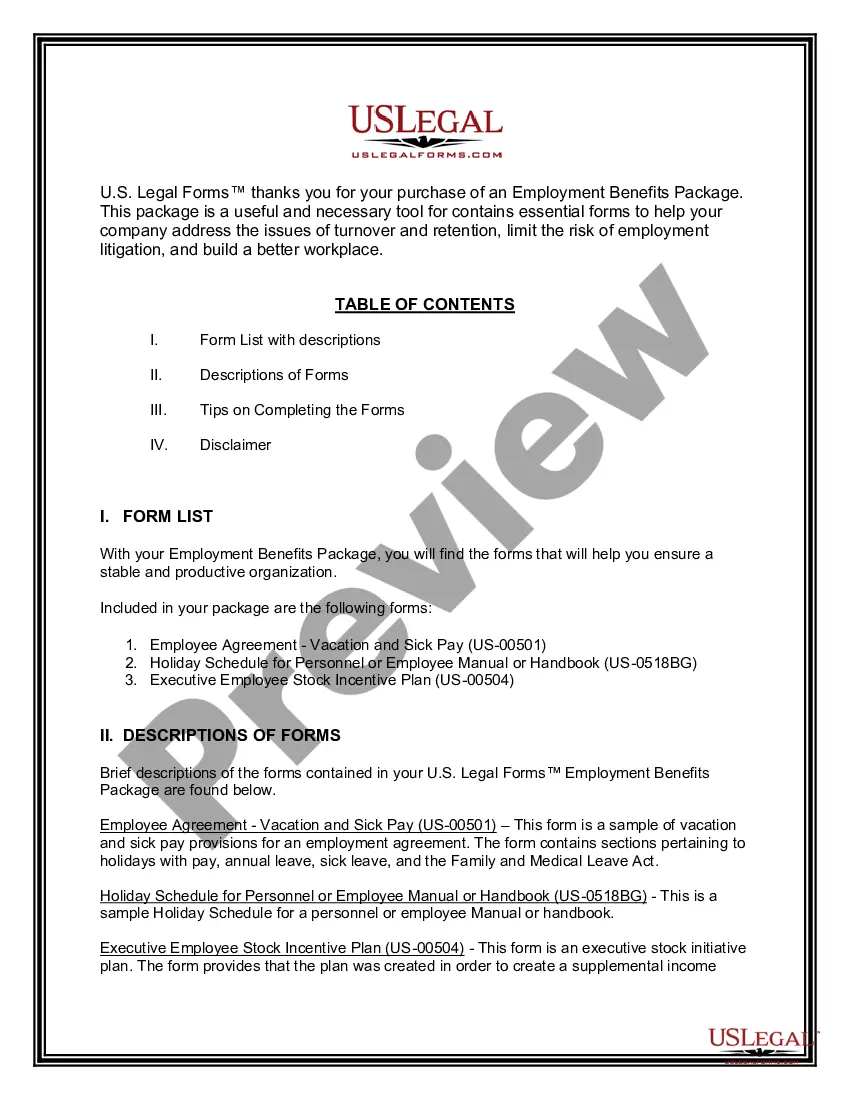
A benefit package covers the full scope of services, pay, insurance, vacation time and other perks available to an employee from his employer.
What are the four major types of employee benefits? These include medical, life, disability, and retirement. Here is a closer look at these employee benefits and why they are often offered by business owners.
10 Most Commonly Offered Employee Benefits Health Insurance Benefits. This one is a no-brainer.Life Insurance.Dental Insurance.Retirement Accounts.Flexible Spending Accounts (FSAs) or Health Savings Accounts (HSAs)Paid Vacation and Sick Time.Paid Holidays.Paid Medical Leave.
There are four major types of employee benefits many employers offer: medical insurance, life insurance, disability insurance, and retirement plans. Below, we've loosely categorized these types of employee benefits and given a basic definition of each.
While this can differ depending on who you ask, the standard in most industries consists of health insurance, dental insurance, flexible spending accounts, retirement savings plans, vacation time, and additional paid time off for events like family medical leave, maternity leave, and sabbaticals.
Examples of benefits within a package may include: Medical insurance. Dental and vision coverage. Profit-sharing. Stock options. Retirement benefits. Wellness benefits such as reimbursement for gym memberships or race registrations, weight loss programs, and smoking cessation.