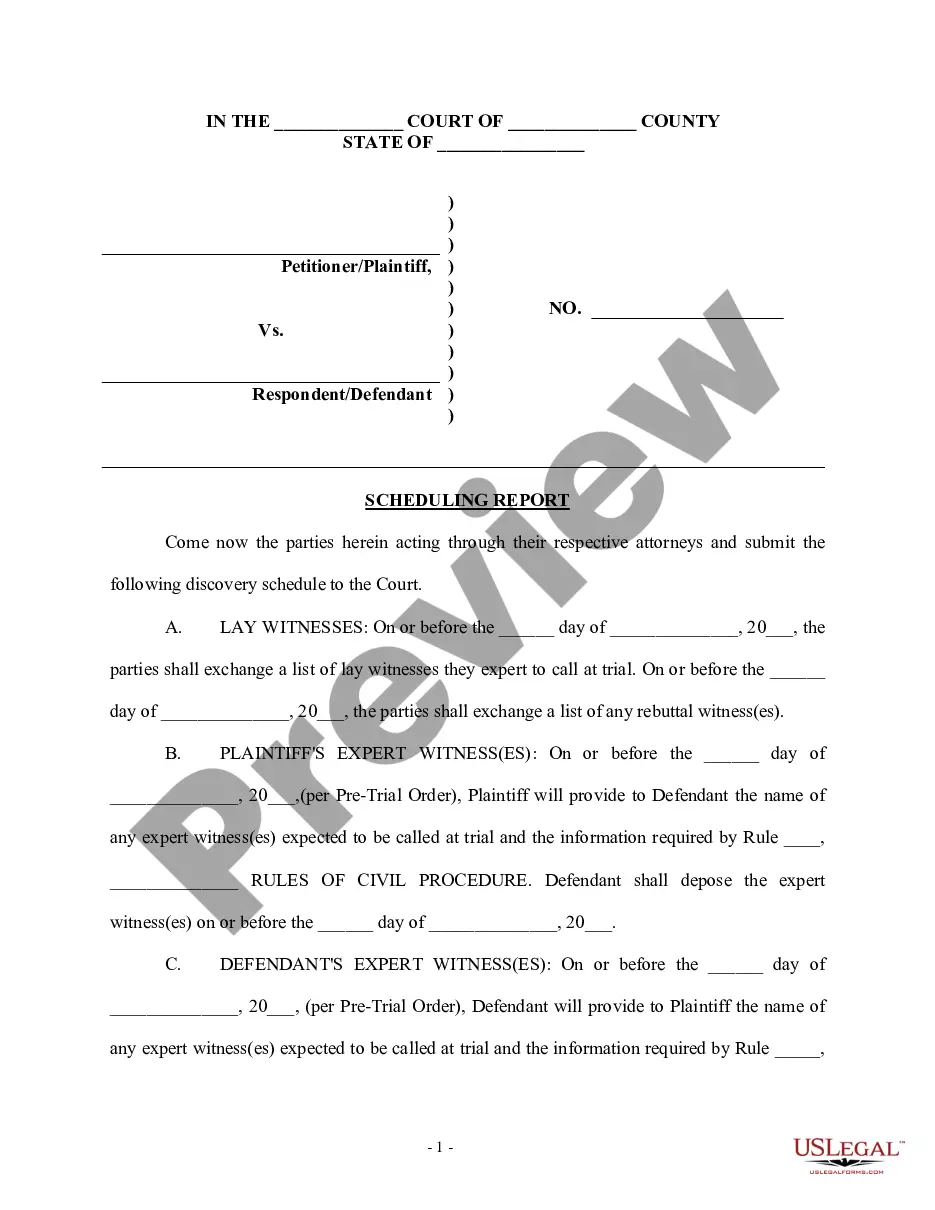
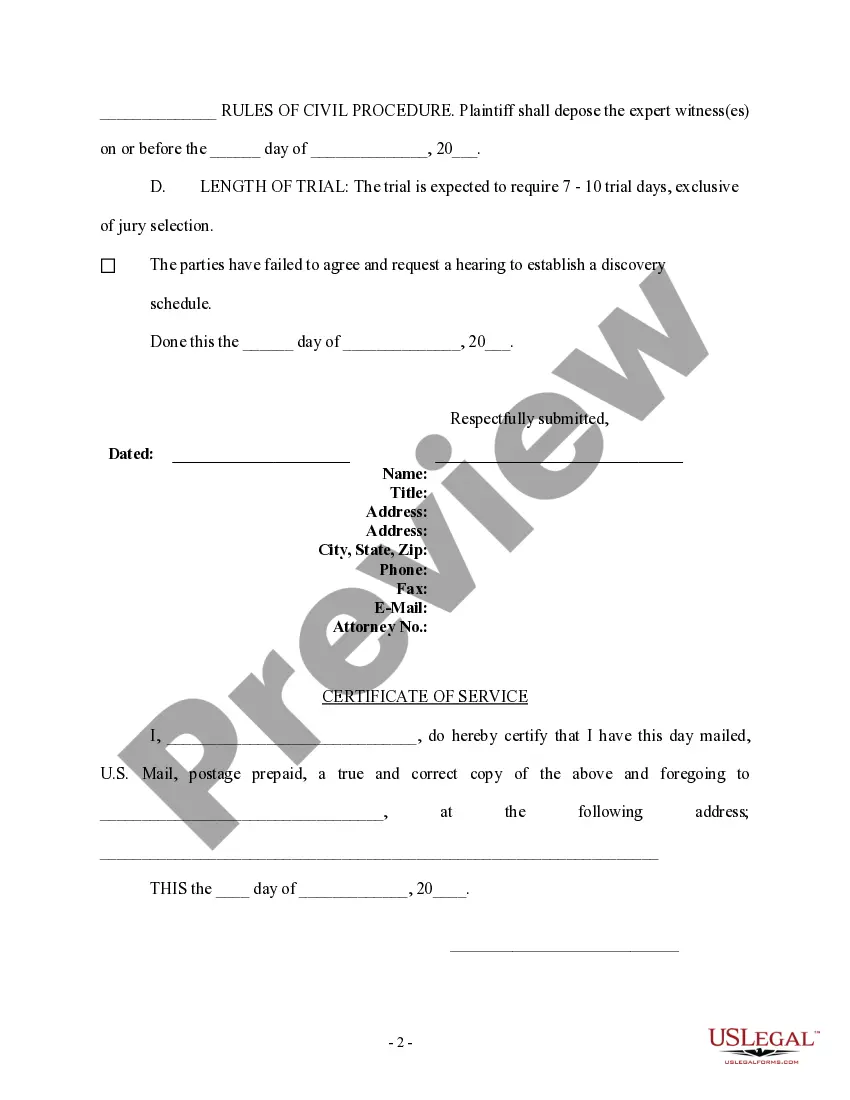
This form is a sample discovery schedule mutually agreed upon between the parties and submitted for the Court's approval.
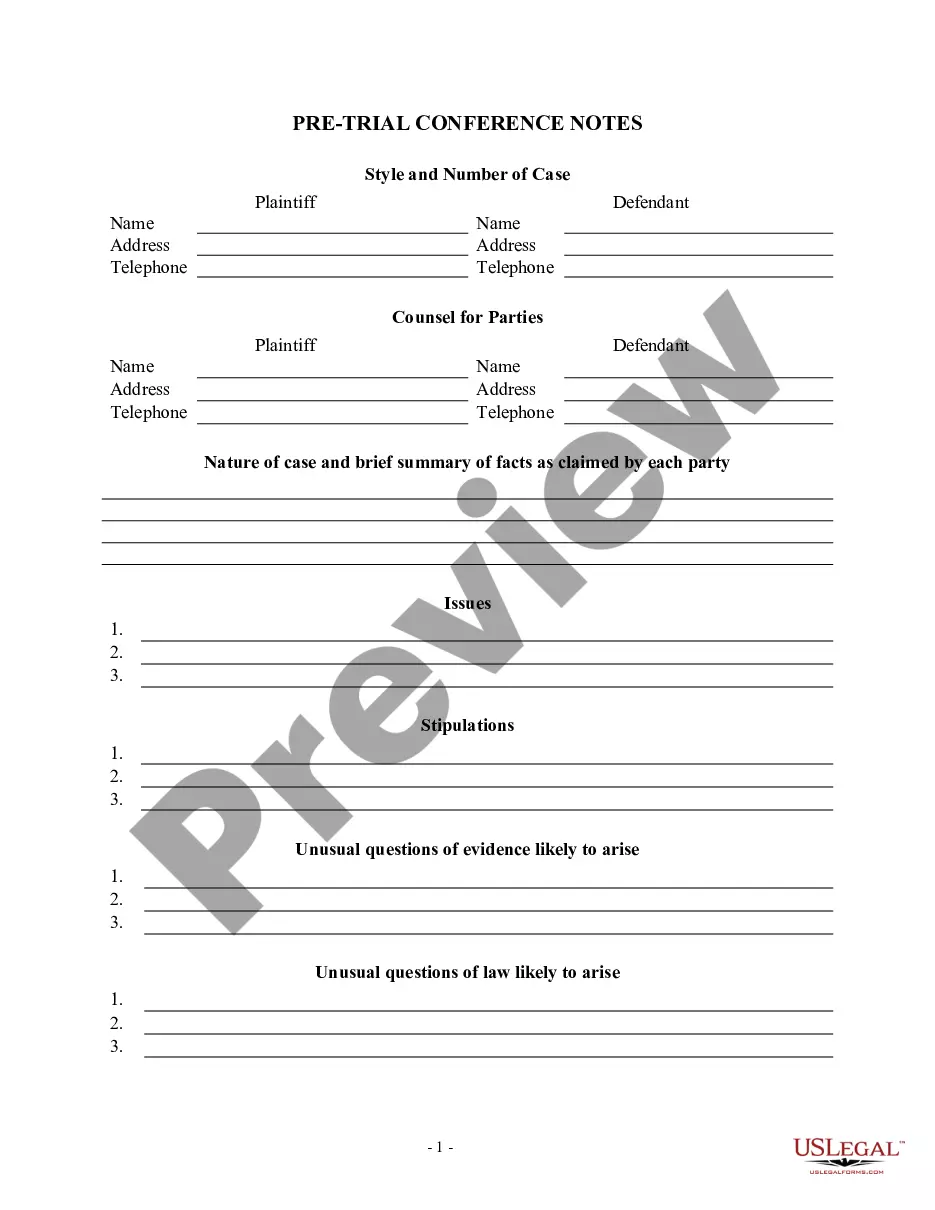
Suffolk New York Scheduling Report - Civil Trial
State:
Multi-State
County:
Suffolk
Control #:
US-PI-0258
Format:
Word;
Rich Text
Instant download
Description
Free preview
Get your form ready online
Our built-in tools help you complete, sign, share, and store your documents in one place.
Built-in online Word editor
Make edits, fill in missing information, and update formatting in US Legal Forms—just like you would in MS Word.
Export easily
Download a copy, print it, send it by email, or mail it via USPS—whatever works best for your next step.
E-sign your document
Sign and collect signatures with our SignNow integration. Send to multiple recipients, set reminders, and more. Go Premium to unlock E-Sign.
Notarize online 24/7
If this form requires notarization, complete it online through a secure video call—no need to meet a notary in person or wait for an appointment.
Store your document securely
We protect your documents and personal data by following strict security and privacy standards.

Make edits, fill in missing information, and update formatting in US Legal Forms—just like you would in MS Word.

Download a copy, print it, send it by email, or mail it via USPS—whatever works best for your next step.

Sign and collect signatures with our SignNow integration. Send to multiple recipients, set reminders, and more. Go Premium to unlock E-Sign.

If this form requires notarization, complete it online through a secure video call—no need to meet a notary in person or wait for an appointment.

We protect your documents and personal data by following strict security and privacy standards.
Looking for another form?
How to fill out Scheduling Report - Civil Trial?
Preparing documents for business or personal objectives is consistently a major obligation.
When formulating a contract, a public service application, or a power of attorney, it is crucial to take into account all federal and state regulations of the particular region.
Nonetheless, small counties and even municipalities also have legislative processes that you must consider.
To identify the one that meets your needs, use the search tab in the page header.
- All these aspects render it laborious and time-consuming to draft a Suffolk Scheduling Report - Civil Trial without professional assistance.
- It is feasible to prevent unnecessary expenditures on attorneys for drafting your documents and produce a legally binding Suffolk Scheduling Report - Civil Trial independently, utilizing the US Legal Forms online library.
- This is the largest online repository of state-specific legal forms that are professionally validated, assuring you of their legitimacy when selecting a template for your county.
- Previously registered users only need to Log In to their profiles to retrieve the required document.
- In the event that you do not yet possess a subscription, follow the step-by-step instructions below to obtain the Suffolk Scheduling Report - Civil Trial.
- Browse the page you've accessed and verify if it holds the document you need.
- To achieve this, utilize the form description and preview if these features are accessible.
Form popularity
FAQ
In New York, depositions generally have a limit of 7 hours unless both parties agree otherwise. Time management during depositions is vital to ensure all relevant topics are covered while staying within this limit. Understanding the rules surrounding depositions can help maximize your effectiveness in trials. The Suffolk New York Scheduling Report - Civil Trial is a great resource to help navigate deposition protocols.
Grounds for a motion to dismiss in New York include lack of subject matter jurisdiction, failure to state a cause of action, and res judicata. These legal foundations can significantly impact your case outcome. Being well-informed about these grounds is vital for effective legal representation. The Suffolk New York Scheduling Report - Civil Trial can offer guidance on crafting a compelling motion.
In New York, you can vacate a default judgment based on several grounds, including excusable neglect, lack of personal jurisdiction, or newly discovered evidence. Demonstrating a valid reason is crucial to successfully overturn a judgment. If you find yourself in this situation, consider the Suffolk New York Scheduling Report - Civil Trial for detailed procedures and strategies.
In New York, an order of protection can remain on your record for up to 10 years, depending on the case specifics. If the order is related to a crime, it may last longer. It's essential to understand how this impacts your situation, particularly if you're involved in civil trials. Using the Suffolk New York Scheduling Report - Civil Trial can help you navigate these complexities.
How can I commence a civil suit? Civil actions are generally commenced by an attorney filing a Summons and Verified Complaint with the correct filing fee. You must file a District Court civil summons form.The summons must be issued (signed) by an attorney, or a Judge, or a Court Clerk.
Call 631 208-5775 with the case number during business hours to check for future dates on: Town Ordinance cases (or call the outlying courthouse where your action is filed) if you cannot find your criminal or traffic matter in WebCrims.
To request said adjournment you must submit a request in writing via certified mail to the court at least 10 days prior to the date of your trial and request that said trial be postponed for good cause. Your "good cause" is subject to approval by the TPVA Judicial Hearing Officer.
You or someone else may start your case by filling out a Complaint Form (DC-283). The Complaint Form describes your claim to the Court. You may file by mail or you may file in person at one of the District Court courthouses. You will be required to pay a filing fee.
Start your Small Claim by completing and filing the Complaint Form (DC283). Commercial Small Claims are Small Claims where a corporation, partnership, or association can sue for up to $5000.Start your Commercial Small Claim by completing and filing the Complaint Form (DC283)
You or someone else may start your case by filling out a Complaint Form (DC-283). The Complaint Form describes your claim to the Court. You may file by mail or you may file in person at one of the District Court courthouses. You will be required to pay a filing fee.