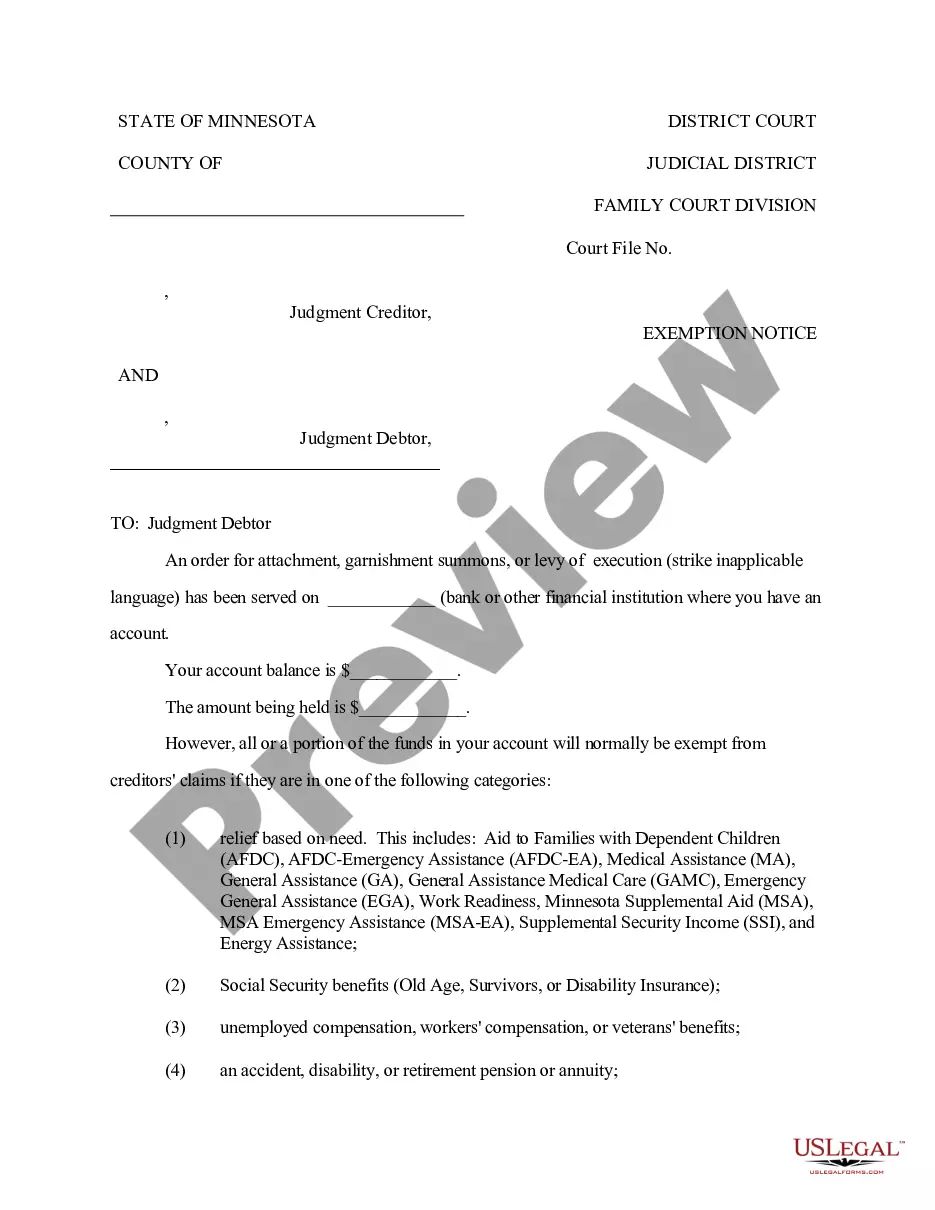
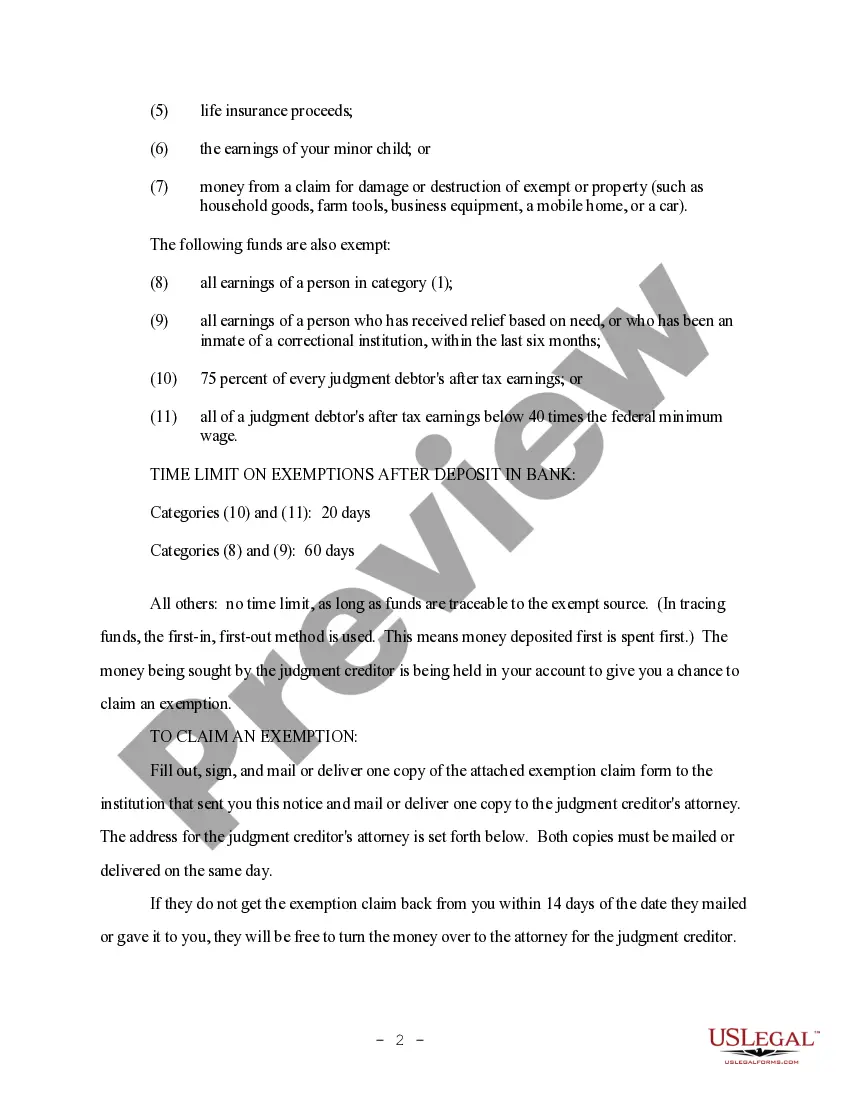
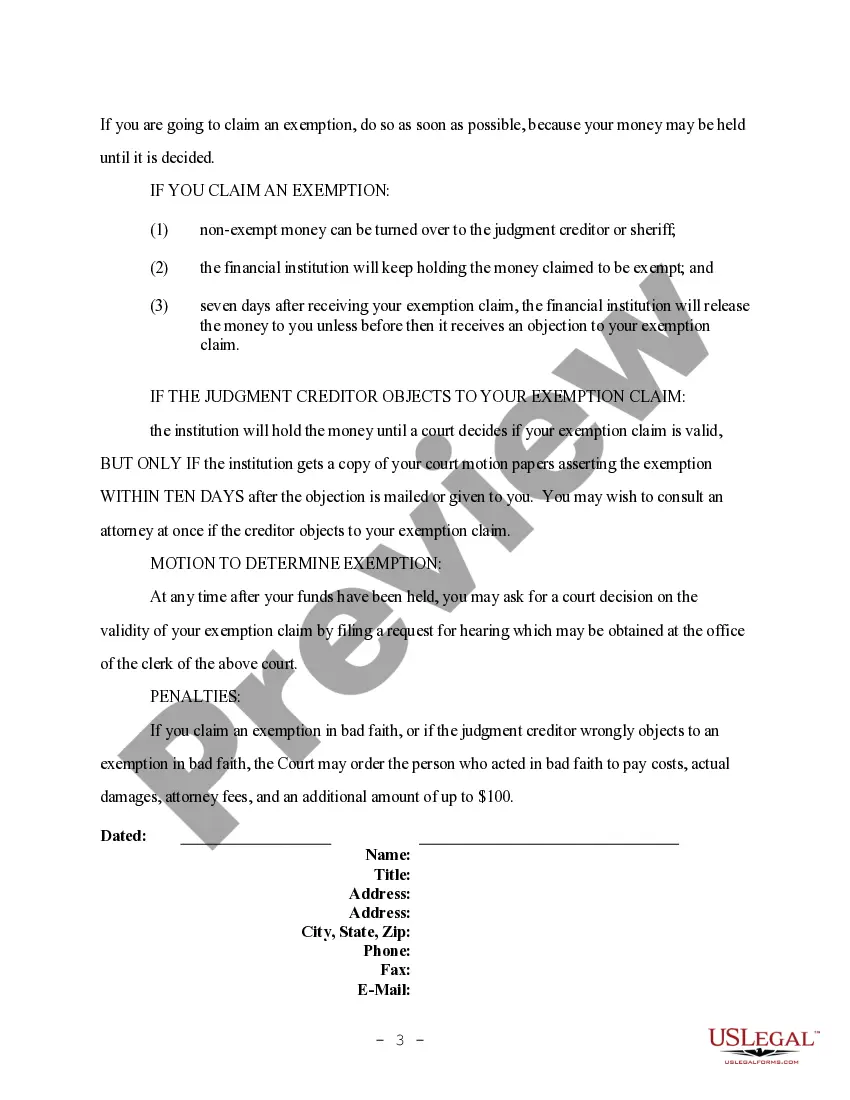
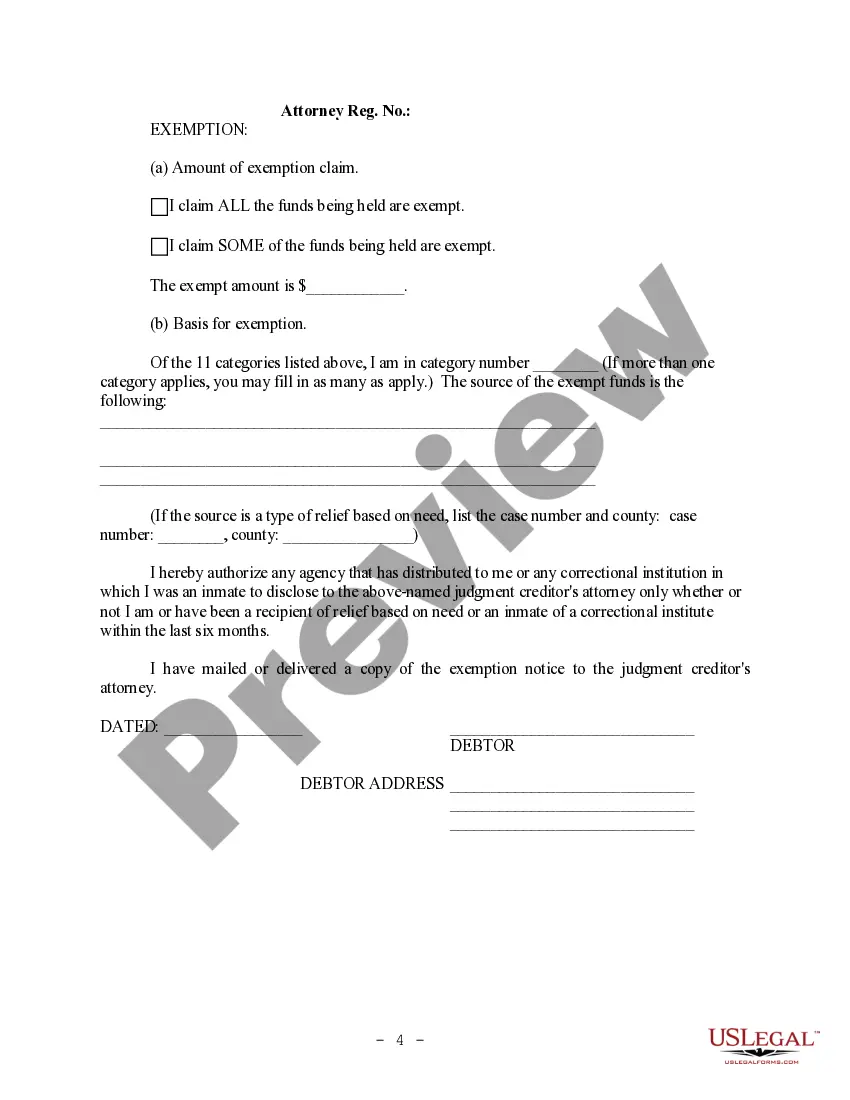
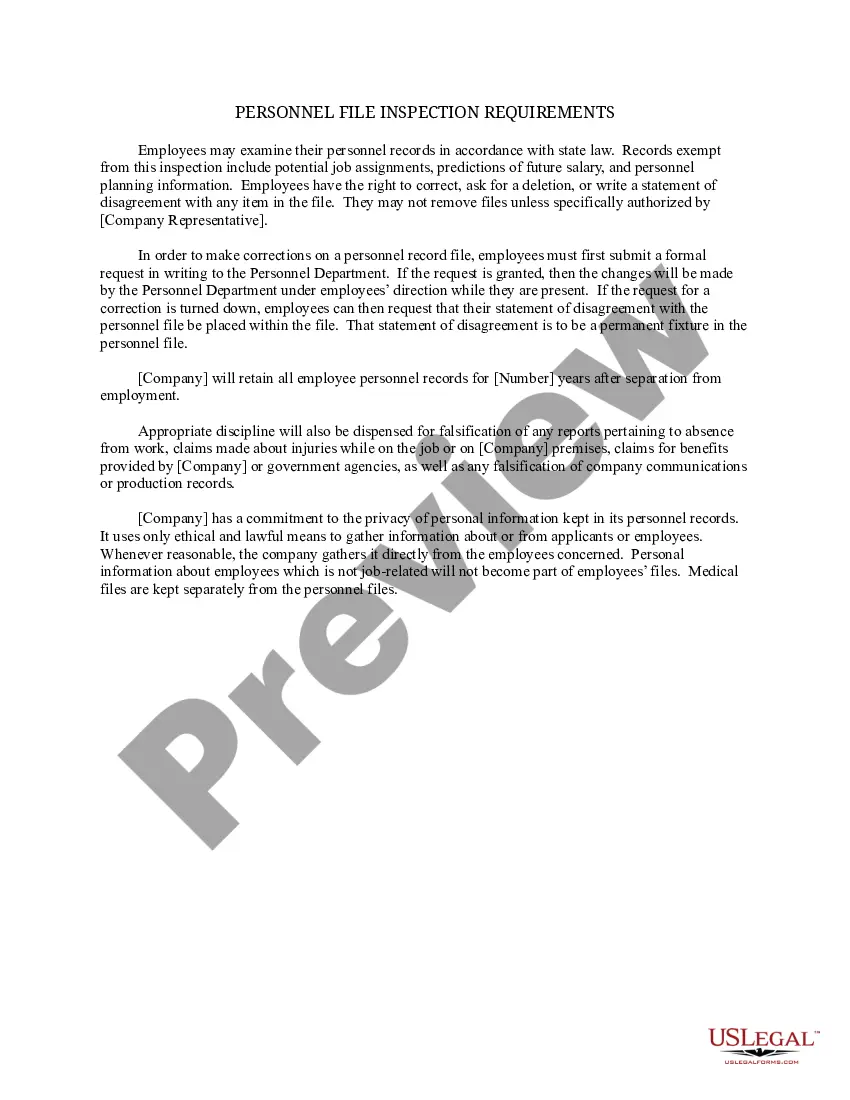
This form is an Exemption Notice. The notice provides that an order for attachment, garnishment, or levy has been served upon the judgment debtor's banking institution where he/she has an account. However, all or a portion of the judgment debtor's funds in the account will be exempt from the creditors' claims if they covered by one of the categories listed in the notice.
Minnesota Notice to Garnishee regarding Wages Exempt from Garnishment
Category:
State:
Minnesota
Control #:
MN-8139D
Format:
Word;
Rich Text
Instant download
Description
Free preview
Key Concepts & Definitions
Understanding the concept of 'notice to garnishee regarding wages exempt from' is crucial for employees and employers alike. A garnishee notice is a legal order requiring a third party to hold or take from an employee's wages to satisfy a debt or judgment. The notice specifies what portion of an employee's wages are exempt from garnishment under federal and state law. In the United States, wage garnishment is governed by both federal and state laws that protect a certain amount of an employee's earnings from creditors, ensuring enough income remains for basic living expenses.
Step-by-Step Guide to Handling a Notice to Garnishee
- Review the Notice: Immediately review the garnishment order for any inaccuracies or exemptions that apply to your situation.
- Understand Exemptions: Familiarize yourself with federal and state laws regarding wage garnishment exemptions.
- Calculate Exempt Wages: Use the provided formulas or guidelines to calculate the portion of wages that are exempt from garnishment.
- Notify Payroll: Communicate with your payroll department to ensure they withhold the correct amount from your wages.
- Seek Legal Advice: If unclear about the process, consult with a legal expert specializing in debt law.
Risk Analysis of Incorrect Garnishment Handling
- Legal Ramifications: Incorrectly handling garnishment can result in legal actions against both the employee and employer.
- Financial Impact: Over-garnishment could leave an employee unable to meet basic financial needs, negatively affecting their quality of life.
- Reputation Damage: Employers who repeatedly mishandle garnishment notices might be viewed poorly, affecting their market reputation and potential legal standing.
How to fill out Minnesota Notice To Garnishee Regarding Wages Exempt From Garnishment?
Obtain any version from 85,000 legal records such as Minnesota Notice to Garnishee concerning Wages Exempt from Garnishment online with US Legal Forms. Each template is crafted and revised by state-licensed legal experts.
If you possess a subscription, Log In. When you’re on the form’s page, hit the Download button and navigate to My documents to gain access to it.
If you haven’t subscribed yet, follow the instructions below: Check the state-specific prerequisites for the Minnesota Notice to Garnishee concerning Wages Exempt from Garnishment you wish to utilize. Review the description and preview the example. Once you’re convinced the template is what you require, click Buy Now. Select a subscription plan that aligns with your financial plan. Establish a personal account. Remit payment in one of two suitable methods: by credit card or through PayPal. Select a format to download the document in; two options are available (PDF or Word). Download the document to the My documents tab. As soon as your reusable template is prepared, print it out or save it to your device.
With US Legal Forms, you will always have instant access to the correct downloadable sample. The service offers you access to forms and categorizes them to enhance your search. Utilize US Legal Forms to acquire your Minnesota Notice to Garnishee concerning Wages Exempt from Garnishment swiftly and effortlessly.
- Obtain any version from 85,000 legal records.
- Each template is crafted and revised by state-licensed legal experts.
- If you possess a subscription, Log In.
- When you’re on the form’s page, hit the Download button.
- Navigate to My documents to gain access.
- Check the state-specific prerequisites for the Minnesota Notice.
- Review the description and preview the example.
- Click Buy Now once convinced the template is required.
- Select a subscription plan that aligns with your financial plan.
Form popularity
FAQ
Filing an exemption for wage garnishment involves submitting a formal request with supporting documentation to the court. You will need to reference the Minnesota Notice to Garnishee regarding Wages Exempt from Garnishment to ensure you meet the necessary criteria. Detailed instructions and forms are available through US Legal Forms, making it easier to understand what to include and how to file your exemption request properly.
Several factors can qualify as reasons to stop wage garnishment, including financial hardship or legal exemptions. If your income falls below the threshold outlined in the Minnesota Notice to Garnishee regarding Wages Exempt from Garnishment, you may be eligible for relief. Additionally, if you have filed for bankruptcy or have made a payment plan agreement, these can also serve as valid reasons. Understanding your rights is crucial in navigating this process.
Writing a letter to stop wage garnishment involves clearly stating your intention and providing relevant details. Start by addressing the creditor and including your account information. Be sure to reference the Minnesota Notice to Garnishee regarding Wages Exempt from Garnishment to support your request. You can also use templates from US Legal Forms to ensure your letter is formatted correctly and contains all necessary information.
To file a wage garnishment exemption in Minnesota, you need to complete the necessary forms and submit them to the court. The Minnesota Notice to Garnishee regarding Wages Exempt from Garnishment provides guidance on the process. You will also need to provide documentation that supports your claim for exemption. Using platforms like US Legal Forms can simplify this process by providing the correct forms and instructions.
To obtain an exemption from wage garnishment, you need to file a claim with the court where the garnishment order was issued. The process typically involves submitting the Minnesota Notice to Garnishee regarding Wages Exempt from Garnishment to demonstrate your eligibility for exemption. Using platforms like US Legal Forms can simplify this process by providing you with the necessary forms and guidance, ensuring that you meet all legal requirements efficiently.
You may qualify for exemption from wage garnishment based on your financial status or specific circumstances. Understanding the Minnesota Notice to Garnishee regarding Wages Exempt from Garnishment can help you identify if your income falls within the exempt categories, such as social security benefits or public assistance. If you believe you qualify, gather the necessary documentation and file for an exemption promptly to protect your earnings.
To avoid wage garnishment, you can negotiate with your creditors to create a payment plan that suits your financial situation. It is also essential to respond to any legal notices, including the Minnesota Notice to Garnishee regarding Wages Exempt from Garnishment, as this can provide you with an opportunity to dispute the garnishment. Additionally, consider seeking legal advice to explore your options, as early intervention can prevent garnishment from occurring.
You can be exempt from wage garnishment due to your income level or the nature of your income. For example, if your earnings are below the federal poverty line or if you receive specific government assistance, you might qualify for exemption. To stay informed about your rights, refer to the Minnesota Notice to Garnishee regarding Wages Exempt from Garnishment.
While this question focuses on Missouri, it's important to note that garnishment rules can vary by state. In Missouri, garnishment limits are based on disposable income, and certain exemptions apply, similar to Minnesota's regulations. If you want to learn more about how these rules compare, consider looking into the Minnesota Notice to Garnishee regarding Wages Exempt from Garnishment.
In Minnesota, various exemptions apply to garnishment, which include minimum wage protections and limitations on the amount that can be garnished from your paycheck. Certain benefits, such as Social Security and veterans' benefits, are also exempt. For a detailed understanding, review the Minnesota Notice to Garnishee regarding Wages Exempt from Garnishment to see how these laws apply to you.