Wisconsin Transfer on Death Deed or TOD - Beneficiary Deed from Individual to Two Individuals
Understanding this form
A Transfer on Death Deed (TOD) allows an individual, known as the Grantor, to designate two individuals as beneficiaries who will receive property upon the Grantor's death. This deed is revocable by the Grantor during their lifetime and becomes effective only after their death. Unlike traditional property transfers, a TOD deed bypasses probate, making the transfer process straightforward and efficient.
Key parts of this document
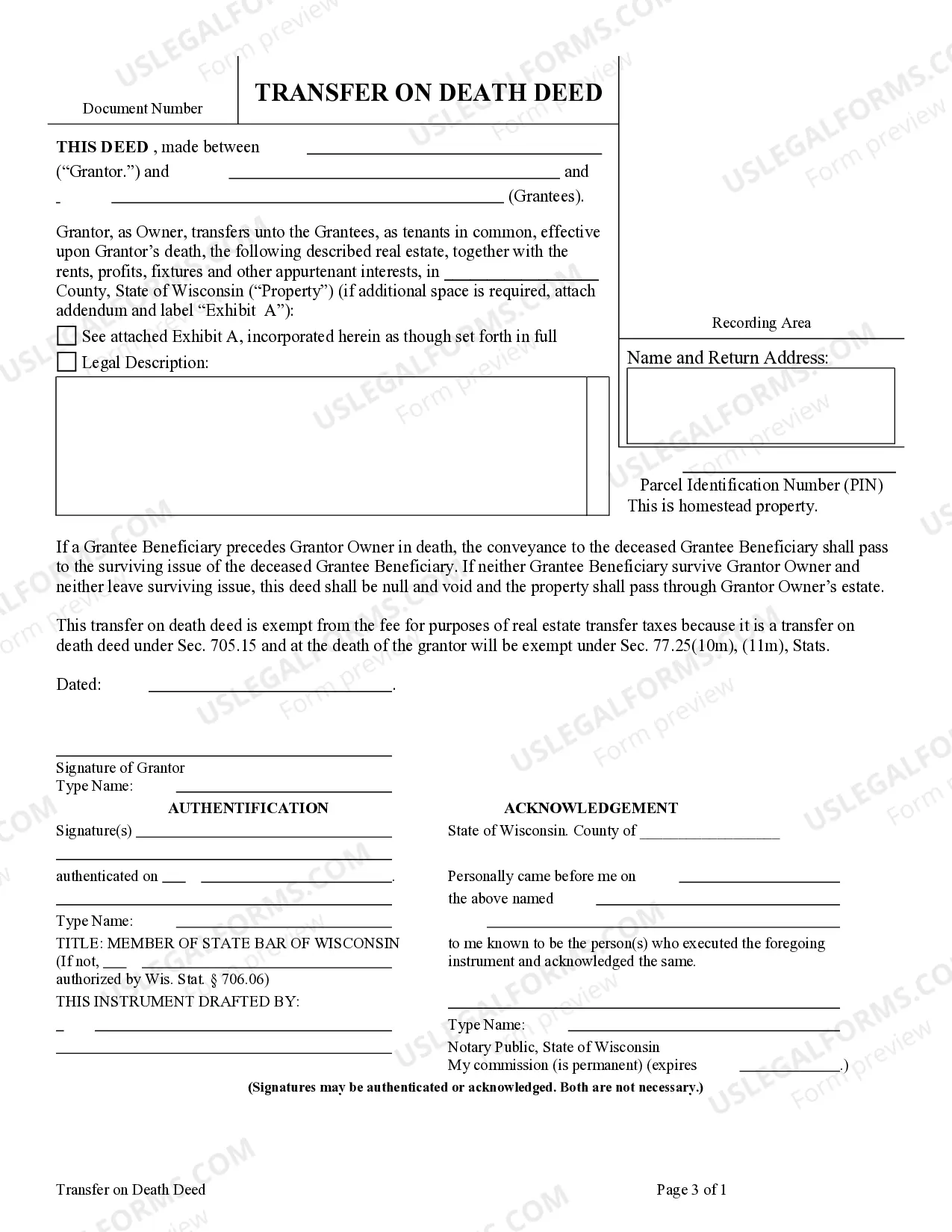
- Grantor information: Details about the person transferring the property.
- Beneficiary information: Names and details of the two individuals receiving the property.
- Property description: A clear and exact description of the property being transferred.
- Revocability clause: Statement indicating that the deed can be revoked by the Grantor at any time prior to their death.
- Execution requirements: Signatures and any necessary witnesses or notary details for validity.




When to use this form
Use this form when you want to transfer real property to two individuals upon your death, ensuring that the transfer does not go through probate. This can be particularly useful for estate planning purposes, allowing you to retain control over the property during your lifetime while providing for a smooth transition after death.
Who needs this form
This form is intended for:
- Individuals who own real property and wish to designate specific beneficiaries.
- Those looking for a simple solution to avoid probate for their estate.
- Persons seeking to manage how their property is transferred after their death.
Steps to complete this form
Follow these steps to complete the form:
- Identify the parties involved: Enter the Grantor's details and the names of the two beneficiaries.
- Specify the property: Provide a clear description of the property being transferred, including any legal descriptions if available.
- Fill in the revocable clause: Ensure that the clause regarding revocability is included clearly.
- Sign the deed: The Grantor must sign the form in the presence of any necessary witnesses or notary, as required by Wisconsin law.
- Record the deed: Submit the completed deed to the appropriate local government office for recording to ensure its validity upon the Grantor's death.
Is notarization required?
This form does not typically require notarization unless specified by local law. However, it is always advisable to check local requirements to ensure all legal bases are covered.
Get your form ready online
Our built-in tools help you complete, sign, share, and store your documents in one place.
Make edits, fill in missing information, and update formatting in US Legal Forms—just like you would in MS Word.
Download a copy, print it, send it by email, or mail it via USPS—whatever works best for your next step.
Sign and collect signatures with our SignNow integration. Send to multiple recipients, set reminders, and more. Go Premium to unlock E-Sign.
If this form requires notarization, complete it online through a secure video call—no need to meet a notary in person or wait for an appointment.
We protect your documents and personal data by following strict security and privacy standards.

Make edits, fill in missing information, and update formatting in US Legal Forms—just like you would in MS Word.

Download a copy, print it, send it by email, or mail it via USPS—whatever works best for your next step.

Sign and collect signatures with our SignNow integration. Send to multiple recipients, set reminders, and more. Go Premium to unlock E-Sign.

If this form requires notarization, complete it online through a secure video call—no need to meet a notary in person or wait for an appointment.

We protect your documents and personal data by following strict security and privacy standards.
Typical mistakes to avoid
- Failing to record the deed: The deed must be recorded prior to the Grantor's death to be effective.
- Incorrect property description: Ensure the property is adequately described to prevent legal disputes later.
- Omitting beneficiary information: All designated beneficiaries must be clearly identified by name.
- Not signing the deed: The Grantor's signature is crucial; without it, the deed will be invalid.
Benefits of using this form online
- Convenience: Easily complete and download the form online at your convenience.
- Editability: Fill out the form electronically using compatible software before printing.
- Legal reliability: Drafted by licensed attorneys, ensuring compliance with local laws.
- This form is a legally recognized method for transferring property upon death.
- Proper execution and recording of the deed are essential for it to be enforceable.
Summary of main points
- A TOD deed facilitates the transfer of property to beneficiaries without probate complications.
- The form is revocable during the Grantor's life, allowing for flexibility in estate planning.
- Proper completion and recording are crucial for the deed's effectiveness.
Looking for another form?
Form popularity
FAQ
The California TOD deed form allows property to be automatically transferred to a new owner when the current owner dies, without the need to go through probate. It also gives the current owner retained control over the property, including the right to change his or her mind about the transfer.
If you'd like to avoid having your property going through the probate process, it's a good idea to look into a transfer on death deed. A transfer on death deed allows you to select a beneficiary who will receive your property, but only when you've passed away.
States that allow TOD deeds are Alaska, Arizona, Arkansas, California, Colorado, District of Columbia, Hawaii, Illinois, Indiana, Kansas, Maine, Minnesota, Mississippi, Missouri, Montana, Nebraska, Nevada, New Mexico, North Dakota, Ohio, Oklahoma, Oregon, South Dakota, Texas, Utah, Virginia, Washington, West Virginia,
Your deed won't be effective unless you recorded (filed) it in the local public records before your death. To get that done, take the signed deed to the land records office for the county in which the real estate is located. This office is commonly called the county recorder, land registry, or registrar of deeds.